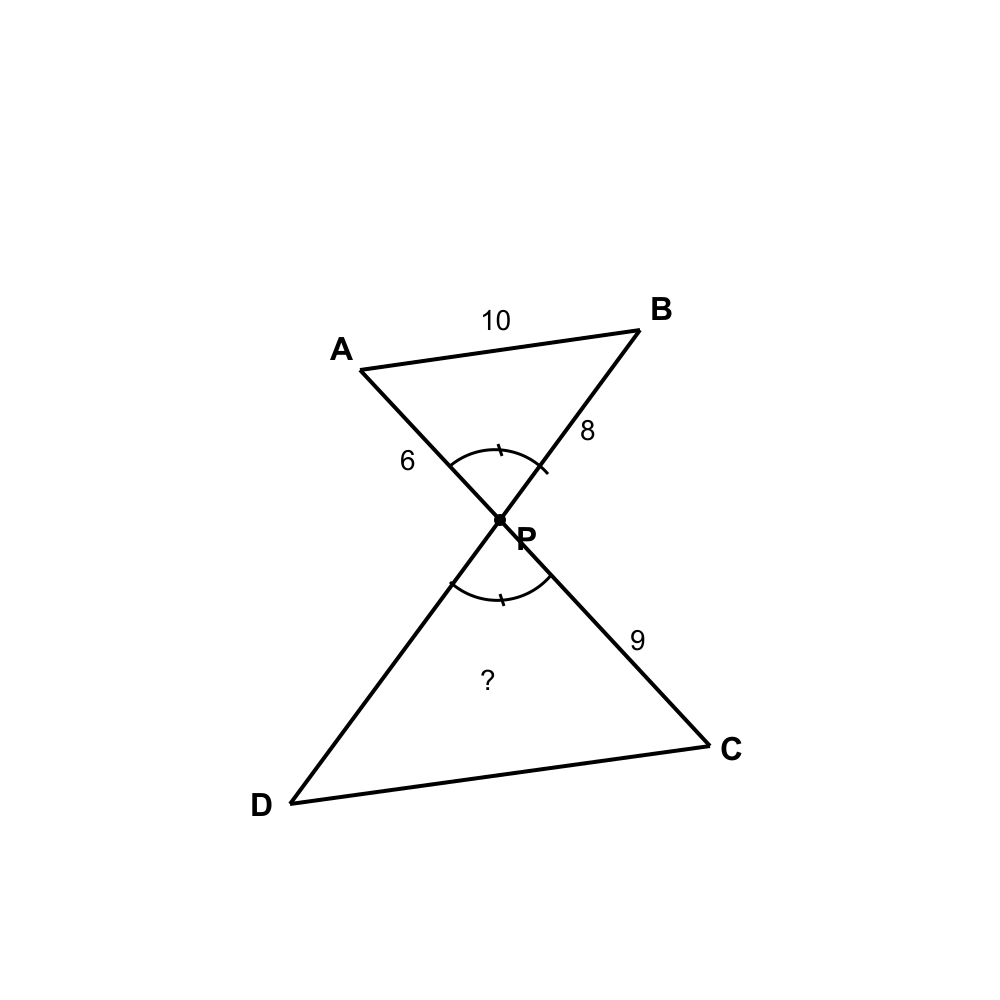
The figure shows two triangles sharing vertex P, with △APB∼△CPD. The side lengths are AP=6, PB=8, CP=9, and segment AB=10. What is the length of segment CD?
Practice Lines Angles And Triangles in PSAT Math with focused quiz questions that help you check what you know, review explanations, and build confidence with test-style prompts.
What this quiz covers
This quiz focuses on Lines Angles And Triangles, giving you a quick way to practice the rules, question types, and explanations that matter most for PSAT Math.
How to use this quiz
Try each quiz question before looking at the correct answer. Use the explanations to review missed ideas, then come back to similar questions until the pattern feels familiar.
All questions
Question 1
The figure shows two triangles sharing vertex P, with △APB∼△CPD. The side lengths are AP=6, PB=8, CP=9, and segment AB=10. What is the length of segment CD?
12
13
15 (correct answer)
7.5
Explanation: Because △APB∼△CPD, corresponding sides are proportional: CPAP=CDAB, so 96=CD10, giving CD=15. (A) 12 uses the scale factor on PB incorrectly. (B) 13 adds 3 to 10. (D) 7.5 reverses the ratio.
Question 2
Triangle RST is equilateral. What is the measure of ∠R?
30∘
45∘
60∘ (correct answer)
90∘
Explanation: This question asks for the measure of angle R in equilateral triangle RST. An equilateral triangle has all three sides equal and all three angles equal. Since the sum of angles in any triangle is 180°, each angle in an equilateral triangle measures 180° ÷ 3 = 60°. Therefore, angle R = 60°. A common mistake would be confusing equilateral triangles with isosceles triangles or forgetting that all angles in an equilateral triangle are 60°. This is a fundamental property that should be memorized.
Question 3
Points P(0,0), Q(6,0), and R(0,8) form triangle PQR. What is the length of QR?
10 (correct answer)
14
52
100
Explanation: This question asks for the length of segment QR using the distance formula. Given points P(0,0), Q(6,0), and R(0,8), we need to find the distance from Q(6,0) to R(0,8). Using the distance formula: QR = √[(0-6)² + (8-0)²] = √[(-6)² + 8²] = √[36 + 64] = √100 = 10. Therefore, the length of QR is 10. A common mistake would be incorrectly substituting coordinates into the distance formula or making arithmetic errors when calculating squares and square roots.
Question 4
A triangle has side lengths 7 cm, 9 cm, and x cm. If the triangle is possible, which of the following could be the value of x?
1
2
16
10 (correct answer)
Explanation: This question tests the triangle inequality theorem. The triangle inequality theorem states that the sum of any two sides of a triangle must be greater than the third side. With sides 7, 9, and x, we need: 7 + 9 > x (so x < 16), 7 + x > 9 (so x > 2), and 9 + x > 7 (so x > -2, which is always true for positive x). Therefore, x must satisfy 2 < x < 16. Among the choices, only x = 10 satisfies this condition. A common error is only checking one inequality or forgetting that all three conditions must be satisfied. Always verify that your chosen value works with all three side combinations.
Question 5
In △DEF, ∠D is an exterior angle formed by extending DE past E. The exterior angle at D measures 125∘, and ∠F measures 55∘. What is the measure of the remote interior angle ∠E?
70∘ (correct answer)
55∘
125∘
180∘
Explanation: This question involves the exterior angle theorem for triangles. The exterior angle theorem states that an exterior angle of a triangle equals the sum of the two remote interior angles. Here, the exterior angle at D measures 125°, and this equals the sum of the two remote interior angles E and F. Since angle F = 55°, we can find angle E: 125° = angle E + 55°, so angle E = 125° - 55° = 70°. A common mistake is thinking the exterior angle equals just one remote interior angle or confusing which angles are remote. When using the exterior angle theorem, identify the two interior angles that are not adjacent to the exterior angle.
Question 6
In the coordinate plane, points A(−2,1), B(4,1), and C(4,6) form triangle ABC. What is the length of segment AC?
61 (correct answer)
52
7
45
Explanation: This question asks for the length of segment AC in triangle ABC with points A(-2,1), B(4,1), and C(4,6) in the coordinate plane. The relevant theorem is the distance formula, which calculates the straight-line distance between two points. To find AC, apply the formula: sqrt[(4 - (-2))^2 + (6 - 1)^2] = sqrt[(6)^2 + (5)^2] = sqrt[36 + 25] = sqrt[61]. This computation emphasizes the horizontal and vertical differences between coordinates. A key error is confusing points, such as using AB instead of AC, or forgetting to square the differences. Another mistake could be omitting the square root. When working with coordinates, plot the points mentally to confirm which segment is being measured.
Question 7
Lines m and n are parallel. A transversal t intersects them. At the intersection with line m, the interior angle on the right side of the transversal measures 68∘. What is the measure of the alternate interior angle at the intersection with line n on the left side of the transversal?
112∘
68∘ (correct answer)
22∘
90∘
Explanation: This question asks for the measure of an alternate interior angle formed when parallel lines are cut by a transversal. When parallel lines are cut by a transversal, alternate interior angles are congruent. The interior angle on the right side of line m measures 68°, and we need the alternate interior angle on the left side of line n. These angles are on opposite sides of the transversal and between the parallel lines, making them alternate interior angles. Therefore, the alternate interior angle also measures 68°. A common error is confusing alternate interior angles with consecutive interior angles, which are supplementary (sum to 180°). When identifying alternate interior angles, look for angles on opposite sides of the transversal between the parallel lines.
Question 8
On a coordinate plane, points A(2,3) and B(2,−5) form a vertical segment. What is the length of AB?
2
8 (correct answer)
8
64
Explanation: This question asks for the length of vertical segment AB on coordinate plane. Given points A(2,3) and B(2,-5), both points have the same x-coordinate (x = 2), making this a vertical segment. For vertical segments, the distance is the absolute value of the difference in y-coordinates: |3 - (-5)| = |8| = 8. Therefore, the length of segment AB is 8. A common mistake would be unnecessarily using the full distance formula when the segment is clearly vertical or horizontal.
Question 9
In the diagram, two parallel lines ℓ and m are cut by a transversal t. At the intersection with ℓ, the angle in the upper-right position is labeled 128∘. What is the measure of the angle in the lower-left position at the intersection with m, labeled x?
52∘
128∘ (correct answer)
180∘
64∘
Explanation: This question asks for the angle in the lower-left position at the intersection with line m when two parallel lines are cut by a transversal. When parallel lines are cut by a transversal, alternate interior angles are equal. The angle in the upper-right at line ℓ (128°) and the angle in the lower-left at line m are alternate interior angles. Since alternate interior angles are congruent when lines are parallel, x = 128°. A common mistake would be confusing this with supplementary angles or corresponding angles. Always identify the specific angle relationship before solving.
Question 10
Refer to the figure. △DEF is isosceles with DE=DF. If ∠E=4x+6 degrees and ∠F=6x−8 degrees, what is the measure of ∠D?
68°
72°
112° (correct answer)
124°
Explanation: Base angles of an isosceles triangle are congruent, so 4x+6=6x−8 giving 2x=14 and x=7. Each base angle is 4(7)+6=34°. The vertex angle ∠D=180°−2(34°)=112°. (A) and (B) are the individual base angles or sums mis-subtracted, and (D) comes from subtracting only one base angle from 180°.
Question 11
In triangle ABC, the measures of angles A and B are 42∘ and 71∘, respectively. What is the measure of angle C?
67∘ (correct answer)
109∘
71∘
42∘
Explanation: This question requires finding the measure of angle C in triangle ABC, where angles A and B are 42 degrees and 71 degrees, respectively. The key property is that the sum of the interior angles in any triangle is 180 degrees. To solve, add angles A and B: 42 + 71 = 113, then subtract from 180 to get angle C = 67 degrees. This direct calculation uses the triangle angle sum theorem. A common error is forgetting to subtract from 180, perhaps adding all three incorrectly or miscalculating the arithmetic. Another mistake might involve confusing this with exterior angles. A useful strategy is to quickly sum the given angles and subtract from 180 to verify the third angle.
Question 12
Refer to the triangle shown. In △ABC, AB=7, BC=9, and AC=x. Which of the following gives ALL possible integer values of x such that the triangle is obtuse with the obtuse angle at B?
x∈{3,4,5,6,7,8,9,10,11}
x∈{12,13,14,15} (correct answer)
x∈{3,4,5,6,7,8,9,10}
x∈{12,13,14,15,16}
Explanation: For the triangle to exist: ∣9−7∣<x<9+7, i.e., 2<x<16. For the angle at B (opposite side AC=x) to be obtuse, the side opposite must satisfy x2>AB2+BC2=49+81=130. So x>130≈11.4. Combined: 11.4<x<16, giving integers {12,13,14,15}. (A) and (C) treat x as small (wrong angle obtuse). (D) includes 16, which violates the triangle inequality.
Question 13
Refer to the right triangle shown. In △ABC, ∠C=90°, and CD is the altitude to the hypotenuse AB. If AD=4 and DB=9, what is the length of CD?
5
6 (correct answer)
6.5
13
Explanation: The geometric mean relation for the altitude to the hypotenuse of a right triangle gives CD=AD⋅DB=4⋅9=36=6. (A) 5 is the average minus a constant. (C) 6.5 is the average of 4 and 9. (D) 13 is the sum of AD and DB.
Question 14
In the figure, AB∥CD. The angle at vertex B measures 42° and the angle at vertex D measures 58°. What is the measure of angle ∠BED?
80°
100° (correct answer)
110°
142°
Explanation: Draw a line through E parallel to both AB and CD. By alternate interior angles, this splits ∠BED into two parts measuring 42° and 58°, so ∠BED=42°+58°=100°. (A) 80° is 180°−100°. (C) 110° is a miscalculation. (D) 142° adds 180°−42°+... wrongly.
Question 15
Refer to the figure. Two parallel lines are cut by two transversals that meet at point P between the parallels. The transversals make angles of 35° and 42° with the upper parallel line on the same side, as shown. What is the measure of the angle at P between the two transversals, on the side facing the lower parallel line?
77°
103° (correct answer)
113°
145°
Explanation: Draw an auxiliary line through P parallel to the two given parallel lines. This line divides the angle at P into two parts. By the properties of parallel lines and transversals, the auxiliary line makes the same angles with each transversal as the upper parallel line does. The angle on the side facing the upper line is 35°+42°=77°. Since the angle we want and this 77° angle are supplementary (they form a straight line), the angle facing the lower parallel line measures 180°−77°=103°.
Question 16
Triangle PQR is isosceles with PQ=PR. The vertex angle at P measures 34∘. What is the measure of angle Q?
73∘ (correct answer)
34∘
146∘
56∘
Explanation: This question asks for the measure of angle Q in isosceles triangle PQR where PQ equals PR and the vertex angle at P is 34 degrees. The key property is that in an isosceles triangle, the base angles are congruent. Since PQ = PR, angles at Q and R are equal; let each be y degrees, so 34 + y + y = 180. Solving, 34 + 2y = 180 yields 2y = 146, so y = 73 degrees for angle Q. This highlights the symmetry in isosceles triangles. A common error is misidentifying the vertex angle or assuming all angles are equal. When solving, always confirm which sides are equal to determine the base angles correctly.
Question 17
Triangle PQR has side lengths PQ=7, QR=10, and PR=x. Which value of x makes a valid triangle?
2
3
17
12 (correct answer)
Explanation: This question asks which value of x makes triangle PQR valid using the triangle inequality theorem. The triangle inequality states that the sum of any two sides must be greater than the third side. For sides PQ = 7, QR = 10, and PR = x, we need: 7 + 10 > x, 7 + x > 10, and 10 + x > 7. This gives us: x < 17, x > 3, and x > -3. Since x must be positive, we need 3 < x < 17. Among the choices, x = 12 satisfies this condition (3 < 12 < 17). The other values either violate the triangle inequality (x = 2, 3, 17) or don't form a valid triangle.
Question 18
Triangle ABC has side lengths AB=9, BC=11, and AC=15. Which inequality must be true for these to form a triangle?
9+11<15
9+15>11 (correct answer)
11−9>15
15+11<9
Explanation: This question asks which triangle inequality must be true for triangle ABC with sides AB = 9, BC = 11, and AC = 15. The triangle inequality theorem states that the sum of any two sides must be greater than the third side. We need to check all three inequalities: 9 + 11 > 15 gives 20 > 15 ✓, 9 + 15 > 11 gives 24 > 11 ✓, and 11 + 15 > 9 gives 26 > 9 ✓. Among the choices, only B (9 + 15 > 11) represents a correct triangle inequality. The other choices either show false inequalities or incorrect relationships.
Question 19
In the diagram, two parallel lines are cut by a transversal. The angle labeled x is supplementary to a corresponding angle of 115∘. What is x?
65∘ (correct answer)
115∘
55∘
180∘
Explanation: This question asks for angle x that is supplementary to a corresponding angle of 115°. When parallel lines are cut by a transversal, corresponding angles are congruent, but this problem states that x is supplementary to a corresponding angle. If x is supplementary to the 115° corresponding angle, then: x + 115° = 180°. Therefore, x = 180° - 115° = 65°. A common mistake would be thinking x equals 115° (if they were corresponding) rather than recognizing the supplementary relationship described in the problem. Always read the problem carefully to identify the correct angle relationship.
Question 20
Triangle DEF is isosceles with DE=DF. The vertex angle at D is 44∘. What is the measure of each base angle, ∠E and ∠F?
44∘
68∘ (correct answer)
88∘
136∘
Explanation: This question asks for the measure of each base angle in isosceles triangle DEF where DE = DF and the vertex angle at D is 44°. In an isosceles triangle, the base angles (opposite the equal sides) are congruent. Using the triangle angle sum theorem: vertex angle + base angle + base angle = 180°. Substituting: 44° + 2(base angle) = 180°. Solving: 2(base angle) = 136°, so each base angle = 68°. Therefore, angles E and F each measure 68°. A common error is confusing which angles are the base angles in an isosceles triangle.