All questions
Question 1
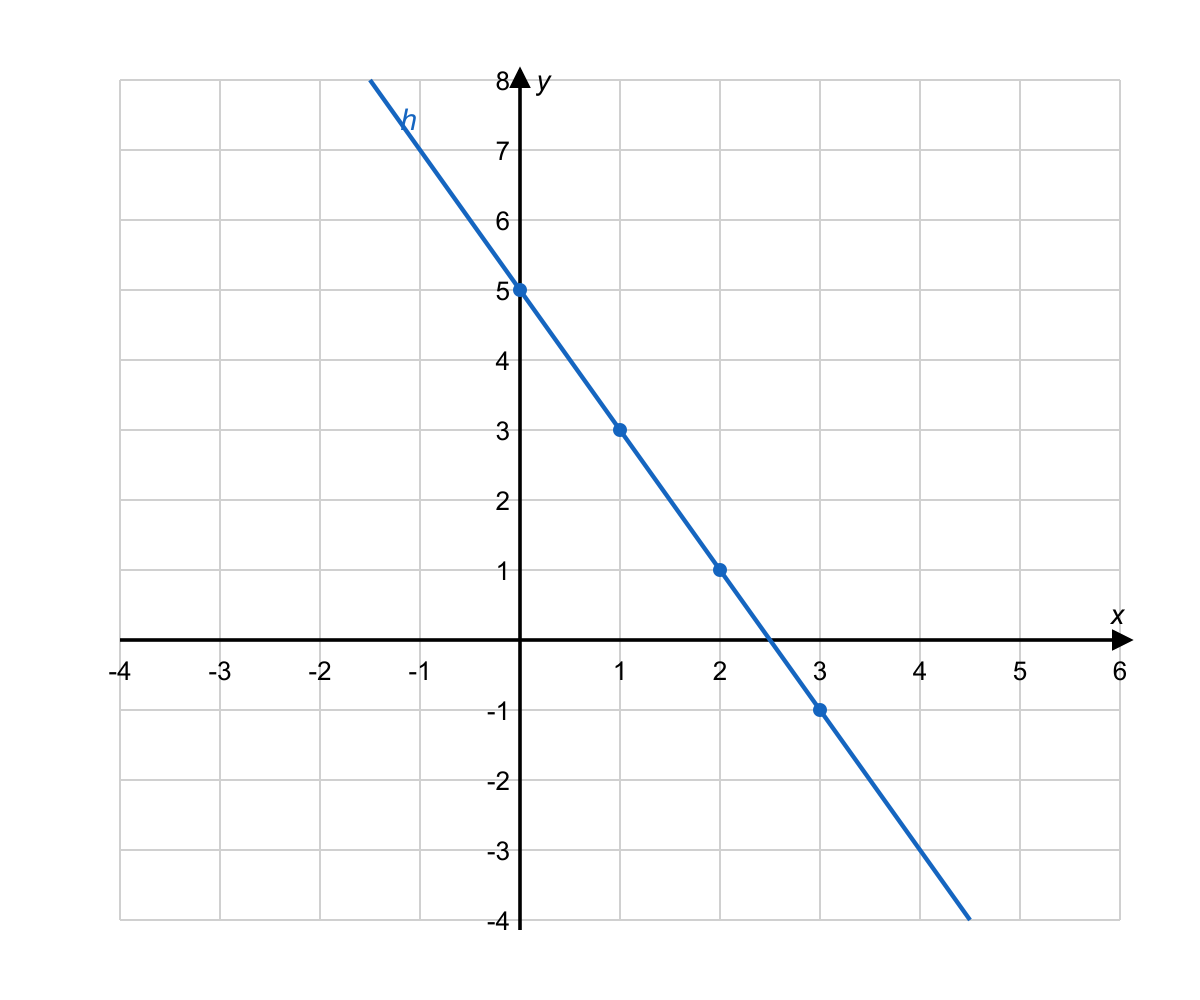
The graph of the linear function h is shown in the xy-plane. If h(x)=mx+b, what is the value of h(b)−h(m)?
- −14 (correct answer)
- 14
- −10
- −2
Explanation: The graph shows slope m=−2 and y-intercept b=5, so h(x)=−2x+5. Then h(b)=h(5)=−2(5)+5=−5 and h(m)=h(−2)=−2(−2)+5=9. Therefore h(b)−h(m)=−5−9=−14. Choice B is the magnitude with wrong sign. Choice C omits the constant in one evaluation. Choice D comes from computing h(b−m) instead. Question 2
The graph shown represents a linear function f on the interval −4≤x≤6. Let g(x)=f(2x)+3. What is the maximum value of g on the interval −2≤x≤3?
- 11 (correct answer)
- 8
- 14
- 5
Explanation: From the graph, f(x)=−x+4 (slope −1, y-intercept 4). Then g(x)=−(2x)+4+3=−2x+7. Since g is decreasing, its max on [−2,3] occurs at x=−2: g(−2)=−2(−2)+7=11. Choice B omits the +3 shift. Choice C evaluates at wrong endpoint. Choice D evaluates at x=1. Question 3
The graph of a linear function g is shown in the xy-plane. The function h is defined by h(x)=g(x−3)+4. What is the x-intercept of the graph of h?
- (5,0) (correct answer)
- (−1,0)
- (7,0)
- (1,0)
Explanation: From the graph, line g passes through (0,−8) and (4,0), so it has slope 4−00−(−8)=2 and equation g(x)=2x−8. The transformed function is h(x)=g(x−3)+4=2(x−3)−8+4=2x−6−8+4=2x−10. To find the x-intercept, set h(x)=0: 2x−10=0, so x=5. The x-intercept is (5,0). Question 4
A line passes through the points (2,−1) and (−4,11). What is the equation of the line in slope-intercept form y=mx+b?
- y=−2x+3 (correct answer)
- y=2x−5
- y=−2x−5
- y=2x+3
Explanation: We need to find the equation of the line passing through (2, -1) and (-4, 11) in the form y = mx + b. First, calculate the slope: m = (11 - (-1))/(-4 - 2) = 12/(-6) = -2. Now use point-slope form with (2, -1): y - (-1) = -2(x - 2), which gives y + 1 = -2x + 4, so y = -2x + 3. The most common error is sign mistakes when subtracting negative numbers in the slope calculation. Always double-check by substituting both original points back into your final equation to verify they satisfy it.
Question 5
A car's value decreases linearly. It is worth 18,000 when it is 2 years old and 12,000 when it is 5 years old. What is the rate of change in value (dollars per year)?
- −2000 (correct answer)
- 2000
- −6000
- 6000
Explanation: This problem asks for the rate of change in a car's value over time. We have two points: (2,18000) and (5,12000), representing (years, value in dollars). The rate of change is the slope: m=5−212000−18000=3−6000=−2000 dollars per year. The negative rate indicates the car is losing value over time, which makes sense for depreciation. This means the car loses 2,000 in value each year. In word problems involving rates of change, the slope directly represents the rate, and the units come from the y-variable divided by the x-variable units. Question 6
Which of the following is the slope of the line that passes through the points (−3,4) and (5,−2) ?
- −43 (correct answer)
- 43
- −34
- 34
Explanation: When you encounter a question asking for the slope between two points, you're being tested on the slope formula: m=x2−x1y2−y1. This formula calculates the rate of change between any two points on a line.
Let's identify our coordinates: (−3,4) and (5,−2). We can assign the first point as (x1,y1)=(−3,4) and the second as (x2,y2)=(5,−2).
Substituting into the slope formula:
m=5−(−3)−2−4=8−6=−43
This confirms that choice A is correct.
Now let's examine why the other answers are wrong. Choice B gives 43, which would result from forgetting the negative sign in the numerator calculation. Choice C shows −34, which happens when you accidentally flip the slope formula to y2−y1x2−x1 instead of x2−x1y2−y1. Choice D gives 34, combining both errors: using the flipped formula AND dropping the negative sign.
Remember that slope measures "rise over run" - the vertical change divided by the horizontal change. Always subtract y-coordinates in the numerator and x-coordinates in the denominator, keeping the same order for both. A negative slope indicates the line falls from left to right, which makes sense here since we go from point (−3,4) down to (5,−2). Question 7
Which of the following is an equation of the line perpendicular to y=−4x+7 that passes through the point (3,1) ?
- y=41x+41 (correct answer)
- y=−41x+47
- y=4x−11
- y=−4x+1
Explanation: When you encounter questions about perpendicular lines, remember that perpendicular lines have slopes that are negative reciprocals of each other. If one line has slope m, a perpendicular line has slope −m1.
The given line y=−4x+7 has a slope of −4. So a perpendicular line must have slope −−41=41. This immediately eliminates choices C and D, which have slopes of 4 and −4 respectively.
Now you need to find which line with slope 41 passes through the point (3,1). Using the point-slope form: y−1=41(x−3). Simplifying: y−1=41x−43, so y=41x+41. This confirms that choice A is correct.
Let's check why the other answers are wrong. Choice B has the correct slope 41 but the wrong y-intercept—if you substitute the point (3,1), you get 1=41(3)+47=410, which is false. Choice C has slope 4, which would be perpendicular to y=−41x, not y=−4x. Choice D has the same slope as the original line, making it parallel, not perpendicular.
Study tip: Always check both conditions—the correct slope relationship AND that the line passes through the given point. Having the right slope but wrong intercept is a common trap answer. Question 8
What are the coordinates of the point of intersection of the lines y=2x−3 and y=−x+9 ?
- (4,5) (correct answer)
- (5,4)
- (3,3)
- (6,6)
Explanation: When you encounter two linear equations and need to find their intersection point, you're looking for the coordinates where both lines meet—the values of x and y that satisfy both equations simultaneously.
To solve this system, set the equations equal since both equal y: 2x−3=−x+9. Adding x to both sides gives 3x−3=9, then adding 3 to both sides yields 3x=12, so x=4. Substitute this back into either original equation: y=2(4)−3=8−3=5. The intersection point is (4,5).
Looking at the wrong answers: Choice B gives (5,4)—this reverses the x and y coordinates, a common error when students mix up their substitution or final answer format. Choice C suggests (3,3), which you might get if you made an arithmetic error when solving 3x=12 or if you incorrectly assumed the intersection has equal coordinates. Choice D gives (6,6), another "equal coordinates" trap that could result from calculation mistakes or misreading the problem.
You can always verify your answer by checking that both coordinates satisfy both original equations: 5=2(4)−3=5 ✓ and 5=−(4)+9=5 ✓.
Study tip: Always substitute your final answer back into both original equations to confirm it works. This catches calculation errors and builds confidence in your solution method. Question 9
Which equation represents the line that has slope 7 and passes through the point (2,−5) ?
- y=7x−19 (correct answer)
- y=7x+5
- y=−7x−19
- y=7x+19
Explanation: When you need to find the equation of a line given its slope and a point it passes through, you'll use the point-slope form and then convert to slope-intercept form.
Start with the point-slope formula: y−y1=m(x−x1), where m is the slope and (x1,y1) is the given point. Here, you have slope m=7 and point (2,−5), so substitute these values:
y−(−5)=7(x−2)
y+5=7x−14
y=7x−14−5
y=7x−19
This confirms that choice A is correct.
Now let's examine why the other options are wrong. Choice B (y=7x+5) has the right slope but wrong y-intercept. If you substitute the point (2,−5): −5=7(2)+5=19, which is false. Choice C (y=−7x−19) uses the opposite slope (−7 instead of 7) — a sign error that's easy to make when working quickly. Choice D (y=7x+19) has the correct slope but the wrong sign on the constant term. This often happens when students make an arithmetic error while isolating y.
Study tip: Always verify your final equation by substituting the given point back into it. The equation should make the statement true. This quick check catches most algebraic errors and gives you confidence in your answer. Question 10
What is the x-intercept of the line 7y+21x=42 ?
- (2,0) (correct answer)
- (−2,0)
- (0,2)
- (0,−2)
Explanation: When you encounter a linear equation and need to find the x-intercept, you're looking for the point where the line crosses the x-axis. At any x-intercept, the y-coordinate is always zero.
To find the x-intercept of 7y+21x=42, substitute y=0 into the equation:
7(0)+21x=42
0+21x=42
21x=42
x=2
This gives you the x-intercept at (2,0), which is choice A.
Let's examine why the other answers are incorrect. Choice B, (−2,0), represents a common sign error—perhaps from incorrectly solving 21x=42 or mixing up operations. Choice C, (0,2), is actually the y-intercept, not the x-intercept. You can verify this by substituting x=0: 7y+21(0)=42 gives y=6, so the y-intercept is (0,6), not (0,2). Choice D, (0,−2), combines both errors—it's formatted as a y-intercept but with an incorrect value.
Remember this key pattern: x-intercepts always have the form (a,0) and y-intercepts have the form (0,b). When finding x-intercepts, set y=0 and solve for x. When finding y-intercepts, set x=0 and solve for y. This systematic approach will help you avoid mixing up coordinates and ensure you're solving for the right variable. Question 11
The function f is linear and satisfies f(1)=9 and f(5)=1. What is the value of f(3)? Incorrect approaches often compute the slope correctly but apply it from the wrong starting point.
- 3
- 5 (correct answer)
- 7
- 9
Explanation: This question asks for f(3) given that f is linear with f(1) = 9 and f(5) = 1. First, find the slope: m = (1 - 9)/(5 - 1) = -8/4 = -2. Since f is linear, it decreases by 2 for each unit increase in x. From x = 1 to x = 3 is an increase of 2 units, so f(3) = f(1) + 2(-2) = 9 - 4 = 5. A common error is computing the slope correctly but then applying it from the wrong starting point, such as calculating from x = 5 instead of x = 1. When finding intermediate values of linear functions, work from the nearest known point to minimize calculation steps.
Question 12
A taxi ride costs a base fare of $4.50 plus $2.00 per mile. Let $mbethenumberofmilesandCbethetotalcostindollars.Whatdoesthey−interceptrepresentinthiscontext?ChoosetheinterpretationthatmatchesthemodelC=2.00m+4.50$.
- The cost per mile
- The base fare when m=0 (correct answer)
- The number of miles for a $4.50 ride
- The change in miles per dollar
Explanation: This question asks for the interpretation of the y-intercept in the context of a taxi fare model C = 2.00m + 4.50. In this equation, C is the total cost, m is the number of miles, 2.00 is the cost per mile (slope), and 4.50 is the y-intercept. The y-intercept represents the value of C when m = 0, which is the base fare charged before any miles are driven. This is the fixed cost that every passenger pays regardless of distance. Students often confuse the y-intercept with other quantities like the rate of change or incorrectly interpret it as a distance value. In real-world linear models, the y-intercept always represents the initial or fixed value when the independent variable equals zero.
Question 13
On a coordinate plane, a line passes through the points (−2,3) and (4,−9). Which equation represents the line in slope-intercept form y=mx+b? Several options have the correct slope but an incorrect intercept.
- y=−2x−1 (correct answer)
- y=2x−1
- y=−2x+1
- y=21x−1
Explanation: This question asks for the slope-intercept form of a line passing through (-2,3) and (4,-9). First, calculate the slope: m = (-9 - 3)/(4 - (-2)) = -12/6 = -2. Now use point-slope form with either point to find the equation; using (-2,3): y - 3 = -2(x - (-2)), which simplifies to y - 3 = -2(x + 2) = -2x - 4, so y = -2x - 1. Common errors include getting the correct slope but making arithmetic mistakes when finding the y-intercept, resulting in equations like y = -2x + 1. Always verify your final equation by substituting both original points.
Question 14
A line crosses the y-axis at −3 and also passes through (4,1). Which equation represents the line?
- y=x−3 (correct answer)
- y=41x−3
- y=−x−3
- y=41x+3
Explanation: This problem provides the y-intercept and one point to find the equation of a line. We know the line crosses the y-axis at -3 and passes through (4, 1). The slope is m = (1 - (-3))/(4 - 0) = 4/4 = 1. Using slope-intercept form with slope 1 and y-intercept -3: y = 1·x + (-3) = x - 3. We can verify with the given point (4, 1): 1 = 4 - 3 = 1 ✓. A common mistake is confusing which point represents the y-intercept; remember that the y-intercept occurs when x = 0. Always double-check your equation by substituting the given point.
Question 15
A line has equation y=−4x+9. Which of the following points lies on the line?
- (2,1) (correct answer)
- (−1,5)
- (1,13)
- (−2,−1)
Explanation: The question asks which of the given points lies on the line with equation y = -4x + 9. To determine this, substitute the x-value of each point into the equation and check if it yields the corresponding y-value. For (2, 1): y = -4(2) + 9 = -8 + 9 = 1, which matches. The other points do not satisfy the equation; for example, (-1, 5) gives y=13, not 5. Thus, the point is (2, 1), choice A. A common error is a calculation mistake, such as multiplying -4 by x incorrectly or forgetting the sign. As a test-taking strategy, when given points and a line equation, systematically substitute each option to verify which one fits the linear relationship.
Question 16
A movie theater sells tickets for a fixed price plus a one-time online processing fee of $2. If 3 tickets cost $35 total and each additional ticket increases the total by $11, which equation gives the total cost y for x tickets?
- y=11x+2 (correct answer)
- y=2x+11
- y=11x−2
- y=11x+35
Explanation: This problem describes a movie theater pricing structure and asks for the cost equation. We're told that each additional ticket increases the total by $11, so the price per ticket is $11 (slope = 11). For 3 tickets at $11 each plus a $2 processing fee: 3 × $11 + $2 = $33 + $2 = $35 ✓, which matches the given information. Therefore, the equation is y = 11x + 2, where x is the number of tickets and y is the total cost. The processing fee is a one-time charge regardless of the number of tickets, making it the y-intercept. Always verify your equation using the given example in word problems.
Question 17
A music streaming service charges a one-time sign-up fee of $8 and then $3 per month. Let $mbethenumberofmonthsandletCbethetotalcostindollars.WhichequationrepresentsthisrelationshipbetweenCandm$?
- C=8m+3
- C=3m+8 (correct answer)
- C=8m−3
- C=3m−8
Explanation: The question asks for the equation representing the total cost C in terms of the number of months m for a music streaming service with a one-time sign-up fee of $8 and a monthly charge of $3. To model this linear relationship, recognize that the fixed sign-up fee is the y-intercept and the monthly charge is the slope in the equation C = 3m + 8. This equation shows that for each additional month, the cost increases by $3, starting from the initial $8 fee. You can verify by plugging in m = 0, which gives C = 8, matching the sign-up fee, or m = 1, giving C = 11, which is the fee plus one month's charge. A common computational error is reversing the slope and intercept, such as writing C = 8m + 3, which would incorrectly imply $8 per month and a $3 fee. Another error might involve subtracting instead of adding the fee, but the context indicates addition for total cost. As a test-taking strategy, always identify the fixed and variable components in word problems to correctly assign the slope and y-intercept in linear equations.
Question 18
A music streaming service charges a one-time sign-up fee of $6 and then $3 per month. Let $mbethenumberofmonthsaftersign−upandCbethetotalcostindollars.WhichequationrepresentstherelationshipbetweenCandm$? Be careful to distinguish the initial fee from the monthly rate.
- C=6m+3
- C=3m+6 (correct answer)
- C=6m−3
- C=3m−6
Explanation: This question asks for an equation representing the total cost C in terms of months m for a music streaming service. The service has a one-time sign-up fee of $6 (this is the starting cost when m = 0) and charges $3 per month thereafter. The total cost equals the initial fee plus the monthly charge times the number of months: C = 6 + 3m, which can be written as C = 3m + 6. A common error is confusing which value is the coefficient (monthly rate) and which is the constant (initial fee), leading to equations like C = 6m + 3. When dealing with linear cost models, identify the fixed cost (y-intercept) and variable cost (slope) before writing the equation.
Question 19
The graph shown models the total cost C, in dollars, for a catering company to serve n guests. Based on the graph, which statement best interprets the slope?
- Each additional guest increases the total cost by $18. (correct answer)
- The fixed setup fee for the event is $18.
- Each additional guest increases the total cost by $25.
- The company charges $150 per guest served.
Explanation: The line passes through (0,150) and (50,1050), giving slope 50−01050−150=18 dollars per guest. Choice B confuses slope with y-intercept. Choice C uses an incorrect rise over wrong run. Choice D misidentifies the y-intercept as per-guest cost. Question 20
In the xy-plane, the graph of line ℓ is shown. Line k (not shown) is parallel to line ℓ and passes through the point (4,−1). What is the y-intercept of line k?
- (0,−9) (correct answer)
- (0,−5)
- (0,7)
- (0,3)
Explanation: From the graph, line ℓ passes through (0,−4) and (2,0), giving slope 2−00−(−4)=2. Since line k is parallel to ℓ, it also has slope 2. Using point-slope form with (4,−1): y−(−1)=2(x−4), which simplifies to y=2x−9. The y-intercept is (0,−9).