Praxis Math Quiz: Apply Congruency And Similarity
20 questions · exam conditions
0:00
Apply Congruency And SimilarityQuestion 1 of 20

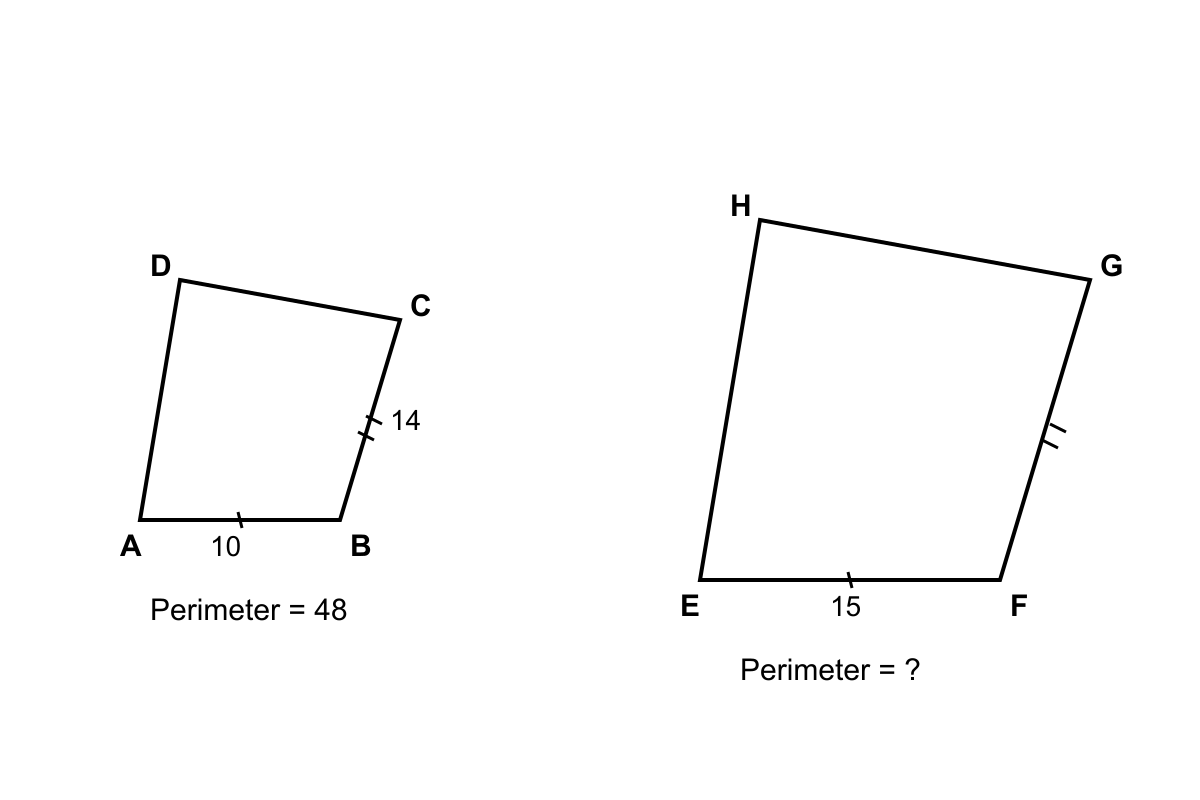
In the figure shown, quadrilateral ABCDABCD is similar to quadrilateral EFGHEFGH. Given AB=10AB = 10, BC=14BC = 14, EF=15EF = 15, and the perimeter of ABCDABCD is 4848, what is the perimeter of EFGHEFGH?

Question graphic
7272
3232
108108
6464
← Back to quizzes

Praxis Math Quiz

Praxis Math Quiz: Apply Congruency And Similarity

Practice Apply Congruency And Similarity in Praxis Math with focused quiz questions that help you check what you know, review explanations, and build confidence with test-style prompts.

What this quiz covers

This quiz focuses on Apply Congruency And Similarity, giving you a quick way to practice the rules, question types, and explanations that matter most for Praxis Math.

How to use this quiz

Try each quiz question before looking at the correct answer. Use the explanations to review missed ideas, then come back to similar questions until the pattern feels familiar.

All questions

Question 1

In the figure shown, quadrilateral ABCDABCD is similar to quadrilateral EFGHEFGH. Given AB=10AB = 10, BC=14BC = 14, EF=15EF = 15, and the perimeter of ABCDABCD is 4848, what is the perimeter of EFGHEFGH?

  1. 7272 (correct answer)
  2. 3232
  3. 108108
  4. 6464
Explanation: The linear scale factor from ABCDABCD to EFGHEFGH is EF/AB=15/10=3/2EF/AB = 15/10 = 3/2. Perimeters scale by the same factor: 483/2=7248 \cdot 3/2 = 72. B (32) uses 482/348 \cdot 2/3 (inverted ratio). C (108) uses squared ratio (489/448 \cdot 9/4). D (64) uses 48+1648 + 16.

Question 2

In the figure, two similar triangles have areas of 4848 and 108108 square units. If the shortest side of the smaller triangle is 88 units, what is the length of the corresponding shortest side of the larger triangle?

  1. 1212 (correct answer)
  2. 1818
  3. 1515
  4. 10.410.4
Explanation: For similar figures, area ratio = (linear ratio)². So (k)2=108/48=9/4(k)^2 = 108/48 = 9/4, giving k=3/2k = 3/2. The corresponding side is 83/2=128 \cdot 3/2 = 12. B (18) uses area ratio directly: 8108/488 \cdot 108/48. C (15) uses 8+78 + 7 or linear difference. D (10.4) uses 108/488\sqrt{108/48} \cdot 8 incorrectly computed.

Question 3

A rectangular garden has a length of 25 feet and a width of 15 feet. A landscape designer creates a scale drawing of the garden where the width on the drawing is 6 inches. What is the length of the garden on the scale drawing?

  1. 8 inches
  2. 10 inches (correct answer)
  3. 12 inches
  4. 16 inches
Explanation: The actual garden and the scale drawing are similar rectangles. The ratio of the width to the length in the actual garden must be equal to the ratio of the width to the length in the drawing. Let LL be the length on the drawing. Set up a proportion: drawing widthactual width=drawing lengthactual length\frac{\text{drawing width}}{\text{actual width}} = \frac{\text{drawing length}}{\text{actual length}}. Or, more simply, drawing lengthdrawing width=actual lengthactual width\frac{\text{drawing length}}{\text{drawing width}} = \frac{\text{actual length}}{\text{actual width}}. So, L6=2515\frac{L}{6} = \frac{25}{15}. Simplifying the fraction gives L6=53\frac{L}{6} = \frac{5}{3}. Multiply both sides by 6 to solve for LL: L=53×6=10L = \frac{5}{3} \times 6 = 10. The length on the drawing is 10 inches.

Question 4

Given JKL\triangle JKL and MNO\triangle MNO, it is known that JK=MNJK = MN and KL=NOKL = NO. Which of the following pieces of additional information is NOT sufficient to prove that the two triangles are congruent?

  1. The third pair of sides are equal, LJ=OMLJ = OM.
  2. The included angles are equal, K=N\angle K = \angle N.
  3. The triangles are right triangles with hypotenuses JLJL and MOMO.
  4. A pair of non-included angles are equal, J=M\angle J = \angle M. (correct answer)
Explanation: The given information is Side-Side (SS). Option A provides the third side, proving congruence by SSS. Option B provides the included angle, proving congruence by SAS. Option C states the triangles are right triangles with equal legs (JK, KL) and (MN, NO) and equal hypotenuses (JL, MO), which proves congruence by SSS (or HL if one of the given sides were a leg and the other a hypotenuse, but as stated SSS applies). Option D provides a non-included angle, which creates the Side-Side-Angle (SSA) condition. SSA is not a valid postulate for proving triangle congruence because it can lead to ambiguous cases. Therefore, this information is not sufficient.

Question 5

Triangle ABC has vertices with coordinates A(0,0), B(4,0), and C(0,3). Triangle DEF is formed by applying a dilation centered at the origin with a scale factor of 2.5 to triangle ABC. What is the length of side EF?

  1. 5
  2. 7.5
  3. 10
  4. 12.5 (correct answer)
Explanation: First, find the length of the corresponding side BC in triangle ABC. Since the vertices are on the axes, triangle ABC is a right triangle. We can use the Pythagorean theorem or the distance formula. The length of AB is 4 and the length of AC is 3. The length of the hypotenuse BC is 42+32=16+9=25=5\sqrt{4^2 + 3^2} = \sqrt{16 + 9} = \sqrt{25} = 5. A dilation multiplies all lengths by the scale factor. The side EF in triangle DEF corresponds to the side BC in triangle ABC. Therefore, the length of EF is the length of BC multiplied by the scale factor: 5×2.5=12.55 \times 2.5 = 12.5.

Question 6

If XYZ\triangle XYZ is congruent to RST\triangle RST, which of the following is NOT necessarily a correct congruence statement?

  1. XYRSXY \cong RS
  2. ZT\angle Z \cong \angle T
  3. YZSTYZ \cong ST
  4. XYSTXY \cong ST (correct answer)
Explanation: The congruence statement XYZRST\triangle XYZ \cong \triangle RST implies that corresponding vertices are listed in the same order. Thus, X corresponds to R, Y to S, and Z to T. This means corresponding parts are congruent: XYRSXY \cong RS, YZSTYZ \cong ST, ZXTRZX \cong TR, XR\angle X \cong \angle R, YS\angle Y \cong \angle S, and ZT\angle Z \cong \angle T. The statement XYSTXY \cong ST is not necessarily true, as it matches a side from the first triangle with a non-corresponding side from the second.

Question 7

In ABC\triangle ABC, M is the midpoint of AB and N is the midpoint of AC. A line segment is drawn connecting M and N. What is the ratio of the perimeter of AMN\triangle AMN to the perimeter of ABC\triangle ABC?

  1. 1:2 (correct answer)
  2. 1:3
  3. 1:4
  4. 2:3
Explanation: The Triangle Midsegment Theorem states that the segment connecting the midpoints of two sides of a triangle is parallel to the third side and is half the length of the third side. So, MN=12BCMN = \frac{1}{2}BC. Since M and N are midpoints, we also know that AM=12ABAM = \frac{1}{2}AB and AN=12ACAN = \frac{1}{2}AC. Because all three sides of AMN\triangle AMN are half the length of the corresponding sides of ABC\triangle ABC, the triangles are similar with a scale factor of 1:2. The ratio of the perimeters is equal to the scale factor, which is 1:2.

Question 8

In LMN\triangle LMN, mL=40m\angle L = 40^\circ and mM=60m\angle M = 60^\circ. In PQR\triangle PQR, mP=40m\angle P = 40^\circ and mR=80m\angle R = 80^\circ. Which statement is true about the two triangles?

  1. They are congruent by ASA.
  2. They are similar. (correct answer)
  3. They are not similar.
  4. They are isosceles.
Explanation: First, find the third angle in each triangle. The sum of angles in a triangle is 180 degrees. In LMN\triangle LMN, mN=1804060=80m\angle N = 180^\circ - 40^\circ - 60^\circ = 80^\circ. In PQR\triangle PQR, mQ=1804080=60m\angle Q = 180^\circ - 40^\circ - 80^\circ = 60^\circ. So, LMN\triangle LMN has angles 40, 60, 80 and PQR\triangle PQR has angles 40, 60, 80. Since all three pairs of corresponding angles are congruent, the triangles are similar by the Angle-Angle-Angle (AAA) or Angle-Angle (AA) similarity criterion. We cannot determine if they are congruent as no side lengths are given.

Question 9

Triangle ABC is similar to triangle DEF. The length of side AB is 8 inches and the length of the corresponding side DE is 12 inches. If the area of triangle ABC is 40 square inches, what is the area of triangle DEF?

  1. 60 square inches
  2. 80 square inches
  3. 90 square inches (correct answer)
  4. 120 square inches
Explanation: The ratio of corresponding side lengths (the scale factor) from triangle ABC to triangle DEF is k=128=32k = \frac{12}{8} = \frac{3}{2}. The ratio of the areas of two similar figures is the square of the scale factor, k2k^2. Therefore, the ratio of the areas is (32)2=94(\frac{3}{2})^2 = \frac{9}{4}. To find the area of triangle DEF, multiply the area of triangle ABC by this ratio: Area(DEF) = Area(ABC) \times \frac{9}{4} = 40 \times \frac{9}{4} = 10 \times 9 = 90) square inches.

Question 10

In XYZ\triangle XYZ, a line segment PQ is drawn such that P is on side XY and Q is on side XZ. If PQ is parallel to YZ, which statement guarantees that XPQ\triangle XPQ is similar to XYZ\triangle XYZ?

  1. No additional information is needed; the triangles are always similar. (correct answer)
  2. The length of XP is half the length of XY.
  3. The segment PQ is perpendicular to the side XZ.
  4. The triangle XYZ must be an isosceles triangle.
Explanation: If a line segment (PQ) is drawn parallel to one side (YZ) of a triangle (XYZ) intersecting the other two sides, it creates a smaller triangle (XPQ) that is similar to the original triangle. This is because the parallel lines create corresponding angles that are congruent: XPQXYZ\angle XPQ \cong \angle XYZ and XQPXZY\angle XQP \cong \angle XZY. Since PXQ\angle PXQ is the same as YXZ\angle YXZ (reflexive property), the triangles are similar by the Angle-Angle (AA) similarity postulate. No further conditions are required.

Question 11

In triangle XYZ, the measure of angle X is 30 degrees and the measure of angle Y is 90 degrees. In triangle MNO, the measure of angle M is 30 degrees and the measure of angle N is 90 degrees. Which congruence postulate or theorem could be used to prove XYZMNO\triangle XYZ \cong \triangle MNO if it were also known that XZ = MO?

  1. Side-Angle-Side (SAS)
  2. Angle-Side-Angle (ASA)
  3. Side-Side-Side (SSS)
  4. Angle-Angle-Side (AAS) (correct answer)
Explanation: We are given two pairs of congruent angles: XM\angle X \cong \angle M (both 30 degrees) and YN\angle Y \cong \angle N (both 90 degrees). We are also given that a pair of non-included sides are congruent: XZMOXZ \cong MO (these are the hypotenuses). The combination of two angles and a non-included side proves congruence by the Angle-Angle-Side (AAS) theorem. It is not ASA because the side is not between the two given angles. It is not SAS because we only have one pair of congruent sides.

Question 12

Based on the figure shown, which of the following is sufficient to conclude that ABCDEF\triangle ABC \cong \triangle DEF?

  1. AB=DEAB = DE, BC=EFBC = EF, and AD\angle A \cong \angle D
  2. AB=DEAB = DE, AC=DFAC = DF, and AD\angle A \cong \angle D (correct answer)
  3. AD\angle A \cong \angle D, BE\angle B \cong \angle E, and CF\angle C \cong \angle F
  4. AB=DEAB = DE, AD\angle A \cong \angle D, and CF\angle C \cong \angle F
Explanation: B gives SAS (two sides and the included angle A\angle A between ABAB and ACAC), which guarantees congruence. A gives SSA (angle not included between the two sides), which is the ambiguous case and does not guarantee congruence. C gives AAA, which guarantees only similarity, not congruence. D gives ASA but with non-corresponding angles (A\angle A and C\angle C are not adjacent to the given side ABAB), making this insufficient.

Question 13

Use the figure shown. In ABC\triangle ABC, point DD lies on AB\overline{AB} and point EE lies on AC\overline{AC} such that DEBC\overline{DE} \parallel \overline{BC}. If AD=xAD = x, DB=x+2DB = x + 2, AE=3AE = 3, and EC=5EC = 5, what is the value of xx?

  1. 33 (correct answer)
  2. 55
  3. 22
  4. 103\dfrac{10}{3}
Explanation: By the Triangle Proportionality Theorem, AD/DB=AE/ECAD/DB = AE/EC, so x/(x+2)=3/5x/(x+2) = 3/5. Cross-multiplying: 5x=3x+65x = 3x + 6, so 2x=62x = 6, x=3x = 3. B (5) uses ECEC directly. C (2) from miscomputing. D (10/310/3) comes from solving x/(x+2)=5/3x/(x+2) = 5/3 (inverted ratio).

Question 14

A polygon is transformed on a coordinate plane. Which of the following transformations does NOT necessarily result in an image that is congruent to the original polygon?

  1. A reflection across the y-axis.
  2. A translation of 3 units to the left.
  3. A rotation of 90 degrees about the origin.
  4. A dilation with a scale factor of 2. (correct answer)
Explanation: Congruent figures have the same size and shape. Reflections, translations, and rotations are rigid transformations (isometries), which means they preserve side lengths and angle measures. Therefore, the image after these transformations is always congruent to the original figure. A dilation, however, changes the size of the figure by a given scale factor. Unless the scale factor is 1 or -1, the resulting image will be similar but not congruent to the original polygon.

Question 15

Triangle FGH has side lengths of 9, 12, and 15. Triangle JKL has side lengths of 12, 16, and 20. Which statement best describes the relationship between the two triangles?

  1. They are congruent but not similar.
  2. They are similar but not congruent. (correct answer)
  3. They are neither similar nor congruent.
  4. They are both congruent and similar.
Explanation: To check for similarity, we check if the ratios of corresponding sides are equal. Let's order the sides from shortest to longest for both triangles: FGH (9, 12, 15) and JKL (12, 16, 20). Now check the ratios: 129=43\frac{12}{9} = \frac{4}{3}, 1612=43\frac{16}{12} = \frac{4}{3}, and 2015=43\frac{20}{15} = \frac{4}{3}. Since all the ratios are equal, the triangles are similar by the SSS similarity criterion. They are not congruent because their corresponding side lengths are not equal (e.g., 9 is not equal to 12).

Question 16

The side lengths of PQR\triangle PQR are 5, 12, and 13. A second triangle, STU\triangle STU, is similar to PQR\triangle PQR, and its longest side is 39. What is the perimeter of STU\triangle STU?

  1. 30
  2. 60
  3. 78
  4. 90 (correct answer)
Explanation: First, find the perimeter of PQR\triangle PQR: 5+12+13=305 + 12 + 13 = 30. The longest side of PQR\triangle PQR is 13. The corresponding longest side of STU\triangle STU is 39. The scale factor from PQR\triangle PQR to STU\triangle STU is the ratio of these corresponding sides: k=3913=3k = \frac{39}{13} = 3. The ratio of the perimeters of two similar triangles is equal to the scale factor of their side lengths. Therefore, the perimeter of STU\triangle STU is the perimeter of PQR\triangle PQR multiplied by the scale factor: 30×3=9030 \times 3 = 90.

Question 17

Triangle ABC is congruent to triangle DEF. The perimeter of triangle ABC is 32. If DE = 10 and EF = 12, what is the length of side AC?

  1. 8
  2. 10 (correct answer)
  3. 12
  4. 14
Explanation: Since ABCDEF\triangle ABC \cong \triangle DEF, their corresponding sides are equal in length. This means AB=DEAB = DE, BC=EFBC = EF, and AC=DFAC = DF. We are given DE = 10 and EF = 12, so AB = 10 and BC = 12. The perimeter of triangle ABC is given as 32. The perimeter is the sum of the side lengths: AB+BC+AC=32AB + BC + AC = 32. Substituting the known values: 10+12+AC=3210 + 12 + AC = 32. This simplifies to 22+AC=3222 + AC = 32. Subtracting 22 from both sides gives AC=10AC = 10.

Question 18

In the figure shown, a right triangle has an altitude drawn from the right angle to the hypotenuse, dividing the hypotenuse into segments of lengths 44 and 99. What is the length of the altitude hh?

  1. 66 (correct answer)
  2. 6.56.5
  3. 1313
  4. 13\sqrt{13}
Explanation: By the geometric mean (altitude-on-hypotenuse) theorem, the altitude is the geometric mean of the two hypotenuse segments: h=49=36=6h = \sqrt{4 \cdot 9} = \sqrt{36} = 6. This arises from similar triangles created by the altitude. B (6.5) is the arithmetic mean. C (13) is the sum (the full hypotenuse). D (13\sqrt{13}) confuses the geometric mean formula with 4+9\sqrt{4+9}.

Question 19

Refer to the figure. Two similar rectangular prisms have corresponding edges in the ratio 2:52:5. If the volume of the smaller prism is 2424 cubic centimeters, what is the volume of the larger prism, in cubic centimeters?

  1. 6060
  2. 150150
  3. 375375 (correct answer)
  4. 240240
Explanation: For similar 3D solids, volume scales by the cube of the linear scale factor. (5/2)3=125/8(5/2)^3 = 125/8. So V=24125/8=3125=375V = 24 \cdot 125/8 = 3 \cdot 125 = 375 cm³. A (60) uses linear ratio only (245/224 \cdot 5/2). B (150) uses squared ratio (2425/424 \cdot 25/4). D (240) uses factor of 10.

Question 20

Use the figure shown. In right triangle ABCABC, C=90°\angle C = 90°. Altitude CD\overline{CD} is drawn to hypotenuse AB\overline{AB}. If AC=12AC = 12 and AB=18AB = 18, what is the length of AD\overline{AD}?

  1. 66
  2. 88 (correct answer)
  3. 99
  4. 233\dfrac{2\sqrt{3}}{3}
Explanation: By the geometric mean (leg) theorem, AC2=ADABAC^2 = AD \cdot AB. So 122=AD1812^2 = AD \cdot 18, giving AD=144/18=8AD = 144/18 = 8. A (6) is ABACAB - AC. C (9) is half of ABAB (treating DD as midpoint). D comes from a misapplication of ratios.