All questions
Question 1
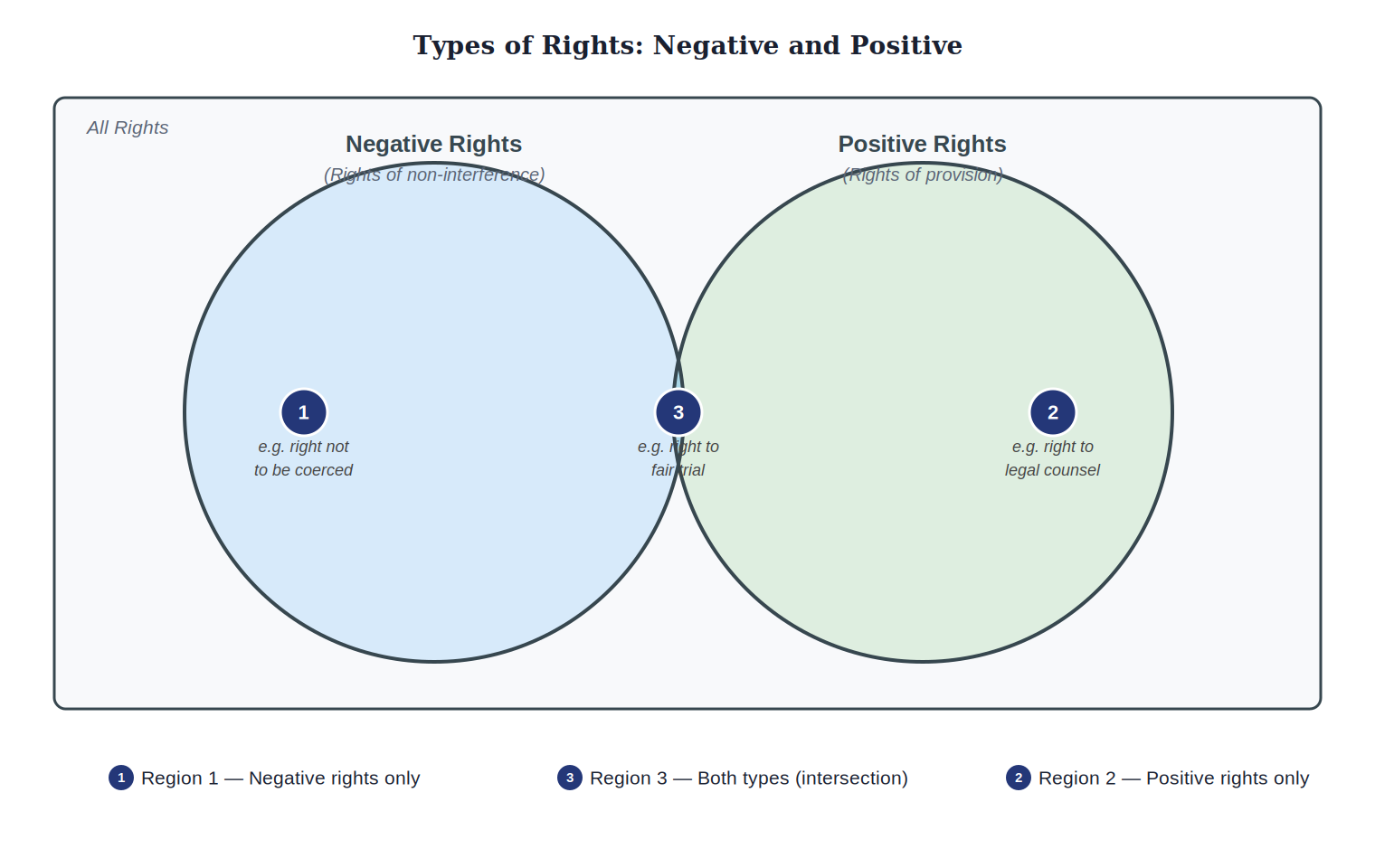
Consider the rights involved in a fair trial. The right not to have a confession coerced is a negative right, while the right to be provided with legal counsel if one cannot afford it is a positive right. Refer to the diagram below.
- Region 1 only
- Region 2 only
- Region 3 (correct answer)
- Outside both circles
Explanation: The correct answer is C. The concept of a 'right to a fair trial' is a composite right that includes multiple components. As the stem specifies, it includes a negative right (not to be coerced) and a positive right (to be provided with counsel). Therefore, the overarching concept of a 'fair trial' belongs in Region 3, the intersection of both sets, because it cannot be fully understood without reference to both types of constituent rights.
Question 2
In a famous thought experiment, a person is drowning in a shallow pond. An adult bystander could easily wade in and save the person at no risk to themselves, but chooses not to. Most people would agree the bystander acted wrongly.
How would a rights-based theorist, distinguishing between positive and negative rights, most likely analyze the bystander's failure to act?
- The bystander violated the drowning person's negative right to life by failing to prevent their death.
- The bystander did not violate a negative right, but may have failed to uphold a moral duty corresponding to the drowning person's positive right to assistance in dire need. (correct answer)
- The bystander's action is wrong because it violates the categorical imperative to treat others as ends in themselves, which is a form of negative right.
- The bystander violated no rights, as rights only pertain to protections from state action, not the actions of private individuals.
Explanation: The correct answer is B. The bystander does not actively harm the drowning person, so they do not violate a negative right (the duty of non-interference). Instead, the wrongness of their inaction stems from the failure to provide aid. This corresponds to a potential positive right to assistance. B correctly identifies that no negative right was violated but that the moral failure relates to a positive duty. A incorrectly classifies the right to life in this context; the negative right to life is a right not to be killed, which the bystander did not do. C brings in Kantian ethics, which is related to deontology but frames the issue differently than the positive/negative rights distinction. D makes an overly narrow claim that rights only apply to state action, which is a specific political view (and a common misconception) but not a universally accepted premise within rights theory.
Question 3
A government agency is found to be collecting the digital communications of its citizens without warrants. A civil liberties advocate argues this is a violation of the right to privacy. The advocate's argument is based on the conception of privacy as a:
- positive right to be given control over one's personal information by the government.
- positive right to be provided with secure communication technologies.
- negative right to be free from government intrusion and surveillance. (correct answer)
- negative right to not be falsely represented in public records.
Explanation: The correct answer is C. The core of the complaint is that the government is engaging in an unwanted action (surveillance, intrusion). The right being claimed is a right from this action, a right of non-interference. This is the definition of a negative right. A and B frame privacy as a positive right—a right to be given or provided with something. While these could be part of a broader conception of privacy, the specific complaint about surveillance is based on a negative right. D describes a different right, related to defamation or libel, not the act of surveillance itself.
Question 4
In a society with a state-sponsored religion, a new law is passed forbidding citizens from publicly displaying symbols of other faiths or from proselytizing.
This law primarily infringes upon what is known in rights theory as a:
- positive right to religious accommodation.
- positive right to have one's religion recognized by the state.
- negative right to freedom of religion and expression. (correct answer)
- negative right to be free from religious persecution by other citizens.
Explanation: The correct answer is C. The law actively forbids certain actions (displaying symbols, proselytizing). A right to be free from such prohibitions is a right of non-interference, which is a negative right. Freedom of religion and expression are classic examples of negative rights. A and B are positive rights; they would require the state to do something (e.g., provide prayer rooms, fund religious schools), which is the opposite of what is being discussed. D is also a negative right, but the law described is an act of persecution by the state, not by other citizens.
Question 5
It is often argued that enforcing negative rights is cost-free, while providing positive rights is economically costly. Which of the following statements represents the most philosophically robust counterargument to this claim?
- The economic costs of positive rights are always justified because they produce greater overall happiness for society.
- The enforcement and protection of negative rights, through institutions like police, courts, and the military, require substantial public expenditure. (correct answer)
- Negative rights are inherently more valuable than positive rights, so any costs associated with them are philosophically irrelevant.
- Positive rights can often be provided by private charities and NGOs, making them potentially cost-free to the state.
Explanation: The correct answer is B. This is a classic critique (associated with philosophers like Stephen Holmes and Cass Sunstein, building on Henry Shue) of the simplistic view that negative rights are 'free.' Protecting a negative right like the right to property requires a costly state apparatus (police to prevent theft, courts to adjudicate disputes). This shows that the distinction is not about cost versus no cost, but about different kinds of costs. A is a utilitarian argument, not a critique of the cost distinction itself. C makes a value judgment but doesn't address the factual claim about costs. D suggests a way to shift costs, but it doesn't refute the idea that fulfilling the right has a cost to someone.
Question 6
A society's constitution guarantees a 'right to a fair trial.' To ensure this right is meaningful, the state provides public defenders to defendants who cannot afford legal representation. The provision of a public defender is best understood as an acknowledgment that:
- a positive right to legal counsel is instrumental in securing a negative right against unjust punishment. (correct answer)
- the right to a fair trial is purely a positive right, requiring the state to manage all aspects of the judicial process.
- all rights are ultimately granted by the state and can be defined by the state's provision of services.
- the negative right to a fair trial requires that all citizens have equal economic resources to defend themselves.
Explanation: The correct answer is A. The core of the right to a fair trial is negative: the right not to be deprived of liberty or property without due process. However, for this negative right to be effective in an adversarial legal system, a defendant may need legal representation. Providing that representation is a positive action. Thus, the positive right (to be given a lawyer) serves as a necessary means to protect the underlying negative right (to not be unjustly convicted). B is incorrect because the right to a fair trial also includes many negative components (e.g., not being coerced into a confession). C makes a broader, controversial claim about the source of all rights. D misstates the implication; the provision of a lawyer is a remedy for economic inequality in this specific context, but it doesn't imply a general right to equal resources.
Question 7
A city is facing a severe housing crisis. A politician proposes seizing all privately-owned vacant apartments and assigning them to homeless families. A critic objects, arguing this violates the owners' rights. The politician replies, 'The right to shelter is more fundamental than the right to own a second home.' The politician is:
- arguing for the priority of a positive right (shelter) over a negative right (property). (correct answer)
- denying the existence of negative rights in favor of a purely utilitarian framework.
- claiming that property rights are not true rights but are merely legal conventions.
- redefining the right to property as a positive right to be given a home by the state.
Explanation: The correct answer is A. The politician's argument implicitly frames the 'right to shelter' as a positive right (a right to be provided with housing) and prioritizes it over the owners' negative right to their property (the right not to have it seized). This is a common form of argument in rights-based discourse: acknowledging that two rights are in conflict and arguing that one is more fundamental or weighty than the other. B is incorrect because the politician is still using the language of rights, not switching to a utilitarian calculus. C is a possible philosophical position, but the politician's statement is about prioritizing rights, not denying the validity of one of them. D misinterprets the argument; the politician is not redefining the right to property but is trying to override it with a different right.
Question 8
A city passes an ordinance requiring all new commercial buildings to be wheelchair accessible. The stated goal is to ensure that citizens with disabilities have equal access to public life.
This ordinance is best understood as enforcing a:
- negative right for business owners against government overreach.
- positive right for citizens with disabilities to access public accommodations. (correct answer)
- negative right for citizens with disabilities against discrimination.
- positive right for business owners to receive subsidies for construction.
Explanation: The correct answer is B. The ordinance imposes a positive duty on business owners—the duty to act by building ramps, elevators, etc.—in order to provide access for people with disabilities. This is the hallmark of a positive right. A is what the ordinance's opponents might claim, not what the ordinance enforces. C is a plausible distractor, as the goal is to prevent discrimination. However, the mechanism of the ordinance is not simply to forbid an action (a negative duty) but to mandate a specific action (a positive duty). The right against discrimination can have both positive and negative components, but this specific law enforces the positive one. D describes a potential complementary policy, not what this ordinance itself enforces.
Question 9
A government passes the "Secure Livelihood Act," which mandates that any corporation with over 500 employees must contribute to a central fund used to provide job retraining and unemployment benefits for all citizens. A civil liberties group challenges the law, arguing that it forces corporations to dispose of their property in a manner not of their own choosing.
The conflict described in the passage is best understood within rights-based ethics as a clash between:
- A claimed positive right to economic security and a claimed negative right to property. (correct answer)
- Two competing negative rights: the right to be free from unemployment and the right to corporate autonomy.
- A legal right created by the government and a moral right based on social contract theory.
- The utilitarian goal of social welfare and the deontological duty of corporations to their shareholders.
Explanation: The correct answer is A. The 'Secure Livelihood Act' establishes a system to provide benefits, which is characteristic of a positive right (a right to something). The civil liberties group's objection is based on the idea that corporations are being forced to act, which they see as a violation of their right to control their property, a classic negative right (a right from interference). B incorrectly classifies the 'right to be free from unemployment' as a negative right; it is a claim for provision, making it positive. C introduces a distinction (legal vs. moral) that is different from the positive/negative distinction at the heart of the conflict. D mischaracterizes the conflict by framing it as a clash between two different ethical systems (utilitarianism vs. deontology) rather than a conflict within a rights-based framework.
Question 10
A libertarian philosopher argues that a just society is one founded solely on the protection of negative rights, particularly self-ownership and property. She claims that the enforcement of any positive right is inherently unjust.
What is the most likely reason for this philosopher's rejection of positive rights?
- Positive rights are often too difficult to define in legal terms, leading to judicial ambiguity.
- Fulfilling positive rights requires coercing some individuals to provide resources for others, violating the provider's negative rights. (correct answer)
- Positive rights tend to lead to less overall happiness than a system based only on negative rights.
- Historically, societies that have focused on positive rights have been less prosperous than those that have not.
Explanation: The correct answer is B. This gets to the core of the libertarian critique of positive rights. To provide someone with a positive right (e.g., healthcare, education), the state must acquire resources. This is typically done through taxation, which, from a strict libertarian perspective, is a coercive seizure of property. This act of coercion to fulfill a positive right for person A is seen as a violation of person B's negative right to their property. A is a practical objection, not a fundamental moral one. C is a utilitarian argument, whereas the philosopher's position is deontological/rights-based. D is an empirical claim about history, not a philosophical argument about justice.
Question 11
The concept of a 'prima facie' right is the idea that a right can be justifiably overridden by a more compelling moral consideration. This concept is most crucial for resolving conflicts in rights-based ethics when:
- a legal right, such as one established by statute, conflicts with a traditional moral right.
- an individual's positive right, such as the right to healthcare, conflicts with another's negative right, such as the right to property. (correct answer)
- it is unclear whether a claimed right, such as the right to internet access, is a genuine right.
- a right, such as freedom of speech, is violated by a foreign government rather than one's own.
Explanation: The correct answer is B. The concept of prima facie rights is most useful when two genuine rights conflict. The classic example is the conflict between positive and negative rights, such as when funding a positive right (healthcare) through taxation is claimed to infringe on a negative right (property). Treating both rights as prima facie allows a theorist to argue that, in this specific context, one right outweighs the other without having to deny the validity of the overridden right entirely. A describes a conflict between different sources of rights (legal vs. moral), not necessarily a conflict between the substance of two rights. C is about whether a right exists at all, not how to adjudicate a conflict between two existing rights. D deals with the jurisdiction of rights, which is a different issue.
Question 12
A city government, citing public safety, implements a policy of preemptive surveillance against individuals who have not committed any crime but are identified by an algorithm as having a high probability of future criminal behavior.
A critique of this policy grounded in rights-based reasoning would most strongly argue that it violates a:
- positive right of the public to be protected by the most advanced technology available.
- negative right of the government to enforce laws and maintain social order.
- positive right to rehabilitation, as it punishes before a crime has even occurred.
- negative right to privacy by subjecting individuals to intrusion without a preceding wrongful act. (correct answer)
Explanation: When analyzing policies through rights-based reasoning, you need to distinguish between positive rights (entitlements to receive something) and negative rights (freedoms from interference). This distinction is crucial for evaluating government actions and their ethical implications.
The surveillance policy violates individuals' negative right to privacy because it subjects people to government intrusion without any wrongful act on their part. Rights-based reasoning emphasizes that people should be free from unwarranted interference, especially when they haven't committed any crime. The policy treats algorithmic predictions as sufficient justification for surveillance, which undermines the fundamental principle that rights protections shouldn't depend on statistical probabilities about future behavior.
Option A incorrectly frames public safety as a positive right to specific technology. While governments may have duties to protect citizens, there's no established positive right to particular surveillance methods, especially controversial ones. Option B mischaracterizes government law enforcement as a "negative right" when it's actually a positive power or duty. Governments don't have rights in the same sense individuals do—they have authorized powers and responsibilities. Option C identifies the wrong violation. While the policy is problematic, it's not primarily about rehabilitation rights, since no punishment is explicitly described, and rehabilitation typically applies after conviction.
Remember that rights-based critiques focus on whether actions respect individual dignity and autonomy. When you see scenarios involving government surveillance or preemptive action against law-abiding citizens, look for violations of negative rights—particularly privacy, due process, or presumption of innocence.
Question 13
The claim of a universal 'right to food' is most accurately classified as a:
- negative right, imposing a duty on others not to interfere with a person's attempts to acquire food.
- legal right only, as there is no philosophical basis for such a right outside of specific national laws.
- meta-right, which is a right to have other rights, both positive and negative, respected.
- positive right, imposing a duty on some agent (e.g., the state) to provide food to those who cannot acquire it. (correct answer)
Explanation: When you encounter questions about rights classifications, you need to distinguish between positive and negative rights—a fundamental distinction in moral and political philosophy. Negative rights require others to refrain from certain actions, while positive rights require others to actively provide something.
The "right to food" is correctly classified as a positive right (D) because it imposes an active duty on some agent—typically the state or society—to ensure people have access to food when they cannot obtain it themselves. This right doesn't just protect your freedom to seek food; it creates an obligation for others to help provide it when necessary. Positive rights generate what philosophers call "duties of assistance."
Option A mischaracterizes this as a negative right. While not interfering with someone's food-seeking efforts might be part of food security, the core claim of a "right to food" goes beyond mere non-interference—it demands active provision when needed.
Option B incorrectly suggests there's no philosophical basis for food rights outside national laws. Philosophers have extensively argued for universal human rights, including subsistence rights, based on human dignity and basic needs theories that transcend specific legal systems.
Option C misapplies the concept of meta-rights. A meta-right is a right to have rights recognized or protected in general, not a specific substantive right like access to food.
Remember this pattern: when evaluating rights claims, ask whether they primarily require others to "stay away" (negative) or to "step up and help" (positive). Subsistence rights like food, healthcare, and housing are typically positive rights requiring active social provision.
Question 14
A government passes the "Secure Livelihood Act," which mandates that any corporation with over 500 employees must contribute to a central fund used to provide job retraining and unemployment benefits for all citizens. A civil liberties group challenges the law, arguing that it forces corporations to dispose of their property in a manner not of their own choosing.
The conflict described in the passage is best understood within rights-based ethics as a clash between:
- A claimed positive right to economic security and a claimed negative right to property. (correct answer)
- Two competing negative rights: the right to be free from unemployment and the right to corporate autonomy.
- A legal right created by the government and a moral right based on social contract theory.
- The utilitarian goal of social welfare and the deontological duty of corporations to their shareholders.
Explanation: The correct answer is A. The 'Secure Livelihood Act' establishes a system to provide benefits, which is characteristic of a positive right (a right to something). The civil liberties group's objection is based on the idea that corporations are being forced to act, which they see as a violation of their right to control their property, a classic negative right (a right from interference). B incorrectly classifies the 'right to be free from unemployment' as a negative right; it is a claim for provision, making it positive. C introduces a distinction (legal vs. moral) that is different from the positive/negative distinction at the heart of the conflict. D mischaracterizes the conflict by framing it as a clash between two different ethical systems (utilitarianism vs. deontology) rather than a conflict within a rights-based framework.
Question 15
Which of the following statements most accurately captures the fundamental structural difference between a claim to a negative right and a claim to a positive right?
- Negative rights are derived from nature or God, whereas positive rights are created by human laws and conventions.
- Negative rights impose a duty of non-action or non-interference on others, whereas positive rights impose a duty of action or provision on others. (correct answer)
- Negative rights protect individual choices, whereas positive rights protect collective interests and community well-being.
- Negative rights are held by all individuals universally, whereas positive rights are held only by citizens of a specific state.
Explanation: The correct answer is B. This choice articulates the core conceptual distinction. Negative rights, like the right to life or free speech, require others to refrain from certain actions (killing, censoring). Positive rights, like the right to healthcare or education, require others (typically the state) to provide a good or service. A describes a possible distinction about the source of rights, not their logical structure, and many philosophers argue for moral, non-legal positive rights. C is an oversimplification; many negative rights (like property rights) are crucial for collective interests, and positive rights protect individuals. D is also a common but not necessary feature; some argue for universal positive rights (e.g., to subsistence).
Question 16
In a famous thought experiment, a person is drowning in a shallow pond. An adult bystander could easily wade in and save the person at no risk to themselves, but chooses not to. Most people would agree the bystander acted wrongly.
How would a rights-based theorist, distinguishing between positive and negative rights, most likely analyze the bystander's failure to act?
- The bystander violated the drowning person's negative right to life by failing to prevent their death.
- The bystander did not violate a negative right, but may have failed to uphold a moral duty corresponding to the drowning person's positive right to assistance in dire need. (correct answer)
- The bystander's action is wrong because it violates the categorical imperative to treat others as ends in themselves, which is a form of negative right.
- The bystander violated no rights, as rights only pertain to protections from state action, not the actions of private individuals.
Explanation: The correct answer is B. The bystander does not actively harm the drowning person, so they do not violate a negative right (the duty of non-interference). Instead, the wrongness of their inaction stems from the failure to provide aid. This corresponds to a potential positive right to assistance. B correctly identifies that no negative right was violated but that the moral failure relates to a positive duty. A incorrectly classifies the right to life in this context; the negative right to life is a right not to be killed, which the bystander did not do. C brings in Kantian ethics, which is related to deontology but frames the issue differently than the positive/negative rights distinction. D makes an overly narrow claim that rights only apply to state action, which is a specific political view (and a common misconception) but not a universally accepted premise within rights theory.
Question 17
A libertarian philosopher argues that a just society is one founded solely on the protection of negative rights, particularly self-ownership and property. She claims that the enforcement of any positive right is inherently unjust.
What is the most likely reason for this philosopher's rejection of positive rights?
- Positive rights are often too difficult to define in legal terms, leading to judicial ambiguity.
- Fulfilling positive rights requires coercing some individuals to provide resources for others, violating the provider's negative rights. (correct answer)
- Positive rights tend to lead to less overall happiness than a system based only on negative rights.
- Historically, societies that have focused on positive rights have been less prosperous than those that have not.
Explanation: The correct answer is B. This gets to the core of the libertarian critique of positive rights. To provide someone with a positive right (e.g., healthcare, education), the state must acquire resources. This is typically done through taxation, which, from a strict libertarian perspective, is a coercive seizure of property. This act of coercion to fulfill a positive right for person A is seen as a violation of person B's negative right to their property. A is a practical objection, not a fundamental moral one. C is a utilitarian argument, whereas the philosopher's position is deontological/rights-based. D is an empirical claim about history, not a philosophical argument about justice.
Question 18
A city is facing a severe housing crisis. A politician proposes seizing all privately-owned vacant apartments and assigning them to homeless families. A critic objects, arguing this violates the owners' rights. The politician replies, 'The right to shelter is more fundamental than the right to own a second home.' The politician is:
- arguing for the priority of a positive right (shelter) over a negative right (property). (correct answer)
- denying the existence of negative rights in favor of a purely utilitarian framework.
- claiming that property rights are not true rights but are merely legal conventions.
- redefining the right to property as a positive right to be given a home by the state.
Explanation: The correct answer is A. The politician's argument implicitly frames the 'right to shelter' as a positive right (a right to be provided with housing) and prioritizes it over the owners' negative right to their property (the right not to have it seized). This is a common form of argument in rights-based discourse: acknowledging that two rights are in conflict and arguing that one is more fundamental or weighty than the other. B is incorrect because the politician is still using the language of rights, not switching to a utilitarian calculus. C is a possible philosophical position, but the politician's statement is about prioritizing rights, not denying the validity of one of them. D misinterprets the argument; the politician is not redefining the right to property but is trying to override it with a different right.
Question 19
A government agency is found to be collecting the digital communications of its citizens without warrants. A civil liberties advocate argues this is a violation of the right to privacy. The advocate's argument is based on the conception of privacy as a:
- positive right to be given control over one's personal information by the government.
- positive right to be provided with secure communication technologies.
- negative right to be free from government intrusion and surveillance. (correct answer)
- negative right to not be falsely represented in public records.
Explanation: The correct answer is C. The core of the complaint is that the government is engaging in an unwanted action (surveillance, intrusion). The right being claimed is a right from this action, a right of non-interference. This is the definition of a negative right. A and B frame privacy as a positive right—a right to be given or provided with something. While these could be part of a broader conception of privacy, the specific complaint about surveillance is based on a negative right. D describes a different right, related to defamation or libel, not the act of surveillance itself.
Question 20
In the context of rights-based reasoning, what is the relationship between rights and duties?
- Duties are morally prior to rights; rights are simply the protections one earns by fulfilling one's duties to society.
- Rights and duties are correlative; for every right held by one person, there is a corresponding duty held by another person or persons. (correct answer)
- Rights are held against the state, while duties are owed to fellow individuals in a community.
- Rights and duties are independent concepts; a person can have a right without anyone else having a specific corresponding duty.
Explanation: The correct answer is B. This describes the doctrine of the correlativity of rights and duties, a central tenet of most rights theories, famously articulated by Wesley Hohfeld. The idea is that a right is meaningless unless someone else has a duty to respect it. For example, my right to life corresponds to your duty not to kill me. A describes a communitarian view that is distinct from and often critical of rights-based liberalism. C makes an incorrect distinction; rights can be held against individuals (e.g., the right not to be assaulted), and duties can be owed to the state (e.g., the duty to pay taxes). D contradicts the core logic of rights-based reasoning; without a corresponding duty, a 'right' is just a wish or a goal.