All questions
Question 1
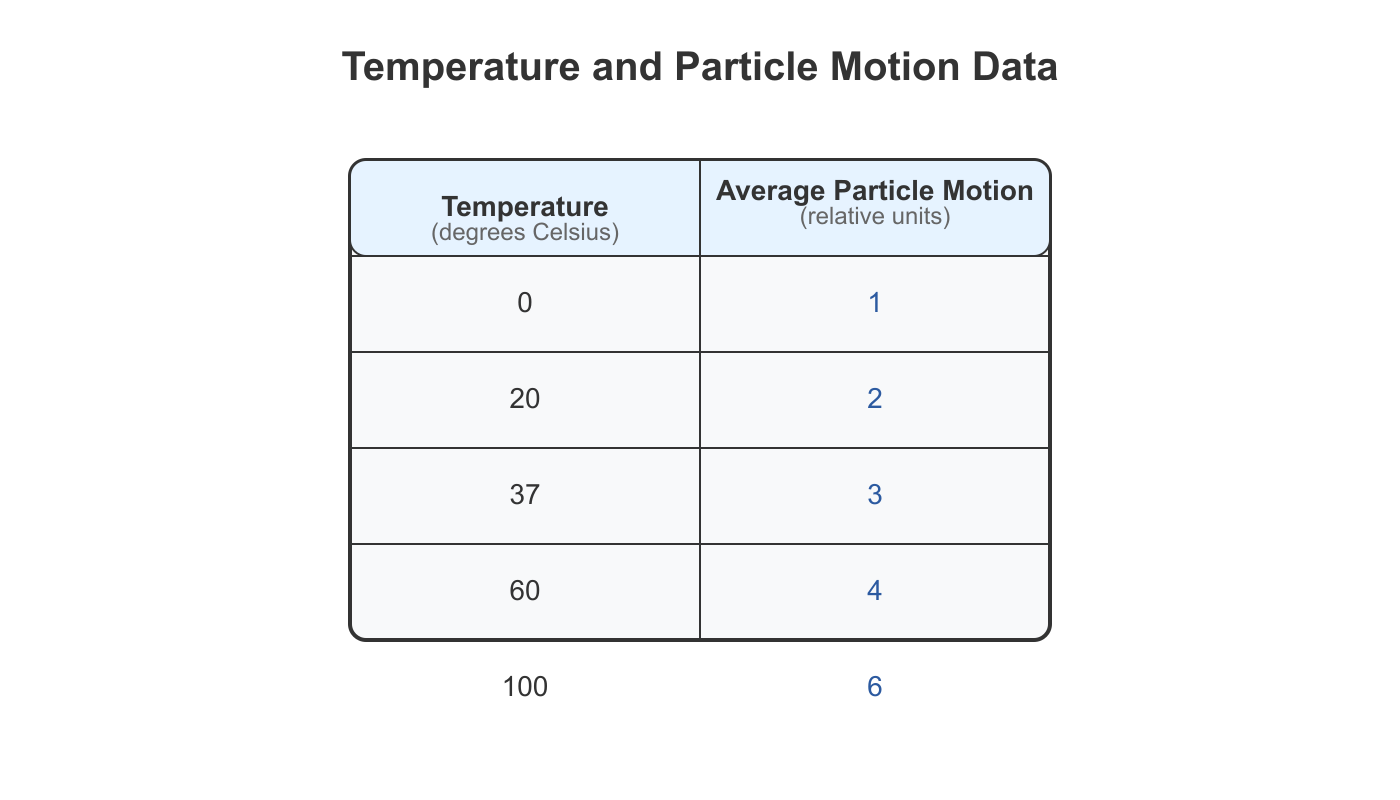
A student measures the temperature of water and estimates the average particle motion (how fast particles move) using a simulation. The data are shown below. Based on the pattern, what happens to average particle motion as temperature increases?
Temperature (degrees Celsius): 0, 20, 37, 60, 100
Average particle motion (relative units): 1, 2, 3, 4, 6
- Average particle motion decreases as temperature increases.
- Average particle motion increases as temperature increases. (correct answer)
- Average particle motion stays the same no matter the temperature.
- Average particle motion depends only on the amount of water, not temperature.
Explanation: This question tests understanding that temperature is a measure of the average kinetic energy of particles—how fast particles are moving on average. Temperature measures the average kinetic energy (energy of motion) of particles in a substance, not the total energy or the energy of just one particle but the average across all the particles—when temperature is high, particles move rapidly on average with high kinetic energy, and when temperature is low, particles move slowly on average with low kinetic energy, which is why a thermometer reading tells us about particle motion. The graph/table shows that as temperature increases from 0 degrees Celsius to 100 degrees Celsius, particle motion also increases proportionally from 1 to 6 relative units—this positive correlation demonstrates that temperature and particle motion are directly connected: you cannot increase temperature without increasing particle motion, and you cannot increase particle motion without increasing temperature (they're different ways of describing the same physical phenomenon). Choice B is correct because it accurately states that higher temperature means faster particle motion and properly identifies the direct relationship between temperature and particle speed. Choice A reverses the relationship, claiming higher temperature means slower particles, when actually temperature and particle motion are directly proportional: higher temperature always means faster average particle motion. To understand temperature and particle motion: (1) temperature measures average particle kinetic energy (how fast particles moving on average), (2) higher temperature = faster average motion (more vigorous vibration, more rapid sliding, faster zooming), (3) lower temperature = slower average motion (gentler vibration, sluggish sliding, slower gas particle speeds), (4) adding thermal energy (heating) increases particle KE making them move faster and temperature rises, (5) removing thermal energy (cooling) decreases particle KE making them move slower and temperature drops. Real-world connection: when you touch a hot stove (high temperature), the rapidly moving particles in the metal collide with molecules in your skin, transferring energy and making your skin molecules speed up (your skin heats up, feels painful)—the stove feels hot precisely because its particles are moving so fast; when you hold ice (low temperature), the slowly moving particles in ice receive energy from your faster-moving skin molecules, making your skin molecules slow down (your skin cools, feels cold)—the ice feels cold because its particles are moving so slowly compared to your skin's particles.
Question 2
A thermometer reads 80 degrees Celsius for a pot of water. Which statement best explains what this temperature tells you about the water particles?
- The water particles have a higher average kinetic energy than they would at 20 degrees Celsius. (correct answer)
- All water particles are moving at exactly the same speed.
- The temperature tells the total thermal energy of the pot, no matter how much water is inside.
- The water particles are moving slower than they would at 20 degrees Celsius because the number is larger.
Explanation: This question tests understanding that temperature is a measure of the average kinetic energy of particles—how fast particles are moving on average. Temperature measures the average kinetic energy (energy of motion) of particles in a substance, not the total energy or the energy of just one particle but the average across all the particles—when temperature is high, particles move rapidly on average with high kinetic energy, and when temperature is low, particles move slowly on average with low kinetic energy, which is why a thermometer reading tells us about particle motion. At the higher temperature of 80°C, particles have greater average kinetic energy and move faster than at the lower temperature of 20°C where particles have less kinetic energy and move more slowly—this is true for all states of matter: hot solids have particles vibrating more vigorously, hot liquids have particles sliding past each other more rapidly, and hot gases have particles zooming through space at higher speeds compared to the same substances when cold. Choice A is correct because it accurately defines temperature as average particle kinetic energy or motion / correctly states that higher temperature means faster particle motion / properly identifies the direct relationship between temperature and particle speed / explains why hot substances have rapidly moving particles. Choice C incorrectly defines temperature as total energy of all particles / the amount of substance / the type of particles present, when actually temperature is the average kinetic energy of particles regardless of how much substance you have—a cup of water at 50°C and a bathtub of water at 50°C have the same temperature (same average particle KE) even though the bathtub has much more total energy due to having many more particles. To understand temperature and particle motion: (1) temperature measures average particle kinetic energy (how fast particles moving on average), (2) higher temperature = faster average motion (more vigorous vibration, more rapid sliding, faster zooming), (3) lower temperature = slower average motion (gentler vibration, sluggish sliding, slower gas particle speeds), (4) adding thermal energy (heating) increases particle KE making them move faster and temperature rises, (5) removing thermal energy (cooling) decreases particle KE making them move slower and temperature drops. Real-world connection: when you touch a hot stove (high temperature), the rapidly moving particles in the metal collide with molecules in your skin, transferring energy and making your skin molecules speed up (your skin heats up, feels painful)—the stove feels hot precisely because its particles are moving so fast; when you hold ice (low temperature), the slowly moving particles in ice receive energy from your faster-moving skin molecules, making your skin molecules slow down (your skin cools, feels cold)—the ice feels cold because its particles are moving so slowly compared to your skin's particles.
Question 3
A student compares two beakers of the same liquid. Beaker 1 is at 40 degrees Celsius and Beaker 2 is at 10 degrees Celsius. Which statement is correct about temperature and particle motion?
- Beaker 2 has faster-moving particles because it is colder.
- Beaker 1 has faster-moving particles because it is warmer. (correct answer)
- Both beakers have the same average particle motion because they are both liquids.
- Temperature measures the total thermal energy, so the beaker with more liquid must have the faster particles.
Explanation: This question tests understanding that temperature is a measure of the average kinetic energy of particles—how fast particles are moving on average. Temperature measures the average kinetic energy (energy of motion) of particles in a substance, not the total energy or the energy of just one particle but the average across all the particles—when temperature is high, particles move rapidly on average with high kinetic energy, and when temperature is low, particles move slowly on average with low kinetic energy, which is why a thermometer reading tells us about particle motion. At the higher temperature of 40 degrees Celsius, particles have greater average kinetic energy and move faster than at the lower temperature of 10 degrees Celsius where particles have less kinetic energy and move more slowly—this is true for all states of matter: hot solids have particles vibrating more vigorously, hot liquids have particles sliding past each other more rapidly, and hot gases have particles zooming through space at higher speeds compared to the same substances when cold. Choice B is correct because it accurately states that higher temperature means faster particle motion and properly identifies the direct relationship between temperature and particle speed. Choice D incorrectly defines temperature as total energy of all particles, when actually temperature is the average kinetic energy of particles regardless of how much substance you have—a cup of water at 50°C and a bathtub of water at 50°C have the same temperature (same average particle KE) even though the bathtub has much more total energy due to having many more particles. To understand temperature and particle motion: (1) temperature measures average particle kinetic energy (how fast particles moving on average), (2) higher temperature = faster average motion (more vigorous vibration, more rapid sliding, faster zooming), (3) lower temperature = slower average motion (gentler vibration, sluggish sliding, slower gas particle speeds), (4) adding thermal energy (heating) increases particle KE making them move faster and temperature rises, (5) removing thermal energy (cooling) decreases particle KE making them move slower and temperature drops. Real-world connection: when you touch a hot stove (high temperature), the rapidly moving particles in the metal collide with molecules in your skin, transferring energy and making your skin molecules speed up (your skin heats up, feels painful)—the stove feels hot precisely because its particles are moving so fast; when you hold ice (low temperature), the slowly moving particles in ice receive energy from your faster-moving skin molecules, making your skin molecules slow down (your skin cools, feels cold)—the ice feels cold because its particles are moving so slowly compared to your skin's particles.
Question 4
A student says, "Temperature is a measure of how much total energy an object has." Which statement is the best correction for middle school science?
- Temperature measures the average kinetic energy (motion) of the particles in a substance. (correct answer)
- Temperature measures the total number of particles in a substance.
- Temperature measures the color of an object.
- Temperature measures how much space the particles take up, not their motion.
Explanation: This question tests understanding that temperature is a measure of the average kinetic energy of particles—how fast particles are moving on average. Temperature measures the average kinetic energy (energy of motion) of particles in a substance, not the total energy or the energy of just one particle but the average across all the particles—when temperature is high, particles move rapidly on average with high kinetic energy, and when temperature is low, particles move slowly on average with low kinetic energy, which is why a thermometer reading tells us about particle motion. At the higher temperature of various scenarios, particles have greater average kinetic energy and move faster than at lower temperatures where particles have less kinetic energy and move more slowly—this is true for all states of matter: hot solids have particles vibrating more vigorously, hot liquids have particles sliding past each other more rapidly, and hot gases have particles zooming through space at higher speeds compared to the same substances when cold. Choice A is correct because it accurately defines temperature as average particle kinetic energy or motion. Choice B incorrectly defines temperature as the total number of particles in a substance, when actually temperature is the average kinetic energy of particles regardless of how much substance you have—a cup of water at 50°C and a bathtub of water at 50°C have the same temperature (same average particle KE) even though the bathtub has much more total energy due to having many more particles. To understand temperature and particle motion: (1) temperature measures average particle kinetic energy (how fast particles moving on average), (2) higher temperature = faster average motion (more vigorous vibration, more rapid sliding, faster zooming), (3) lower temperature = slower average motion (gentler vibration, sluggish sliding, slower gas particle speeds), (4) adding thermal energy (heating) increases particle KE making them move faster and temperature rises, (5) removing thermal energy (cooling) decreases particle KE making them move slower and temperature drops. Real-world connection: when you touch a hot stove (high temperature), the rapidly moving particles in the metal collide with molecules in your skin, transferring energy and making your skin molecules speed up (your skin heats up, feels painful)—the stove feels hot precisely because its particles are moving so fast; when you hold ice (low temperature), the slowly moving particles in ice receive energy from your faster-moving skin molecules, making your skin molecules slow down (your skin cools, feels cold)—the ice feels cold because its particles are moving so slowly compared to your skin's particles.
Question 5
Air in a balloon is cooled from 30 degrees Celsius to 5 degrees Celsius. What is the best prediction about the average motion of the air particles after cooling?
- They move faster because cooling adds kinetic energy.
- They move more slowly because the average kinetic energy decreases. (correct answer)
- They move at the same speed because particle motion is unrelated to temperature.
- They stop moving completely at 5 degrees Celsius.
Explanation: This question tests understanding that temperature is a measure of the average kinetic energy of particles—how fast particles are moving on average. Temperature measures the average kinetic energy (energy of motion) of particles in a substance, not the total energy or the energy of just one particle but the average across all the particles—when temperature is high, particles move rapidly on average with high kinetic energy, and when temperature is low, particles move slowly on average with low kinetic energy, which is why a thermometer reading tells us about particle motion. Conversely, when thermal energy is removed (cooling), particles lose kinetic energy and slow down, the motion indicators decrease, and thermometer reading drops. Choice B is correct because it accurately states that lower temperature means slower particle motion and properly identifies the direct relationship between temperature and particle speed. Choice A reverses the relationship, claiming cooling makes particles move faster, when actually temperature and particle motion are directly proportional: higher temperature always means faster average particle motion. To understand temperature and particle motion: (1) temperature measures average particle kinetic energy (how fast particles moving on average), (2) higher temperature = faster average motion (more vigorous vibration, more rapid sliding, faster zooming), (3) lower temperature = slower average motion (gentler vibration, sluggish sliding, slower gas particle speeds), (4) adding thermal energy (heating) increases particle KE making them move faster and temperature rises, (5) removing thermal energy (cooling) decreases particle KE making them move slower and temperature drops. Real-world connection: when you touch a hot stove (high temperature), the rapidly moving particles in the metal collide with molecules in your skin, transferring energy and making your skin molecules speed up (your skin heats up, feels painful)—the stove feels hot precisely because its particles are moving so fast; when you hold ice (low temperature), the slowly moving particles in ice receive energy from your faster-moving skin molecules, making your skin molecules slow down (your skin cools, feels cold)—the ice feels cold because its particles are moving so slowly compared to your skin's particles.
Question 6
Three samples of the same substance are at different temperatures: Sample A is 0 degrees Celsius, Sample B is 25 degrees Celsius, and Sample C is 90 degrees Celsius. In which sample are the particles moving most rapidly on average?
- Sample A (0 degrees Celsius)
- Sample B (25 degrees Celsius)
- Sample C (90 degrees Celsius) (correct answer)
- All three samples have the same average particle motion.
Explanation: This question tests understanding that temperature is a measure of the average kinetic energy of particles—how fast particles are moving on average. Temperature measures the average kinetic energy (energy of motion) of particles in a substance, not the total energy or the energy of just one particle but the average across all the particles—when temperature is high, particles move rapidly on average with high kinetic energy, and when temperature is low, particles move slowly on average with low kinetic energy, which is why a thermometer reading tells us about particle motion. At the higher temperature of 90 degrees Celsius, particles have greater average kinetic energy and move faster than at the lower temperature of 0 degrees Celsius where particles have less kinetic energy and move more slowly—this is true for all states of matter: hot solids have particles vibrating more vigorously, hot liquids have particles sliding past each other more rapidly, and hot gases have particles zooming through space at higher speeds compared to the same substances when cold. Choice C is correct because it accurately states that higher temperature means faster particle motion and properly identifies the direct relationship between temperature and particle speed. Choice D incorrectly claims particle speed is unrelated to temperature, when actually temperature is specifically a measure of average particle kinetic energy—a thermometer reading of 100°C tells you particles are moving much faster on average than at 0°C. To understand temperature and particle motion: (1) temperature measures average particle kinetic energy (how fast particles moving on average), (2) higher temperature = faster average motion (more vigorous vibration, more rapid sliding, faster zooming), (3) lower temperature = slower average motion (gentler vibration, sluggish sliding, slower gas particle speeds), (4) adding thermal energy (heating) increases particle KE making them move faster and temperature rises, (5) removing thermal energy (cooling) decreases particle KE making them move slower and temperature drops. Real-world connection: when you touch a hot stove (high temperature), the rapidly moving particles in the metal collide with molecules in your skin, transferring energy and making your skin molecules speed up (your skin heats up, feels painful)—the stove feels hot precisely because its particles are moving so fast; when you hold ice (low temperature), the slowly moving particles in ice receive energy from your faster-moving skin molecules, making your skin molecules slow down (your skin cools, feels cold)—the ice feels cold because its particles are moving so slowly compared to your skin's particles.
Question 7
Two identical metal spoons are left in different places. Spoon X is at 10 degrees Celsius, and Spoon Y is at 70 degrees Celsius. Which statement best describes the particles in Spoon Y compared to Spoon X?
- Particles in Spoon Y have greater average kinetic energy and vibrate faster. (correct answer)
- Particles in Spoon Y have less average kinetic energy and vibrate slower.
- Particles in Spoon Y have the same motion because solids do not have moving particles.
- Particles in Spoon Y are faster only if the spoon is changing state (melting).
Explanation: This question tests understanding that temperature is a measure of the average kinetic energy of particles—how fast particles are moving on average. Temperature measures the average kinetic energy (energy of motion) of particles in a substance, not the total energy or the energy of just one particle but the average across all the particles—when temperature is high, particles move rapidly on average with high kinetic energy, and when temperature is low, particles move slowly on average with low kinetic energy, which is why a thermometer reading tells us about particle motion. At the higher temperature of 70°C, particles have greater average kinetic energy and move faster than at the lower temperature of 10°C where particles have less kinetic energy and move more slowly—this is true for all states of matter: hot solids have particles vibrating more vigorously, hot liquids have particles sliding past each other more rapidly, and hot gases have particles zooming through space at higher speeds compared to the same substances when cold. Choice A is correct because it accurately defines temperature as average particle kinetic energy or motion / correctly states that higher temperature means faster particle motion / properly identifies the direct relationship between temperature and particle speed / explains why hot substances have rapidly moving particles. Choice C incorrectly claims particle speed is unrelated to temperature / you cannot tell particle motion from temperature, when actually temperature is specifically a measure of average particle kinetic energy—a thermometer reading of 100°C tells you particles are moving much faster on average than at 0°C. To understand temperature and particle motion: (1) temperature measures average particle kinetic energy (how fast particles moving on average), (2) higher temperature = faster average motion (more vigorous vibration, more rapid sliding, faster zooming), (3) lower temperature = slower average motion (gentler vibration, sluggish sliding, slower gas particle speeds), (4) adding thermal energy (heating) increases particle KE making them move faster and temperature rises, (5) removing thermal energy (cooling) decreases particle KE making them move slower and temperature drops. Real-world connection: when you touch a hot stove (high temperature), the rapidly moving particles in the metal collide with molecules in your skin, transferring energy and making your skin molecules speed up (your skin heats up, feels painful)—the stove feels hot precisely because its particles are moving so fast; when you hold ice (low temperature), the slowly moving particles in ice receive energy from your faster-moving skin molecules, making your skin molecules slow down (your skin cools, feels cold)—the ice feels cold because its particles are moving so slowly compared to your skin's particles.
Question 8
Two metal spoons are left in different places. Spoon 1 measures 10 degrees Celsius and Spoon 2 measures 60 degrees Celsius. Which statement best describes the particles in Spoon 2 compared to Spoon 1?
- Particles in Spoon 2 vibrate more slowly because it is warmer.
- Particles in Spoon 2 vibrate more quickly on average because it has a higher temperature. (correct answer)
- Particles in Spoon 2 have less kinetic energy because it is hotter.
- Temperature only affects gases, so the spoons' particles move the same.
Explanation: This question tests understanding that temperature is a measure of the average kinetic energy of particles—how fast particles are moving on average. Temperature measures the average kinetic energy (energy of motion) of particles in a substance, not the total energy or the energy of just one particle but the average across all the particles—when temperature is high, particles move rapidly on average with high kinetic energy, and when temperature is low, particles move slowly on average with low kinetic energy, which is why a thermometer reading tells us about particle motion. At the higher temperature of 60°C, particles have greater average kinetic energy and move faster than at the lower temperature of 10°C where particles have less kinetic energy and move more slowly—this is true for all states of matter: hot solids have particles vibrating more vigorously, hot liquids have particles sliding past each other more rapidly, and hot gases have particles zooming through space at higher speeds compared to the same substances when cold. Choice B is correct because it properly identifies that Spoon 2's higher temperature (60°C) means its particles vibrate more quickly on average due to having more kinetic energy. Choice A reverses the relationship, claiming warmer objects have slower particles, when actually temperature and particle motion are directly proportional: higher temperature always means faster average particle motion. To understand temperature and particle motion: (1) temperature measures average particle kinetic energy (how fast particles moving on average), (2) higher temperature = faster average motion (more vigorous vibration, more rapid sliding, faster zooming), (3) lower temperature = slower average motion (gentler vibration, sluggish sliding, slower gas particle speeds), (4) adding thermal energy (heating) increases particle KE making them move faster and temperature rises, (5) removing thermal energy (cooling) decreases particle KE making them move slower and temperature drops. Real-world connection: when you touch a hot stove (high temperature), the rapidly moving particles in the metal collide with molecules in your skin, transferring energy and making your skin molecules speed up (your skin heats up, feels painful)—the stove feels hot precisely because its particles are moving so fast; when you hold ice (low temperature), the slowly moving particles in ice receive energy from your faster-moving skin molecules, making your skin molecules slow down (your skin cools, feels cold)—the ice feels cold because its particles are moving so slowly compared to your skin's particles.
Question 9
A pot of water is at 100 degrees Celsius and a glass of water is at 25 degrees Celsius. Which statement best explains why the pot of water can burn your skin more easily?
- The hotter water's particles move faster on average and transfer energy to your skin more quickly. (correct answer)
- The hotter water has slower particles, so they stick to your skin and burn it.
- The hotter water has more particles, so temperature is higher even if particle motion is the same.
- Thermometer readings are not related to particle motion, only to the container.
Explanation: This question tests understanding that temperature is a measure of the average kinetic energy of particles—how fast particles are moving on average. Temperature measures the average kinetic energy (energy of motion) of particles in a substance, not the total energy or the energy of just one particle but the average across all the particles—when temperature is high, particles move rapidly on average with high kinetic energy, and when temperature is low, particles move slowly on average with low kinetic energy, which is why a thermometer reading tells us about particle motion. At the higher temperature of 100°C, particles have greater average kinetic energy and move faster than at the lower temperature of 25°C where particles have less kinetic energy and move more slowly—this is true for all states of matter: hot solids have particles vibrating more vigorously, hot liquids have particles sliding past each other more rapidly, and hot gases have particles zooming through space at higher speeds compared to the same substances when cold. Choice A is correct because it explains why hot water burns: the rapidly moving particles in 100°C water collide with skin molecules more vigorously, transferring more energy quickly. Choice B reverses the relationship, claiming hotter water has slower particles, when actually temperature and particle motion are directly proportional: higher temperature always means faster average particle motion. To understand temperature and particle motion: (1) temperature measures average particle kinetic energy (how fast particles moving on average), (2) higher temperature = faster average motion (more vigorous vibration, more rapid sliding, faster zooming), (3) lower temperature = slower average motion (gentler vibration, sluggish sliding, slower gas particle speeds), (4) adding thermal energy (heating) increases particle KE making them move faster and temperature rises, (5) removing thermal energy (cooling) decreases particle KE making them move slower and temperature drops. Real-world connection: when you touch a hot stove (high temperature), the rapidly moving particles in the metal collide with molecules in your skin, transferring energy and making your skin molecules speed up (your skin heats up, feels painful)—the stove feels hot precisely because its particles are moving so fast; when you hold ice (low temperature), the slowly moving particles in ice receive energy from your faster-moving skin molecules, making your skin molecules slow down (your skin cools, feels cold)—the ice feels cold because its particles are moving so slowly compared to your skin's particles.
Question 10
A student says, "This beaker is at 40 degrees Celsius, so every particle in it must be moving at the same speed." Which response is most accurate?
- Correct—temperature means all particles have identical speeds.
- Incorrect—temperature is related to the average kinetic energy, so particles can have different speeds. (correct answer)
- Correct—temperature measures total energy, so all particles match speeds.
- Incorrect—temperature is unrelated to particle motion.
Explanation: This question tests understanding that temperature is a measure of the average kinetic energy of particles—how fast particles are moving on average. Temperature measures the average kinetic energy (energy of motion) of particles in a substance, not the total energy or the energy of just one particle but the average across all the particles—when temperature is high, particles move rapidly on average with high kinetic energy, and when temperature is low, particles move slowly on average with low kinetic energy, which is why a thermometer reading tells us about particle motion. The student's claim that all particles move at identical speeds misunderstands that temperature represents an average—at any given temperature, some particles move faster and some slower than the average, with temperature telling us about the overall average kinetic energy. Choice B is correct because it properly identifies that temperature relates to average kinetic energy, meaning particles can have different individual speeds while the average corresponds to the temperature. Choice A incorrectly agrees with the student's misconception that all particles have identical speeds, when actually temperature is specifically about the average kinetic energy across the entire population of particles, not individual particles moving identically. To understand temperature and particle motion: (1) temperature measures average particle kinetic energy (how fast particles moving on average), (2) higher temperature = faster average motion (more vigorous vibration, more rapid sliding, faster zooming), (3) lower temperature = slower average motion (gentler vibration, sluggish sliding, slower gas particle speeds), (4) adding thermal energy (heating) increases particle KE making them move faster and temperature rises, (5) removing thermal energy (cooling) decreases particle KE making them move slower and temperature drops. Real-world connection: when you touch a hot stove (high temperature), the rapidly moving particles in the metal collide with molecules in your skin, transferring energy and making your skin molecules speed up (your skin heats up, feels painful)—the stove feels hot precisely because its particles are moving so fast; when you hold ice (low temperature), the slowly moving particles in ice receive energy from your faster-moving skin molecules, making your skin molecules slow down (your skin cools, feels cold)—the ice feels cold because its particles are moving so slowly compared to your skin's particles.
Question 11
A thermometer shows a beaker of water warming from 0 degrees Celsius (ice-water mixture) to 20 degrees Celsius (room temperature). What does this temperature increase tell you about the water particles?
- The average kinetic energy of the particles increased, so their motion increased. (correct answer)
- The total number of particles increased, so the temperature increased.
- The particles changed into a different type of particle, which caused the temperature increase.
- The particles' motion decreased because warming makes them settle down.
Explanation: This question tests understanding that temperature is a measure of the average kinetic energy of particles—how fast particles are moving on average. Temperature measures the average kinetic energy (energy of motion) of particles in a substance, not the total energy or the energy of just one particle but the average across all the particles—when temperature is high, particles move rapidly on average with high kinetic energy, and when temperature is low, particles move slowly on average with low kinetic energy, which is why a thermometer reading tells us about particle motion. When thermal energy is added to the substance (warming from 0°C to 20°C), particles absorb this energy and their kinetic energy increases, making them move faster—the thermometer reading increases because temperature directly reflects this increase in average particle kinetic energy. Choice A is correct because it accurately defines the temperature increase as resulting from increased average kinetic energy and particle motion. Choice B incorrectly defines temperature as related to the total number of particles, when actually temperature is the average kinetic energy of particles regardless of how much substance you have—a cup of water at 20°C and a bathtub of water at 20°C have the same temperature (same average particle KE) even though the bathtub has many more particles. To understand temperature and particle motion: (1) temperature measures average particle kinetic energy (how fast particles moving on average), (2) higher temperature = faster average motion (more vigorous vibration, more rapid sliding, faster zooming), (3) lower temperature = slower average motion (gentler vibration, sluggish sliding, slower gas particle speeds), (4) adding thermal energy (heating) increases particle KE making them move faster and temperature rises, (5) removing thermal energy (cooling) decreases particle KE making them move slower and temperature drops. Real-world connection: when you touch a hot stove (high temperature), the rapidly moving particles in the metal collide with molecules in your skin, transferring energy and making your skin molecules speed up (your skin heats up, feels painful)—the stove feels hot precisely because its particles are moving so fast; when you hold ice (low temperature), the slowly moving particles in ice receive energy from your faster-moving skin molecules, making your skin molecules slow down (your skin cools, feels cold)—the ice feels cold because its particles are moving so slowly compared to your skin's particles.
Question 12
A thermometer reads 0 degrees Celsius for ice and 20 degrees Celsius for liquid water in the same room. What can you conclude about the particles in the liquid water compared with the particles in the ice?
- The liquid water particles have lower average kinetic energy and move more slowly.
- The liquid water particles have higher average kinetic energy and move faster on average. (correct answer)
- The ice particles are moving faster because solids always have faster particles than liquids.
- Temperature measures how much water there is, so the phase does not matter.
Explanation: This question tests understanding that temperature is a measure of the average kinetic energy of particles—how fast particles are moving on average. Temperature measures the average kinetic energy (energy of motion) of particles in a substance, not the total energy or the energy of just one particle but the average across all the particles—when temperature is high, particles move rapidly on average with high kinetic energy, and when temperature is low, particles move slowly on average with low kinetic energy, which is why a thermometer reading tells us about particle motion. At the higher temperature of 20°C, particles have greater average kinetic energy and move faster than at the lower temperature of 0°C where particles have less kinetic energy and move more slowly—this is true for all states of matter: the liquid water molecules at 20°C are sliding past each other more rapidly than the ice molecules at 0°C are vibrating in their fixed positions. Choice B is correct because it accurately states that liquid water particles at 20°C have higher average kinetic energy and move faster on average than ice particles at 0°C. Choice C incorrectly claims solids always have faster particles than liquids, when actually temperature determines particle speed regardless of phase—ice at -10°C has slower-moving particles than liquid water at 50°C, and the phase itself doesn't determine particle speed. To understand temperature and particle motion: (1) temperature measures average particle kinetic energy, (2) higher temperature = faster average motion regardless of phase, (3) 20°C liquid water has faster-moving particles than 0°C ice. Real-world connection: ice cubes cool your drink because the slowly vibrating ice particles (0°C or below) absorb energy from the faster-moving liquid particles, causing the drink particles to slow down and the drink to cool.
Question 13
A student cools a balloon filled with air from 25 degrees Celsius to 5 degrees Celsius.
What change should the student expect in the average motion of the air particles inside the balloon?
- The particles move faster on average because cooling adds kinetic energy.
- The particles move slower on average because lower temperature means lower average kinetic energy. (correct answer)
- The particles' average speed stays the same because gases are not affected by temperature.
- The particles stop moving completely at 5 degrees Celsius.
Explanation: This question tests understanding that temperature is a measure of the average kinetic energy of particles—how fast particles are moving on average. Temperature measures the average kinetic energy (energy of motion) of particles in a substance, not the total energy or the energy of just one particle but the average across all the particles—when temperature is high, particles move rapidly on average with high kinetic energy, and when temperature is low, particles move slowly on average with low kinetic energy, which is why a thermometer reading tells us about particle motion. When thermal energy is added to the substance (heating it up), particles absorb this energy and their kinetic energy increases, making them move faster—in the model this is shown by [longer arrows / wider vibrations / increased motion indicators], and the thermometer reading increases because temperature directly reflects this increase in average particle kinetic energy. Conversely, when thermal energy is removed (cooling), particles lose kinetic energy and slow down, the motion indicators decrease, and thermometer reading drops. Choice B is correct because it accurately defines temperature as average particle kinetic energy or motion / correctly states that higher temperature means faster particle motion / properly identifies the direct relationship between temperature and particle speed / explains why hot substances have rapidly moving particles. Choice A reverses the relationship, claiming higher temperature means slower particles / cooling makes particles move faster / hot substances have particles with low kinetic energy, when actually temperature and particle motion are directly proportional: higher temperature always means faster average particle motion. To understand temperature and particle motion: (1) temperature measures average particle kinetic energy (how fast particles moving on average), (2) higher temperature = faster average motion (more vigorous vibration, more rapid sliding, faster zooming), (3) lower temperature = slower average motion (gentler vibration, sluggish sliding, slower gas particle speeds), (4) adding thermal energy (heating) increases particle KE making them move faster and temperature rises, (5) removing thermal energy (cooling) decreases particle KE making them move slower and temperature drops. Real-world connection: when you touch a hot stove (high temperature), the rapidly moving particles in the metal collide with molecules in your skin, transferring energy and making your skin molecules speed up (your skin heats up, feels painful)—the stove feels hot precisely because its particles are moving so fast; when you hold ice (low temperature), the slowly moving particles in ice receive energy from your faster-moving skin molecules, making your skin molecules slow down (your skin cools, feels cold)—the ice feels cold because its particles are moving so slowly compared to your skin's particles.
Question 14
Two metal spoons are the same size. Spoon 1 has been sitting in a freezer at 0 degrees Celsius. Spoon 2 has been sitting in a warm room at 30 degrees Celsius. Which statement best describes the particles in Spoon 2 compared with Spoon 1?
- The particles in Spoon 2 vibrate faster on average because it has a higher temperature. (correct answer)
- The particles in Spoon 2 vibrate slower on average because it has a higher temperature.
- The particles in both spoons vibrate the same because solids cannot change particle motion.
- The particles in Spoon 2 have less kinetic energy because it is warmer.
Explanation: This question tests understanding that temperature is a measure of the average kinetic energy of particles—how fast particles are moving on average. Temperature measures the average kinetic energy (energy of motion) of particles in a substance, not the total energy or the energy of just one particle but the average across all the particles—when temperature is high, particles move rapidly on average with high kinetic energy, and when temperature is low, particles move slowly on average with low kinetic energy, which is why a thermometer reading tells us about particle motion. At the higher temperature of 30°C, particles have greater average kinetic energy and move faster than at the lower temperature of 0°C where particles have less kinetic energy and move more slowly—this is true for all states of matter: hot solids have particles vibrating more vigorously, hot liquids have particles sliding past each other more rapidly, and hot gases have particles zooming through space at higher speeds compared to the same substances when cold. Choice A is correct because it accurately defines temperature as average particle kinetic energy or motion / correctly states that higher temperature means faster particle motion / properly identifies the direct relationship between temperature and particle speed / explains why hot substances have rapidly moving particles. Choice B reverses the relationship, claiming higher temperature means slower particles / cooling makes particles move faster / hot substances have particles with low kinetic energy, when actually temperature and particle motion are directly proportional: higher temperature always means faster average particle motion. To understand temperature and particle motion: (1) temperature measures average particle kinetic energy (how fast particles moving on average), (2) higher temperature = faster average motion (more vigorous vibration, more rapid sliding, faster zooming), (3) lower temperature = slower average motion (gentler vibration, sluggish sliding, slower gas particle speeds), (4) adding thermal energy (heating) increases particle KE making them move faster and temperature rises, (5) removing thermal energy (cooling) decreases particle KE making them move slower and temperature drops. Real-world connection: when you touch a hot stove (high temperature), the rapidly moving particles in the metal collide with molecules in your skin, transferring energy and making your skin molecules speed up (your skin heats up, feels painful)—the stove feels hot precisely because its particles are moving so fast; when you hold ice (low temperature), the slowly moving particles in ice receive energy from your faster-moving skin molecules, making your skin molecules slow down (your skin cools, feels cold)—the ice feels cold because its particles are moving so slowly compared to your skin's particles.
Question 15
A student compares ice at 0 degrees Celsius and water vapor (steam) at 100 degrees Celsius. Which statement best connects the temperatures to particle motion?
- Particles in ice move faster because solids always have higher kinetic energy than gases.
- Particles in steam move faster on average because the temperature is higher. (correct answer)
- Particles in ice and steam move at the same speed because both are made of water.
- Temperature measures how tightly particles are packed, not how they move.
Explanation: This question tests understanding that temperature is a measure of the average kinetic energy of particles—how fast particles are moving on average. Temperature measures the average kinetic energy (energy of motion) of particles in a substance, not the total energy or the energy of just one particle but the average across all the particles—when temperature is high, particles move rapidly on average with high kinetic energy, and when temperature is low, particles move slowly on average with low kinetic energy, which is why a thermometer reading tells us about particle motion. At the higher temperature of 100°C, particles have greater average kinetic energy and move faster than at the lower temperature of 0°C where particles have less kinetic energy and move more slowly—this is true for all states of matter: hot solids have particles vibrating more vigorously, hot liquids have particles sliding past each other more rapidly, and hot gases have particles zooming through space at higher speeds compared to the same substances when cold. Choice B is correct because it accurately defines temperature as average particle kinetic energy or motion / correctly states that higher temperature means faster particle motion / properly identifies the direct relationship between temperature and particle speed / explains why hot substances have rapidly moving particles. Choice A reverses the relationship, claiming higher temperature means slower particles / cooling makes particles move faster / hot substances have particles with low kinetic energy, when actually temperature and particle motion are directly proportional: higher temperature always means faster average particle motion. To understand temperature and particle motion: (1) temperature measures average particle kinetic energy (how fast particles moving on average), (2) higher temperature = faster average motion (more vigorous vibration, more rapid sliding, faster zooming), (3) lower temperature = slower average motion (gentler vibration, sluggish sliding, slower gas particle speeds), (4) adding thermal energy (heating) increases particle KE making them move faster and temperature rises, (5) removing thermal energy (cooling) decreases particle KE making them move slower and temperature drops. Real-world connection: when you touch a hot stove (high temperature), the rapidly moving particles in the metal collide with molecules in your skin, transferring energy and making your skin molecules speed up (your skin heats up, feels painful)—the stove feels hot precisely because its particles are moving so fast; when you hold ice (low temperature), the slowly moving particles in ice receive energy from your faster-moving skin molecules, making your skin molecules slow down (your skin cools, feels cold)—the ice feels cold because its particles are moving so slowly compared to your skin's particles.
Question 16
Three samples of the same substance are shown below:
- Sample X: ice at 0 degrees Celsius
- Sample Y: liquid water at 20 degrees Celsius
- Sample Z: water vapor (steam) at 100 degrees Celsius
In which sample are the particles moving most rapidly on average?
- Sample X (0 degrees Celsius) because solids have tightly packed particles that move fastest.
- Sample Y (20 degrees Celsius) because room temperature is the most "active."
- Sample Z (100 degrees Celsius) because it has the highest temperature and highest average kinetic energy. (correct answer)
- All three samples because temperature does not affect particle motion.
Explanation: This question tests understanding that temperature is a measure of the average kinetic energy of particles—how fast particles are moving on average. Temperature measures the average kinetic energy (energy of motion) of particles in a substance, not the total energy or the energy of just one particle but the average across all the particles—when temperature is high, particles move rapidly on average with high kinetic energy, and when temperature is low, particles move slowly on average with low kinetic energy, which is why a thermometer reading tells us about particle motion. At the higher temperature of 100°C, particles have greater average kinetic energy and move faster than at the lower temperature of 0°C where particles have less kinetic energy and move more slowly—this is true for all states of matter: hot solids have particles vibrating more vigorously, hot liquids have particles sliding past each other more rapidly, and hot gases have particles zooming through space at higher speeds compared to the same substances when cold. Choice C is correct because it accurately defines temperature as average particle kinetic energy or motion / correctly states that higher temperature means faster particle motion / properly identifies the direct relationship between temperature and particle speed / explains why hot substances have rapidly moving particles. Choice D incorrectly claims particle speed is unrelated to temperature / you cannot tell particle motion from temperature, when actually temperature is specifically a measure of average particle kinetic energy—a thermometer reading of 100°C tells you particles are moving much faster on average than at 0°C. To understand temperature and particle motion: (1) temperature measures average particle kinetic energy (how fast particles moving on average), (2) higher temperature = faster average motion (more vigorous vibration, more rapid sliding, faster zooming), (3) lower temperature = slower average motion (gentler vibration, sluggish sliding, slower gas particle speeds), (4) adding thermal energy (heating) increases particle KE making them move faster and temperature rises, (5) removing thermal energy (cooling) decreases particle KE making them move slower and temperature drops. Real-world connection: when you touch a hot stove (high temperature), the rapidly moving particles in the metal collide with molecules in your skin, transferring energy and making your skin molecules speed up (your skin heats up, feels painful)—the stove feels hot precisely because its particles are moving so fast; when you hold ice (low temperature), the slowly moving particles in ice receive energy from your faster-moving skin molecules, making your skin molecules slow down (your skin cools, feels cold)—the ice feels cold because its particles are moving so slowly compared to your skin's particles.
Question 17
Two identical metal spoons are left in different places. Spoon X is at 10 degrees Celsius and Spoon Y is at 70 degrees Celsius. Which statement best describes the particles in Spoon Y compared to Spoon X?
- Particles in Spoon Y vibrate faster on average because the temperature is higher. (correct answer)
- Particles in Spoon Y vibrate slower on average because the temperature is higher.
- Particles in Spoon Y have the same average motion because solids do not change particle motion with temperature.
- Particles in Spoon Y have more potential energy but not more motion.
Explanation: This question tests understanding that temperature is a measure of the average kinetic energy of particles—how fast particles are moving on average. Temperature measures the average kinetic energy (energy of motion) of particles in a substance, not the total energy or the energy of just one particle but the average across all the particles—when temperature is high, particles move rapidly on average with high kinetic energy, and when temperature is low, particles move slowly on average with low kinetic energy, which is why a thermometer reading tells us about particle motion. At the higher temperature of 70 degrees Celsius, particles have greater average kinetic energy and move faster than at the lower temperature of 10 degrees Celsius where particles have less kinetic energy and move more slowly—this is true for all states of matter: hot solids have particles vibrating more vigorously, hot liquids have particles sliding past each other more rapidly, and hot gases have particles zooming through space at higher speeds compared to the same substances when cold. Choice A is correct because it accurately states that higher temperature means faster particle motion and properly identifies the direct relationship between temperature and particle speed. Choice B reverses the relationship, claiming higher temperature means slower particles, when actually temperature and particle motion are directly proportional: higher temperature always means faster average particle motion. To understand temperature and particle motion: (1) temperature measures average particle kinetic energy (how fast particles moving on average), (2) higher temperature = faster average motion (more vigorous vibration, more rapid sliding, faster zooming), (3) lower temperature = slower average motion (gentler vibration, sluggish sliding, slower gas particle speeds), (4) adding thermal energy (heating) increases particle KE making them move faster and temperature rises, (5) removing thermal energy (cooling) decreases particle KE making them move slower and temperature drops. Real-world connection: when you touch a hot stove (high temperature), the rapidly moving particles in the metal collide with molecules in your skin, transferring energy and making your skin molecules speed up (your skin heats up, feels painful)—the stove feels hot precisely because its particles are moving so fast; when you hold ice (low temperature), the slowly moving particles in ice receive energy from your faster-moving skin molecules, making your skin molecules slow down (your skin cools, feels cold)—the ice feels cold because its particles are moving so slowly compared to your skin's particles.
Question 18
A student touches a mug of hot cocoa at 65 degrees Celsius and a mug of water at 15 degrees Celsius. The hot cocoa feels hotter because its particles are .
- moving faster on average and transferring energy more quickly to the student's hand (correct answer)
- moving slower on average and transferring energy more quickly to the student's hand
- not moving at all, so energy builds up in the mug
- the same speed, but the thermometer is reading incorrectly
Explanation: This question tests understanding that temperature is a measure of the average kinetic energy of particles—how fast particles are moving on average. Temperature measures the average kinetic energy (energy of motion) of particles in a substance, not the total energy or the energy of just one particle but the average across all the particles—when temperature is high, particles move rapidly on average with high kinetic energy, and when temperature is low, particles move slowly on average with low kinetic energy, which is why a thermometer reading tells us about particle motion. At the higher temperature of 65 degrees Celsius, particles have greater average kinetic energy and move faster than at the lower temperature of 15 degrees Celsius where particles have less kinetic energy and move more slowly—this is true for all states of matter: hot solids have particles vibrating more vigorously, hot liquids have particles sliding past each other more rapidly, and hot gases have particles zooming through space at higher speeds compared to the same substances when cold. Choice A is correct because it accurately states that higher temperature means faster particle motion and explains why hot substances have rapidly moving particles. Choice B reverses the relationship, claiming higher temperature means slower particles, when actually temperature and particle motion are directly proportional: higher temperature always means faster average particle motion. To understand temperature and particle motion: (1) temperature measures average particle kinetic energy (how fast particles moving on average), (2) higher temperature = faster average motion (more vigorous vibration, more rapid sliding, faster zooming), (3) lower temperature = slower average motion (gentler vibration, sluggish sliding, slower gas particle speeds), (4) adding thermal energy (heating) increases particle KE making them move faster and temperature rises, (5) removing thermal energy (cooling) decreases particle KE making them move slower and temperature drops. Real-world connection: when you touch a hot stove (high temperature), the rapidly moving particles in the metal collide with molecules in your skin, transferring energy and making your skin molecules speed up (your skin heats up, feels painful)—the stove feels hot precisely because its particles are moving so fast; when you hold ice (low temperature), the slowly moving particles in ice receive energy from your faster-moving skin molecules, making your skin molecules slow down (your skin cools, feels cold)—the ice feels cold because its particles are moving so slowly compared to your skin's particles.
Question 19
A student compares two beakers containing the same amount of water. Beaker A is at 10 degrees Celsius and Beaker B is at 60 degrees Celsius.
Which statement is correct about the particles in Beaker B compared with Beaker A?
- Particles in Beaker B have lower average kinetic energy because the temperature is higher.
- Particles in Beaker B have higher average kinetic energy and move faster on average. (correct answer)
- Particles in Beaker B move faster only if the water is boiling.
- Particles in Beaker B move at the same average speed because both samples are liquid water.
Explanation: This question tests understanding that temperature is a measure of the average kinetic energy of particles—how fast particles are moving on average. Temperature measures the average kinetic energy (energy of motion) of particles in a substance, not the total energy or the energy of just one particle but the average across all the particles—when temperature is high, particles move rapidly on average with high kinetic energy, and when temperature is low, particles move slowly on average with low kinetic energy, which is why a thermometer reading tells us about particle motion. At the higher temperature of 60°C, particles have greater average kinetic energy and move faster than at the lower temperature of 10°C where particles have less kinetic energy and move more slowly—this is true for all states of matter: hot solids have particles vibrating more vigorously, hot liquids have particles sliding past each other more rapidly, and hot gases have particles zooming through space at higher speeds compared to the same substances when cold. Choice B is correct because it accurately defines temperature as average particle kinetic energy or motion / correctly states that higher temperature means faster particle motion / properly identifies the direct relationship between temperature and particle speed / explains why hot substances have rapidly moving particles. Choice A reverses the relationship, claiming higher temperature means slower particles / cooling makes particles move faster / hot substances have particles with low kinetic energy, when actually temperature and particle motion are directly proportional: higher temperature always means faster average particle motion. To understand temperature and particle motion: (1) temperature measures average particle kinetic energy (how fast particles moving on average), (2) higher temperature = faster average motion (more vigorous vibration, more rapid sliding, faster zooming), (3) lower temperature = slower average motion (gentler vibration, sluggish sliding, slower gas particle speeds), (4) adding thermal energy (heating) increases particle KE making them move faster and temperature rises, (5) removing thermal energy (cooling) decreases particle KE making them move slower and temperature drops. Real-world connection: when you touch a hot stove (high temperature), the rapidly moving particles in the metal collide with molecules in your skin, transferring energy and making your skin molecules speed up (your skin heats up, feels painful)—the stove feels hot precisely because its particles are moving so fast; when you hold ice (low temperature), the slowly moving particles in ice receive energy from your faster-moving skin molecules, making your skin molecules slow down (your skin cools, feels cold)—the ice feels cold because its particles are moving so slowly compared to your skin's particles.
Question 20
Two cups contain the same amount of water. Cup A is 25 degrees Celsius and Cup B is 75 degrees Celsius. Which statement best explains why Cup B feels hotter to touch?
- Cup B feels hotter because its particles are moving faster on average and transfer energy to your skin more quickly. (correct answer)
- Cup B feels hotter because colder particles always transfer more energy than warmer particles.
- Cup B feels hotter because it has more particles, which is what temperature measures.
- Cup B feels hotter because particle motion does not affect energy transfer.
Explanation: This question tests understanding that temperature is a measure of the average kinetic energy of particles—how fast particles are moving on average. Temperature measures the average kinetic energy (energy of motion) of particles in a substance, not the total energy or the energy of just one particle but the average across all the particles—when temperature is high, particles move rapidly on average with high kinetic energy, and when temperature is low, particles move slowly on average with low kinetic energy, which is why a thermometer reading tells us about particle motion. At the higher temperature of 75°C, particles have greater average kinetic energy and move faster than at the lower temperature of 25°C where particles have less kinetic energy and move more slowly—when you touch the hotter cup, these rapidly moving water molecules collide with your skin molecules more frequently and forcefully, transferring energy quickly and making it feel hot. Choice A is correct because it accurately explains that Cup B feels hotter because its particles are moving faster on average and transfer energy to your skin more quickly. Choice B reverses the relationship, claiming colder particles transfer more energy than warmer particles, when actually faster-moving (hotter) particles transfer energy more rapidly than slower-moving (colder) particles. To understand temperature and particle motion: (1) temperature measures average particle kinetic energy, (2) higher temperature = faster particle motion, (3) faster particles transfer energy more quickly during collisions. Real-world connection: this is why metal at room temperature feels cooler than wood at the same temperature—metal conducts heat well, so its particles quickly absorb energy from your warmer skin, making your skin particles slow down and feel cold, while wood particles conduct poorly and don't remove energy from your skin as quickly.