All questions
Question 1
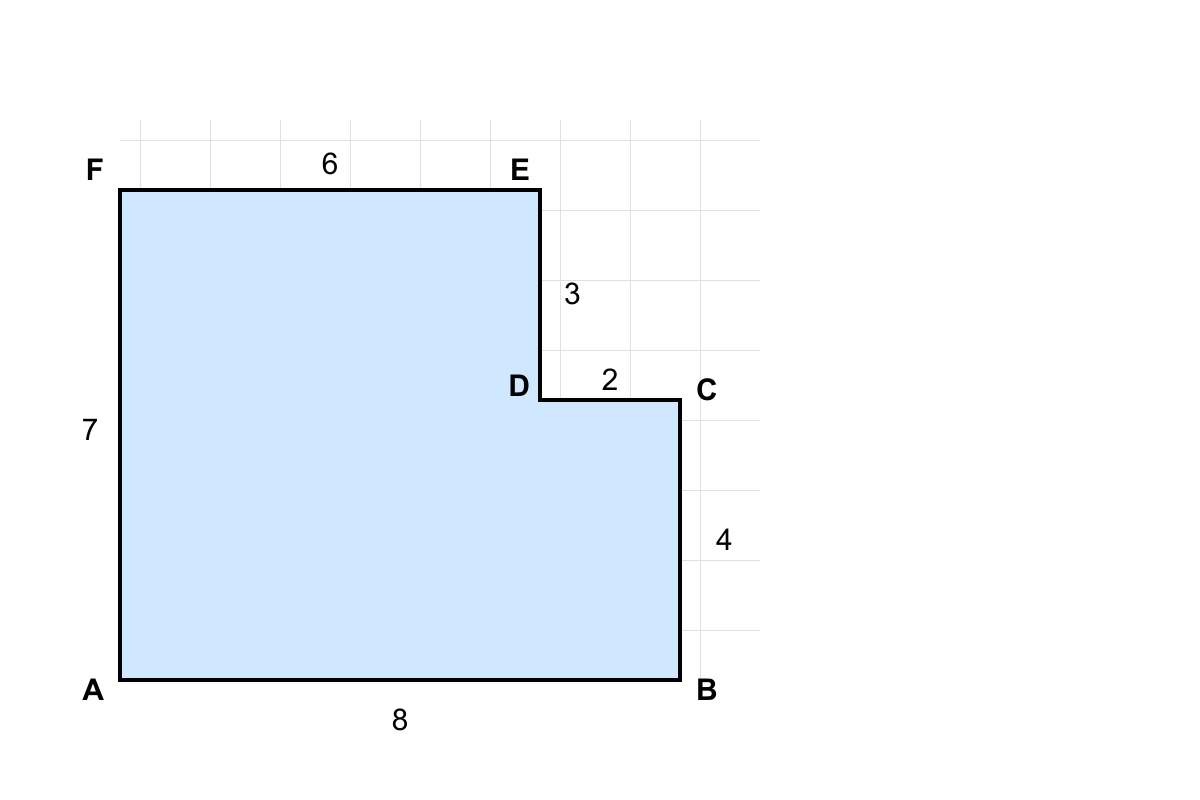
Look at the composite figure. To find its area, Jason decomposes it into simpler shapes. Which decomposition strategy will give him the correct total area?
- Two rectangles: (6×4)+(8×3)=48 square units
- One large rectangle minus one small rectangle: (8×7)−(2×3)=50 square units (correct answer)
- Two rectangles: (6×4)+(2×3)=30 square units
- One trapezoid with parallel sides 6 and 8, height 4: 21(6+8)×4=28 square units
Explanation: The L-shaped figure can be decomposed as a large 8×7 rectangle (56 sq units) minus the missing 2×3 rectangle in the upper right (6 sq units), giving 50 sq units. Choice A incorrectly identifies the dimensions of the right rectangle. Choice C uses wrong dimensions for both rectangles. Choice D incorrectly treats the figure as a trapezoid, which it is not.
Question 2
A table top is shaped like a trapezoid with parallel sides 6 cm and 10 cm and height 4 cm. What is the area of the trapezoid?
- 16 cm2
- 32 cm2 (correct answer)
- 64 cm2
- 24 cm2
Explanation: This question tests finding the area of polygons by composing into rectangles (large minus cutout) or decomposing into triangles/rectangles (sum parts), using A=(1/2)bh for triangles, A=lw for rectangles. Strategies include decomposing by breaking into simpler shapes like a triangle as half a rectangle with A=(1/2)bh, L-shape as two rectangles summing areas, or composing by enclosing in a rectangle and subtracting outside parts, such as a right triangle in a 6×4 rectangle giving (1/2)×24=12. Formulas are rectangle A=lw (length×width), triangle A=(1/2)bh (base×height divided by 2—half of a rectangle); for this trapezoid with bases 6 and 10, height 4, decompose into rectangle 6×4=24 plus triangle base 4, height 4: (1/2)×4×4=8, total 32 cm², or use average base (6+10)/2×4=32. For example, an L-shape: large rectangle 8×6=48 minus cutout 3×2=6 gives 48-6=42, or decompose into 5×6=30 and 3×4=12 summing to 42. A common error is forgetting to average the bases, like (6+10)×4=64 without dividing by 2, or arithmetic like 24+8=30 instead of 32. To decompose, identify simpler shapes, draw lines dividing, calculate each part (rectangle: lw, triangle: (1/2)bh), and sum; for composing, enclose in rectangle, identify cutouts, calculate, and subtract. Triangle key: A=(1/2)bh always; real-world: table top area for covering, mistakes include wrong decomposition or units not squared.
Question 3
Which method correctly finds the area of an L-shaped floor made from a large 8 m×6 m rectangle with a 3 m×2 m corner cut out?
- Subtract: 8⋅6−3⋅2 (correct answer)
- Subtract: 3⋅2−8⋅6
- Add: 8⋅6+3⋅2
- Multiply: (8+3)(6+2)
Explanation: This question tests finding the area of polygons by composing into rectangles (large minus cutout) or decomposing into triangles/rectangles (sum parts), using A=(1/2)bh for triangles, A=lw for rectangles. Strategies include decomposing by breaking into simpler shapes like a triangle as half a rectangle with A=(1/2)bh, L-shape as two rectangles summing areas, or composing by enclosing in a rectangle and subtracting outside parts, such as a right triangle in a 6×4 rectangle giving (1/2)×24=12. Formulas are rectangle A=lw (length×width), triangle A=(1/2)bh (base×height divided by 2—half of a rectangle); example: trapezoid bases 6 and 10, height 4, decompose into rectangle 6×4=24 plus triangle base 4, height 4: (1/2)×4×4=8, total 32. The correct method for this L-shape is composing and subtracting: 8×6 - 3×2, which is 48-6=42 m². A common error is adding instead of subtracting, like 8×6 + 3×2=54, or reversing subtraction like 3×2 - 8×6=-42. To decompose, identify simpler shapes, draw lines, calculate parts, and sum; for composing, enclose in rectangle, identify cutouts, calculate, and subtract. Real-world: floor area for tiling; mistakes include mixing addition/subtraction or arithmetic errors.
Question 4
A school garden is shaped like a right triangle with base 6 m and height 4 m. What is the area of the garden?
- 24 m2
- 12 m2 (correct answer)
- 10 m2
- 28 m2
Explanation: This question tests finding the area of polygons by composing into rectangles (large minus cutout) or decomposing into triangles/rectangles (sum parts), using A=(1/2)bh for triangles, A=lw for rectangles. Strategies include decomposing by breaking into simpler shapes like a triangle as half a rectangle with A=(1/2)bh, or composing by enclosing in a rectangle and subtracting outside parts, such as a right triangle in a 6×4 rectangle giving (1/2)×24=12. Formulas are rectangle A=lw (length×width), triangle A=(1/2)bh (base×height divided by 2—half of a rectangle); for example, a trapezoid with bases 6 and 10, height 4, can be decomposed into a rectangle 6×4=24 plus a triangle with base 4, height 4: (1/2)×4×4=8, total 24+8=32. For this right triangle with base 6 m and height 4 m, you can compose it into a 6×4 rectangle of area 24 and take half, or directly use (1/2)×6×4=12 m². A common error is treating it like a rectangle without dividing by 2, getting 6×4=24 m² instead of 12. To decompose, identify simpler shapes like triangles, draw dividing lines, calculate each part using (1/2)bh, and sum them up; for composing, enclose in a rectangle, identify cutouts, calculate areas, and subtract. Remember, a triangle's area is always (1/2)bh as it's half a rectangle with the same base and height; in real-world uses, like garden areas for planting, mistakes include forgetting the 1/2 for triangles or arithmetic errors like 6×4=26.
Question 5
Which strategy correctly finds the area of an L-shaped floor that fits inside an 11 ft×9 ft rectangle with a 4 ft×3 ft rectangular corner cut out?
- Subtract: (4×3)−(11×9)
- Multiply: 11×9×4×3
- Add: (11×9)+(4×3)
- Subtract: (11×9)−(4×3) (correct answer)
Explanation: This question tests finding the area of polygons by composing into rectangles (large minus cutout) or decomposing into triangles/rectangles (sum parts), using A=(1/2)bh for triangles, A=lw for rectangles. Strategies: decompose (break into simpler shapes: triangle as half rectangle with A=(1/2)bh, L-shape as two rectangles summing areas), compose (enclose in rectangle, subtract outside parts: right triangle in 6×4 rectangle is (1/2)×24=12). Formulas: rectangle A=lw (length×width), triangle A=(1/2)bh (base×height divided by 2—half of rectangle). Example: trapezoid bases 6 and 10, height 4, decompose into rectangle 6×4=24 plus triangle with base 4, height 4: (1/2)×4×4=8, total 24+8=32. Example: right triangle base 6, height 4, fits in rectangle 6×4=24, triangle is half: (1/2)×24=12, or directly (1/2)×6×4=12; or L-shape: large rectangle 8×6=48 minus cutout 3×2=6 gives 48-6=42, or decompose into rectangles 5×6=30 and 3×4=12, sum 30+12=42 (both methods work). The correct strategy is subtracting the cutout from the large rectangle: (11 × 9) - (4 × 3) = 99 - 12 = 87 ft². A common error is adding the cutout instead ((11 × 9) + (4 × 3) = 111 ft²), or subtracting in the wrong order ((4 × 3) - (11 × 9) = -87 ft²), or multiplying all dimensions. Decomposing: (1) identify simpler shapes (can polygon be split into rectangles and triangles?), (2) draw lines dividing (dotted lines showing decomposition), (3) calculate each part (rectangle: lw, triangle: (1/2)bh), (4) sum (total=part₁+part₂+...). Composing: (1) enclose in rectangle (smallest rectangle containing polygon), (2) identify cutouts (triangles or rectangles outside polygon), (3) calculate rectangle and cutouts, (4) subtract (rectangle area minus cutout areas). Triangle key: A=(1/2)bh always (half of rectangle with same base and height). Real-world: room area for flooring (L-shaped room composed/decomposed), garden area for fencing, window area for glass. Mistakes: forgetting (1/2) for triangles, wrong decomposition (incorrect shapes), arithmetic errors, units not squared.
Question 6
A right triangle banner has a base of 6 ft and a height of 4 ft. What is its area?
- 10 ft2
- 24 ft2
- 12 ft2 (correct answer)
- 20 ft2
Explanation: This question tests finding the area of polygons by composing into rectangles (large minus cutout) or decomposing into triangles/rectangles (sum parts), using A=(1/2)bh for triangles, A=lw for rectangles. Strategies: decompose (break into simpler shapes: triangle as half rectangle with A=(1/2)bh, L-shape as two rectangles summing areas), compose (enclose in rectangle, subtract outside parts: right triangle in 6×4 rectangle is (1/2)×24=12). Formulas: rectangle A=lw (length×width), triangle A=(1/2)bh (base×height divided by 2—half of rectangle). Example: trapezoid bases 6 and 10, height 4, decompose into rectangle 6×4=24 plus triangle with base 4, height 4: (1/2)×4×4=8, total 24+8=32. Example: right triangle base 6, height 4, fits in rectangle 6×4=24, triangle is half: (1/2)×24=12, or directly (1/2)×6×4=12; or L-shape: large rectangle 8×6=48 minus cutout 3×2=6 gives 48-6=42, or decompose into rectangles 5×6=30 and 3×4=12, sum 30+12=42 (both methods work). The correct area is found using the triangle formula: (1/2) × 6 ft × 4 ft = 12 ft², or by composing into a 6 ft × 4 ft rectangle (24 ft²) and taking half. A common error is forgetting the 1/2 and calculating as a rectangle (6 × 4 = 24 ft²), or mixing up base and height, or arithmetic like (1/2) × 6 × 4 = 24 instead of 12. Decomposing: (1) identify simpler shapes (can polygon be split into rectangles and triangles?), (2) draw lines dividing (dotted lines showing decomposition), (3) calculate each part (rectangle: lw, triangle: (1/2)bh), (4) sum (total=part₁+part₂+...). Composing: (1) enclose in rectangle (smallest rectangle containing polygon), (2) identify cutouts (triangles or rectangles outside polygon), (3) calculate rectangle and cutouts, (4) subtract (rectangle area minus cutout areas). Triangle key: A=(1/2)bh always (half of rectangle with same base and height). Real-world: room area for flooring (L-shaped room composed/decomposed), garden area for fencing, window area for glass. Mistakes: forgetting (1/2) for triangles, wrong decomposition (incorrect shapes), arithmetic errors, units not squared.
Question 7
An irregular patio can be decomposed into two rectangles that do not overlap: Rectangle 1 is 5 m×6 m and Rectangle 2 is 3 m×4 m. What is the total area of the patio?
- 34 m2
- 42 m2 (correct answer)
- 46 m2
- 54 m2
Explanation: This question tests finding the area of polygons by composing into rectangles (large minus cutout) or decomposing into triangles/rectangles (sum parts), using A=(1/2)bh for triangles, A=lw for rectangles. Strategies include decomposing by breaking into simpler shapes like a triangle as half a rectangle with A=(1/2)bh, L-shape as two rectangles summing areas, or composing by enclosing in a rectangle and subtracting outside parts, such as a right triangle in a 6×4 rectangle giving (1/2)×24=12. Formulas are rectangle A=lw (length×width), triangle A=(1/2)bh (base×height divided by 2—half of a rectangle); example: trapezoid bases 6 and 10, height 4, decompose into rectangle 6×4=24 plus triangle base 4, height 4: (1/2)×4×4=8, total 32. For this patio, decompose into two rectangles: 5×6=30 m² and 3×4=12 m², summing to 42 m². A common error is adding wrong, like 30+12=40, or treating as one shape without decomposing. To decompose, identify simpler shapes like rectangles and triangles, draw dividing lines, calculate each (rectangle: lw, triangle: (1/2)bh), and sum; for composing, enclose in rectangle, identify cutouts, calculate, and subtract. Real-world: patio area for paving; mistakes include arithmetic errors or forgetting non-overlapping parts.
Question 8
A triangular pennant is a right triangle with base 6 cm and height 4 cm. What is its area? (Use A=21bh.)
- 12 cm2 (correct answer)
- 10 cm2
- 20 cm2
- 24 cm2
Explanation: This question tests finding the area of a right triangle by using A = (1/2)bh, composing it as half of a rectangle. Strategies include directly applying the formula for the triangle with base 6 cm and height 4 cm, or composing a 6×4 rectangle of 24 cm² and taking half for 12 cm². Formulas: triangle A = (1/2)bh, which is half of a rectangle's A = lw with same base and height; example, trapezoid bases 6 and 10, height 4, decomposes to rectangle 24 plus triangle 8 for 32. For example, this right triangle base 6, height 4 is (1/2)×6×4=12, or half of 24=12; an L-shape might be 48 minus 6=42 by composition. The correct area is (1/2)×6×4 = 12 cm² using the formula. A common error is forgetting the 1/2, calculating bh=24 instead of 12, or mixing with rectangle formula. For triangles: always use (1/2)bh; real-world like pennant fabric area. Steps: identify base and height, multiply and halve; mistakes include arithmetic errors or unsquared units.
Question 9
A trapezoid-shaped window has parallel sides 6 in and 10 in and height 4 in. A student computes (6+10)⋅4=64 in2. What is the correct area?
- 32 in2 (correct answer)
- 40 in2
- 16 in2
- 64 in2
Explanation: This question tests finding the area of polygons by composing into rectangles (large minus cutout) or decomposing into triangles/rectangles (sum parts), using A=(1/2)bh for triangles, A=lw for rectangles. Strategies include decomposing by breaking into simpler shapes like a triangle as half a rectangle with A=(1/2)bh, L-shape as two rectangles summing areas, or composing by enclosing in a rectangle and subtracting outside parts, such as a right triangle in a 6×4 rectangle giving (1/2)×24=12. Formulas are rectangle A=lw (length×width), triangle A=(1/2)bh (base×height divided by 2—half of a rectangle); example: trapezoid bases 6 and 10, height 4, decompose into rectangle 6×4=24 plus triangle base 4, height 4: (1/2)×4×4=8, total 32 in². The student computed (6+10)×4=64, but the correct area is (6+10)/2 ×4=32 in², forgetting to divide by 2 for the average base. A common error is halving wrong, like (6+10)×(4/2)=32 but misplaced, or arithmetic like (16/2)×4=30. To decompose, identify simpler shapes, draw lines, calculate parts, and sum; for composing, enclose in rectangle, identify cutouts, and subtract. Real-world: window area for glass; mistakes include forgetting to average bases or units not squared.
Question 10
A tabletop is shaped like a trapezoid. The parallel sides are 6 ft and 10 ft, and the height is 4 ft. What is the area of the tabletop? (You may use A=21(b1+b2)h.)
- 64 ft2
- 32 ft2 (correct answer)
- 16 ft2
- 40 ft2
Explanation: This question tests finding the area of a trapezoid using A = (1/2)(b1 + b2)h, which relates to decomposing into a rectangle and triangles. Strategies include using the formula directly for bases 6 ft and 10 ft, height 4 ft, giving (1/2)×16×4=32 ft², or decomposing into a rectangle and triangle. Formulas: trapezoid as average bases times height, rectangle A=lw, triangle (1/2)bh; example, this trapezoid decomposes to 6×4=24 plus (1/2)×4×4=8 for 32. Like a right triangle in 6×4=24, half is 12; or L-shape 48-6=42. The correct area is (1/2)(6+10)×4 = 32 ft² using the formula. Errors include not halving, getting 16×4=64, or adding bases wrong like 6+10=18. Decomposing: (1) split into rectangle and triangle, (2) calculate each, (3) sum; real-world for tabletops like painting area. Mistakes: forgetting 1/2 in formula, arithmetic like 8×4=36 instead of 32, squared units.
Question 11
A storage mat is an irregular shape that can be found by composing a large rectangle and subtracting a triangular cutout.
- The large rectangle is 12 ft by 7 ft.
- A right-triangular cutout has base 6 ft and height 3 ft.
What is the area of the mat?
- 66 ft2
- 93 ft2
- 84 ft2
- 75 ft2 (correct answer)
Explanation: This question tests finding the area of an irregular mat by composing a large rectangle and subtracting a triangular cutout, using A = lw minus (1/2)bh. Strategies: large 12 ft × 7 ft = 84 ft², cutout (1/2)×6×3=9 ft², area 84-9=75 ft². Formulas: rectangle A = lw, triangle (1/2)bh; example, trapezoid 24 + 8 = 32. Like L-shape 48-6=42, triangle 12. The correct area is 84 - 9 = 75 ft² using composition. Errors include full triangle 18, 84-18=66, or no subtract 84. Composing: (1) enclose, (2) identify cutout, (3) calculate, (4) subtract; real-world for mats like cleaning area. Mistakes: forgetting 1/2, arithmetic like 84-9=74, unsquared units.
Question 12
A stage platform is an L-shape that can be decomposed into two rectangles:
- Rectangle 1: 5 m×6 m
- Rectangle 2: 3 m×4 m
What is the total area of the platform?
- 42 m2 (correct answer)
- 12 m2
- 30 m2
- 48 m2
Explanation: This question tests finding the area of an L-shaped platform by decomposing into two rectangles and summing, using A = lw for each. Strategies: decompose into 5 m × 6 m = 30 m² and 3 m × 4 m = 12 m², total 42 m², or compose and subtract. Formulas: rectangle A = lw; triangle (1/2)bh; example, trapezoid 24 + 8 = 32. Like L-shape compose 48 - 6 = 42, or triangle half of 24 = 12. The correct area is 30 + 12 = 42 m² using decomposition. Errors include only one rectangle like 30, or multiplying wrong like 5×6=35. Decomposing: (1) identify rectangles, (2) calculate each, (3) sum; composing: enclose and subtract. Real-world for stages like carpeting; mistakes: overlap addition, arithmetic, unsquared units.
Question 13
A student says the area of a right triangle with base 6 cm and height 4 cm is 24 cm2 because 6×4=24. Which statement best checks the student's answer?
- The student is correct because A=bh for triangles.
- The student forgot to square the units; the area should be 24 cm.
- The student should add the base and height; the area is 6+4=10 cm2.
- The student should divide by 2; the area is 21⋅6⋅4=12 cm2. (correct answer)
Explanation: This question tests finding the area of polygons by composing into rectangles (large minus cutout) or decomposing into triangles/rectangles (sum parts), using A=(1/2)bh for triangles, A=lw for rectangles. Strategies include decomposing by breaking into simpler shapes like a triangle as half a rectangle with A=(1/2)bh, L-shape as two rectangles summing areas, or composing by enclosing in a rectangle and subtracting outside parts, such as a right triangle in a 6×4 rectangle giving (1/2)×24=12. Formulas are rectangle A=lw (length×width), triangle A=(1/2)bh (base×height divided by 2—half of a rectangle); example: trapezoid bases 6 and 10, height 4, decompose into rectangle 6×4=24 plus triangle base 4, height 4: (1/2)×4×4=8, total 32. The best check is that the student should divide by 2: (1/2)×6×4=12 cm², as they used the rectangle formula bh=24 instead of triangle (1/2)bh. A common error is thinking addition like 6+4=10, or forgetting units squared. To decompose, identify simpler shapes, draw lines, calculate parts like (1/2)bh for triangles, and sum; for composing, enclose in rectangle, identify cutouts, and subtract. Triangle key: A=(1/2)bh always; real-world: area checks for shapes, mistakes include using wrong formulas or not dividing by 2.
Question 14
A banner is a triangle with base 14 in and height 6 in. A student says the area is 84 in2.
Is the student correct?
- No, because A=21bh=21×14×6=42 in2. (correct answer)
- Yes, because A=21bh=21×14×6=84 in2.
- Yes, because A=bh=14×6=84 in2.
- No, because A=bh=14+6=20 in2.
Explanation: This question tests verifying the area of a triangle using A = (1/2)bh, checking if the student's 84 in² is correct for base 14 in, height 6 in. Strategies: apply formula (1/2)×14×6=42 in², so student is wrong by not halving. Formulas: triangle (1/2)bh, half of rectangle bh; example, trapezoid 24 + 8 = 32. Like triangle (1/2)×6×4=12, not 24; L-shape correct 42. The student is incorrect because the area is 42 in², not 84. Errors include using bh=84 without 1/2, or adding like 14+6=20. For triangles: identify base/height, halve product; real-world for banners like material. Mistakes: forgetting 1/2, using perimeter, arithmetic, no units.
Question 15
A playground area is a pentagon that can be decomposed into a rectangle and a triangle. The rectangle is 8 yd×5 yd, and attached to one side is a triangle with base 8 yd and height 3 yd. What is the total area of the playground?
- 28 yd2
- 64 yd2
- 40 yd2
- 52 yd2 (correct answer)
Explanation: This question tests finding the area of polygons by composing into rectangles (large minus cutout) or decomposing into triangles/rectangles (sum parts), using A=(1/2)bh for triangles, A=lw for rectangles. Strategies include decomposing by breaking into simpler shapes like a triangle as half a rectangle with A=(1/2)bh, L-shape as two rectangles summing areas, or composing by enclosing in a rectangle and subtracting outside parts, such as a right triangle in a 6×4 rectangle giving (1/2)×24=12. Formulas are rectangle A=lw (length×width), triangle A=(1/2)bh (base×height divided by 2—half of a rectangle); example: trapezoid bases 6 and 10, height 4, decompose into rectangle 6×4=24 plus triangle base 4, height 4: (1/2)×4×4=8, total 32. For this pentagon, decompose into rectangle 8×5=40 yd² and triangle (1/2)×8×3=12 yd², summing to 52 yd². A common error is using rectangle formula for the triangle, like 8×3=24 giving total 64, or arithmetic like 40+12=50. To decompose, identify simpler shapes like rectangles and triangles, draw dividing lines, calculate each part, and sum; for composing, enclose in rectangle, identify cutouts, and subtract. Real-world: playground area for surfacing; mistakes include forgetting 1/2 for triangles or wrong decomposition.
Question 16
The figure shows a hexagon that can be divided into rectangles and triangles. Sarah calculates the area by decomposing it into two rectangles and two triangles. If her rectangles have areas of 35 and 42 square centimeters, and her triangles have areas of 15 and 18 square centimeters, what is the total area of the hexagon?
- 95 square centimeters
- 110 square centimeters (correct answer)
- 125 square centimeters
- 140 square centimeters
Explanation: To find the total area, add all the component areas: 35 + 42 + 15 + 18 = 110 square centimeters. Choice A omits one triangle (110 - 15 = 95). Choice C adds an extra 15 (possibly double-counting one triangle). Choice D appears to use incorrect component areas or double-counts multiple shapes.
Question 17
Maya is designing a garden bed in the shape shown in the figure. She wants to plant flowers in the triangular sections and vegetables in the rectangular sections. What is the total area available for planting vegetables?
- 84 square feet (correct answer)
- 96 square feet
- 108 square feet
- 120 square feet
Explanation: The figure can be decomposed into a large rectangle (12 × 10 = 120 sq ft) minus two triangles. The triangles each have base 6 ft and height 6 ft, so each triangle has area ½ × 6 × 6 = 18 sq ft. Total triangular area = 36 sq ft. Rectangular area for vegetables = 120 - 36 = 84 sq ft. Choice B incorrectly calculates one triangle as 24 sq ft. Choice C uses the wrong base measurement. Choice D fails to subtract the triangular areas.
Question 18
A stage backdrop is shaped like a rectangle with a triangular piece cut out. The full rectangle is 10 ft×6 ft. The cut-out is a right triangle with base 4 ft and height 3 ft. What is the area of the remaining backdrop?
- 54 ft2 (correct answer)
- 48 ft2
- 66 ft2
- 60 ft2
Explanation: This question tests finding the area of polygons by composing into rectangles (large minus cutout) or decomposing into triangles/rectangles (sum parts), using A=(1/2)bh for triangles, A=lw for rectangles. Strategies include decomposing by breaking into simpler shapes like a triangle as half a rectangle with A=(1/2)bh, L-shape as two rectangles summing areas, or composing by enclosing in a rectangle and subtracting outside parts, such as a right triangle in a 6×4 rectangle giving (1/2)×24=12. Formulas are rectangle A=lw (length×width), triangle A=(1/2)bh (base×height divided by 2—half of a rectangle); example: trapezoid bases 6 and 10, height 4, decompose into rectangle 6×4=24 plus triangle base 4, height 4: (1/2)×4×4=8, total 32. For this backdrop, compose the 10×6 rectangle of 60 ft² minus the triangle (1/2)×4×3=6 ft², giving 54 ft². A common error is adding the cutout instead of subtracting, like 60+6=66, or forgetting 1/2 for the triangle getting 60-12=48. To decompose, identify simpler shapes, draw lines, calculate parts, and sum; for composing, enclose in rectangle, identify cutouts like triangles, calculate, and subtract. Triangle key: A=(1/2)bh always; real-world: backdrop area for painting, mistakes include arithmetic errors or wrong formulas.
Question 19
A craftsman is making a decorative wooden piece by combining shapes. He starts with a square measuring 16 cm on each side, then adds four identical right triangles to the outside of each edge. Each triangle has legs of 8 cm and 6 cm. What is the total area of the completed decorative piece?
- 256 square centimeters
- 352 square centimeters (correct answer)
- 448 square centimeters
- 512 square centimeters
Explanation: Square area: 16² = 256 sq cm. Each triangle area: ½ × 8 × 6 = 24 sq cm. Four triangles: 4 × 24 = 96 sq cm. Total area: 256 + 96 = 352 sq cm. Choice A only includes the square. Choice C incorrectly calculates each triangle as 48 sq cm (using 8 × 6 instead of ½ × 8 × 6). Choice D doubles the square area.
Question 20
A pentagon-shaped sign can be decomposed into a rectangle and a triangle that sit on top of it.
- The rectangle is 8 ft wide and 5 ft tall.
- The triangle on top has the same base as the rectangle (8 ft) and a height of 3 ft.
What is the area of the pentagon?
- 28 ft2
- 40 ft2
- 52 ft2 (correct answer)
- 64 ft2
Explanation: This question tests finding the area of polygons by composing into rectangles (large minus cutout) or decomposing into triangles/rectangles (sum parts), using A=(1/2)bh for triangles, A=lw for rectangles. Strategies: decompose (break into simpler shapes: triangle as half rectangle with A=(1/2)bh, L-shape as two rectangles summing areas), compose (enclose in rectangle, subtract outside parts: right triangle in 6×4 rectangle is (1/2)×24=12). Formulas: rectangle A=lw (length×width), triangle A=(1/2)bh (base×height divided by 2—half of rectangle). Example: trapezoid bases 6 and 10, height 4, decompose into rectangle 6×4=24 plus triangle with base 4, height 4: (1/2)×4×4=8, total 24+8=32. Example: right triangle base 6, height 4, fits in rectangle 6×4=24, triangle is half: (1/2)×24=12, or directly (1/2)×6×4=12; or L-shape: large rectangle 8×6=48 minus cutout 3×2=6 gives 48-6=42, or decompose into rectangles 5×6=30 and 3×4=12, sum 30+12=42 (both methods work). The correct area is found by decomposing: rectangle 8 ft × 5 ft = 40 ft² plus triangle (1/2) × 8 ft × 3 ft = 12 ft², total 52 ft². A common error is forgetting the 1/2 for the triangle (40 + 24 = 64 ft²), or using rectangle height for triangle base, or arithmetic like 40 + 12 = 54. Decomposing: (1) identify simpler shapes (can polygon be split into rectangles and triangles?), (2) draw lines dividing (dotted lines showing decomposition), (3) calculate each part (rectangle: lw, triangle: (1/2)bh), (4) sum (total=part₁+part₂+...). Composing: (1) enclose in rectangle (smallest rectangle containing polygon), (2) identify cutouts (triangles or rectangles outside polygon), (3) calculate rectangle and cutouts, (4) subtract (rectangle area minus cutout areas). Triangle key: A=(1/2)bh always (half of rectangle with same base and height). Real-world: room area for flooring (L-shaped room composed/decomposed), garden area for fencing, window area for glass. Mistakes: forgetting (1/2) for triangles, wrong decomposition (incorrect shapes), arithmetic errors, units not squared.