All questions
Question 1
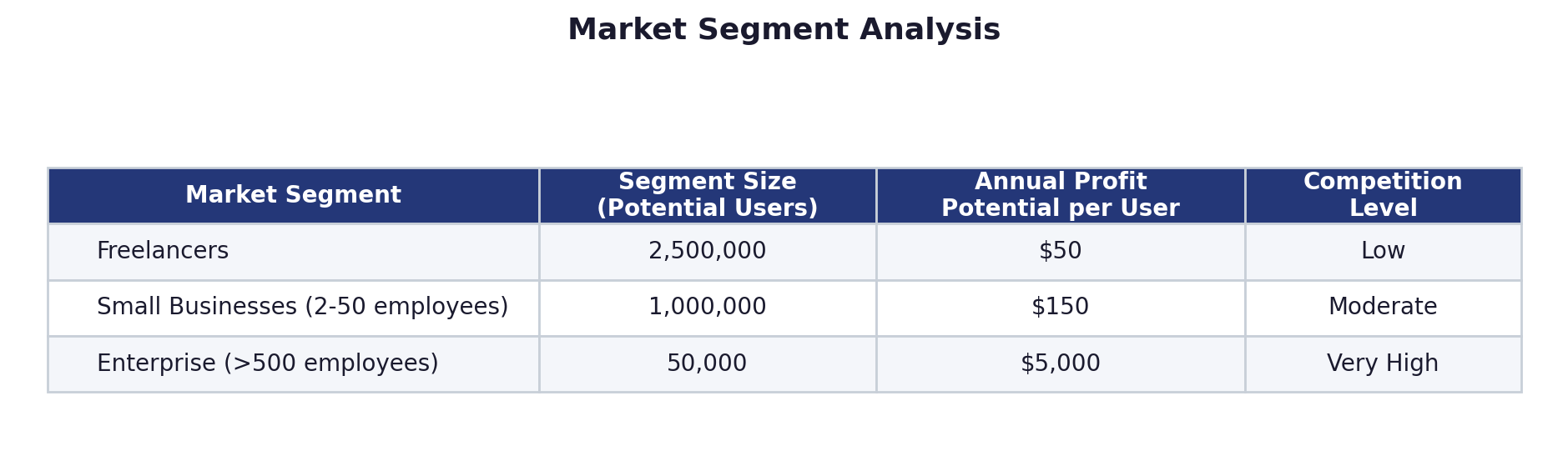
A consulting firm analyzed the market for project management software and identified three potential segments. The firm presented the following data to its client, a software developer.
Based on the market analysis in the table provided, a new company with limited venture capital funding would most logically adopt which targeting strategy?
- Mass marketing, by developing a single product that combines features from all three segments to maximize reach.
- Differentiated marketing, by creating and marketing separate products for Freelancers and Small Businesses.
- Concentrated marketing, by focusing exclusively on the Small Business segment due to its high profit potential and moderate competition. (correct answer)
- Niche marketing, by targeting only the Enterprise segment because it has the highest per-customer value.
Explanation: The correct answer is C. A new company with limited funding needs to be strategic. The Small Business segment offers the best combination of factors: a large size (1,000,000 potential users), high profit potential per user ($150), and moderate competition. Focusing all resources here (a concentrated strategy) provides the best chance of success. A is incorrect because a single product would likely fail to meet the distinct needs of any segment well. B is incorrect because developing two separate products (differentiated strategy) would likely be too costly for a company with limited funding. D is incorrect because while the per-customer value is high, the competition in the Enterprise segment is 'Very High' and the market size is small, making it a very risky choice for a new entrant.
Question 2
A firm is considering a shift from a mass marketing to a differentiated marketing strategy for its line of personal care products. Which of the following represents the most significant strategic trade-off the firm must evaluate?
- A decrease in overall market share in exchange for higher prices in certain segments.
- A potential increase in total sales volume in exchange for higher operational costs. (correct answer)
- A reduction in brand loyalty in exchange for reaching a wider customer base.
- A simplification of the supply chain in exchange for more complex advertising campaigns.
Explanation: The correct answer is B. The primary goal of a differentiated strategy is to achieve a stronger position and higher sales within several segments, leading to a potential increase in total sales compared to a mass-market approach. However, this comes at the cost of increased expenses for product development, manufacturing, and marketing for each segment. This trade-off between higher potential revenue and higher costs is the core strategic consideration. A is incorrect; the goal is to increase, not decrease, overall market share. C is incorrect; a differentiated strategy aims to increase brand loyalty within each target segment. D is incorrect; this strategy complicates, rather than simplifies, the supply chain.
Question 3
A beverage company historically sold a single, flagship energy drink advertised to the entire market. Recently, it launched three new product lines: a zero-sugar version for health-conscious adults, a vitamin-fortified version for students, and a high-caffeine 'extreme' version for gamers. Each line has its own branding and promotional campaigns. This shift in strategy is best described as moving from:
- concentrated to differentiated marketing.
- mass to differentiated marketing. (correct answer)
- differentiated to niche marketing.
- mass to concentrated marketing.
Explanation: The correct answer is B. The company's original strategy of selling one product to the entire market is mass (or undifferentiated) marketing. By creating distinct products and marketing campaigns for separate segments (health-conscious adults, students, gamers), the company is now employing a differentiated (or segmented) marketing strategy. A is incorrect because the original strategy was mass, not concentrated, as it targeted the whole market. C is incorrect as the company is expanding to cover more segments, not narrowing its focus to a single niche. D is incorrect because the company is targeting multiple segments, not focusing on a large share of a single segment.
Question 4
A company's mission statement says, "We aim to serve every computer user in the world." However, its product portfolio consists of a high-end gaming laptop brand, a budget-friendly Chromebook brand, and a professional-grade workstation brand, each with its own marketing team. The company's actual targeting strategy is:
- mass marketing, as stated in its mission.
- concentrated, as it only focuses on the computer market.
- niche, because gaming laptops are a small market segment.
- differentiated, based on its portfolio and marketing actions. (correct answer)
Explanation: The correct answer is D. A company's true strategy is revealed by its actions, not its mission statement. By creating distinct products with distinct brands and marketing efforts for different segments (gamers, budget users, professionals), the company is practicing differentiated marketing. A is incorrect because the actions contradict the broad mission statement. B is incorrect because the company is not focusing on a single segment within the computer market, but several. C is incorrect because it describes only one part of the company's portfolio, not its overall strategy.
Question 5
A software company markets two distinct products: 'FinancePro' for certified public accountants and 'LegalEase' for attorneys. Each product has unique features tailored to the profession, is promoted in industry-specific journals, and has a separate sales team. Which statement most accurately describes the company's approach?
- It is using a concentrated strategy by focusing solely on professional service firms.
- It is using a differentiated strategy by developing distinct offerings for separate market segments. (correct answer)
- It is using a mass marketing strategy since both products are types of business software.
- It is using a niche strategy by targeting two very small, specialized markets.
Explanation: The correct answer is B. The company is targeting two separate and distinct market segments (accountants and attorneys) with products and marketing mixes specifically designed for each. This is the definition of differentiated marketing. A is incorrect because while the overall market is 'professional services,' the company is not treating it as a single segment; it is serving multiple segments within that market. C is incorrect because the products and marketing are highly tailored, not generic. D is plausible, but 'differentiated' is a more accurate description of the overall strategy of targeting multiple segments, even if each segment could be considered a niche.
Question 6
When a firm with limited resources successfully implements a concentrated marketing strategy, it can achieve a strong market position within its target segment. What is the most likely reason for this success?
- It achieves lower production costs per unit than its diversified competitors.
- It gains a deeper understanding of the segment's needs and builds specialized expertise. (correct answer)
- It can easily pivot to target other segments if the initial one becomes unprofitable.
- Its marketing messages appeal to a broad range of consumers outside the target segment.
Explanation: The correct answer is B. The power of a concentrated strategy lies in specialization. By focusing all of its efforts on a single segment, the firm can gain intimate knowledge of its customers' needs, preferences, and behaviors. This allows it to fine-tune its products, services, and messaging more effectively than diversified competitors who must divide their attention. A is not necessarily true; economies of scale might still favor larger, diversified firms. C is the opposite of the truth; a concentrated strategy makes pivoting difficult due to specialized assets and reputation. D is contrary to the goal, which is to create a highly targeted appeal, not a broad one.
Question 7
A large consumer goods company sells dozens of brands across various categories like laundry detergent, toothpaste, and soap. Within the laundry detergent category alone, it offers separate brands targeting families (stain removal), individuals (scent), and environmentally-conscious consumers (plant-based). This strategy within a single product category is best described as:
- mass marketing, because laundry detergent is a household staple.
- concentrated marketing, because the company is focusing on the laundry category.
- niche marketing, because plant-based detergents appeal to a small group.
- differentiated marketing, by creating specific value propositions for distinct user segments. (correct answer)
Explanation: When you encounter questions about marketing strategies, focus on how companies divide and target their markets. The key is identifying whether they're treating everyone the same, focusing on one segment, or creating different approaches for multiple segments.
This scenario describes a company creating distinct brands within laundry detergent, each designed for specific customer groups with unique needs: families want stain removal, individuals prioritize scent, and eco-conscious consumers seek plant-based options. This is differentiated marketing—developing separate marketing mixes for different market segments within the same product category. The company recognizes that different consumer groups have different priorities and creates targeted value propositions for each.
Let's examine why the other options miss the mark. Choice A suggests mass marketing, but that would mean treating all laundry detergent customers identically with one product and message—the opposite of what's happening here. Choice B identifies concentrated marketing, which occurs when a company focuses all efforts on one specific segment; however, this company is targeting multiple segments simultaneously. Choice C calls this niche marketing, but while the plant-based detergent might serve a niche, the strategy encompasses three different segments, not just the small eco-conscious group.
Remember this pattern: differentiated marketing involves multiple segments with tailored approaches, concentrated marketing targets just one segment, and mass marketing treats everyone the same. When you see companies creating different products or messages for distinct customer groups within the same category, think differentiated marketing.
Question 8
A luxury watchmaker produces only a few hundred timepieces a year, with prices starting at $50,000. The company relies on word-of-mouth among the ultra-wealthy and events at exclusive yacht clubs and private jet shows for promotion. This approach is best defined as:
- concentrated marketing because it targets a single segment of high-income individuals.
- differentiated marketing because each watch model is slightly different.
- mass marketing due to the global appeal and recognition of the luxury brand.
- niche marketing due to the hyper-focused targeting of a small, specific, and affluent customer base. (correct answer)
Explanation: The correct answer is D. This is a classic example of niche marketing. The target market is not just 'wealthy' (which would be concentrated) but a very small, specific sub-segment of the 'ultra-wealthy' with particular interests. The product, price, and promotion are all tailored to this hyper-focused group. A is plausible, but 'niche' is more precise due to the extreme specificity and small size of the target group. B is incorrect because product variation within a single segment does not define a differentiated strategy, which requires targeting multiple distinct segments. C is incorrect as the approach is highly exclusive, not aimed at the masses.
Question 9
A company launched a new, technologically complex smart home device. The initial marketing campaign consisted of a single, humorous ad run during the Super Bowl. Sales were extremely poor. The most likely reason for this failure is a mismatch between:
- a differentiated product and a mass marketing promotional tactic.
- a niche product and a mass marketing promotional tactic. (correct answer)
- a mass-market product and a concentrated promotional tactic.
- a concentrated product and a differentiated promotional tactic.
Explanation: The correct answer is B. A technologically complex, new smart home device is likely to appeal to a specific segment of early adopters and tech enthusiasts, making it a niche product. Using a Super Bowl ad—a classic mass marketing tactic—is an inefficient and ineffective way to reach this specialized audience. The broad audience lacks the technical interest and knowledge to appreciate the product's benefits from a single, generic ad. This illustrates a fundamental mismatch between the product/target market and the promotional strategy. A is less accurate; while the product is differentiated from others, its target audience is best described as a niche. C and D describe mismatches that are the reverse of what happened.
Question 10
A startup has developed a highly advanced, expensive prosthetic limb for competitive para-athletes. The company has limited funding and a small sales team. Given these circumstances, which targeting strategy would be most effective for the company's initial market entry?
- Differentiated marketing, to create variations for different athletic disciplines.
- Mass marketing, to build broad brand awareness as quickly as possible.
- Concentrated marketing, to focus all resources on this specific, high-potential segment. (correct answer)
- Undifferentiated marketing, to appeal to the common needs of all prosthetic users.
Explanation: The correct answer is C. The product is highly specialized for a small, specific group (competitive para-athletes), and the company has limited resources. This situation is ideal for a concentrated (or niche) marketing strategy, which allows the firm to focus its efforts, build expertise, and gain a strong market position within that single segment. A is incorrect because creating multiple product variations would be too costly for a startup with limited funding. B and D are incorrect because mass/undifferentiated marketing is inappropriate for a specialized, expensive product and would waste the company's limited resources by trying to reach a broad, irrelevant audience.
Question 11
A large automotive corporation produces a wide range of vehicles, including economy sedans, luxury SUVs, family minivans, and high-performance sports cars. Each category is marketed under a different brand name with a unique value proposition. The primary risk associated with this differentiated targeting strategy is:
- increased vulnerability to a single economic downturn affecting the entire market.
- failure to build brand loyalty due to a lack of focus on any single consumer group.
- significant increases in production, inventory, and marketing costs across the portfolio. (correct answer)
- the potential for a larger competitor to enter one of the company's smaller segments.
Explanation: The correct answer is C. Differentiated marketing, by its nature, involves developing, producing, and marketing multiple products for multiple segments. This leads to higher costs compared to a mass-market approach. These costs include separate R&D, manufacturing processes, advertising campaigns, and channel management for each product line. A is incorrect; a differentiated strategy can actually reduce this risk by diversifying across segments that may be affected differently by economic changes. B is incorrect because this strategy is designed to build strong brand loyalty within each target segment. D describes a primary risk of a concentrated/niche strategy, not a differentiated one.
Question 12
A bicycle manufacturer produces road bikes, mountain bikes, and children's bikes. If this company decided to abandon the mountain and children's bike lines to focus all its resources on becoming the world leader in high-performance road bikes for competitive cyclists, it would be switching from a to a strategy.
- differentiated; concentrated (correct answer)
- concentrated; mass
- mass; differentiated
- differentiated; niche
Explanation: The correct answer is A. Initially, by producing distinct bikes for different segments (road cyclists, mountain bikers, children), the company was using a differentiated strategy. By choosing to focus all its efforts on a single segment (high-performance road bikes for competitive cyclists), it is switching to a concentrated strategy. D is also plausible as 'competitive cyclists' could be considered a niche, but 'concentrated' is the broader and more accurate term for focusing on a single segment, making it the better answer in this context of a major strategic shift.
Question 13
A firm that produces artisanal, vegan cheese targets a small but growing segment of consumers who are both vegan and have lactose intolerance. A major national dairy corporation, seeing the growth in this market, launches its own line of vegan cheese, supported by a massive advertising budget and extensive distribution network. This scenario highlights the most significant danger of which targeting strategy?
- Mass marketing
- Differentiated marketing
- Niche marketing (correct answer)
- Local marketing
Explanation: The correct answer is C. The artisanal firm is using a niche strategy, focusing on a very specific, small segment. The greatest risk of this strategy is that its success can attract larger, better-resourced competitors who can use their scale to overwhelm the niche player. The scenario describes this exact situation. A is incorrect as the firm is not using a mass marketing approach. B is incorrect because the firm is targeting a single segment, not multiple ones. D is a form of micromarketing, but niche marketing is the more accurate term for targeting a specific consumer interest group regardless of location.
Question 14
A company sells a basic, unbranded commodity like rock salt for de-icing roads. The product has minimal variation, and customers primarily make decisions based on price and availability. The company sells to both individual homeowners and large municipalities. Which targeting strategy is most appropriate and efficient for this product?
- Differentiated marketing, with separate brands for consumer and government segments.
- Concentrated marketing, focusing only on the more profitable municipal contracts.
- Mass marketing, offering one standard product through wide distribution channels. (correct answer)
- Niche marketing, targeting homeowners in specific high-snowfall zip codes.
Explanation: The correct answer is C. Mass (undifferentiated) marketing is most suitable when a product has broad appeal, little differentiation, and consumer needs are largely homogenous. Rock salt fits this description perfectly. The company can achieve economies of scale in production and marketing by offering a single product to the entire market. A would add unnecessary costs for a product where branding is not a key purchase driver. B ignores a significant portion of the market (homeowners). D is too narrow and inefficient for a commodity product.
Question 15
A local bookstore has thrived by focusing exclusively on selling rare and first-edition books to serious collectors. The owner knows most customers by name and offers personalized search services. This business model is an example of a successful strategy.
- mass marketing
- undifferentiated
- concentrated (correct answer)
- differentiated
Explanation: The correct answer is C. The bookstore is targeting a large share of a specific, smaller market segment (serious collectors of rare books). This is the definition of a concentrated strategy. It allows the small business to compete effectively by becoming a specialist. A and B are incorrect as the store is clearly not targeting the entire book-buying market. D is incorrect because the store is focusing its efforts on a single segment, not developing separate offerings for multiple segments (e.g., collectors, students, casual readers).
Question 16
A national hotel chain operates three distinct brands: 'Summit Suites' for business travelers, 'Family Stays' for vacationing families, and 'Metro Hostels' for young budget travelers. Which factor is most essential for the success of this hotel chain's chosen targeting strategy?
- The segments must be substantial enough in size and purchasing power to be profitable. (correct answer)
- The overall market for travel accommodation must be homogenous in its needs.
- The company must achieve significant economies of scale in its marketing communications.
- Each hotel brand must appeal broadly to all types of travelers to maximize occupancy.
Explanation: The correct answer is A. The hotel chain is using a differentiated strategy. A key requirement for any segmentation and targeting approach, but especially for a costly differentiated one, is that the identified segments must be substantial—large or profitable enough to be worth targeting with a separate marketing mix. If the segments were too small, the cost of creating and marketing separate brands would outweigh the benefits. B is the opposite of the condition needed for this strategy; it relies on market heterogeneity. C is unlikely because differentiated marketing often reduces economies of scale in promotion. D contradicts the core principle of the strategy, which is to tailor offerings to specific segments, not appeal to everyone.
Question 17
A beverage company historically sold a single, flagship energy drink advertised to the entire market. Recently, it launched three new product lines: a zero-sugar version for health-conscious adults, a vitamin-fortified version for students, and a high-caffeine 'extreme' version for gamers. Each line has its own branding and promotional campaigns. This shift in strategy is best described as moving from:
- concentrated to differentiated marketing.
- mass to differentiated marketing. (correct answer)
- differentiated to niche marketing.
- mass to concentrated marketing.
Explanation: The correct answer is B. The company's original strategy of selling one product to the entire market is mass (or undifferentiated) marketing. By creating distinct products and marketing campaigns for separate segments (health-conscious adults, students, gamers), the company is now employing a differentiated (or segmented) marketing strategy. A is incorrect because the original strategy was mass, not concentrated, as it targeted the whole market. C is incorrect as the company is expanding to cover more segments, not narrowing its focus to a single niche. D is incorrect because the company is targeting multiple segments, not focusing on a large share of a single segment.
Question 18
A startup has developed a highly advanced, expensive prosthetic limb for competitive para-athletes. The company has limited funding and a small sales team. Given these circumstances, which targeting strategy would be most effective for the company's initial market entry?
- Differentiated marketing, to create variations for different athletic disciplines.
- Mass marketing, to build broad brand awareness as quickly as possible.
- Concentrated marketing, to focus all resources on this specific, high-potential segment. (correct answer)
- Undifferentiated marketing, to appeal to the common needs of all prosthetic users.
Explanation: The correct answer is C. The product is highly specialized for a small, specific group (competitive para-athletes), and the company has limited resources. This situation is ideal for a concentrated (or niche) marketing strategy, which allows the firm to focus its efforts, build expertise, and gain a strong market position within that single segment. A is incorrect because creating multiple product variations would be too costly for a startup with limited funding. B and D are incorrect because mass/undifferentiated marketing is inappropriate for a specialized, expensive product and would waste the company's limited resources by trying to reach a broad, irrelevant audience.
Question 19
A firm that produces artisanal, vegan cheese targets a small but growing segment of consumers who are both vegan and have lactose intolerance. A major national dairy corporation, seeing the growth in this market, launches its own line of vegan cheese, supported by a massive advertising budget and extensive distribution network. This scenario highlights the most significant danger of which targeting strategy?
- Mass marketing
- Differentiated marketing
- Niche marketing (correct answer)
- Local marketing
Explanation: The correct answer is C. The artisanal firm is using a niche strategy, focusing on a very specific, small segment. The greatest risk of this strategy is that its success can attract larger, better-resourced competitors who can use their scale to overwhelm the niche player. The scenario describes this exact situation. A is incorrect as the firm is not using a mass marketing approach. B is incorrect because the firm is targeting a single segment, not multiple ones. D is a form of micromarketing, but niche marketing is the more accurate term for targeting a specific consumer interest group regardless of location.
Question 20
A luxury watchmaker produces only a few hundred timepieces a year, with prices starting at $50,000. The company relies on word-of-mouth among the ultra-wealthy and events at exclusive yacht clubs and private jet shows for promotion. This approach is best defined as:
- concentrated marketing because it targets a single segment of high-income individuals.
- differentiated marketing because each watch model is slightly different.
- mass marketing due to the global appeal and recognition of the luxury brand.
- niche marketing due to the hyper-focused targeting of a small, specific, and affluent customer base. (correct answer)
Explanation: The correct answer is D. This is a classic example of niche marketing. The target market is not just 'wealthy' (which would be concentrated) but a very small, specific sub-segment of the 'ultra-wealthy' with particular interests. The product, price, and promotion are all tailored to this hyper-focused group. A is plausible, but 'niche' is more precise due to the extreme specificity and small size of the target group. B is incorrect because product variation within a single segment does not define a differentiated strategy, which requires targeting multiple distinct segments. C is incorrect as the approach is highly exclusive, not aimed at the masses.