All questions
Question 1
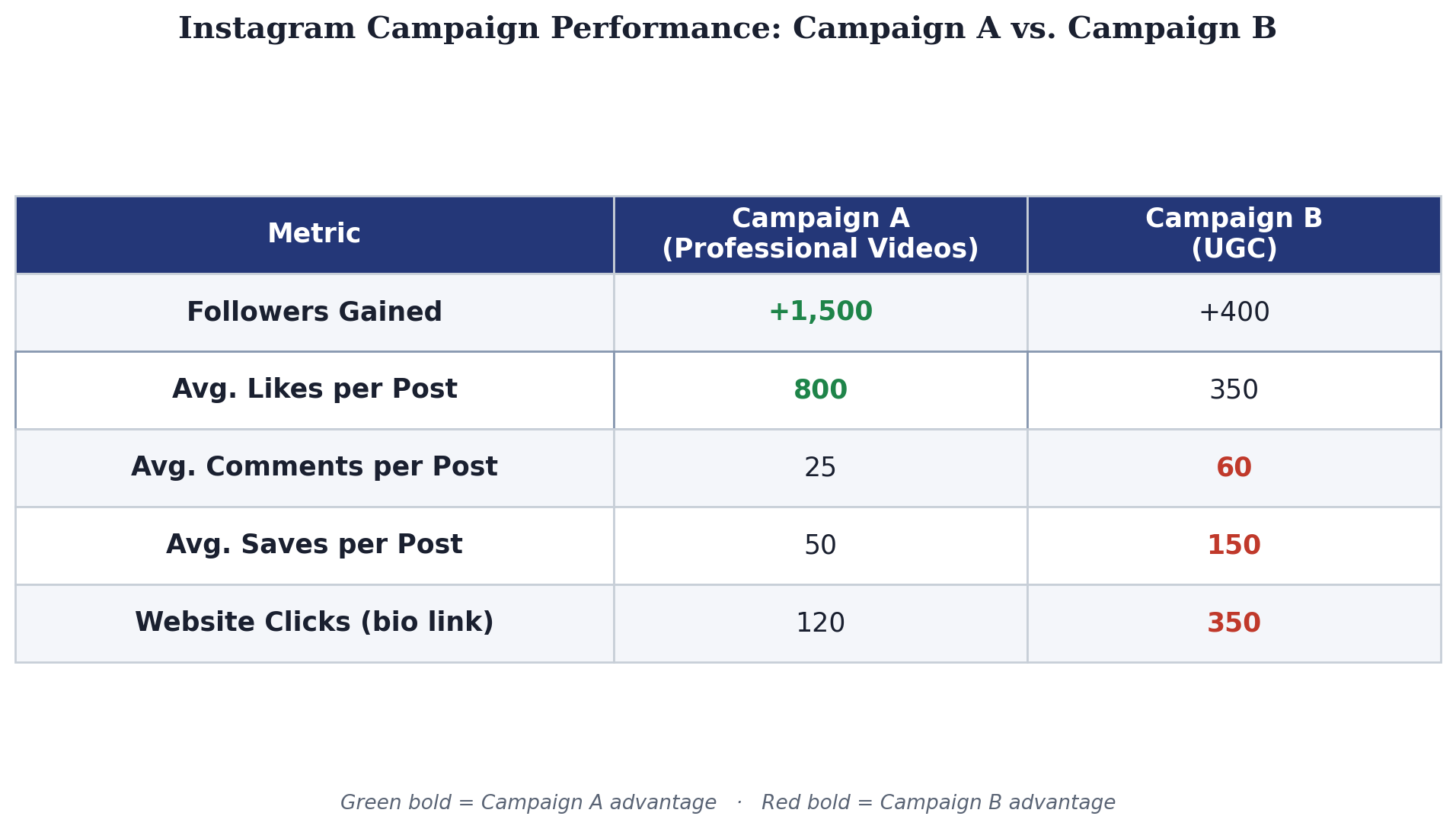
A fitness app company ran two separate month-long Instagram campaigns. Campaign A focused on high-production workout videos. Campaign B focused on user-generated content (UGC), reposting photos and testimonials from customers. The marketing team compiled the following results. Based on the data in the table, which conclusion is the most strategically sound?
- Campaign B was more effective at driving consideration and action, despite having lower reach and surface-level engagement. (correct answer)
- Campaign A was more successful because it generated a significantly higher number of new followers and likes.
- The user-generated content in Campaign B was likely of lower visual quality, leading to fewer likes and slower follower growth.
- Both campaigns were equally effective, as one excelled in awareness metrics while the other excelled in conversion metrics.
Explanation: A strategic analysis requires looking past vanity metrics (followers, likes) to metrics that indicate deeper interest and business impact. Campaign B generated far more post saves (a sign of consideration, as users want to return to the content) and website clicks (a direct action toward a business goal). Therefore, despite Campaign A's superior performance on awareness metrics, Campaign B was strategically more successful in moving users down the marketing funnel. Option B incorrectly prioritizes vanity metrics. Option C makes an unsubstantiated assumption and misses the point about effectiveness. Option D is a weak conclusion that avoids making a strategic choice; Campaign B's performance on high-intent metrics makes it the clear winner.
Question 2
A marketing team has developed a detailed audience persona named "Eco-conscious Emily," a 28-year-old urban dweller who values sustainability, shops at local markets, and follows environmental activists online. The company sells artisanal soap. Which content idea is most strategically aligned with this persona?
- A graphic announcing a "50% Off Flash Sale" designed to drive immediate revenue from the entire follower base.
- A high-quality, studio-shot photo of the soap on a marble background with the simple caption, "Cleanse and Refresh."
- A behind-the-scenes video showing how the company sources local, sustainable ingredients and uses plastic-free packaging. (correct answer)
- A contest where followers must tag three friends in the comments for a chance to win a year's supply of soap.
Explanation: Effective social media content speaks directly to the target audience's values and interests. The persona "Eco-conscious Emily" is defined by her commitment to sustainability and local sourcing. The content idea in (C) directly addresses these core values, building a much stronger connection with this specific persona than generic marketing tactics. The flash sale (A), generic product shot (B), and tag-a-friend contest (D) do not appeal to the unique psychographics of the target persona.
Question 3
A brand's post about a sensitive social issue receives an unusually high number of comments, tripling its average engagement rate. However, a qualitative analysis shows the comments are mostly from non-followers engaged in heated, off-topic arguments with each other in the comments section. From a strategic perspective, how should this engagement spike be interpreted?
- As a major success, since high engagement signals to the algorithm that the content is important, increasing overall account reach.
- As a valuable opportunity to identify and convert a new audience segment that is passionate about social issues.
- As a neutral event, because the increase in negative sentiment in the comments is offset by the increase in algorithmic visibility.
- As low-quality engagement that is unlikely to contribute positively to brand community or business goals. (correct answer)
Explanation: A critical part of social media strategy is understanding the difference between engagement quantity and quality. While the engagement rate is high, the context shows the engagement is not from the target audience and is creating a negative environment. This is strategically detrimental. It does not build a healthy community or foster positive brand association. Chasing engagement for the algorithm's sake (A) is a common trap that ignores the quality and sentiment of the interaction. The engagement is off-topic, so it's not a relevant new audience (B). It is not a neutral event (C) because it can actively harm brand perception.
Question 4
A B2B software company's LinkedIn page primarily posts product updates and feature announcements. These posts consistently show low engagement rates and declining organic reach. To improve performance, the marketing manager proposes a new content strategy. Which proposal represents the most effective strategic pivot?
- Increase the frequency of product update posts from twice a week to daily and run paid ad campaigns to boost their visibility.
- Develop content pillars around industry challenges, featuring customer case studies and expert interviews that solve audience problems. (correct answer)
- Repost popular articles and viral news from other industry publications to generate more consistent activity on the page.
- Create humorous memes and short, viral-style videos related to generic office life to increase overall engagement metrics.
Explanation: The current strategy is overly promotional and self-focused, which typically results in low engagement on social media. The most effective pivot is to shift to a value-driven approach that addresses the audience's pain points and interests. Developing content pillars around industry challenges (B) establishes thought leadership and builds an audience by providing value, which is a core tenet of modern content strategy. Option A doubles down on the failing strategy. Option C builds the authority of other publications, not the company's. Option D is likely misaligned with a professional B2B audience and brand identity, chasing superficial engagement.
Question 5
A popular restaurant chain's Twitter account receives a tweet from an influential food blogger detailing a negative experience with cold food and poor service. The tweet is gaining traction and being shared by the blogger's followers. What is the most strategically sound immediate response?
- Ignore the tweet to avoid amplifying its visibility through a direct reply and hope it loses momentum on its own.
- Use platform tools to hide replies to the tweet and block the food blogger to prevent further negative comments.
- Post a general public statement defending the restaurant's high quality standards without directly mentioning the blogger's tweet.
- Reply publicly to the tweet, apologizing for the specific experience and asking the blogger to send a direct message to discuss details. (correct answer)
Explanation: The best practice for handling public negative feedback, especially from an influencer, is to acknowledge the issue publicly and then move the conversation to a private channel for resolution. This strategy shows other followers that the brand is responsive and cares about customer service (the public part) while allowing for a detailed, non-confrontational resolution (the private part). Ignoring the tweet (A) or blocking the user (B) often leads to accusations of poor service and censorship, escalating the situation. A general defensive statement (C) appears dismissive and fails to address the individual's valid concerns.
Question 6
A brand finds that its organic posts on Facebook have very low reach. However, an analyst notes that posts receiving high organic engagement (comments, shares) in the first few hours tend to have a much lower cost-per-click (CPC) and higher relevance score when subsequently promoted as paid ads. What is the most logical strategic implication of this finding?
- The brand should abandon organic posting altogether and shift its entire budget to a paid advertising strategy to guarantee reach.
- The brand should first test content organically with its core audience and then allocate ad budget to amplify only the top-performing posts. (correct answer)
- The brand should focus exclusively on creating highly engaging organic content and stop all paid advertising to save money.
- The brand should use paid ads to promote all of its organic posts equally to ensure every message is seen by the target audience.
Explanation: This scenario highlights the synergistic relationship between organic and paid social media. The data shows that organic engagement serves as a validation signal for content quality, which the platform's ad algorithm then rewards with lower costs. The best strategy (B) is to use organic posting as a testing ground to identify resonant content and then use paid promotion to scale the reach of those proven winners. This is far more efficient than promoting everything (D) or choosing one channel over the other (A, C).
Question 7
A restaurant's marketing manager presents a plan for the next quarter. The plan includes the item: "Post one photo of a daily special on Instagram every day at noon." This statement is best described as a:
- tactic, which is a specific action taken to execute a strategy. (correct answer)
- strategy, which outlines the high-level goals and overall approach.
- goal, which is a specific, measurable outcome to be achieved.
- metric, which is a standard of measurement used to track performance.
Explanation: This question tests the hierarchy of strategic planning. A strategy might be "Use Instagram to increase lunch sales by targeting local office workers." A goal might be "Increase lunch sales attributed to Instagram by 15% in Q3." A metric would be "reach" or "website clicks." The specific action of "posting one photo...every day at noon" is a tactic—a concrete step taken to implement the strategy and achieve the goal.
Question 8
A local coffee shop wants to use its Facebook page to transform casual customers into a loyal community. Currently, they post daily photos of their products and cafe. Which engagement tactic would be most effective at achieving this specific goal of building a community?
- Running a weekly "tag-a-friend-to-win" contest to significantly increase post reach and the page's follower count.
- Partnering with local food bloggers for sponsored posts to reach a wider, food-interested audience in the city.
- Responding to every comment on their posts with a generic but polite "Thanks for your support!" message.
- Creating a private Facebook Group for "VIP Members" to share feedback, vote on new seasonal drinks, and receive exclusive offers. (correct answer)
Explanation: The goal is to build a community, which implies a deeper, two-way relationship beyond simple follower counts. Creating a dedicated space like a Facebook Group (D) fosters a sense of belonging and exclusivity, allowing for richer interaction and making members feel like insiders. Contests (A) and influencer marketing (B) are primarily tactics for audience growth and reach, not deep community building. Generic replies (C) are a basic form of engagement but do not actively cultivate a strong community bond.
Question 9
A university is using social media to attract prospective students for its new data science program. They plan a content sequence based on the AIDA (Awareness, Interest, Desire, Action) model. Which piece of content is misaligned with its stated funnel stage?
- Awareness: A short, visually engaging video titled "A Day in the Life of a Data Science Student" for broad targeting.
- Interest: A detailed blog post that outlines the specific curriculum and unique courses offered in the program.
- Desire: A live Q&A session with successful alumni who now work at top tech companies, sharing their success stories.
- Action: An infographic about the growing salary potential and high demand for data scientists in the job market. (correct answer)
Explanation: The 'Action' stage of the funnel should contain content with a clear and direct call to perform the final step, such as applying. An infographic about job demand (D) is classic top-of-funnel content designed to build Awareness or Interest, not drive an immediate action. The other options are correctly aligned: 'A Day in the Life' (A) builds broad awareness, curriculum details (B) capture interest from those aware, and alumni success stories (C) build desire for the outcome. An appropriate 'Action' post would be "Applications are now open! Click here to start yours."
Question 10
The primary strategic goal of a non-profit's social media activity is to increase online donations for a specific fundraising campaign. Which metric is the most direct and meaningful indicator of the strategy's success?
- The total number of shares on posts related to the donation campaign.
- The overall engagement rate (likes, comments, shares combined) across all platforms.
- Conversion rate from social media referral traffic on the campaign's donation page. (correct answer)
- The growth in total follower count during the campaign period.
Explanation: A key part of social media strategy is aligning metrics with specific goals. For a goal of driving donations, the most important metric is the one that tracks the desired action. The conversion rate on the donation page for traffic coming from social media (C) directly measures how effectively the social media effort is turning audience attention into donations. Shares (A), general engagement (B), and follower growth (D) are all valuable top-of-funnel or awareness metrics, but they are not direct indicators of fundraising success.
Question 11
A direct-to-consumer brand selling high-end, minimalist home office furniture is planning its first paid social media campaign. Their ideal customer is a 30-45 year old professional with a high household income who follows design influencers and has recently shown online purchase behavior in the home goods category. Which targeting strategy demonstrates the most sophisticated understanding of this audience?
- Broadly targeting all users aged 25-50 who live in major metropolitan areas to maximize the campaign's potential reach.
- Creating a lookalike audience based on their existing small email list of early adopters and targeting only that audience.
- Layering demographic targeting (age, income) with interest targeting (design blogs, competitor brands) and behavioral targeting (recent online purchasers). (correct answer)
- Targeting only the followers of the top five largest interior design accounts on the platform to capture the most engaged users.
Explanation: The most effective and sophisticated social media targeting strategies involve layering multiple types of data to create a highly specific audience. Option C correctly combines demographic (age, income), psychographic/interest (design blogs), and behavioral (purchase history) data. This multi-layered approach is more precise and efficient than relying on a single targeting method. Broad targeting (A) is inefficient. A lookalike audience (B) is a powerful tool, but relying on it alone can be limiting, especially with a small seed list. Targeting followers of large accounts (D) is a good interest-based tactic but lacks the precision of layering demographic and behavioral data.
Question 12
A financial advisory firm wants to establish itself as a thought leader on social media. The marketing director suggests creating ongoing content around three core themes: "Retirement Planning," "Investing for Beginners," and "Market Analysis." This approach is best described as defining the firm's:
- content pillars, which will guide long-term, consistent content creation. (correct answer)
- engagement strategy, which will dictate the methods for user interaction.
- social media campaigns, which are short-term initiatives with specific start and end dates.
- brand voice, which determines the specific personality and tone of their posts.
Explanation: Content pillars (or content buckets) are the foundational, high-level themes that a brand creates content about on an ongoing basis. They ensure content is consistent, relevant to the audience, and aligned with the brand's expertise. This is distinct from a campaign (C), which is time-bound and focused on a specific goal. It is also different from engagement strategy (B), which is about interaction, and brand voice (D), which is about the personality of the communication, not the topics themselves.
Question 13
A travel gear company launches a user-generated content (UGC) campaign by asking customers to post photos of their adventures using a branded hashtag. What is the primary strategic benefit of this approach compared to the company creating its own professional content?
- It builds social proof and authenticity, which can be more persuasive to potential customers than traditional advertising. (correct answer)
- It guarantees a higher volume of content for their social media calendar at a significantly lower average production cost.
- It allows the company to gather direct product feedback and ideas for new features from its most engaged users.
- It significantly increases the organic reach of their profile because social media algorithms favor content from individual users.
Explanation: The most powerful aspect of UGC from a strategic marketing perspective is its ability to provide social proof. When potential customers see real people using and enjoying a product, it acts as a trustworthy, authentic endorsement that is often more effective than polished, branded content. While lower cost (B) and product feedback (C) are valuable secondary benefits, the primary strategic goal is leveraging authenticity to build trust and persuade new customers. Algorithmic favor (D) is not a guaranteed outcome and is secondary to the psychological impact on the audience.
Question 14
A company's social media manager reports that their strategy is to "push out key marketing messages and press releases across all our channels daily." This approach fundamentally misunderstands social media's core strength compared to traditional media, which is its ability to:
- foster two-way conversations and build direct relationships with the audience. (correct answer)
- achieve mass-market reach at a lower cost-per-impression than television or print.
- deliver highly targeted, personalized advertisements based on specific user data.
- broadcast time-sensitive information more rapidly than corporate websites or email newsletters.
Explanation: The described 'push' strategy treats social media as a one-way broadcast channel, similar to traditional advertising. This misses its unique and core strategic strength: interactivity. Social media platforms are designed for two-way communication, allowing brands to engage in conversations, build community, and foster relationships (A). While cost-effective reach (B), ad targeting (C), and speed (D) are all features of social media, its conversational nature is the most fundamental strategic element that a broadcast-only approach fails to leverage.
Question 15
A software company is using its social media channels to promote a free, downloadable whitepaper. The strategic goal of the campaign is lead generation (collecting email addresses). The company is tracking impressions, engagement rate, click-through rate (CTR), and follower growth. Which of these metrics should be considered the key performance indicator (KPI) for this specific campaign?
- Impressions, as they measure the total visibility and awareness of the campaign posts.
- Engagement rate, as it shows how many people are actively interacting with the content.
- Click-through rate (CTR) on the link to the whitepaper's download page. (correct answer)
- Follower growth, as it indicates a growing audience for future lead generation campaigns.
Explanation: A KPI must directly measure progress toward the specific campaign goal. In this case, the goal is lead generation, which requires users to leave the social media platform and go to the download page. The Click-Through Rate (CTR) is the metric that directly measures this action. While impressions (A) and engagement (B) are important for the campaign's visibility, a post could have high engagement without anyone clicking the link. Follower growth (D) is a long-term audience metric, not the primary measure of success for this specific lead-gen campaign.
Question 16
An analysis of a brand's social media feed reveals that 80% of its posts are direct promotions for its products, 10% are posts about company culture, and 10% are curated articles from other industry sources. Engagement is consistently low across all content. Based on common content strategy principles, what is the most likely cause of the low engagement?
- The posts about company culture are likely uninteresting to the brand's target customers.
- Curating content from other sources undermines the brand's authority and confuses the audience's perception.
- The posting schedule is not optimized for the times when the target audience is most active online.
- An over-reliance on promotional content and a lack of value-driven, educational, or entertaining content for the audience. (correct answer)
Explanation: A successful content strategy typically provides value to the audience far more often than it asks for a sale. A common guideline is the 80/20 rule, where 80% of content is valuable (educational, entertaining) and only 20% is promotional. This feed has the ratio inverted, with 80% being promotional. This 'overselling' is the most significant strategic flaw and the most likely reason for low engagement, as the feed offers little value to the audience. While other factors (A, C) could play a role, the content mix (D) is the most fundamental problem.
Question 17
A startup launching an innovative kitchen gadget wants to use influencer marketing to build credibility and trust with serious home cooks. Which approach represents the most effective social media strategy for achieving this specific goal?
- Collaborating with a select group of micro-influencers who are respected food bloggers for authentic video reviews. (correct answer)
- Paying a single mega-influencer with millions of followers in the general lifestyle category for one sponsored post.
- Sending the product for free to a large list of 500 nano-influencers in the hope that some will post about it.
- Sponsoring a post from a famous celebrity chef who will simply hold the product and smile for a photo.
Explanation: The goal is to build credibility with a specific, knowledgeable audience. Micro-influencers often have smaller but highly engaged and trusting niche audiences. An authentic review from a respected food blogger (A) provides social proof and is perceived as more trustworthy than a simple endorsement. A mega-influencer (B) provides reach but often has lower credibility with a niche audience. The 'spray and pray' approach (C) is unreliable. A celebrity endorsement (D) can build awareness but an in-depth, authentic review from a credible expert (A) is superior for building trust.
Question 18
A legacy financial institution, known for its formal and conservative brand voice, wants to connect with a younger audience on Instagram without alienating its existing older client base. Which strategy for adapting its content is most appropriate?
- Adopt a completely new brand voice using slang, memes, and humor that is popular with the younger demographic.
- Maintain the brand's professional and trustworthy tone, but create content in formats that are native to the platform, such as educational carousels and short Q&A videos. (correct answer)
- Create a separate, trendy sub-brand and Instagram account specifically for the younger audience to avoid brand confusion.
- Repost the same formal, text-heavy articles and press releases from their corporate website directly to their Instagram feed.
Explanation: This question tests the ability to adapt to a platform without sacrificing core brand identity. The best strategy is to separate the brand's tone (which should remain consistent and trustworthy) from the content format (which should be adapted for the platform). Using native formats like carousels and short videos (B) makes the content accessible and engaging for an Instagram audience while still delivering credible financial information. A drastic change in voice (A) would be inauthentic and alienating. Reposting website content (D) ignores the visual nature of the platform. Creating a sub-brand (C) is a much larger, more complex strategic decision and not the most appropriate first step.
Question 19
A B2B software company's LinkedIn page primarily posts product updates and feature announcements. These posts consistently show low engagement rates and declining organic reach. To improve performance, the marketing manager proposes a new content strategy. Which proposal represents the most effective strategic pivot?
- Increase the frequency of product update posts from twice a week to daily and run paid ad campaigns to boost their visibility.
- Develop content pillars around industry challenges, featuring customer case studies and expert interviews that solve audience problems. (correct answer)
- Repost popular articles and viral news from other industry publications to generate more consistent activity on the page.
- Create humorous memes and short, viral-style videos related to generic office life to increase overall engagement metrics.
Explanation: The current strategy is overly promotional and self-focused, which typically results in low engagement on social media. The most effective pivot is to shift to a value-driven approach that addresses the audience's pain points and interests. Developing content pillars around industry challenges (B) establishes thought leadership and builds an audience by providing value, which is a core tenet of modern content strategy. Option A doubles down on the failing strategy. Option C builds the authority of other publications, not the company's. Option D is likely misaligned with a professional B2B audience and brand identity, chasing superficial engagement.
Question 20
A financial advisory firm wants to establish itself as a thought leader on social media. The marketing director suggests creating ongoing content around three core themes: "Retirement Planning," "Investing for Beginners," and "Market Analysis." This approach is best described as defining the firm's:
- content pillars, which will guide long-term, consistent content creation. (correct answer)
- engagement strategy, which will dictate the methods for user interaction.
- social media campaigns, which are short-term initiatives with specific start and end dates.
- brand voice, which determines the specific personality and tone of their posts.
Explanation: Content pillars (or content buckets) are the foundational, high-level themes that a brand creates content about on an ongoing basis. They ensure content is consistent, relevant to the audience, and aligned with the brand's expertise. This is distinct from a campaign (C), which is time-bound and focused on a specific goal. It is also different from engagement strategy (B), which is about interaction, and brand voice (D), which is about the personality of the communication, not the topics themselves.