All questions
Question 1
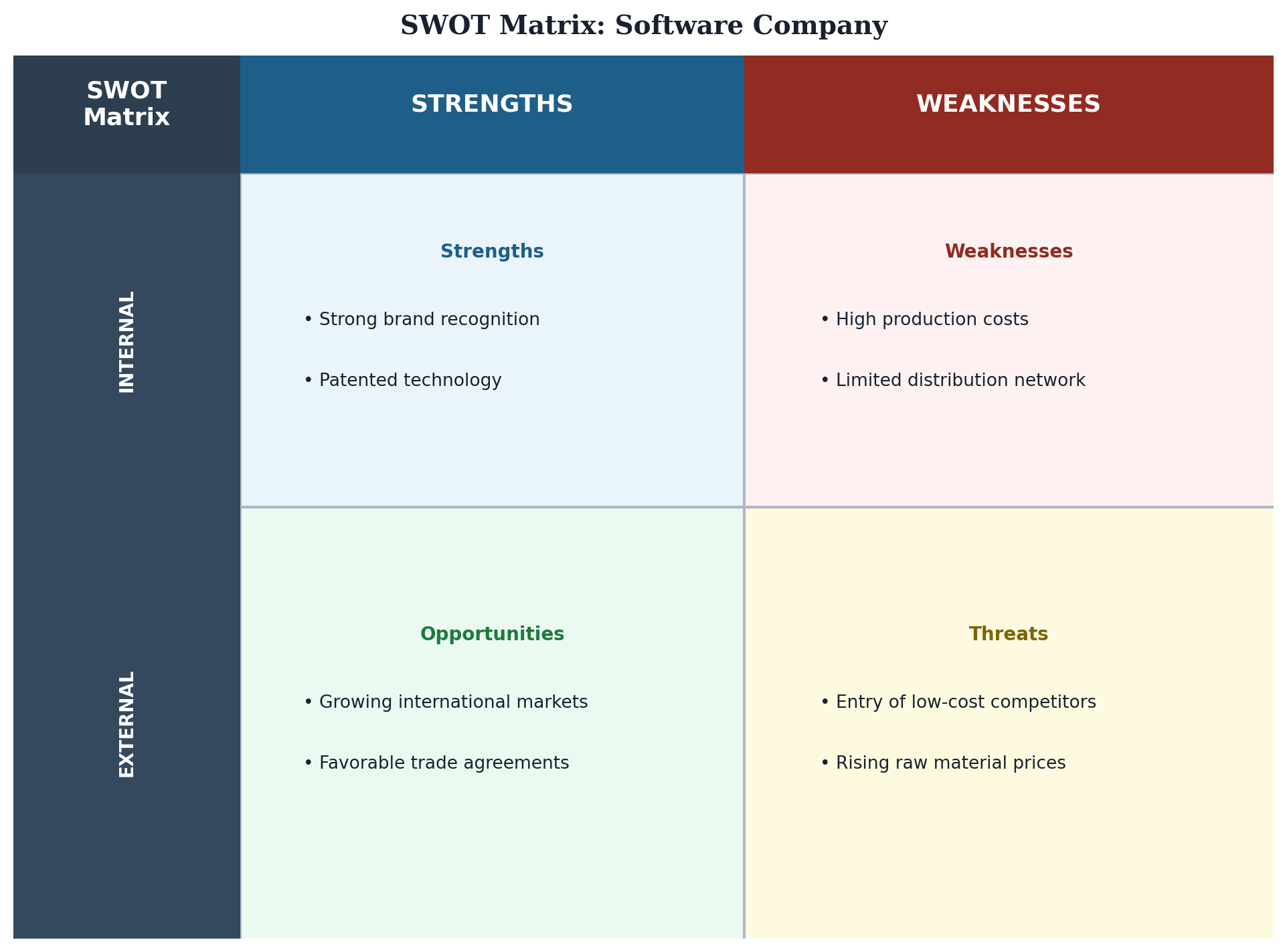
Refer to the SWOT matrix for a software company below. Which of the following strategies represents a 'W-O' (Weakness-Opportunity) approach?
- Leverage strong brand recognition to launch the patented technology into new international markets.
- Use the company's strong brand as justification for premium pricing to offset rising material costs.
- Form a strategic alliance with an international distributor to address the limited distribution network and access growing global markets. (correct answer)
- Invest in R&D to develop a lower-cost version of the product to fend off new low-cost competitors.
Explanation: A W-O (Weakness-Opportunity) strategy aims to overcome an internal weakness to take advantage of an external opportunity. Choice C directly addresses the 'Limited distribution network' (Weakness) by forming a partnership to access 'Growing international markets' (Opportunity). Choice A is an S-O (Strength-Opportunity) strategy. Choice B is an S-T (Strength-Threat) strategy. Choice D is a W-T (Weakness-Threat) strategy.
Question 2
Rival adds free support; our premium brand cannot match the cost. Best response?
- Match the added service offer
- Underprice the rival's offer
- Drop the competing feature
- Shift focus to another benefit (correct answer)
Explanation: A premium brand can't win a cost war after a rival gives support away for free. Matching the free service is tempting but would destroy your price position and margins. Instead, redirect the conversation to a benefit your rival can't easily copy, because buyers choose on value, not on one feature.
Question 3
Situation analysis shows a market threat and a firm weakness. What response fits?
- Fix weakness to blunt threat (correct answer)
- Exploit both before rivals do
- Turn threat into a strength
- Wait for the threat to pass
Explanation: A market threat is external, while a firm weakness is internal, so the vulnerability is your own gap. Shoring up the weakness reduces the threat's impact. The tempting wrong answer is to exploit both before rivals do, but you cannot exploit a weakness, and a threat is not an opportunity. Waiting or trying to turn a threat into a strength misreads the situation.
Question 4
A market shift makes a core strength obsolete. Best strategic move?
- Rebrand the obsolete skill
- Keep funding the old skill
- Reallocate to new priorities (correct answer)
- Wait for the market to revert
Explanation: A core strength that the market no longer values is sunk; resources should follow demand. Rebranding an obsolete skill is tempting because it sounds like a fresh start, but it only dresses up a capability buyers no longer need. Reallocating to new priorities puts your effort where the market is actually heading.
Question 5
Rival cuts price while demand falls. Which decision is best supported?
- Match the price cut now
- Wait until causes are clear (correct answer)
- Assume price drives demand
- Copy the rival's strategy
Explanation: When demand is falling, a rival's price cut may be a response to the same market shift, not a move you should mirror. Wait until you know whether lower prices or weaker demand is driving sales, then decide. Matching immediately assumes price is the cause, which is the tempting error; copying strategy without evidence is just guesswork.
Question 6
Given stricter privacy rules and falling ad trust, which decision is best supported?
- Shift spend to owned media (correct answer)
- Increase digital ad frequency
- Lower prices to rebuild trust
- Rely solely on word of mouth
Explanation: With privacy rules limiting targeting and ad trust falling, owned media lets you reach audiences through channels you control without paid ad dependency. Relying solely on word of mouth is tempting because it feels trusted, but it is too passive and uncontrollable to be the best-supported decision. Increasing ad frequency or lowering prices does not address the trust and privacy problem.
Question 7
A cruise line company is conducting a situation analysis. A major challenge is a recent wave of negative media coverage about the cruise industry's environmental impact, leading to public criticism and calls for boycotts. In a SWOT analysis, how should this specific factor be categorized?
- As a Weakness, because the company's own fleet of ships contributes to the environmental problem.
- As a Threat, because it is an external factor involving public perception and media that negatively affects the entire industry. (correct answer)
- As a Strength, if the company can demonstrate its environmental record is better than its competitors'.
- As an Opportunity, because it presents a chance to innovate and market new, 'green' cruise experiences.
Explanation: The critical distinction in SWOT is between internal and external factors. The company's own pollution record is an internal weakness. However, the media coverage and public criticism are external forces affecting all players in the market. Therefore, this development is properly categorized as a Threat. Choices C and D describe potential strategic responses to the threat, not the classification of the threat itself.
Question 8
A telecommunications company's primary strength is its extensive portfolio of patents related to 4G network technology. An environmental scan indicates that the industry is rapidly transitioning to 5G technology, and the company's own R&D pipeline for 5G is several years behind competitors. How does this environmental shift affect the company's situation analysis?
- It converts a current key strength (4G patents) into a diminishing asset that could become a future weakness. (correct answer)
- It creates an immediate opportunity to license its 4G technology at a premium to competitors who are focused on 5G.
- It strengthens the company's position with its current 4G customers who are not yet ready to upgrade.
- It has little effect on the current SWOT analysis, as the majority of consumers will remain on 4G for several more years.
Explanation: This question tests the dynamic nature of a SWOT analysis. A strength is only valuable in a relevant context. The technological shift to 5G makes the 4G patents less valuable over time and highlights the company's lack of 5G readiness, effectively turning a current strength into a future liability or weakness. B is unlikely, as competitors would not pay a premium for aging technology. C is a short-term view that ignores the long-term strategic threat. D represents a dangerous complacency; situation analysis must be forward-looking.
Question 9
A regional airline's analysis reveals that its primary competitor has just signed a major code-sharing agreement with a large international carrier, effectively allowing them to sell tickets to a global network of destinations. From the perspective of the regional airline, this competitor action is best categorized as a(n):
- Internal weakness, because the airline now has a comparatively limited network.
- Competitive threat, because it significantly enhances the competitor's service offering and market reach. (correct answer)
- Market opportunity, as it signals that international carriers are actively seeking new regional partners.
- Socio-cultural trend, reflecting a growing consumer preference for seamless international travel.
Explanation: A competitor's action that improves its position relative to yours is a competitive threat. The code-sharing agreement makes the competitor stronger and more appealing to customers. While it highlights a comparative weakness (A), the action itself is external and thus a threat. Viewing it as an opportunity (C) is a possible secondary thought, but the primary classification is a threat. The consumer preference (D) is the underlying trend, but the competitor's specific action is the threat.
Question 10
A well-established luxury watch brand, famous for its hand-crafted quality (a key strength), is conducting a situation analysis. The analysis reveals two critical external factors: a rapid market shift towards smartwatches (a threat) and the emergence of new micro-technology that allows for smart features to be integrated without compromising traditional aesthetics (an opportunity). The brand's traditional, slow production process is a recognized weakness. Which marketing strategy most effectively integrates these findings?
- Decrease prices on all traditional watches to better compete with the lower price point of most smartwatches.
- Launch a massive digital marketing campaign focused on brand heritage to persuade younger consumers to abandon smartwatches.
- Develop a new 'hybrid' watch line that leverages the brand's reputation for quality craftsmanship with discreetly integrated smart features. (correct answer)
- Invest in modernizing the production process to increase output and lower costs for its existing watch collections.
Explanation: The correct strategy should leverage internal strengths to take advantage of external opportunities while mitigating threats. Choice C does this perfectly by using the brand's strength (quality craftsmanship) and the technological opportunity (new micro-technology) to counter the threat of smartwatches. Choice A competes on price, which erodes a luxury brand's core value proposition and ignores its strengths. Choice B only addresses the threat but fails to capitalize on the opportunity. Choice D addresses a weakness but does not leverage strengths or opportunities to adapt to the primary market threat.
Question 11
A fast-food chain's environmental scan reveals that the median age in its key markets is steadily increasing and that this demographic group shows a strong preference for healthier, lower-sodium meal options. This insight is primarily the result of analyzing which component of the macroenvironment?
- The economic environment, as it relates to the disposable income and spending habits of an aging population.
- The political environment, as government-led health initiatives may be influencing consumer choices.
- The technological environment, as new food science allows for the creation of healthier menu items.
- The socio-cultural environment, as it pertains to demographic shifts and changes in lifestyle values and preferences. (correct answer)
Explanation: The core of the finding involves demographics (median age increasing) and lifestyle values (health consciousness). These are central components of the socio-cultural environment. While this trend will have economic consequences (A) and may require technological solutions (C), the source of the insight is socio-cultural analysis.
Question 12
A local artisanal coffee shop is analyzing its competitive landscape. Which of the following should be prioritized as the most immediate and direct competitive threat requiring a strategic marketing response?
- A recent news report indicating a national trend of consumers reducing caffeine intake for health reasons.
- A nearby supermarket that just expanded its aisle of high-quality, whole-bean coffee from around the world.
- A globally recognized coffee chain that has just begun construction for a new location on the same block. (correct answer)
- A popular local bakery, known for its pastries, that recently started offering a single variety of drip coffee.
Explanation: Situation analysis requires distinguishing between different types and levels of threats. A global chain opening on the same block (C) is the most immediate and direct competitor. It offers a similar core product, targets a similar customer base (by location), and has significant brand and resource advantages. The health trend (A) is a broader socio-cultural threat, not a direct competitor. The supermarket (B) is an indirect competitor for the at-home coffee market. The bakery (D) is a weaker, secondary competitor whose primary business is not coffee.
Question 13
A financial services firm's situation analysis yields two key insights: (1) The 'millennial' demographic is entering its peak investing years, representing a major market opportunity. (2) The firm's current investment products are extremely complex and best suited for experienced, high-net-worth clients, which is an internal weakness in this context. How should these integrated findings most logically inform the firm's marketing decisions?
- Focus all marketing efforts on the traditional high-net-worth segment, as this is where the current products fit best.
- Create a simplified, low-fee investment product with a mobile-first interface to specifically attract the millennial segment. (correct answer)
- Aggressively market the existing complex products to millennials, emphasizing the products' long-term potential.
- Launch a public relations campaign about financial literacy without changing the existing product portfolio.
Explanation: A successful strategy addresses the situation holistically. The analysis shows a mismatch between an opportunity (millennials) and the current product portfolio (a weakness). The logical response is to correct this mismatch. Choice B does this by proposing a new product development and marketing strategy (a change in the 'Product' and 'Place/Promotion' mix) that is tailored to the opportunity. A ignores the opportunity. C tries to force an unsuitable product onto the new market, which is likely to fail. D is a weak response that doesn't solve the core product-market fit problem.
Question 14
A luxury automaker, known for high-performance engines (high quality) and very high prices, conducts a situation analysis. It identifies a rapidly growing market segment of young professionals who desire a premium brand but are more price-sensitive than the automaker's traditional clientele. A key competitor has already found success in this segment with a model that offers high quality at a moderately high price. What does this analysis suggest as the most appropriate marketing strategy?
- Launch a lower-priced, entry-level model that maintains the brand's quality reputation to attract the new segment. (correct answer)
- Increase advertising to emphasize the exclusivity and top-tier performance of its existing high-priced models.
- Reduce the quality of materials in existing models to lower the price point for all customers.
- Begin lobbying efforts to create stricter import tariffs on the successful competitor's vehicles.
Explanation: The analysis identifies an opportunity (a new, growing segment) and a threat (a competitor already serving it). The company's strength is its quality reputation, but its high price is a weakness for this segment. The best strategy is to leverage the strength (quality reputation) to pursue the opportunity (new segment) by addressing the price issue. Launching a new, more accessible model (A) does this without damaging the brand's core identity. B ignores the opportunity. C would damage the brand's primary strength. D is a political action, not a marketing strategy to meet customer needs.
Question 15
A marketing department has spent six months conducting a deeply comprehensive situation analysis, resulting in voluminous reports on competitors, market trends, and internal capabilities. However, no new marketing objectives have been set and no changes have been proposed to the current marketing plan. This scenario most likely illustrates:
- a market that is so stable that the analysis confirmed the perfection of the current strategy.
- the 'analysis paralysis' phenomenon, where an organization fails to translate insights into strategic action. (correct answer)
- a situation where the initial analysis was found to be inconclusive, requiring the process to be restarted.
- a successful first phase of the marketing planning process, which will be followed by a separate strategy phase.
Explanation: The fundamental purpose of a situation analysis is to inform and guide marketing decisions. When an exhaustive analysis leads to no action or decision-making, it is a classic case of 'analysis paralysis.' The organization becomes so engrossed in studying the situation that it fails to act on the findings. A is highly improbable in any modern market. C is a possibility but B is a more common and direct interpretation of the inaction. D is an overly generous interpretation; a successful process would have interim conclusions that begin to shape strategy concurrently.
Question 16
A small, local bakery's competitor analysis reveals that its main rival, a large supermarket chain, consistently receives poor customer reviews regarding the 'artificial taste' and 'mass-produced quality' of its in-store bakery products. Which marketing strategy would most effectively exploit this specific competitive weakness?
- Introducing a price-matching guarantee to compete directly with the supermarket's lower prices.
- Developing a customer loyalty program that offers a free coffee with the purchase of five pastries.
- Launching a campaign centered on 'Handmade Daily with Real Butter' and featuring in-store baking demonstrations. (correct answer)
- Expanding its operating hours to be open earlier in the morning and later in the evening than the supermarket.
Explanation: An effective strategy attacks a competitor's weakness with a corresponding strength. The campaign in choice C directly contrasts the supermarket's weakness (artificial, mass-produced) with the bakery's presumed strength (authentic, handmade), creating a strong point of differentiation. A foolishly attempts to compete on the competitor's main strength (price). B and D are generic tactics that are not specifically derived from the competitive insight.
Question 17
A company manufacturing plastic food packaging faces new government legislation that mandates all such packaging be composed of at least 50% biodegradable materials within three years. This development is best identified as a primary change in which element of the company's macroenvironment?
- The technological environment, because new technologies will be required to comply with the mandate.
- The socio-cultural environment, because the law reflects changing consumer attitudes toward sustainability.
- The economic environment, because the shift to new materials will significantly impact production costs and pricing.
- The legal environment, because the change is a government-enacted regulation that carries penalties for non-compliance. (correct answer)
Explanation: While this change has technological, social, and economic implications, the direct driver of the required action is new legislation. Therefore, it is primarily a factor in the legal environment. The other factors are secondary: the socio-cultural trend (B) is likely the reason the law was passed, and the technological (A) and economic (C) changes are the results of having to comply with the new law. The question asks to identify the primary change itself, which is the regulation.
Question 18
A SWOT analysis for a solar panel installation company identifies a key strength in its highly skilled, certified installation team and a major opportunity in new government tax credits for homeowners who adopt solar energy. Which marketing decision is best supported by explicitly linking this specific strength and opportunity?
- Lowering the price of installation services to become the market's low-cost leader.
- Launching a promotion that highlights both the team's expertise for a flawless installation and the maximum financial return from new tax credits. (correct answer)
- Diversifying into the manufacturing of solar panels to reduce reliance on third-party suppliers.
- Investing in a new CRM system to better manage the influx of leads generated by interest in the tax credits.
Explanation: Effective strategy often involves linking internal strengths with external opportunities. Choice B creates a compelling, synergistic value proposition: not only do customers get financial benefits from the opportunity (tax credits), but they also get the peace of mind of having it done right by experts (the strength). A ignores the strength. C is a corporate strategy, not a marketing decision linking these specific points. D is a reactive, operational tactic, not a proactive marketing strategy based on this linkage.
Question 19
A brand manager for a breakfast cereal reviews the following data: (1) The brand's unit sales declined by 4% last year. (2) The total market for breakfast cereal declined by 9% in the same period. (3) A key competitor's sales declined by 12%. (4) A recent consumer survey indicates a growing trend of people opting for breakfast bars and smoothies. Which is the most accurate conclusion to inform marketing decisions?
- The brand's marketing mix is ineffective, as evidenced by the 4% sales decline.
- The brand is gaining market share from its competitors within a declining market. (correct answer)
- The key competitor is successfully implementing a strategy that is taking sales from the brand.
- The primary cause of the sales decline is likely a failure in the brand's distribution channels.
Explanation: This question requires interpreting data in context. Although the brand's sales are down (a negative sign), they have declined less than the overall market and significantly less than a key competitor. This means the brand's share of the market has actually increased. This is a crucial insight: the problem isn't necessarily poor marketing execution relative to competitors, but a broader market trend (the threat identified in point 4). A is an incomplete analysis. C is directly contradicted by the data. D is a possible explanation but is not supported by the provided data.
Question 20
A ride-sharing company is forced to significantly increase its operating costs after the government passes new legislation reclassifying its drivers as full employees, mandating minimum wage, healthcare, and other benefits. This change to the company's business environment is a direct result of an intersection between which two macro-environmental factors?
- Technological and Economic
- Socio-cultural and Economic
- Political and Legal (correct answer)
- Legal and Technological
Explanation: The scenario describes a government (a political entity) creating and passing new legislation (a legal framework). While this action has profound economic consequences and may be driven by socio-cultural shifts in attitudes about labor, the event itself is a direct product of the political process resulting in a legal change. Therefore, it lies at the intersection of the political and legal environments.