All questions
Question 1
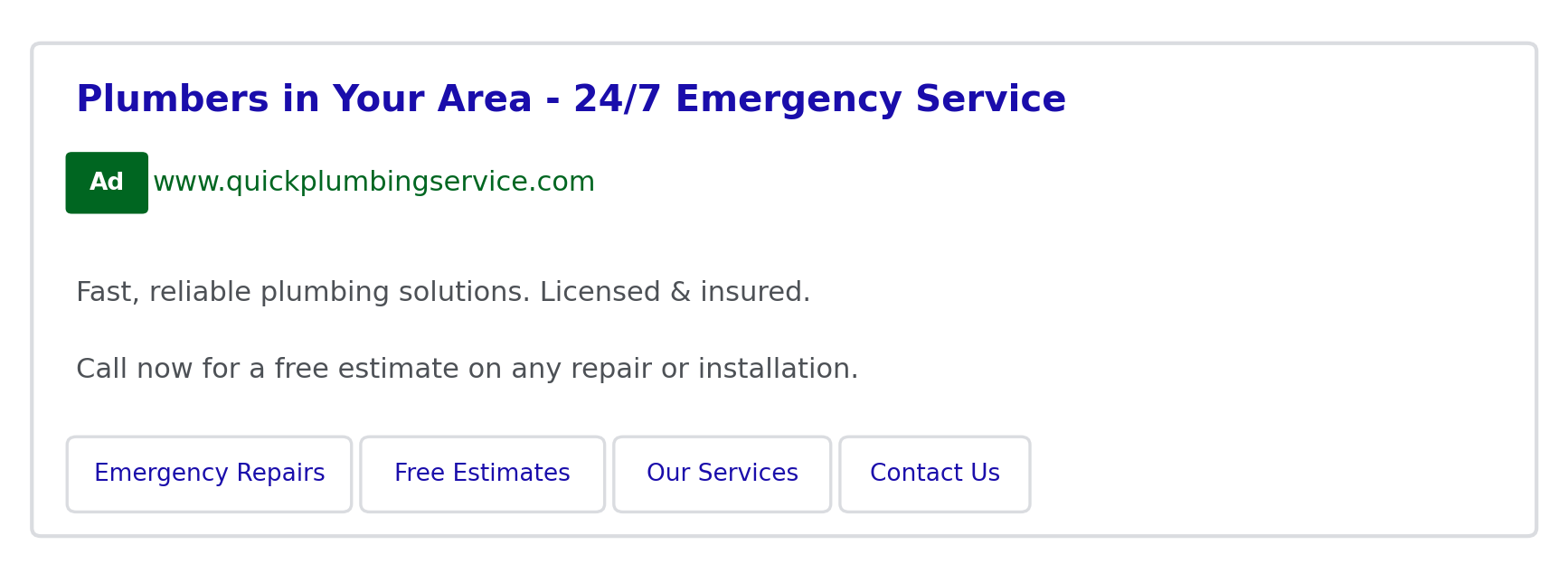
Refer to the search engine results page element shown. Which marketing activity is solely responsible for the appearance and ranking of this specific element?
- Technical SEO
- Local SEO
- Off-page SEO
- SEM (PPC) (correct answer)
Explanation: The graphic shows a search result with a small 'Ad' label next to the display URL. This label explicitly indicates that the placement is a paid advertisement, which is part of a Search Engine Marketing (SEM) pay-per-click (PPC) campaign. While SEO tactics (A, B, C) are used to achieve organic rankings, they do not result in a listing with the 'Ad' designation.
Question 2
A company's website has two separate pages that are ranking intermittently for the same high-value keyword: a blog post titled 'Top 10 Benefits of CRM Software' and a product page for their CRM solution. This is causing fluctuating search engine rankings for both pages. What is this issue called, and what is the best strategic approach to resolve it?
- This is called domain dilution; the best approach is to create a new microsite for the blog to separate the content from the commercial pages.
- This is called keyword cannibalization; the best approach is to consolidate the valuable content from the blog post onto the product page and 301 redirect the blog post's URL. (correct answer)
- This is called SERP crowding; the best approach is to de-optimize the blog post by removing the target keyword to allow the product page to rank exclusively.
- This is called content duplication; the best approach is to use a canonical tag on the product page pointing to the blog post to signal it as the preferred version.
Explanation: This scenario describes keyword cannibalization, where multiple pages on the same site compete for the same search query, confusing search engines and splitting ranking signals like backlinks and CTR. The most effective solution is to consolidate the content into the single, most appropriate page (often the one with higher conversion potential, like the product page) and use a 301 redirect to pass the link equity from the less important page.
Question 3
A marketer is explaining to a client why focusing solely on keyword density (the number of times a keyword appears on a page) is an outdated and ineffective SEO strategy. What is the most accurate reason for this?
- Modern search engine algorithms prioritize semantic search, understanding the topic and user intent rather than simply matching exact keywords. (correct answer)
- High keyword density is now exclusively a ranking factor for paid search campaigns, not for organic search results.
- Search engines now penalize any page where a target keyword appears more than once in the body content.
- Backlinks from other websites have become the only factor that search engines use to determine the relevance of a page.
Explanation: Early search engines relied heavily on keyword density. Modern algorithms, however, use natural language processing and machine learning to understand the overall topic of a page and how well it satisfies a user's intent. This is known as semantic search. They look for related concepts, synonyms, and contextual relevance. Over-optimizing for a specific keyword (keyword stuffing) can even be seen as a negative signal. While backlinks (D) are critical, they are not the only factor.
Question 4
A website's analytics show a high click-through rate (CTR) from the search engine results page (SERP) for a specific keyword, but the on-page analytics reveal an extremely high bounce rate and low average time on page. Which conclusion is best supported by this data?
- The website's server is slow, causing users to leave before the page fully loads, which negatively affects user experience.
- The page's title tag and meta description are compelling and align with search intent, but the landing page content fails to deliver on that promise. (correct answer)
- Competitors are engaging in click fraud by repeatedly clicking the organic listing and leaving immediately to hurt its rankings.
- The off-page backlink profile is strong enough to achieve a high ranking, but the on-page content is poorly written and unengaging.
Explanation: A high CTR from the SERP indicates that the title tag and meta description are effective at attracting clicks, suggesting they accurately reflect what the user is looking for. However, a high bounce rate and low time on page signify that once the user arrives, the content does not meet their expectations or solve their problem. This points to a disconnect between the promise made in the SERP and the content delivered on the page.
Question 5
A marketing analyst reviews the performance of a landing page optimized for the keyword 'best noise-cancelling headphones'. The page receives significant organic traffic, but its bounce rate is over 90% and the conversion rate is near zero. The page itself is a standard product page for a single headphone model. What is the most likely cause of this poor performance?
- The page has poor technical SEO, preventing search engines from properly crawling and indexing the on-page content.
- The content on the page fails to satisfy the user's search intent, which is primarily commercial investigation rather than transactional. (correct answer)
- The off-page SEO strategy lacks sufficient high-quality backlinks, resulting in low authority and user trust.
- The keyword 'best noise-cancelling headphones' is too competitive, leading to traffic from users who are not genuinely interested.
Explanation: The keyword 'best...' implies a commercial investigation intent. Users want to compare options, read reviews, and see pros and cons. A landing page featuring only a single product fails to meet this intent, causing users to 'bounce' back to the search results to find a comparative review. The high traffic indicates that on-page and off-page SEO might be effective at ranking, but the content itself is a mismatch for the user's goal.
Question 6
A user searches for 'apple'. The search engine results page (SERP) is dominated by links to apple.com, Apple Store locations, and news about the latest iPhone. Which concept best explains why a website about the fruit has little chance of ranking on the first page for this single-word query?
- Query ambiguity and dominant search intent. (correct answer)
- Keyword stuffing by the technology company.
- Lack of mobile optimization on the fruit website.
- Algorithmic bias against agricultural topics.
Explanation: The term 'apple' is ambiguous. However, search engines analyze massive amounts of user data to determine the dominant search intent. The data shows that the overwhelming majority of users searching for 'apple' are looking for the technology company (navigational or commercial intent). The search engine therefore prioritizes results that satisfy this dominant intent, making it extremely difficult for content related to the secondary intent (the fruit) to rank for such a broad, competitive term.
Question 7
A financial planning firm writes a comprehensive, 5,000-word article on retirement planning. Despite being well-researched and clearly written, it fails to rank on the first page for its target keywords. Competing articles from major financial institutions dominate the search results. Which SEO concept is most likely the primary reason for the firm's struggle to rank?
- The article's length is excessive, causing a poor user experience and high bounce rates that negatively impact its ranking.
- The firm's website has a low level of E-A-T (Expertise, Authoritativeness, and Trustworthiness) compared to established institutions. (correct answer)
- The firm has neglected on-page SEO factors such as keyword density and the use of LSI keywords within the article's body.
- The search query is informational, and search engines prioritize shorter, more concise content like videos or infographics for this intent.
Explanation: For topics that fall under 'Your Money or Your Life' (YMYL), such as finance and health, Google places a very high emphasis on E-A-T. Even with excellent content, a smaller, less-known firm will struggle to outrank large, authoritative institutions because the latter have a much stronger established reputation, more high-authority backlinks, and are considered more trustworthy sources. This is a crucial off-page and site-level factor that on-page content alone cannot overcome.
Question 8
A travel blog wants to create content targeting users who are in the initial stages of planning a vacation to Italy. They are not yet ready to book flights or hotels. Which keyword best aligns with the informational search intent of this target audience?
- cheap flights to Rome
- book guided tour of Colosseum
- Hilton Garden Inn Florence review
- best time of year to visit Italy (correct answer)
Explanation: When you encounter questions about search intent, you need to understand the three main types: informational (seeking knowledge), navigational (finding a specific site), and transactional (ready to buy or take action). The key is matching the user's mindset to the appropriate keyword strategy.
Answer D, "best time of year to visit Italy," perfectly aligns with informational search intent. Users searching this phrase are in the early research phase, gathering fundamental knowledge to help them plan. They're not ready to purchase anything yet—they're simply trying to understand when Italy has the best weather, fewer crowds, or optimal conditions for their interests. This matches exactly with the scenario's description of users "in the initial stages of planning" who "are not yet ready to book."
Answer A, "cheap flights to Rome," represents transactional intent. Users searching this are ready to purchase flights and are comparing prices—they've already decided on their destination and timing. Answer B, "book guided tour of Colosseum," is clearly transactional since it includes the action word "book" and targets users ready to make a reservation. Answer C, "Hilton Garden Inn Florence review," shows navigational or late-stage transactional intent, where users are evaluating specific accommodations they're considering booking.
Remember this pattern: informational keywords typically include question words (what, when, where, how, why) or phrases like "best," "guide to," or "tips for." They focus on knowledge-gathering rather than specific products or services. When targeting early-stage planners, always think about what foundational questions they need answered first.
Question 9
A user's search journey starts with 'what is content marketing', progresses to 'best content marketing tools', and concludes with a search for 'HubSpot pricing'. How does this progression reflect the evolution of their search intent?
- The intent remains purely informational throughout the entire journey as the user is only conducting research.
- The intent shifts from transactional to navigational and finally to informational.
- The intent shifts from informational to commercial investigation and finally to transactional. (correct answer)
- The intent begins as navigational, becomes informational, and ends as commercial investigation.
Explanation: This sequence perfectly illustrates the typical marketing funnel as reflected in search intent. 'what is content marketing' is a classic informational query. 'best content marketing tools' shows the user is now investigating solutions and comparing options—commercial investigation. 'HubSpot pricing' is a late-stage query indicating a strong intent to make a purchase—transactional intent. The marketer's goal is to have content that meets the user at each of these stages.
Question 10
A content team wants to capture the featured snippet (or 'position zero') for the search query 'how to change a bike tire'. Which of the following content structuring approaches is most likely to be successful?
- Writing a long-form narrative that tells a compelling story about the first time the author changed a bike tire.
- Creating a visually engaging infographic that illustrates all the steps without accompanying text on the main page.
- Placing a concise, well-structured list with numbered steps and clear headings directly answering the query near the top of the page. (correct answer)
- Embedding a high-quality video tutorial at the top of the page while placing the text transcription at the very bottom.
Explanation: Search engines often pull featured snippets from content that directly and clearly answers the user's question. For a 'how-to' query, a numbered or bulleted list is a highly structured format that is easy for algorithms to parse and present as a direct answer. While other formats can be valuable for user experience, the clear, text-based list format is the most common source for step-by-step featured snippets.
Question 11
The rise of voice search queries like 'Hey Google, what are the symptoms of dehydration?' has shifted the focus of keyword strategy. How must content creators adapt their SEO approach to effectively target this type of search intent?
- By focusing primarily on short, single-word keywords that are easier for voice assistants to recognize and process.
- By creating content in a conversational, question-and-answer format and using structured data to define key information. (correct answer)
- By prioritizing mobile ad spending, as most voice searches originate from mobile devices with ad placements.
- By optimizing for exact match domains (EMDs) that precisely match the conversational search queries.
Explanation: Voice searches are typically conversational and phrased as questions. To capture this traffic, content should be structured to directly answer these questions. Using a natural, conversational tone and implementing structured data (like FAQ schema) helps search engines understand the content and select it as the source for a spoken answer. Short keywords (A) are the opposite of conversational queries. Ad spending (C) is an SEM tactic separate from content optimization for organic voice search. EMDs (D) are an outdated and ineffective SEO tactic.
Question 12
A local bakery runs a PPC campaign on Google Ads targeting the broad keyword 'cakes'. They find they are spending a lot on clicks from users searching for 'angel food cake recipe' and 'what are rice cakes'. These clicks do not result in sales. Which SEM feature should they use to prevent their ads from showing on these irrelevant searches?
- Ad extensions to provide more specific information about the types of cakes they sell.
- A lower daily budget to reduce the overall number of clicks from all types of search queries.
- Geotargeting to ensure their ads are only shown to users in their immediate delivery area.
- Negative keywords, such as 'recipe' and 'rice', to exclude their ads from irrelevant search queries. (correct answer)
Explanation: When you encounter SEM (Search Engine Marketing) questions about irrelevant clicks and wasted ad spend, focus on keyword control mechanisms. The bakery's problem is classic: their broad keyword "cakes" is triggering ads for searches that won't convert to sales, like recipe searches and completely different products (rice cakes).
Negative keywords are the primary tool for solving this exact problem. By adding "recipe" and "rice" as negative keywords, the bakery prevents their ads from appearing when users search for terms containing these words. This directly addresses both problem searches mentioned - "angel food cake recipe" and "what are rice cakes" - while preserving visibility for relevant searches like "birthday cakes" or "wedding cakes." Answer D correctly identifies this targeted solution.
The other options miss the mark: Option A (ad extensions) would provide more information but wouldn't prevent the irrelevant clicks from happening in the first place - users would still see and potentially click the ads. Option B (lower budget) is a blunt instrument that reduces all traffic, including valuable clicks from actual cake buyers. Option C (geotargeting) addresses location relevance but does nothing about search intent - local users searching for recipes still won't buy cakes.
Remember this pattern: when you see questions about irrelevant clicks or poor search query match, negative keywords are usually the solution. They're the scalpel that removes bad traffic while preserving good traffic, unlike budget caps or other broad restrictions that reduce everything equally.
Question 13
A site audit reveals that a website's important service pages are being blocked from search engine crawlers by a directive in the robots.txt file. Even if a user had a direct link, the pages would not appear in organic search results. This is an example of a failure in which specific area of SEO?
- On-page SEO, related to keyword optimization within the page content.
- Off-page SEO, related to the site's backlink profile and domain authority.
- Content strategy, related to a mismatch between the content and user intent.
- Technical SEO, related to the site's crawlability and indexability by search engines. (correct answer)
Explanation: Technical SEO concerns the aspects of a website that allow search engines to crawl and index it effectively. The robots.txt file is a core component of this, as it gives instructions to web crawlers. Blocking important pages in this file is a critical technical SEO error that prevents them from being indexed and ranking, regardless of how good their content or backlinks are.
Question 14
A marketing team is analyzing their website's performance for a page targeting the keyword 'eco-friendly cleaning products'. They notice their rank has dropped from #2 to #9 over the last month. They have made no changes to their page. Upon reviewing the search results, they see that the new #1 result is a highly detailed guide comparing 15 different products with user-generated reviews and an interactive quiz to help users choose a product.
Based on the passage, what is the most likely reason for the drop in search ranking?
- The website was likely penalized by a Google algorithm update for using overly aggressive SEO tactics.
- The search intent for the keyword has shifted from transactional to purely informational, making their product page obsolete.
- A competitor has created a piece of content that better satisfies the commercial investigation intent of the search query. (correct answer)
- The competitor is using a larger SEM budget to run ads, which has negatively influenced the organic rankings of other sites.
Explanation: Search rankings are relative. The drop is best explained by a competitor creating a superior asset. The description of the new #1 result (detailed guide, comparisons, reviews, quiz) indicates it is exceptionally good at satisfying users with commercial investigation intent—those looking to research and compare before buying. This new, more comprehensive content has been rewarded by the search engine as being a better result for users, causing the original page to be pushed down.
Question 15
A new e-commerce website specializing in custom-made hiking boots wants to generate sales quickly for the upcoming season. While their long-term goal is to build organic authority, their immediate priority is to drive traffic from users actively looking to purchase. Which of the following strategies best aligns with their immediate priority?
- Initiating a comprehensive off-page SEO campaign focused on acquiring backlinks from authoritative outdoor blogs to build domain trust.
- Launching a targeted SEM campaign using pay-per-click (PPC) ads for transactional keywords like 'buy custom hiking boots'. (correct answer)
- Developing a series of in-depth blog posts optimized for informational keywords such as 'how to choose hiking boots' to capture top-of-funnel traffic.
- Performing a thorough technical SEO audit and implementing schema markup to improve eligibility for rich snippets in organic search results.
Explanation: The key here is the immediate need for sales from users with high purchase intent. SEM (specifically PPC) is the most effective tool for this, as it can place the company's product in front of users searching with transactional keywords almost instantly. While SEO (A, C, D) is crucial for long-term success, it takes significant time to show results and is less suited for immediate sales generation.
Question 16
A marketing analyst reviews the performance of a landing page optimized for the keyword 'best noise-cancelling headphones'. The page receives significant organic traffic, but its bounce rate is over 90% and the conversion rate is near zero. The page itself is a standard product page for a single headphone model. What is the most likely cause of this poor performance?
- The page has poor technical SEO, preventing search engines from properly crawling and indexing the on-page content.
- The content on the page fails to satisfy the user's search intent, which is primarily commercial investigation rather than transactional. (correct answer)
- The off-page SEO strategy lacks sufficient high-quality backlinks, resulting in low authority and user trust.
- The keyword 'best noise-cancelling headphones' is too competitive, leading to traffic from users who are not genuinely interested.
Explanation: The keyword 'best...' implies a commercial investigation intent. Users want to compare options, read reviews, and see pros and cons. A landing page featuring only a single product fails to meet this intent, causing users to 'bounce' back to the search results to find a comparative review. The high traffic indicates that on-page and off-page SEO might be effective at ranking, but the content itself is a mismatch for the user's goal.
Question 17
A company's website has two separate pages that are ranking intermittently for the same high-value keyword: a blog post titled 'Top 10 Benefits of CRM Software' and a product page for their CRM solution. This is causing fluctuating search engine rankings for both pages. What is this issue called, and what is the best strategic approach to resolve it?
- This is called domain dilution; the best approach is to create a new microsite for the blog to separate the content from the commercial pages.
- This is called keyword cannibalization; the best approach is to consolidate the valuable content from the blog post onto the product page and 301 redirect the blog post's URL. (correct answer)
- This is called SERP crowding; the best approach is to de-optimize the blog post by removing the target keyword to allow the product page to rank exclusively.
- This is called content duplication; the best approach is to use a canonical tag on the product page pointing to the blog post to signal it as the preferred version.
Explanation: This scenario describes keyword cannibalization, where multiple pages on the same site compete for the same search query, confusing search engines and splitting ranking signals like backlinks and CTR. The most effective solution is to consolidate the content into the single, most appropriate page (often the one with higher conversion potential, like the product page) and use a 301 redirect to pass the link equity from the less important page.
Question 18
A financial planning firm writes a comprehensive, 5,000-word article on retirement planning. Despite being well-researched and clearly written, it fails to rank on the first page for its target keywords. Competing articles from major financial institutions dominate the search results. Which SEO concept is most likely the primary reason for the firm's struggle to rank?
- The article's length is excessive, causing a poor user experience and high bounce rates that negatively impact its ranking.
- The firm's website has a low level of E-A-T (Expertise, Authoritativeness, and Trustworthiness) compared to established institutions. (correct answer)
- The firm has neglected on-page SEO factors such as keyword density and the use of LSI keywords within the article's body.
- The search query is informational, and search engines prioritize shorter, more concise content like videos or infographics for this intent.
Explanation: For topics that fall under 'Your Money or Your Life' (YMYL), such as finance and health, Google places a very high emphasis on E-A-T. Even with excellent content, a smaller, less-known firm will struggle to outrank large, authoritative institutions because the latter have a much stronger established reputation, more high-authority backlinks, and are considered more trustworthy sources. This is a crucial off-page and site-level factor that on-page content alone cannot overcome.
Question 19
A content team wants to capture the featured snippet (or 'position zero') for the search query 'how to change a bike tire'. Which of the following content structuring approaches is most likely to be successful?
- Writing a long-form narrative that tells a compelling story about the first time the author changed a bike tire.
- Creating a visually engaging infographic that illustrates all the steps without accompanying text on the main page.
- Placing a concise, well-structured list with numbered steps and clear headings directly answering the query near the top of the page. (correct answer)
- Embedding a high-quality video tutorial at the top of the page while placing the text transcription at the very bottom.
Explanation: Search engines often pull featured snippets from content that directly and clearly answers the user's question. For a 'how-to' query, a numbered or bulleted list is a highly structured format that is easy for algorithms to parse and present as a direct answer. While other formats can be valuable for user experience, the clear, text-based list format is the most common source for step-by-step featured snippets.
Question 20
A local bakery runs a PPC campaign on Google Ads targeting the broad keyword 'cakes'. They find they are spending a lot on clicks from users searching for 'angel food cake recipe' and 'what are rice cakes'. These clicks do not result in sales. Which SEM feature should they use to prevent their ads from showing on these irrelevant searches?
- Ad extensions to provide more specific information about the types of cakes they sell.
- A lower daily budget to reduce the overall number of clicks from all types of search queries.
- Geotargeting to ensure their ads are only shown to users in their immediate delivery area.
- Negative keywords, such as 'recipe' and 'rice', to exclude their ads from irrelevant search queries. (correct answer)
Explanation: When you encounter SEM (Search Engine Marketing) questions about irrelevant clicks and wasted ad spend, focus on keyword control mechanisms. The bakery's problem is classic: their broad keyword "cakes" is triggering ads for searches that won't convert to sales, like recipe searches and completely different products (rice cakes).
Negative keywords are the primary tool for solving this exact problem. By adding "recipe" and "rice" as negative keywords, the bakery prevents their ads from appearing when users search for terms containing these words. This directly addresses both problem searches mentioned - "angel food cake recipe" and "what are rice cakes" - while preserving visibility for relevant searches like "birthday cakes" or "wedding cakes." Answer D correctly identifies this targeted solution.
The other options miss the mark: Option A (ad extensions) would provide more information but wouldn't prevent the irrelevant clicks from happening in the first place - users would still see and potentially click the ads. Option B (lower budget) is a blunt instrument that reduces all traffic, including valuable clicks from actual cake buyers. Option C (geotargeting) addresses location relevance but does nothing about search intent - local users searching for recipes still won't buy cakes.
Remember this pattern: when you see questions about irrelevant clicks or poor search query match, negative keywords are usually the solution. They're the scalpel that removes bad traffic while preserving good traffic, unlike budget caps or other broad restrictions that reduce everything equally.