All questions
Question 1
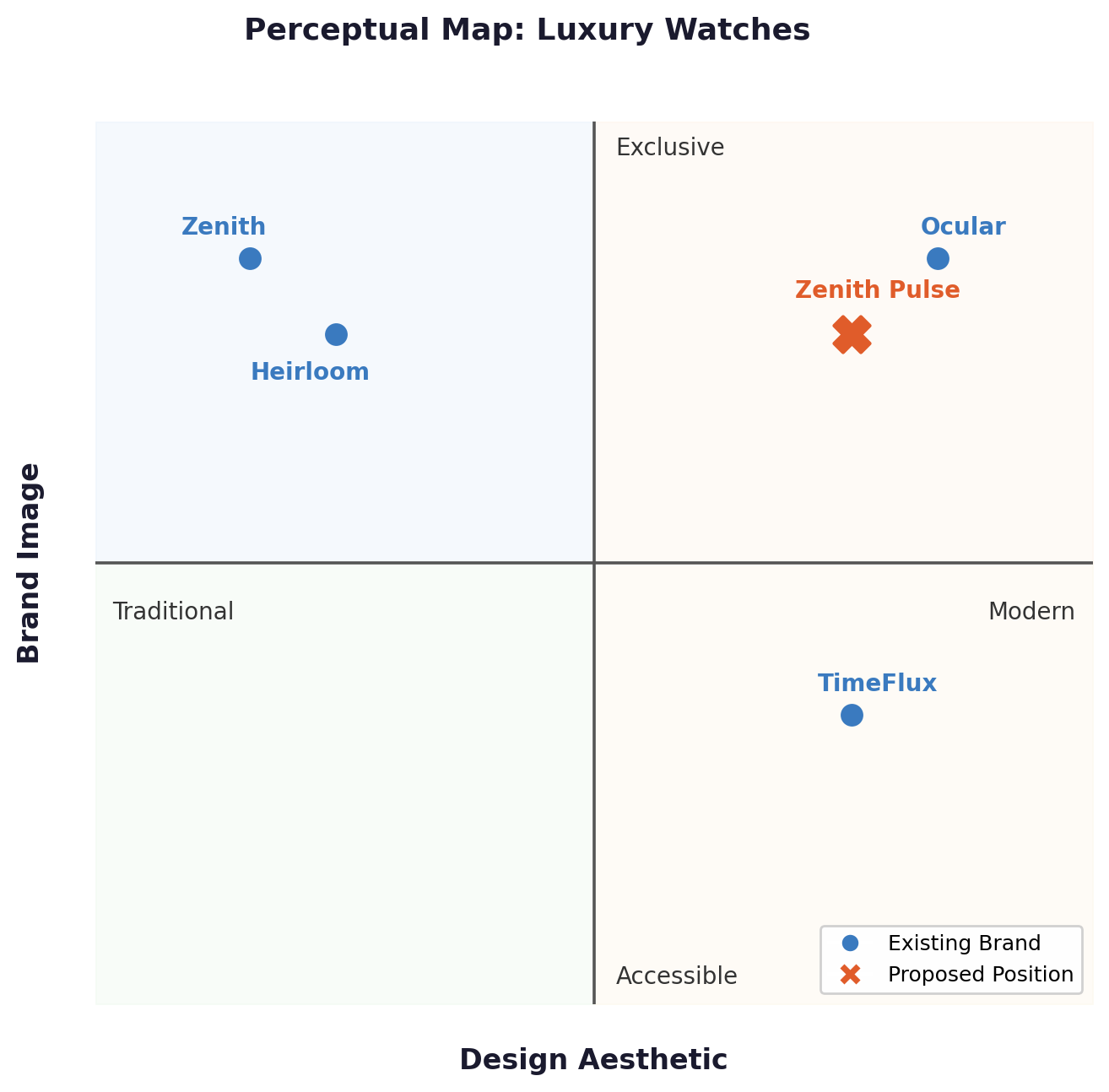
The management of 'Zenith,' a luxury watchmaker, is examining its position on the perceptual map below. Zenith is currently perceived as highly traditional. To increase its appeal to a younger demographic, a proposal is made to launch a sub-brand, 'Zenith Pulse,' positioned as 'Modern' but still 'Exclusive.' Which statement accurately assesses the primary risk of this strategy?
- The sub-brand will fail because the 'Modern & Exclusive' quadrant is already dominated by competitor 'Ocular'.
- The sub-brand must be priced lower than 'Zenith' watches, which will devalue the premium perception of the parent brand.
- If 'Zenith Pulse' is too closely associated with 'Zenith,' it could dilute the parent brand's clear, traditional positioning. (correct answer)
- A modern design is incompatible with an exclusive brand image, making the proposed position fundamentally unappealing to consumers.
Explanation: The correct answer is C. Brand dilution is a major risk when a brand with a very strong, clear identity (like Zenith's 'Traditional & Exclusive' position) launches a sub-brand with a conflicting identity ('Modern & Exclusive'). If consumers strongly link 'Zenith Pulse' back to the parent brand, it can confuse the market and weaken the hard-won perception of the original 'Zenith' brand. The core identity of the parent brand is at risk.
A is about competition, which is a risk, but brand dilution (C) is an internal risk to the existing brand equity.
B discusses pricing, which is a component of exclusivity but not the primary risk related to positioning on these specific axes.
D is an invalid assertion; the map shows a competitor, Ocular, successfully occupying that very position, proving it is viable.
Question 2
The perceptual map below shows the positions of several sedan brands based on consumer surveys. An automotive company is planning to launch a new brand, 'Aura,' at the position marked by the 'X'. Based on this map, which statement represents the most significant strategic challenge Aura will likely face upon market entry?
- Aura will be perceived as a low-quality, impractical vehicle due to its position in the bottom-left quadrant.
- Aura's position lacks a clear point of differentiation, placing it in direct and intense competition with both Brand B and Brand D. (correct answer)
- Aura is positioned too far from the luxury segment, making it impossible to command a premium price from consumers.
- Aura will struggle to gain market share because it is entering a market quadrant with no existing consumer demand.
Explanation: The correct answer is B because the position 'X' for Aura is located very close to both Brand B and Brand D. Proximity on a perceptual map indicates that consumers perceive the brands as similar, leading to direct competition. Aura lacks a unique position and will have to compete intensely on factors like price, promotion, or minor features to stand out from these established brands.
A is incorrect because the axes are 'Conservative vs. Sporty' and 'Practical vs. Luxurious,' not quality or practicality in general. A brand can be practical and conservative without being low-quality.
C is incorrect because while it's not in the 'Luxury' space, its position doesn't make it 'impossible' to command a premium over brands in the 'Practical' half; its price point will be relative to its direct competitors.
D is incorrect because the presence of two existing competitors (B and D) near position X strongly suggests that consumer demand exists in this area of the map; it is not an empty quadrant.
Question 3
An analyst is interpreting a perceptual map of the laptop market where the size of each brand's circle corresponds to its market share. Brand C and Brand D are positioned as direct competitors. Brand C has a much larger market share than Brand D. What is the most logical inference from this information?
- Brand C offers a superior combination of performance and portability compared to Brand D.
- Brand D is a new entrant and has not had enough time to build market share.
- Brand C and D are perceived similarly on these two dimensions, but Brand C is stronger on other attributes not shown on the map. (correct answer)
- Brand D should increase its advertising spending to close the market share gap with Brand C.
Explanation: The correct answer is C. The map shows that consumers perceive Brand C and Brand D as offering a very similar mix of performance and portability. Since their positions are nearly identical, their differentiation must come from factors not on the map. These could include brand reputation, customer service, distribution channels, price, or other features. Brand C's larger market share suggests it has an advantage in one or more of these unmapped dimensions.
A is incorrect because their similar positions mean they are perceived as offering a comparable, not superior, combination of the two mapped attributes.
B is a possible explanation, but it is an assumption not directly supported by the map; C is a more direct inference from the data presented.
D is a potential marketing action, not an inference explaining the current situation.
Question 4
A beverage company is using the perceptual map to find an opportunity for a new soft drink. A junior analyst notes that the area for 'Low Sweetness / Exotic Flavor' is completely empty and suggests launching a product there. Which of the brand positions shown on the map most strongly challenges the viability of this empty space?
- The success of ColaCorp and PopSoda, which indicates a strong market preference for traditional flavors.
- The proximity of Zest+ and AquaFizz, suggesting intense competition in the low sweetness category regardless of flavor.
- The isolated position of Tropicana, which demonstrates that exotic flavors are a niche market with limited appeal.
- The position of Glucorush, which pairs an exotic flavor with high sweetness, suggesting consumers who want exotic flavors also prefer high sweetness. (correct answer)
Explanation: The correct answer is D. This question requires multi-step reasoning. The analyst sees an empty space. The student must find evidence on the map that suggests the space is empty for a good reason. Glucorush is the only product in the 'Exotic Flavor' category, and it is positioned at the highest level of sweetness. This implies a strong correlation in consumer preference: the segment of the market that desires exotic flavors also desires high sweetness. Therefore, a product with low sweetness and an exotic flavor would fail to meet the preferences of this key segment, making the empty space a likely 'hole' in the market, not an opportunity.
A, B, and C are plausible observations but D provides the most direct evidence by showing the attributes of the only successful product in the exotic flavor space.
Question 5
A car manufacturer is analyzing the provided map, which includes an ideal point for the 'Young Urban Professionals' segment. The manufacturer's Brand X is currently perceived as Conservative and Practical. To effectively target this segment, Brand X would need to undertake a repositioning effort that emphasizes which combination of changes?
- Maintaining its practical focus while making the styling significantly more sporty.
- Making the styling sportier and shifting its focus to be more luxurious. (correct answer)
- Shifting its focus to luxury while maintaining its conservative styling.
- Making marginal improvements to both styling and luxury focus to move towards the center of the map.
Explanation: The correct answer is B. This is a multi-step problem. First, locate Brand X (Conservative, Practical). Second, locate the 'Young Urban Professionals' ideal point (Sporty, Luxurious). Third, determine the path from Brand X to the ideal point. This path requires moving from the left side of the map (Conservative) to the right side (Sporty), and from the bottom of the map (Practical) to the top (Luxurious). Therefore, the repositioning effort must involve changes on both dimensions.
A and C are incorrect because they only address changing one dimension, which would not move the brand close enough to the target segment's ideal point.
D is incorrect because the target is not the center of the map, but a specific quadrant, and marginal changes would be insufficient to cover the large perceptual distance.
Question 6
The following perceptual map illustrates the market for coffee shops. 'The Daily Grind' is considering a 15% price increase while keeping its service model and atmosphere the same. How would this change likely affect its competitive position on the map?
- It would shift horizontally to the right, becoming more of an 'experience-oriented' destination.
- It would shift vertically upwards, increasing the perceptual distance from 'Brew & Go' and moving it closer to 'Artisan Roast'. (correct answer)
- It would remain in the same position, as price changes alone do not alter consumer perceptions of brand experience.
- It would shift diagonally, as consumers would perceive both its price and convenience to be lower.
Explanation: The correct answer is B. The proposed action is a price increase only. On this map, price is the vertical axis ('Value' to 'Premium'). Therefore, a price increase would cause a vertical shift upwards toward the 'Premium' end. This move would increase its distance from the low-price 'Brew & Go' and decrease its distance to the high-price 'Artisan Roast,' making Artisan Roast a more direct competitor.
A is incorrect because the service model is not changing, so its position on the horizontal 'Convenience vs. Experience' axis should not change.
C is incorrect because price is a key attribute that strongly shapes perception and is a primary dimension on this map.
D is incorrect because the move is only along one dimension (price), and convenience would not be affected.
Question 7
The marketing director for an outdoor apparel company is reviewing the perceptual map. The map shows the company's brand, 'Summit,' and its key competitors. Which competitor's position on the map poses the most immediate and direct threat to Summit's market share?
- Brand V (Trekker), because it has a similar focus on technical performance.
- Brand X (Urban Explorer), because it is the closest brand to Summit on the map. (correct answer)
- Brand W (All-Weather), because it dominates the durability dimension.
- Brand Y (Trailblazer), because it is closer to the center of the map and has broader appeal.
Explanation: The correct answer is B. On a perceptual map, the distance between two brands is inversely related to the level of direct competition. The closer two brands are, the more they are seen as substitutes by consumers, and the more intense their direct competition. Brand X (Urban Explorer) is plotted closest to Summit, indicating that consumers perceive them as offering the most similar combination of style and performance. Therefore, Urban Explorer is Summit's most direct competitor and poses the most immediate threat.
A is incorrect because while Trekker is similar on one dimension (performance), it is very different on the other (style), making it a less direct competitor than Urban Explorer.
C and D are incorrect because neither brand's position is as close to Summit as Urban Explorer's is.
Question 8
A university's marketing department created the perceptual map to understand its competitive position. If the university initiates a major investment in its career services and internship programs, which would directly improve its graduates' job placement rates, how would its position on the map be expected to shift?
- It would move upwards, reflecting an improvement in academic reputation.
- It would move to the right, reflecting an enhanced focus on career outcomes. (correct answer)
- It would move diagonally up and to the right, improving on both dimensions simultaneously.
- Its position would not change, as these programs do not affect perception of tuition or academic reputation.
Explanation: The correct answer is B. The question requires linking a specific marketing action to a change in perception on the map. The action is investing in career services and job placement. The horizontal axis is 'Focus,' with the right side being 'Career Outcomes.' Therefore, a successful investment in this area should shift the university's perceived position to the right.
A is incorrect because career services are distinct from academic reputation (the vertical axis), which is more related to faculty research, selectivity, and program rigor.
C is incorrect because the action described does not have a direct, immediate impact on academic reputation.
D is incorrect because a major, successful initiative in a key area like career outcomes would almost certainly shift perceptions.
Question 9
The following map shows the positions of several fashion retailers in 2020 and their new positions in 2024, indicated by arrows. Based on the movement shown, which company's strategic shift has resulted in the most significant increase in direct competition with 'VogueWear'?
- StyleHouse, because it moved into the same quadrant as VogueWear.
- ChicCo, because its movement parallels VogueWear's own shift, maintaining competitive distance.
- Everyday Threads, because it moved from a distant position to one of direct perceptual overlap with VogueWear's 2024 position. (correct answer)
- LuxeLife, because it now occupies the premium position that VogueWear abandoned.
Explanation: The correct answer is C. The question asks which brand's shift resulted in the most significant increase in competition with VogueWear. Everyday Threads started in a completely different market space (Fast Fashion, Low Quality) and moved directly to the position now occupied by VogueWear (Timeless, High Quality). This constitutes a massive strategic shift, creating a new, direct competitor where none previously existed.
A is incorrect because while StyleHouse is in the same quadrant, its final position is still perceptually distinct from VogueWear.
B is incorrect because parallel movement, by definition, maintains the competitive distance and positioning relative to each other.
D is incorrect because LuxeLife is moving away from VogueWear's new position, reducing direct competition with where VogueWear is now.
Question 10
The provided perceptual map displays several fast-food chains based on service speed and food quality. Management at 'Quickly's' (currently positioned as fast service, low quality) wants to reposition the brand to compete with 'Speedy Gourmet'. What does the map suggest is the most significant barrier to this repositioning strategy?
- The market for high-quality, fast food is already saturated with competitors like Speedy Gourmet and Fresh & Fast.
- Consumers are unlikely to find a brand promise of high-quality food credible from a company known for prioritizing speed and low cost. (correct answer)
- Moving to a high-quality position would require abandoning Quickly's core competency of fast service.
- The cost of improving food quality will force a price increase, moving the brand into competition with 'The Bistro'.
Explanation: The correct answer is B. Perceptual maps reflect consumer perceptions, which are often deeply ingrained and difficult to change. A brand like 'Quickly's,' whose entire identity is built on low quality and high speed, would face a significant credibility gap in trying to convince consumers it can deliver high-quality food. This is a larger barrier than simply entering a competitive space. The repositioning requires a massive shift in perception, which is more difficult than operational changes alone.
A is a valid concern, but the credibility issue (B) is a more fundamental barrier to the success of the repositioning attempt itself.
C is incorrect because the goal is to move towards 'Speedy Gourmet,' which occupies a 'Fast Service, High Quality' position, implying it's possible to have both. The repositioning would not require abandoning speed.
D discusses a potential consequence (price increase), but the most significant barrier is whether consumers will believe the new positioning in the first place, regardless of price.
Question 11
A marketing manager for a hotel chain is analyzing the perceptual map. Brand D and Brand E are located very close to each other on the map. However, financial reports show that Brand D is highly profitable while Brand E is struggling to break even. What is the most plausible explanation for this discrepancy, according to a proper interpretation of the map?
- The perceptual map is inaccurate because profitable and unprofitable brands cannot be perceived as similar.
- Brand D likely has a higher advertising budget, leading to its superior profitability.
- The brands are perceived as close substitutes, but Brand D likely has a superior cost structure or operational efficiency. (correct answer)
- Brand E should reposition to the 'Budget / Leisure' quadrant to escape competition with Brand D.
Explanation: The correct answer is C. A perceptual map shows how consumers perceive brands, not their internal financial performance. If two brands are perceived as nearly identical (close substitutes), but have vastly different financial outcomes, the explanation must lie in factors not captured by the map's dimensions. These are typically internal factors like cost management, supply chain efficiency, or better management. Brand D could be delivering the same perceived value as Brand E but at a much lower cost.
A is incorrect; perceptual maps measure perception, not financial viability. It is very common for similarly perceived brands to have different outcomes.
B is a possibility, but a superior cost structure (C) is a more fundamental and direct explanation for higher profitability when perceived value is similar. High ad spend does not guarantee profitability.
D is a strategic suggestion, not an explanation for the current situation.
Question 12
A consultant presents the perceptual map for the streaming services market. After reviewing the distribution of existing services, the consultant identifies a potential opportunity in the 'Niche Content / Low Price' quadrant. Which statement provides the strongest reason to be skeptical of this proposed opportunity?
- Services with niche content are generally unable to attract a large enough subscriber base to be profitable.
- The 'Niche Content / High Price' quadrant is also empty, suggesting a broader issue with niche content offerings.
- The dominant position of StreamFlix at a low price point creates immense pricing pressure for any new entrant.
- The absence of any brand in that quadrant may indicate a 'hole' in the market that exists because it is not a viable or profitable position. (correct answer)
Explanation: The correct answer is D. While an empty space on a perceptual map can represent an untapped opportunity (a 'blue ocean'), it can also represent a combination of attributes that consumers do not want or that is not commercially viable to provide. The fact that no company, new or established, has occupied this space is a strong signal that it might be a 'market hole' rather than a 'market opportunity'. A critical analyst must first question why the space is empty.
A is a generalization that may not be true; many niche services are profitable. The map itself doesn't provide enough information to support this claim.
B is an observation, but it doesn't explain why the quadrant is empty. D provides a more direct and critical evaluation of the specific empty space in question.
C is a valid competitive threat but doesn't address the fundamental viability of the 'Niche Content / Low Price' position itself, which is the core of the consultant's proposal.
Question 13
The perceptual map was created without explicitly labeling the axes. Based on the relative positions of the well-known brands shown, which of the following are the most likely labels for Axis 1 (horizontal) and Axis 2 (vertical)?
- Axis 1: Quality; Axis 2: Price
- Axis 1: Variety; Axis 2: Convenience
- Axis 1: Price (Low to High); Axis 2: Nutrition (Low to High) (correct answer)
- Axis 1: Customer Service (Poor to Good); Axis 2: Price
Explanation: The correct answer is C. This question requires inferring the dimensions based on common knowledge of the brands. McDonald's and Taco Bell are generally perceived as low price. Whole Foods is high price. This fits a Low-to-High Price X-axis (Axis 1). For the Y-axis, McDonald's and Taco Bell are generally perceived as having lower nutritional value, while Subway is perceived as healthier, and Whole Foods is perceived as very healthy/natural. This fits a Low-to-High Nutrition Y-axis (Axis 2).
A is incorrect because while Whole Foods is high price/high quality, McDonald's vs. Subway is less clear on a single 'quality' dimension.
B is incorrect as Subway has less variety than Whole Foods, and convenience is similar for the fast-food outlets.
D is incorrect because customer service is not the primary differentiator between these specific brands in the way price and health perceptions are.
Question 14
A marketing team is analyzing the competitive landscape for snack foods using the perceptual map below. The map includes ideal points for three distinct consumer segments (Segment 1, Segment 2, Segment 3). Which brand is most poorly positioned, failing to adequately meet the preferences of any major consumer segment?
- Brand V, because it is located in a crowded space with many direct competitors.
- Brand W, because it is perceived as the most indulgent and traditional snack.
- Brand X, because it is positioned far from all three identified consumer segment ideal points. (correct answer)
- Brand Y, because it has no competitors in the healthy and innovative quadrant.
Explanation: The correct answer is C. The effectiveness of a brand's position is often determined by its proximity to consumer ideal points. Brand X is located in a part of the map with no ideal points nearby, indicating that its combination of attributes (moderately indulgent, moderately innovative) does not align well with the preferences of any of the major identified segments. This suggests it may struggle with low sales and a lack of a loyal customer base.
A is incorrect because while Brand V is in a competitive space, its proximity to Segment 2's ideal point suggests it is well-positioned to serve that large segment.
B is incorrect because Brand W's position, while extreme, is very close to the ideal point for Segment 1, indicating it strongly appeals to that group.
D is incorrect because being without direct competitors (a 'blue ocean') can be a significant strategic advantage, especially if it is near an ideal point like Segment 3, which Brand Y is.
Question 15
The perceptual map below shows brands in the yogurt market. The company that owns Brand Y, a leader in the 'Low Fat / Low Sugar' segment, wants to launch a new product to capture a different part of the market. Which new product position would create the highest risk of sales cannibalization for Brand Y?
- Position 1, to compete directly with 'Indulgence Creamery' in the high fat, high sugar segment.
- Position 2, to create a new niche of low fat, high sugar yogurt.
- Position 3, to offer a slightly healthier version of 'Indulgence Creamery'.
- Position 4, to offer a slightly less healthy option that is still very close to Brand Y's current position. (correct answer)
Explanation: The correct answer is D. Cannibalization occurs when a company's new product takes sales away from its existing products rather than from competitors. This risk is highest when the new product is perceived as very similar to an existing product. Position 4 is located very close to Brand Y on the perceptual map. A new product launched there would be seen as a close substitute by Brand Y's existing customers, many of whom might switch to the new product, resulting in little to no net gain in sales for the company.
A, B, and C all represent positions that are perceptually distant from Brand Y, meaning they would likely attract different customer segments and compete with other brands, minimizing the risk of cannibalization.
Question 16
The perceptual map below was generated using multidimensional scaling (MDS) based on customer ratings of brand similarity for several grocery retailers. The axes represent abstract underlying dimensions. Without knowing what the axes mean, what is the most definitive conclusion that can be drawn from the map?
- Retailer A and Retailer B compete more directly with each other than with Retailer E. (correct answer)
- Retailer C has the highest quality products of all the retailers shown.
- Retailer D is the market leader in terms of sales volume.
- There is a market opportunity for a new retailer to position itself between C and D.
Explanation: The correct answer is A. The fundamental principle of a perceptual map, especially one generated by MDS, is that the distance between brands represents perceived similarity. Brands that are closer together are seen as more similar and are therefore closer substitutes and more direct competitors. Retailer A and Retailer B are plotted very close to each other, while Retailer E is far away from both. Therefore, we can definitively conclude they are in more direct competition.
B is incorrect because we cannot know what the axes represent; the top of the map might not be 'high quality'.
C is incorrect as a perceptual map does not show market share or sales volume.
D is incorrect because the space between C and D could be a 'market hole'—an undesirable position that no one wants.
Question 17
The perceptual map below shows consumer perceptions of various athletic shoe brands. 'Aero,' a brand known for its classic designs and moderate performance, plans to launch a new high-performance shoe to compete with 'Momentum.' Based on the map, which risk should Aero's management be most concerned about with this new product launch?
- The new shoe will be perceived as too expensive for Aero's current customer base.
- The high-performance segment is too small to be profitable for a new entrant like Aero.
- The new shoe may be so similar to Aero's existing products that it confuses consumers and cannibalizes sales.
- Momentum and Apex have such strong brand equity in the high-performance space that Aero's entry will not be seen as credible. (correct answer)
Explanation: The correct answer is D. Aero is currently perceived as 'Classic' and 'Moderate Performance.' Momentum and Apex are clustered in the 'Modern / High Performance' quadrant. For Aero to launch a product in that space represents a significant leap in positioning. The biggest risk is that consumers, who associate Aero with a different set of attributes, will not find their entry into the high-performance category believable or authentic. This is a credibility problem.
A is about price, which is not on the map.
B makes an assumption about segment size that isn't supported by the map.
C describes cannibalization, which is a risk when a new product is too close to existing ones. Here, the proposed move is far away from Aero's current position, making credibility the bigger issue.
Question 18
Based on the distribution of brands in the perceptual map of the airline industry below, what is the most logical conclusion about the market structure?
- All airlines in the market are perceived as relatively undifferentiated by consumers.
- There appears to be a direct trade-off in the market; airlines with expansive route networks tend to have lower-quality service. (correct answer)
- The budget carriers and legacy carriers operate in completely separate markets with no competitive overlap.
- Most airlines are clustered around a central point, suggesting a lack of clear positioning strategies across the industry.
Explanation: The correct answer is B. This question requires interpreting the overall pattern of the brands, not just a single point. The brands on the map form a rough diagonal line from the top-left (High Service, Narrow Network) to the bottom-right (Low Service, Broad Network). This distribution suggests a negative correlation between the two dimensions. In this market, airlines that are perceived as having better service intangibles tend to have more limited route networks, and vice-versa. This implies a strategic trade-off.
A and D are incorrect because the brands are quite spread out, indicating clear differentiation.
C is incorrect because while there are distinct clusters, they are on the same map, meaning they are still compared by consumers and thus have some competitive overlap, even if indirect.
Question 19
A new cereal brand, 'Nutri-Crunch,' is launched and its initial perceived position is marked on the map below. Its marketing campaign heavily emphasized 'Great Taste.' However, post-launch surveys show the brand is perceived as only moderately tasty. According to the map, what is the most likely consumer perception of Nutri-Crunch?
- Consumers perceive it as a high-nutrition, great-tasting cereal, just as the campaign intended.
- Consumers perceive it as a low-nutrition, poor-tasting cereal, indicating a complete campaign failure.
- Consumers perceive it as having high nutrition but only moderate taste, placing it in a crowded space with Brands A and B. (correct answer)
- Consumers perceive its nutrition as lower than advertised due to the failure of the taste message to resonate.
Explanation: The correct answer is C. The question states the campaign emphasized 'Great Taste' but post-launch surveys show it's perceived as only 'moderately tasty.' This means its position on the horizontal 'Taste' axis is not at the far right ('Great') but somewhere in the middle. The stem provides no information to suggest the 'Nutrition' message failed, so we assume it was perceived as intended ('High Nutrition'). This places the brand on the top half of the map (High Nutrition) but in the center horizontally (Moderate Taste). This position is shown to be close to competitors A and B.
A is incorrect because the premise states the taste message was not fully successful.
B is incorrect as there is no reason to assume the nutrition perception also failed.
D incorrectly links the failure of the taste perception to a change in the nutrition perception; consumers can evaluate these attributes independently.
Question 20
A consulting firm analyzes the smartphone market and produces the perceptual map below. An industry executive argues that Brand E's position is competitively weak. Which statement provides the strongest support for this executive's claim?
- Brand E has no direct competitors, indicating a lack of consumer interest in its feature set.
- Brand E is positioned in the middle of the map, suggesting it lacks a clear, differentiated identity and is a 'jack of all trades, master of none'. (correct answer)
- Brand E's price is too high for its feature set when compared to Brand A, the market leader.
- Brand E fails to be either the cheapest option or the most feature-rich option available to consumers.
Explanation: The correct answer is B. Brands positioned in the center of a perceptual map often suffer from a lack of clear differentiation. They are not the best on any single dimension. In this case, Brand E is not the cheapest (like Brand B), not the most innovative (like Brand C), and not the most reliable (like Brand A). This 'stuck in the middle' position can be very weak, as it fails to be the top choice for any specific consumer segment.
A is incorrect because a lack of direct competitors is often a strength (a 'blue ocean').
C makes a specific price/feature comparison to Brand A, but the broader issue is its lack of differentiation against all competitors.
D is true, but B provides a more comprehensive strategic explanation for why this is a weak position—it points to the core marketing problem of an undifferentiated identity.