All questions
Question 1
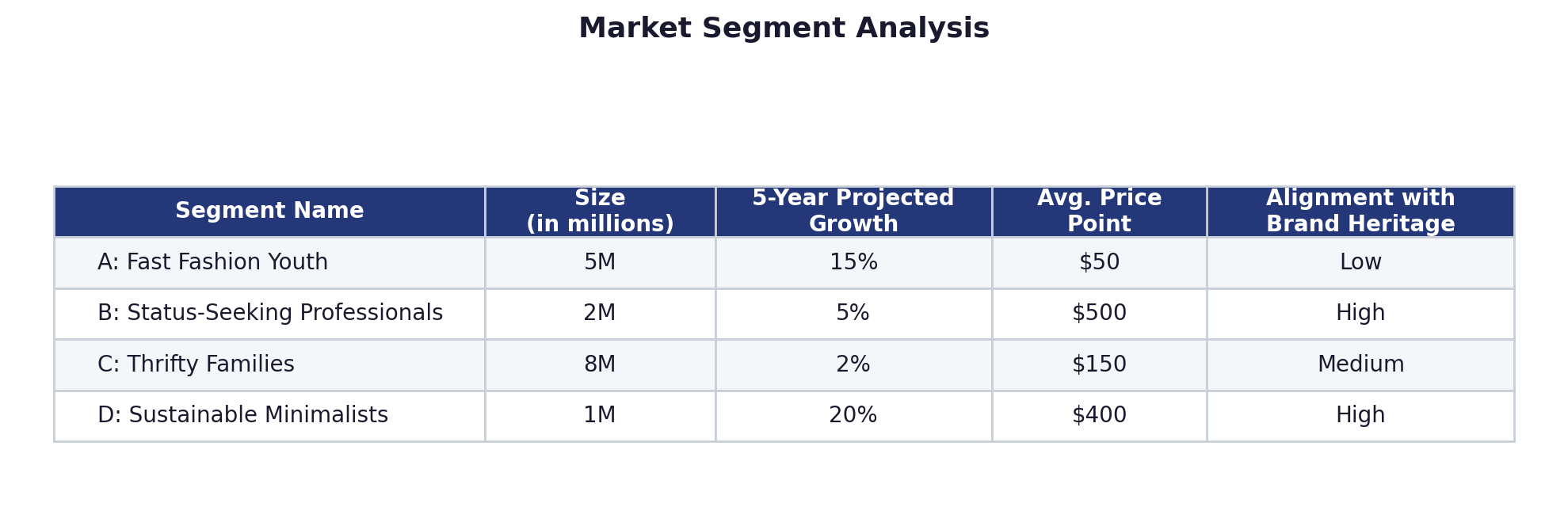
The table presents data for four segments being considered by a heritage brand that makes high-quality, durable leather goods. Which segment represents the most attractive strategic opportunity when balancing future growth potential with brand integrity?
- Segment A, because its high growth rate promises the most significant future revenue stream.
- Segment B, because its high alignment and high price point reinforce the brand's premium positioning.
- Segment C, because its very large size offers the greatest immediate sales volume.
- Segment D, because it offers the best combination of very high growth, high price point, and strong brand alignment. (correct answer)
Explanation: The correct answer is D. This question requires a holistic assessment, weighing multiple criteria. Segment A has high growth but poor brand fit ('Low' alignment), posing a risk to brand equity. Segment B has excellent fit but mediocre growth (5%). Segment C is large but has very low growth and only 'Medium' alignment. Segment D, while the smallest in current size, is the most strategically attractive because it excels on the three most important long-term factors: the highest projected growth (20%), a high price point that fits a premium brand ($400), and a 'High' alignment with the brand's heritage values.
Question 2
A B2B software company is analyzing two segments for its new data analytics tool. Segment A consists of 1,000 large enterprise corporations, with a potential average contract value (ACV) of $200,000. Segment B consists of 100,000 small-to-medium businesses (SMBs), with a potential ACV of 2,000.AjunioranalystrecommendsprioritizingSegmentA,arguingthatitstotalmarketpotential(200M) is equal to Segment B's ($200M), but the deals are larger and more prestigious.
The analyst's recommendation most critically overlooks which key difference that typically affects the attractiveness of an enterprise segment versus an SMB segment?
- Enterprise clients are more likely to have existing competitor solutions in place.
- The profitability per sale, which is likely higher for the larger enterprise contracts.
- The total market potential, which should be the primary factor for prioritization.
- The cost and length of the sales cycle, which are typically much higher for enterprise clients. (correct answer)
Explanation: The correct answer is D. While both segments may have the same theoretical market potential, their attractiveness is not equal. A critical difference is the cost and complexity of acquisition. Enterprise sales (Segment A) famously involve long sales cycles (often 6-18 months), multiple decision-makers, and high sales and marketing costs. SMB sales (Segment B) are typically faster and less costly per unit. Overlooking these vast differences in the cost-to-acquire and time-to-revenue can lead to a flawed evaluation of segment profitability and attractiveness.
Question 3
A company with a 50-year heritage of producing rugged, durable, and functional work boots is exploring expansion opportunities. They have identified a large and growing segment of 'Fashion-Forward Urbanites.' This segment is willing to pay premium prices for stylish footwear that has an 'authentic' or 'heritage' look. Market research indicates this segment is highly profitable. However, their purchasing decisions are driven by fleeting fashion trends and celebrity endorsements, not by the product's durability or functional performance.
What is the most significant risk to the attractiveness of the 'Fashion-Forward Urbanites' segment for this specific company?
- The segment's large size may strain the company's current production capacity, leading to stockouts and operational inefficiencies.
- The segment's willingness to pay premium prices may not be sustainable if the economy enters a downturn, leading to revenue volatility.
- Targeting this segment could dilute the brand's core identity of rugged functionality, potentially alienating its loyal, long-term customer base. (correct answer)
- The segment's reliance on celebrity endorsements will significantly increase marketing costs, thereby reducing the overall segment profitability.
Explanation: The correct answer is C. This question assesses the concept of 'strategic fit.' While the segment appears attractive based on size, growth, and profitability, it represents a poor fit with the company's established brand identity and core value proposition (durability and function). Catering to this trend-driven segment could damage the brand's authenticity and alienate its primary customers, which is a major strategic risk.
Question 4
An online retailer has recently started shipping its products globally and is evaluating its 'International Customers' segment. The segment shows promising growth and a higher average order value compared to domestic customers. Despite this, the company's controller reports that the net profit margin from this segment is significantly lower than expected. The products sold and their manufacturing costs are identical for both domestic and international customers.
Which factor is the most likely reason for the lower-than-expected profitability of the 'International Customers' segment?
- Higher variable costs associated with cross-border logistics, tariffs, and processing returns. (correct answer)
- Increased competition from local retailers in the customers' home countries.
- Lower brand loyalty among international customers leading to higher churn rates over time.
- The need to spend more on digital advertising to reach customers in different countries.
Explanation: When analyzing segment profitability, you need to consider all costs that differ between segments, not just the obvious ones like manufacturing. The key insight here is that identical products can have vastly different profit margins depending on the unique costs associated with serving each customer segment.
Answer A correctly identifies the primary culprit: higher variable costs from cross-border operations. International shipping is substantially more expensive than domestic delivery, often involving multiple carriers, customs processing, and longer transit times. Tariffs and duties add direct costs that don't exist domestically. Return processing becomes exponentially more complex and costly when products must cross borders twice. These operational costs can easily erode the benefit of higher average order values.
Answer B is incorrect because increased competition affects sales volume and pricing power, not the cost structure that's driving lower margins here. The passage indicates the segment is growing well, suggesting competition isn't the limiting factor.
Answer C misses the mark because customer churn affects long-term revenue and customer acquisition costs, but doesn't explain why current transactions are less profitable when the same products are being sold.
Answer D focuses on acquisition costs rather than fulfillment costs. While international advertising might be more expensive, these are typically fixed marketing investments, not variable costs that would directly impact the profit margin of each sale.
Study tip: When evaluating segment profitability issues, always trace through the entire customer journey from acquisition to fulfillment. International operations almost always involve hidden logistics costs that can surprise companies expanding globally.
Question 5
A startup has developed a new line of sustainable, cruelty-free cosmetics. Their target segment is 'Eco-conscious Gen Z,' consumers aged 18-25 who prioritize ethical production. Market research confirms this segment is large, growing, and aligns perfectly with the brand's values. The research also shows this segment overwhelmingly discovers and evaluates new products through influencer reviews on TikTok and Instagram. The startup's founding team, however, consists of marketing veterans with deep expertise in print advertising and public relations, but no experience with influencer or social media marketing.
This situation highlights a potential weakness in which two interconnected aspects of segment attractiveness?
- Size and Growth, as the team cannot effectively tap into the segment's potential.
- Profitability and Competitive Intensity, as they will have to spend more to compete online.
- Accessibility and Strategic Fit, as the team's capabilities do not match the segment's media habits. (correct answer)
- Fit and Profitability, as the brand values align but the marketing costs will be too high.
Explanation: The correct answer is C. The problem links two key criteria. 'Accessibility' is low because the company lacks the skills to use the channels (TikTok, Instagram) needed to reach the segment effectively. This lack of skills also creates a problem with 'Strategic Fit,' which isn't just about brand values but also about having the right resources and capabilities to serve the segment. The company's capabilities (print, PR) are a mismatch for what is required, making the otherwise perfect segment much less attractive.
Question 6
A new gourmet sandwich shop is deciding between two locations for its first store. Location A is in a bustling downtown business district with very high daytime foot traffic from a segment of 'Office Workers' with high disposable income. However, there are four other established, popular sandwich shops within a two-block radius. Location B is in a rapidly growing residential neighborhood. The primary segment is 'Young Families,' with moderate disposable income and less daytime foot traffic. There are no direct competitors for gourmet sandwiches within a one-mile radius.
When evaluating the attractiveness of the 'Office Workers' segment in Location A, which factor presents the most significant challenge?
- The segment's accessibility, as high foot traffic does not guarantee store visits.
- The segment's profitability, as office workers are likely to be price-sensitive during lunch hours.
- The intensity of existing competition, which will make it difficult and costly to capture market share. (correct answer)
- The segment's size and growth, as the population of office workers may be stagnant or declining.
Explanation: The correct answer is C. While the segment in Location A is attractive in terms of size (high foot traffic) and profitability (high disposable income), the presence of four established competitors creates a highly intense competitive environment. This significantly reduces the segment's attractiveness because it will require substantial marketing effort and/or a highly differentiated product to simply win customers from incumbents, thus increasing costs and risk.
Question 7
A B2B software firm is assessing the 'Small Non-Profit Organizations' segment. They've found that this segment is growing rapidly and is currently underserved by competitors, representing a significant market opportunity. However, they also discovered that these organizations have highly inconsistent revenue streams and very tight budgets, making them extremely price-sensitive and likely to have a high rate of subscription churn.
Which factors create the most significant tension when evaluating the attractiveness of this segment?
- High growth potential versus poor strategic fit with the firm's existing products.
- Large market size versus difficulty in reaching the segment with marketing.
- Low competitive intensity versus high cost to develop a new product for them.
- High growth and low competition versus low and unstable customer lifetime value. (correct answer)
Explanation: The correct answer is D. The core conflict in this scenario is between the positive market characteristics (high growth, low competition) and the negative customer characteristics (price sensitivity, high churn). High churn and price sensitivity directly lead to a low Customer Lifetime Value (CLV), which is a key measure of profitability. This tension between a seemingly open market and the poor economics of the customers within it is the central challenge in evaluating the segment's attractiveness.
Question 8
A U.S.-based medical device company has developed a revolutionary new surgical tool. It has identified a large and underserved segment of surgeons in Japan who would benefit greatly from the device. Market research confirms that this segment is sizable, has the funds to purchase the device, and is eager for better surgical solutions. However, the device has not yet been approved by Japan's Pharmaceuticals and Medical Devices Agency (PMDA), a regulatory process known to be lengthy and uncertain.
The lack of PMDA approval most directly and significantly undermines which criterion of segment attractiveness?
- Accessibility (correct answer)
- Strategic Fit
- Profitability
- Growth Potential
Explanation: When evaluating market segments, marketers assess four key criteria: accessibility (can you actually reach and serve the segment?), strategic fit (does it align with company capabilities?), profitability (will it generate adequate returns?), and growth potential (is the segment expanding?). Regulatory approval issues directly impact your ability to legally enter and serve a market.
The lack of PMDA approval creates an accessibility problem. Even though willing customers exist with purchasing power, the company cannot legally sell to them without regulatory clearance. Accessibility means having the practical ability to reach customers and deliver your product - regulatory barriers make the segment effectively inaccessible regardless of customer demand.
Let's examine why the other options don't fit: (B) Strategic fit remains strong since the company has developed the right product for the right customer need - the regulatory hurdle doesn't change whether this aligns with company capabilities. (C) Profitability isn't directly undermined because the research confirms customers have funds and demand exists; once approved, profit potential remains intact. (D) Growth potential stays positive since the underlying market trends and customer needs driving segment expansion haven't changed due to the approval issue.
The key insight is that accessibility problems are often regulatory or logistical barriers that prevent market entry, while the other criteria focus on whether the opportunity itself is attractive. Remember: a segment can look perfect on paper (profitable, growing, aligned with your strategy) but still be inaccessible due to external barriers like regulations, distribution challenges, or legal restrictions.
Question 9
A marketing manager has identified a new consumer segment that is substantial in size, shows a consistent 10% annual growth rate, and is easily reachable via the company's existing distribution channels. Which of the following additional findings would be the most compelling reason to classify this segment as unattractive?
- The company's current brand awareness within the segment is less than 5%.
- The segment's needs would require minor modifications to the company's flagship product.
- Analysis shows the average customer lifetime value (CLV) within the segment is negative. (correct answer)
- A major competitor has recently launched a marketing campaign targeting the same segment.
Explanation: The correct answer is C. The other factors represent challenges that can often be overcome. Low brand awareness (A) can be addressed with marketing. Product modifications (B) are a standard part of business. Competition (D) is a challenge, but not a disqualifier. However, a negative Customer Lifetime Value (CLV) is a fundamental flaw. It means that, on average, the company loses money on every customer it acquires from this segment over the long run. This makes the segment inherently unprofitable and therefore unattractive, regardless of its size, growth, or accessibility.
Question 10
A manufacturer of high-performance electric vehicles (EVs) is evaluating two potential customer segments. Segment A consists of 'Tech-Savvy Early Adopters' who are knowledgeable about EV technology. This segment is currently large but projected to have slow growth. They are highly price-sensitive and acquisition costs are high due to a competitive landscape. Segment B, 'Eco-Conscious Families,' is a smaller, emerging segment with a very high projected growth rate. They are less price-sensitive, valuing safety and sustainability over raw performance, and acquisition costs are currently low.
Given the company's position as a high-performance EV brand, which of the following provides the most accurate evaluation of these two segments' attractiveness?
- Segment A is more attractive because its large current size presents a greater immediate revenue opportunity and aligns better with a high-performance brand.
- Segment B is more attractive due to its high growth potential, lower price sensitivity, and lower acquisition costs, indicating higher long-term profitability. (correct answer)
- Both segments are equally attractive, as Segment A's large size is balanced by Segment B's high growth rate, making the choice dependent on short-term versus long-term goals.
- Neither segment is attractive, as Segment A has low profitability due to price sensitivity, and Segment B does not align with the company's high-performance brand image.
Explanation: The correct answer is B. A key principle of segment attractiveness is evaluating long-term profitability. Segment B, despite being smaller currently, shows stronger indicators of future profitability: high growth, low price sensitivity (allowing for better margins), and lower acquisition costs. These factors combined often outweigh the appeal of a large but stagnant and price-sensitive segment like A.
Question 11
A small, high-end chocolatier is renowned for its artisanal, handcrafted chocolates made in small batches. The owner is considering two segments for expansion. Segment A is 'Corporate Gifting,' which would require producing thousands of standardized, logo-branded boxes of chocolates, primarily during the holiday season. This segment promises high-volume, recurring revenue. Segment B is 'Gourmet Food Tours,' which involves partnering with tour operators to offer tasting experiences and sell premium, curated chocolate collections to small groups of tourists.
From a strategic fit perspective, why is the 'Corporate Gifting' segment likely less attractive for the chocolatier?
- The seasonal demand would lead to inconsistent revenue streams throughout the year.
- The required high-volume production conflicts with the company's core capability of small-batch artisanship. (correct answer)
- The corporate clients would likely be very price-sensitive and negotiate for large discounts.
- The market is already saturated with large, established players in the corporate gifting space.
Explanation: The correct answer is B. This question focuses on 'fit' in terms of operational capabilities and resources. The chocolatier's core strength and brand identity are built on small-batch, handcrafted quality. The demands of the 'Corporate Gifting' segment (high-volume, standardized production) are in direct opposition to these capabilities. Fulfilling these orders would require a fundamental change in their production process, which could compromise their quality and brand, making it a poor strategic fit.
Question 12
A large food and beverage company identifies a growing segment of 'Health-Conscious Consumers' who want snacks with very specific nutritional profiles (e.g., low-glycemic, plant-based, no artificial ingredients). The company's marketing department confirms it can reach this segment effectively, and its finance department confirms the segment is profitable. However, the company's R&D division has no experience with these ingredients, and its manufacturing plants are not equipped to handle the required production processes without a multi-million dollar overhaul.
This company's primary obstacle in targeting this otherwise attractive segment relates to a lack of:
- accessibility.
- strategic fit.
- profitability.
- actionability. (correct answer)
Explanation: The correct answer is D. Actionability is the criterion that evaluates whether a company has the resources and capabilities to create products and marketing programs that will effectively serve the target segment. In this case, while the segment is attractive on other dimensions (fit, accessibility, profitability), the company lacks the R&D and manufacturing capabilities to actually create the product the segment desires. This is a classic actionability problem.
Question 13
A software-as-a-service (SaaS) company is evaluating two segments. Segment A is comprised of businesses using a competitor's software that is being discontinued next year. This creates a large, one-time opportunity to migrate these customers. Once these businesses have chosen a new provider, this specific market opportunity will disappear. Segment B consists of new startups in a growing industry that are adopting this type of software for the first time. This segment is smaller than Segment A today but is expected to grow by 20% annually for the foreseeable future.
Which statement provides the most accurate assessment of Segment A's attractiveness?
- Attractive for securing short-term revenue, but unattractive from the perspective of sustainable, long-term growth. (correct answer)
- Unattractive, because these customers are likely to be loyal to the competitor and resistant to change.
- Highly attractive, as the clear and present need reduces customer acquisition costs and shortens the sales cycle.
- Neither attractive nor unattractive until the competitive response to the market opportunity is clear.
Explanation: When evaluating market segments, you need to consider both immediate opportunity and long-term sustainability. This question tests your ability to analyze segment attractiveness across different time horizons and recognize the strategic trade-offs involved.
Segment A presents a classic time-limited opportunity. The competitor's software discontinuation creates urgency and reduces switching barriers, making these customers more receptive to new solutions. This can indeed lead to faster sales cycles and strong short-term revenue. However, once this migration window closes, the opportunity vanishes entirely. There's no mechanism for continued growth from this segment—it's essentially a one-time harvest.
Answer A correctly identifies this dual nature: attractive for immediate revenue but problematic for sustainable growth. The assessment acknowledges both the short-term benefits and long-term limitations.
Answer B is wrong because it misreads the situation entirely. These customers aren't loyal to a competitor—they're forced to switch because their current software is being discontinued. They have no choice but to migrate.
Answer C overstates the attractiveness by focusing only on the immediate benefits while ignoring the fundamental sustainability problem. Yes, acquisition costs may be lower and sales cycles shorter, but this doesn't make the segment "highly attractive" overall when growth prospects are considered.
Answer D incorrectly suggests the assessment depends on competitive response. The segment's characteristics—large but time-limited—are clear regardless of what competitors do.
Remember: Strong segment evaluation requires balancing immediate opportunity against long-term growth potential. Beware of segments that offer short-term windfalls but no sustainable growth engine.
Question 14
A manufacturer of high-performance electric vehicles (EVs) is evaluating two potential customer segments. Segment A consists of 'Tech-Savvy Early Adopters' who are knowledgeable about EV technology. This segment is currently large but projected to have slow growth. They are highly price-sensitive and acquisition costs are high due to a competitive landscape. Segment B, 'Eco-Conscious Families,' is a smaller, emerging segment with a very high projected growth rate. They are less price-sensitive, valuing safety and sustainability over raw performance, and acquisition costs are currently low.
Given the company's position as a high-performance EV brand, which of the following provides the most accurate evaluation of these two segments' attractiveness?
- Segment A is more attractive because its large current size presents a greater immediate revenue opportunity and aligns better with a high-performance brand.
- Segment B is more attractive due to its high growth potential, lower price sensitivity, and lower acquisition costs, indicating higher long-term profitability. (correct answer)
- Both segments are equally attractive, as Segment A's large size is balanced by Segment B's high growth rate, making the choice dependent on short-term versus long-term goals.
- Neither segment is attractive, as Segment A has low profitability due to price sensitivity, and Segment B does not align with the company's high-performance brand image.
Explanation: The correct answer is B. A key principle of segment attractiveness is evaluating long-term profitability. Segment B, despite being smaller currently, shows stronger indicators of future profitability: high growth, low price sensitivity (allowing for better margins), and lower acquisition costs. These factors combined often outweigh the appeal of a large but stagnant and price-sensitive segment like A.
Question 15
A company with a 50-year heritage of producing rugged, durable, and functional work boots is exploring expansion opportunities. They have identified a large and growing segment of 'Fashion-Forward Urbanites.' This segment is willing to pay premium prices for stylish footwear that has an 'authentic' or 'heritage' look. Market research indicates this segment is highly profitable. However, their purchasing decisions are driven by fleeting fashion trends and celebrity endorsements, not by the product's durability or functional performance.
What is the most significant risk to the attractiveness of the 'Fashion-Forward Urbanites' segment for this specific company?
- The segment's large size may strain the company's current production capacity, leading to stockouts and operational inefficiencies.
- The segment's willingness to pay premium prices may not be sustainable if the economy enters a downturn, leading to revenue volatility.
- Targeting this segment could dilute the brand's core identity of rugged functionality, potentially alienating its loyal, long-term customer base. (correct answer)
- The segment's reliance on celebrity endorsements will significantly increase marketing costs, thereby reducing the overall segment profitability.
Explanation: The correct answer is C. This question assesses the concept of 'strategic fit.' While the segment appears attractive based on size, growth, and profitability, it represents a poor fit with the company's established brand identity and core value proposition (durability and function). Catering to this trend-driven segment could damage the brand's authenticity and alienate its primary customers, which is a major strategic risk.
Question 16
A financial technology (FinTech) firm specializes in investment tools for experienced, active traders. They are evaluating the 'College Student' segment. Currently, this segment is small, has limited investment capital, and is not actively trading, making it unattractive by standard metrics. However, industry forecasts predict a massive increase in retail investing among young adults over the next 5-10 years, driven by new technologies and a cultural shift towards financial literacy.
How does the predicted industry trend most significantly impact the current evaluation of the 'College Student' segment's attractiveness?
- It has no impact, as segments must be evaluated based on their current, measurable size and profitability.
- It makes the segment immediately attractive, and the firm should pivot all resources to target it now.
- It significantly increases the attractiveness of the segment's future growth potential, making it a strategic target for long-term investment. (correct answer)
- It decreases the segment's attractiveness by signaling that intense competition will soon enter this market.
Explanation: The correct answer is C. Segment attractiveness is not a static evaluation; it must consider future potential. While the 'College Student' segment is currently unattractive based on size and profitability, its projected high growth rate makes it highly attractive from a long-term strategic perspective. Companies often target such segments early to build brand loyalty and capture future value, even if it's not profitable in the short term. The other options represent flawed reasoning: A is too short-sighted, B is an overreaction, and D, while plausible, is a secondary effect of the primary factor which is the massive growth potential.
Question 17
A small, high-end chocolatier is renowned for its artisanal, handcrafted chocolates made in small batches. The owner is considering two segments for expansion. Segment A is 'Corporate Gifting,' which would require producing thousands of standardized, logo-branded boxes of chocolates, primarily during the holiday season. This segment promises high-volume, recurring revenue. Segment B is 'Gourmet Food Tours,' which involves partnering with tour operators to offer tasting experiences and sell premium, curated chocolate collections to small groups of tourists.
From a strategic fit perspective, why is the 'Corporate Gifting' segment likely less attractive for the chocolatier?
- The seasonal demand would lead to inconsistent revenue streams throughout the year.
- The required high-volume production conflicts with the company's core capability of small-batch artisanship. (correct answer)
- The corporate clients would likely be very price-sensitive and negotiate for large discounts.
- The market is already saturated with large, established players in the corporate gifting space.
Explanation: The correct answer is B. This question focuses on 'fit' in terms of operational capabilities and resources. The chocolatier's core strength and brand identity are built on small-batch, handcrafted quality. The demands of the 'Corporate Gifting' segment (high-volume, standardized production) are in direct opposition to these capabilities. Fulfilling these orders would require a fundamental change in their production process, which could compromise their quality and brand, making it a poor strategic fit.
Question 18
A B2B software company is analyzing two segments for its new data analytics tool. Segment A consists of 1,000 large enterprise corporations, with a potential average contract value (ACV) of $200,000. Segment B consists of 100,000 small-to-medium businesses (SMBs), with a potential ACV of 2,000.AjunioranalystrecommendsprioritizingSegmentA,arguingthatitstotalmarketpotential(200M) is equal to Segment B's ($200M), but the deals are larger and more prestigious.
The analyst's recommendation most critically overlooks which key difference that typically affects the attractiveness of an enterprise segment versus an SMB segment?
- Enterprise clients are more likely to have existing competitor solutions in place.
- The profitability per sale, which is likely higher for the larger enterprise contracts.
- The total market potential, which should be the primary factor for prioritization.
- The cost and length of the sales cycle, which are typically much higher for enterprise clients. (correct answer)
Explanation: The correct answer is D. While both segments may have the same theoretical market potential, their attractiveness is not equal. A critical difference is the cost and complexity of acquisition. Enterprise sales (Segment A) famously involve long sales cycles (often 6-18 months), multiple decision-makers, and high sales and marketing costs. SMB sales (Segment B) are typically faster and less costly per unit. Overlooking these vast differences in the cost-to-acquire and time-to-revenue can lead to a flawed evaluation of segment profitability and attractiveness.
Question 19
An online retailer has recently started shipping its products globally and is evaluating its 'International Customers' segment. The segment shows promising growth and a higher average order value compared to domestic customers. Despite this, the company's controller reports that the net profit margin from this segment is significantly lower than expected. The products sold and their manufacturing costs are identical for both domestic and international customers.
Which factor is the most likely reason for the lower-than-expected profitability of the 'International Customers' segment?
- Higher variable costs associated with cross-border logistics, tariffs, and processing returns. (correct answer)
- Increased competition from local retailers in the customers' home countries.
- Lower brand loyalty among international customers leading to higher churn rates over time.
- The need to spend more on digital advertising to reach customers in different countries.
Explanation: When analyzing segment profitability, you need to consider all costs that differ between segments, not just the obvious ones like manufacturing. The key insight here is that identical products can have vastly different profit margins depending on the unique costs associated with serving each customer segment.
Answer A correctly identifies the primary culprit: higher variable costs from cross-border operations. International shipping is substantially more expensive than domestic delivery, often involving multiple carriers, customs processing, and longer transit times. Tariffs and duties add direct costs that don't exist domestically. Return processing becomes exponentially more complex and costly when products must cross borders twice. These operational costs can easily erode the benefit of higher average order values.
Answer B is incorrect because increased competition affects sales volume and pricing power, not the cost structure that's driving lower margins here. The passage indicates the segment is growing well, suggesting competition isn't the limiting factor.
Answer C misses the mark because customer churn affects long-term revenue and customer acquisition costs, but doesn't explain why current transactions are less profitable when the same products are being sold.
Answer D focuses on acquisition costs rather than fulfillment costs. While international advertising might be more expensive, these are typically fixed marketing investments, not variable costs that would directly impact the profit margin of each sale.
Study tip: When evaluating segment profitability issues, always trace through the entire customer journey from acquisition to fulfillment. International operations almost always involve hidden logistics costs that can surprise companies expanding globally.
Question 20
A U.S.-based medical device company has developed a revolutionary new surgical tool. It has identified a large and underserved segment of surgeons in Japan who would benefit greatly from the device. Market research confirms that this segment is sizable, has the funds to purchase the device, and is eager for better surgical solutions. However, the device has not yet been approved by Japan's Pharmaceuticals and Medical Devices Agency (PMDA), a regulatory process known to be lengthy and uncertain.
The lack of PMDA approval most directly and significantly undermines which criterion of segment attractiveness?
- Accessibility (correct answer)
- Strategic Fit
- Profitability
- Growth Potential
Explanation: When evaluating market segments, marketers assess four key criteria: accessibility (can you actually reach and serve the segment?), strategic fit (does it align with company capabilities?), profitability (will it generate adequate returns?), and growth potential (is the segment expanding?). Regulatory approval issues directly impact your ability to legally enter and serve a market.
The lack of PMDA approval creates an accessibility problem. Even though willing customers exist with purchasing power, the company cannot legally sell to them without regulatory clearance. Accessibility means having the practical ability to reach customers and deliver your product - regulatory barriers make the segment effectively inaccessible regardless of customer demand.
Let's examine why the other options don't fit: (B) Strategic fit remains strong since the company has developed the right product for the right customer need - the regulatory hurdle doesn't change whether this aligns with company capabilities. (C) Profitability isn't directly undermined because the research confirms customers have funds and demand exists; once approved, profit potential remains intact. (D) Growth potential stays positive since the underlying market trends and customer needs driving segment expansion haven't changed due to the approval issue.
The key insight is that accessibility problems are often regulatory or logistical barriers that prevent market entry, while the other criteria focus on whether the opportunity itself is attractive. Remember: a segment can look perfect on paper (profitable, growing, aligned with your strategy) but still be inaccessible due to external barriers like regulations, distribution challenges, or legal restrictions.