All questions
Question 1
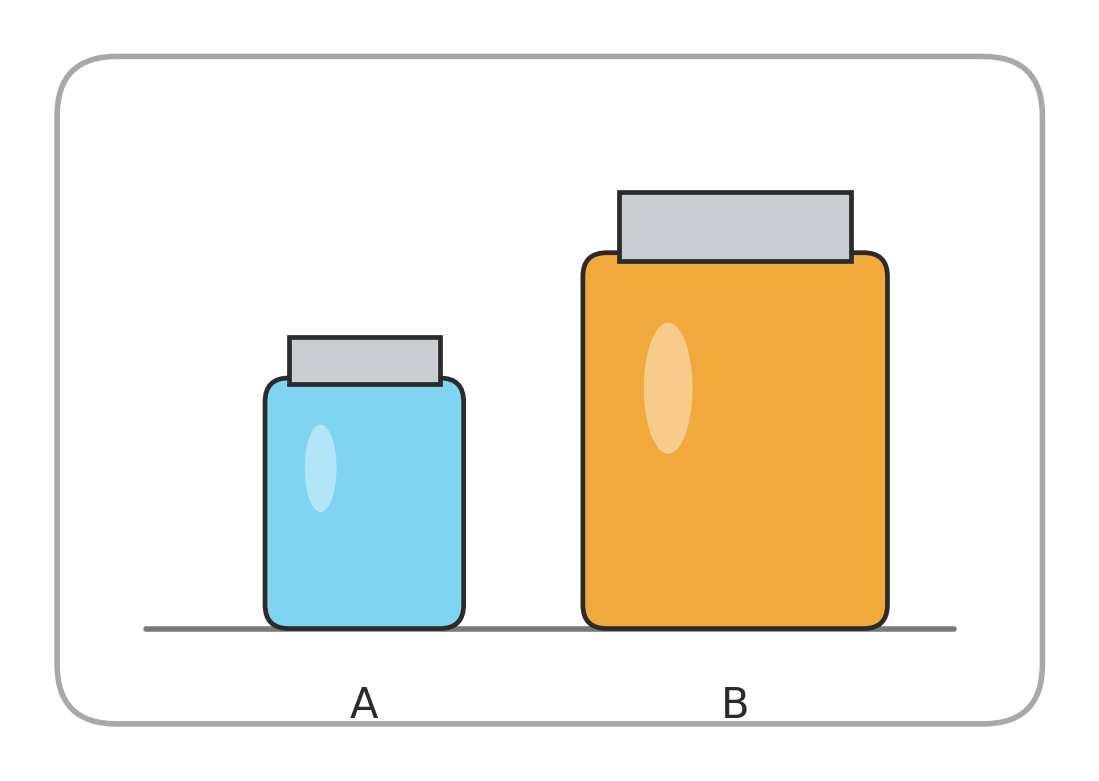
Look at the two jars.
Which sentence is true?
- Jar A holds less than Jar B. (correct answer)
- Jar A holds more than Jar B.
- Jar A and Jar B hold the same amount.
- Jar A is taller than Jar B.
Explanation: Jar B is both taller and wider than Jar A, so Jar A holds less than Jar B. Because Jar B is the taller of the two, Jar A cannot be taller.
Question 2
Look at the pencil and the crayon.
Which sentence is true?
- The pencil and the crayon are the same length.
- The crayon is longer than the pencil.
- The crayon is shorter than the pencil. (correct answer)
- The crayon is thicker than the pencil.
Explanation: The pencil and the crayon both start at the same dashed line. The crayon ends before the pencil does, so the crayon is shorter than the pencil. The two are drawn the same thickness, so neither is thicker.
Question 3
Look at the two crayons.
Which sentence is true?
- Crayon A and Crayon B are the same length. (correct answer)
- Crayon A is longer than Crayon B.
- Crayon B is longer than Crayon A.
- Crayon A is thicker than Crayon B.
Explanation: Both crayons start at the same dashed line and end at the same place, so they are the same length. Neither crayon is longer than the other, and they are drawn the same thickness.
Question 4
Look at the containers shown. Container X is completely full of water. When all the water from Container X is poured into Container Y, Container Y is only half full. What does this tell us about the containers?
- Container Y can hold more water than Container X (correct answer)
- Container X can hold more water than Container Y
- Both containers hold the same amount of water
- Container Y is taller than Container X
Explanation: Since Container X's full amount only fills Container Y halfway, Container Y has a greater capacity and can hold more water. Choice B is incorrect because X's contents don't fill Y completely. Choice C is wrong because equal capacity would mean X's water would completely fill Y. Choice D discusses height, not volume capacity being measured.
Question 5
Look at the picture below. Maya has a red crayon and a blue crayon. If the red crayon can draw a line that goes from one side of her paper to the other side, but the blue crayon's line stops in the middle, what can Maya say about her crayons?
- The red crayon is longer than the blue crayon (correct answer)
- The blue crayon is longer than the red crayon
- The red crayon is heavier than the blue crayon
- The blue crayon is heavier than the red crayon
Explanation: Since the red crayon can draw across the entire paper while the blue crayon's line stops in the middle, this shows the red crayon is longer. The drawing ability demonstrates length comparison. Choices B is incorrect because the blue crayon is shorter. Choices C and D are incorrect because drawing ability shows length, not weight.
Question 6
During snack time, Alex has two cups. He fills Cup A with apple juice until it's full. Then he pours all of Cup A's juice into Cup B, and Cup B overflows with juice spilling out. Before the juice spilled, what was true about the cups?
- Cup A could hold more juice than Cup B (correct answer)
- Cup B could hold more juice than Cup A
- Both cups could hold the same amount of juice
- Cup A was taller than Cup B
Explanation: Since Cup A's contents caused Cup B to overflow, Cup A has a larger capacity and can hold more juice than Cup B. Choice B is incorrect because if Cup B held more, it wouldn't overflow. Choice C is wrong because equal capacity wouldn't cause overflow. Choice D discusses height, not volume capacity being demonstrated.
Question 7
Look at the two caterpillars.
Which sentence is true?
- Caterpillar B is longer than Caterpillar A.
- Caterpillar A is longer than Caterpillar B. (correct answer)
- Caterpillar A and Caterpillar B are the same length.
- Caterpillar B is thicker than Caterpillar A.
Explanation: Both caterpillars start at the same dashed line, so their lengths can be compared directly. Caterpillar A reaches farther to the right, so Caterpillar A is longer. The two caterpillars are the same thickness, so Caterpillar B is not thicker.
Question 8
Look at the two candles.
Which sentence is true?
- Candle A is taller than Candle B.
- Candle A is shorter than Candle B. (correct answer)
- Candle A and Candle B are the same height.
- Candle A is wider than Candle B.
Explanation: Both candles stand on the same ground line. Candle A does not reach as high as Candle B, so Candle A is shorter than Candle B. The two candles are drawn the same width.
Question 9
The blocks are on a balance.
Which sentence is true?
- Block B is heavier than Block A.
- Block A and Block B weigh the same.
- Block B is bigger than Block A.
- Block A is heavier than Block B. (correct answer)
Explanation: The pan holding Block A went down. On a balance, the side that goes down holds the heavier object, so Block A is heavier than Block B. The two blocks are drawn the same size, which shows that being bigger and being heavier are not the same thing.
Question 10
Look at the two trees.
Which sentence is true?
- Tree A is taller than Tree B.
- Tree A and Tree B are the same height.
- Tree B is taller than Tree A. (correct answer)
- Tree A has a wider top than Tree B.
Explanation: Both trees stand on the same ground line. Tree B reaches higher than Tree A, so Tree B is taller. Tree B also has the wider top, so Tree A does not.
Question 11
Look at the two flowers.
Which sentence is true?
- Flower A is taller than Flower B.
- Flower B is taller than Flower A.
- Flower A has more petals than Flower B.
- Flower A and Flower B are the same height. (correct answer)
Explanation: Both flowers stand on the same ground line and reach the same height, so they are the same height. Neither flower is taller than the other, and each one has 6 petals.
Question 12
Look at the two jars.
Which sentence is true?
- Jar B holds more than Jar A.
- Jar A and Jar B hold the same amount.
- Jar A holds more than Jar B. (correct answer)
- Jar B is taller than Jar A.
Explanation: Jar A is both taller and wider than Jar B, so Jar A holds more than Jar B. Because Jar A is the taller of the two, Jar B cannot be taller.
Question 13
The blocks are on a balance.
Which sentence is true?
- Block A is heavier than Block B.
- Block A and Block B weigh the same. (correct answer)
- Block B is heavier than Block A.
- Block A is bigger than Block B.
Explanation: The balance is level, so neither pan went down and neither block is heavier. Block A and Block B weigh the same. The two blocks are also drawn the same size.