All questions
Question 1
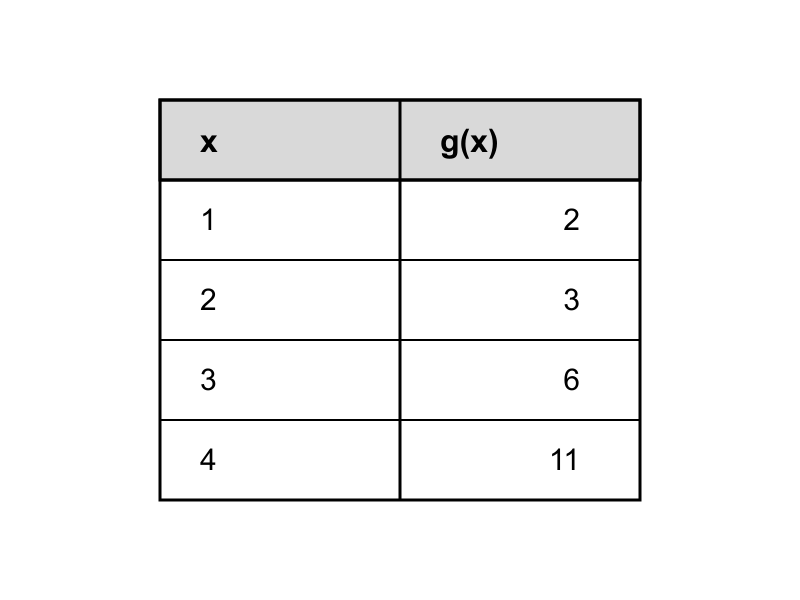
The table shows corresponding values of x and g(x). Based on this data, which function rule best describes g(x)?
- g(x)=3x−2
- g(x)=x2−2x+3 (correct answer)
- g(x)=2x+x−2
- g(x)=2x3−x+2
Explanation: Testing each function with the given points: For g(x) = x² - 2x + 3: g(1) = 1 - 2 + 3 = 2, g(2) = 4 - 4 + 3 = 3, g(3) = 9 - 6 + 3 = 6, g(4) = 16 - 8 + 3 = 11. All values match. Choice A gives g(3) = 7, not 6. Choice C gives g(3) = 8 + 3 - 2 = 9, not 6. Choice D gives g(3) = 13, not 6.
Question 2
The graph shows a piecewise linear function h(x). What is the rule for h(x) when 2≤x≤5?
- h(x)=−32x+316 (correct answer)
- h(x)=−23x+7
- h(x)=32x+32
- h(x)=−21x+5
Explanation: From the graph, when x = 2, h(x) = 4, and when x = 5, h(x) = 2. The slope is (2-4)/(5-2) = -2/3. Using point-slope form with (2,4): h(x) - 4 = -2/3(x - 2), so h(x) = -2/3x + 4/3 + 4 = -2/3x + 16/3. Choice B has the wrong slope. Choice C has positive slope. Choice D uses slope -1/2 instead of -2/3.
Question 3
A function f(x) is defined such that f(1)=3, f(2)=7, f(3)=15, and f(4)=31. If this pattern continues, what is the value of f(6)?
- 127 (correct answer)
- 135
- 143
- 151
Explanation: When you encounter a sequence problem like this, your goal is to identify the underlying pattern by examining how the function values change from one input to the next.
Let's look at the given values: f(1)=3, f(2)=7, f(3)=15, f(4)=31. First, calculate the differences between consecutive terms: 7−3=4, 15−7=8, 31−15=16. The differences are 4, 8, 16 — each difference doubles! This suggests the pattern follows f(x)=2x+1−1.
Let's verify: f(1)=22−1=3 ✓, f(2)=23−1=7 ✓, f(3)=24−1=15 ✓, f(4)=25−1=31 ✓.
Now we can find f(6)=27−1=128−1=127. We also need f(5)=26−1=63 to continue the sequence.
Answer A (127) is correct. Answer B (135) might result from incorrectly adding 32 twice to get from f(4) to f(6), missing that the differences themselves increase. Answer C (143) could come from assuming a constant second difference without recognizing the doubling pattern. Answer D (151) might result from misapplying an arithmetic progression with too large a common difference.
Strategy tip: For sequence problems, always examine first differences, then second differences if needed. Look for patterns like doubling, squaring, or adding consecutive integers — these frequently appear on standardized tests. Question 4
A function p(x) is defined recursively by p(0)=3, p(1)=7, and p(n)=2p(n−1)−p(n−2)+4 for n≥2. What is the explicit formula for p(n)?
- p(n)=2n2+n+3
- p(n)=n2+3n+3
- p(n)=2n2+2n+3 (correct answer)
- p(n)=n2+4n+3
Explanation: When you encounter a recursive function definition, you need to find an explicit formula that produces the same values. The best approach is to test each given formula against the known values and the recursive pattern.
Let's verify the correct formula by checking p(n)=2n2+2n+3 against our initial conditions:
- p(0)=2(0)2+2(0)+3=3 ✓
- p(1)=2(1)2+2(1)+3=7 ✓
Now let's check if this formula satisfies the recursive relationship. For n=2:
- Using recursion: p(2)=2p(1)−p(0)+4=2(7)−3+4=15
- Using formula: p(2)=2(4)+4+3=15 ✓
Choice A gives p(0)=3 and p(1)=6, which fails the second initial condition. Choice B produces p(0)=3 and p(1)=7, but p(2)=13 instead of the required 15. Choice D yields p(0)=3 and p(1)=8, failing at p(1).
The key insight is that recursive sequences often have polynomial explicit formulas. When the recursive relation involves adding a constant (like the +4 here), you're typically looking at a quadratic formula. Always verify your answer by checking both the initial conditions and at least one recursively calculated value.
For recursive-to-explicit problems, systematically test each option against the given conditions rather than trying to derive the formula from scratch—it's much faster and more reliable on timed exams. Question 5
The diagram shows the graph of an inverse function pair f(x) and f−1(x). Based on the graph, what is the value of f−1(8)?
- 2
- 3 (correct answer)
- 4
- 5
Explanation: To find f⁻¹(8), we need to find the x-value where f(x) = 8. From the graph, f(3) = 8, so f⁻¹(8) = 3. Alternatively, since f and f⁻¹ are reflections across y = x, the point (8,3) on f⁻¹ corresponds to (3,8) on f. Choice A corresponds to f⁻¹(6). Choice C corresponds to f⁻¹(10). Choice D corresponds to f⁻¹(12).
Question 6
The figure shows the graph of a function f(x). What is the average rate of change of f(x) from x=1 to x=4?
- 32 (correct answer)
- 43
- 34
- 35
Explanation: The average rate of change from x = 1 to x = 4 is [f(4) - f(1)]/(4 - 1). From the graph, f(1) = 2 and f(4) = 4. Therefore, the average rate of change is (4 - 2)/(4 - 1) = 2/3. Choice B uses the wrong endpoint values. Choice C inverts the fraction. Choice D uses f(4) = 7 instead of 4.
Question 7
The data in the table represents a quadratic function q(x)=ax2+bx+c. What is the value of a+b+c?
- 8
- 12
- 16 (correct answer)
- 20
Explanation: For a quadratic function q(x) = ax² + bx + c, we have q(1) = a + b + c. From the table, q(1) = 16. Therefore, a + b + c = 16. Choice A assumes q(0) gives a + b + c. Choice B uses the average of the given values. Choice D uses q(2) incorrectly.
Question 8
The table shows input-output pairs for a function f(x). Based on the pattern, what type of function best describes f(x)?
- Linear function with positive slope
- Quadratic function with positive leading coefficient
- Exponential function with base greater than 1 (correct answer)
- Logarithmic function with positive coefficient
Explanation: Examining the ratios between consecutive outputs: 6/2 = 3, 18/6 = 3, 54/18 = 3, 162/54 = 3. Since the ratio is constant, this indicates an exponential function. The function appears to be f(x) = 2 × 3^(x-1). Choice A would show constant differences. Choice B would show constant second differences. Choice D would show decreasing differences that approach zero.
Question 9
A sequence follows the pattern where each term after the first two is the sum of the two preceding terms multiplied by 2, minus 1. If a1=1 and a2=3, what is a5?
- 47
- 51 (correct answer)
- 55
- 59
Explanation: When you encounter a recursive sequence problem, you need to carefully identify the pattern and apply it step by step to find the desired term.
This sequence follows the rule: each term after the first two equals the sum of the two preceding terms, multiplied by 2, minus 1. Mathematically, this is an=2(an−1+an−2)−1 for n≥3.
Starting with a1=1 and a2=3, let's calculate each subsequent term:
For a3: a3=2(a2+a1)−1=2(3+1)−1=2(4)−1=7
For a4: a4=2(a3+a2)−1=2(7+3)−1=2(10)−1=19
For a5: a5=2(a4+a3)−1=2(19+7)−1=2(26)−1=51
Therefore, a5=51, which is choice B.
Choice A (47) might result from forgetting to subtract 1 in the final calculation. Choice C (55) could come from adding 1 instead of subtracting 1 in the recursive formula. Choice D (59) might occur if you forgot the "minus 1" part entirely and just used an=2(an−1+an−2).
For recursive sequence problems, always write out each step methodically rather than trying to jump ahead. Double-check your arithmetic at each stage, and make sure you're applying the exact formula given—small details like "minus 1" are crucial and often where test-makers place traps. Question 10
A function f satisfies the condition that f(x+1)=3f(x)−2 for all real numbers x. If f(0)=4, what is f(3)?
- 82 (correct answer)
- 86
- 94
- 106
Explanation: When you encounter a recursive function like this, you're working with a formula that defines each output in terms of a previous output. The key is to apply the given relationship step-by-step, starting from the known value.
Given that f(x+1)=3f(x)−2 and f(0)=4, you need to find f(3) by calculating f(1), then f(2), then f(3).
Start with f(1): Using x=0 in the formula gives f(0+1)=3f(0)−2, so f(1)=3(4)−2=12−2=10.
Next, find f(2): Using x=1 gives f(1+1)=3f(1)−2, so f(2)=3(10)−2=30−2=28.
Finally, find f(3): Using x=2 gives f(2+1)=3f(2)−2, so f(3)=3(28)−2=84−2=82.
Choice A (82) is correct. Choice B (86) likely comes from adding 2 instead of subtracting it in the final step: 3(28)+2=86. Choice C (94) might result from miscalculating f(2) as 32 instead of 28, then computing 3(32)−2=94. Choice D (106) could come from forgetting to subtract 2 entirely in multiple steps or other arithmetic errors.
For recursive function problems, always work systematically from the given starting point. Double-check each calculation before moving to the next step, since errors compound quickly in sequential computations.