Geometry Quiz: Solving Right Triangles Pythagorean Theorem Trigonometry
20 questions · exam conditions
0:00
Solving Right Triangles Pythagorean Theorem TrigonometryQuestion 1 of 20
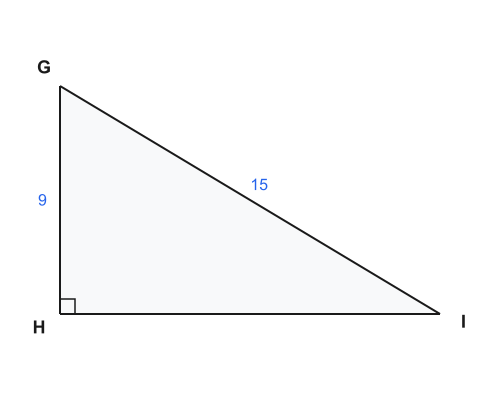
In the plane, right triangle △GHI is shown. The right angle is explicitly marked at H (∠GHI=90∘). The hypotenuse is GI and is labeled 15. The leg GH is labeled 9. The leg HI is unlabeled.
Which method should be used to find the length of HI?
(Diagram is not drawn to scale. No acute angle measures are given.)
Geometry Quiz: Solving Right Triangles Pythagorean Theorem Trigonometry
Practice Solving Right Triangles Pythagorean Theorem Trigonometry in Geometry with focused quiz questions that help you check what you know, review explanations, and build confidence with test-style prompts.
What this quiz covers
This quiz focuses on Solving Right Triangles Pythagorean Theorem Trigonometry, giving you a quick way to practice the rules, question types, and explanations that matter most for Geometry.
How to use this quiz
Try each quiz question before looking at the correct answer. Use the explanations to review missed ideas, then come back to similar questions until the pattern feels familiar.
All questions
Question 1
In the plane, right triangle △GHI is shown. The right angle is explicitly marked at H (∠GHI=90∘). The hypotenuse is GI and is labeled 15. The leg GH is labeled 9. The leg HI is unlabeled.
Which method should be used to find the length of HI?
(Diagram is not drawn to scale. No acute angle measures are given.)
Use the Pythagorean Theorem with 15 and 9. (correct answer)
Use sin(90∘)=159.
Use tan(9∘)=15HI.
Use a 30-60-90 triangle relationship.
Explanation: Solving right triangles involves using the Pythagorean theorem or trigonometry to find unknown sides or angles. In this problem, we are given the hypotenuse GI = 15 and one leg GH = 9. Since we have the hypotenuse and one leg, and need the other leg HI, the Pythagorean theorem applies. The equation is HI² = 15² - 9². This setup correctly finds HI, matching the method in choice A. A common misconception is assuming a special triangle like 30-60-90 without angle information, as in choice D. To transfer this strategy, always choose whether to use the Pythagorean theorem or trig ratios based on the given information before computing.
Question 2
In the plane, right triangle △JKL is shown. The right angle is explicitly marked at K (∠JKL=90∘). The hypotenuse is JL (explicitly identified) and is labeled 10. The acute angle at J is marked and labeled 35∘. The leg JK is unlabeled.
What is the length of JK?
(Diagram is not drawn to scale. No other angles are marked.)
10sin(35∘)
10cos(35∘) (correct answer)
sin(35∘)10
10tan(35∘)
Explanation: Solving right triangles involves using the Pythagorean theorem or trigonometry to find unknown sides or angles. In this problem, we are given the hypotenuse JL=10 and the acute angle at J=35∘. Since we have the hypotenuse and an angle, and need the adjacent leg JK, trigonometric ratios apply. The setup is cos(35∘)=10JK. This gives JK=10cos(35∘), matching choice B. A common misconception is using sine for the adjacent side, as in choice A, confusing opposite and adjacent. To transfer this strategy, always choose whether to use the Pythagorean theorem or trig ratios based on the given information before computing.
Question 3
In the diagram, △RST is a right triangle with the right angle explicitly marked at S. The hypotenuse is RT. The legs are labeled RS=5 and ST=12. Which method should be used to find the length of RT?
(Diagram is not drawn to scale; no acute angles are labeled.)
Use the Pythagorean Theorem because two side lengths are known. (correct answer)
Use sine because an acute angle and the opposite side are known.
Use cosine because an acute angle and the adjacent side are known.
Use tangent because an acute angle and two legs are known.
Explanation: Solving right triangles involves finding unknown sides or angles using the Pythagorean theorem or trigonometric ratios. In this problem, both legs are given as 5 and 12. The Pythagorean theorem applies because both legs are known, and we need the hypotenuse. The equation is RT = √(5² + 12²). This justifies using the theorem over trigonometry, matching choice A. A common misconception is opting for sine when no angles are given, as in choice B. To transfer this strategy, always choose between the Pythagorean theorem or trigonometry based on whether sides or angles are provided before computing.
Question 4
In the right triangle △VWX shown, ∠W is a right angle and the hypotenuse is VX. The acute angle at V is 41∘, and WX=10. What is the length of VX?
cos41∘10
sin41∘10 (correct answer)
10sin41∘
10cos41∘
Explanation: This problem involves finding the hypotenuse using trigonometry. We are given the opposite side WX = 10 and the angle at V = 41°, and need to find the hypotenuse VX. Since we have the opposite side and need the hypotenuse, we use the sine ratio: sin(angle) = opposite/hypotenuse. Setting up the equation: sin(41°) = 10/VX, which rearranges to VX = 10/sin(41°). This is justified because sine relates the opposite side to the hypotenuse in a right triangle. A common mistake is using cosine (10/cos(41°)) which would be used if WX were adjacent to angle V. Before solving, identify the position of the known side relative to the given angle.
Question 5
In right triangle △DEF shown, ∠E is a right angle. The hypotenuse is DF=13 and one leg is DE=5. What is the length of leg EF?
8
194
144 (correct answer)
18
Explanation: This problem involves finding a missing leg when given the hypotenuse and one leg of a right triangle. We have hypotenuse DF = 13 and leg DE = 5, and need to find leg EF. The Pythagorean theorem applies in the form a² + b² = c², where c is the hypotenuse. Rearranging to find the missing leg: EF² = DF² - DE² = 13² - 5² = 169 - 25 = 144. Therefore, EF = √144 = 12. A common mistake is adding instead of subtracting when finding a leg (13² + 5² = 194). Remember: when finding a leg, subtract the known leg squared from the hypotenuse squared.
Question 6
Right triangle △STU is shown in the plane. The right angle is explicitly marked at T (∠STU=90∘). The hypotenuse is SU and is labeled 17. The leg TU is labeled 8. The acute angle at S is unlabeled.
What is the measure of ∠S?
(Diagram is not drawn to scale. No other angles are marked.)
sin−1(178) (correct answer)
cos−1(178)
tan−1(817)
sin(178)
Explanation: Solving right triangles involves using the Pythagorean theorem or trigonometry to find unknown sides or angles. In this problem, we are given the hypotenuse SU = 17 and the opposite leg to angle S, TU = 8. Since we have the opposite side and hypotenuse, and need the angle at S, inverse trigonometric ratios apply. The setup is angle S = sin⁻¹(8/17). This correctly finds the angle, matching choice A. A common misconception is using inverse cosine instead, as in choice B, which would apply to the adjacent side. To transfer this strategy, always choose whether to use the Pythagorean theorem or trig ratios based on the given information before computing.
Question 7
A right triangle △MNO is shown with the right angle at N. What is the length of hypotenuseMO?
21
63
225
15 (correct answer)
Explanation: This problem asks us to find the hypotenuse of a right triangle given both legs. We have a right angle at N, with legs MN = 9 and NO = 12. The Pythagorean theorem applies directly since we know both legs: MO² = MN² + NO². Setting up the calculation: MO² = 9² + 12² = 81 + 144 = 225, so MO = √225 = 15. The answer is 15 because this is a 3-4-5 right triangle scaled by 3 (9-12-15). A common error would be adding the legs directly (9 + 12 = 21) instead of using the Pythagorean theorem. Recognizing special right triangle ratios like 3-4-5 can help verify your answer quickly.
Question 8
In the coordinate plane, triangle △ABC is shown. ∠B is a right angle (marked with a square). The segment AB is horizontal from A(−1,2) to B(5,2), and BC is vertical from B(5,2) to C(5,10). The hypotenuse is AC. The diagram is not drawn to scale. No other angles or lengths are marked.
What is the length of AC?
6+8=14
62+82 (correct answer)
82−62
62−82
Explanation: Solving right triangles involves finding unknown sides or angles using the Pythagorean theorem or trigonometric ratios. In this problem, the coordinates provide the lengths of the legs AB = 6 and BC = 8 in right triangle ABC with right angle at B. The Pythagorean theorem applies because both legs are known, and we need the hypotenuse AC. The correct equation is AC = √(6² + 8²). This setup is justified as it directly relates the squares of the legs to the square of the hypotenuse in a right triangle. A common misconception is subtracting the squares, as in choice C, which might confuse finding a leg with finding the hypotenuse. To transfer this strategy, always choose the method—Pythagorean for sides or trig for angles—before computing.
Question 9
In the diagram, △PQR is a right triangle with the right angle explicitly marked at Q. The hypotenuse is PR. The side PQ is labeled 12, and the acute angle at P is labeled 35∘. What is the length of PR?
(Diagram is not drawn to scale; no other angles are marked.)
12cos35∘
cos35∘12 (correct answer)
sin35∘12
12tan35∘
Explanation: Solving right triangles involves finding unknown sides or angles using the Pythagorean theorem or trigonometric ratios. In this problem, one leg is 12, and an adjacent acute angle is 35°. Cosine applies because it relates the adjacent side to the hypotenuse for the given angle. The equation is cos(35°) = 12 / PR, so PR = 12 / cos(35°). This matches choice B, as it correctly isolates the hypotenuse. A common misconception is using sine instead, leading to 12 / sin(35°) in choice C, which would be for the opposite side. To transfer this strategy, always choose between the Pythagorean theorem or trigonometry based on whether sides or angles are provided before computing.
Question 10
In right triangle △ABC shown, ∠C is a right angle. The legs are AC=6 and BC=8. What is the length of hypotenuse AB?
10 (correct answer)
14
28
100
Explanation: This problem requires solving for the hypotenuse of a right triangle using the Pythagorean theorem. We are given the two legs: AC = 6 and BC = 8, and need to find the hypotenuse AB. Since we have both legs of a right triangle, the Pythagorean theorem applies: a² + b² = c². Setting up the equation: 6² + 8² = AB², which gives us 36 + 64 = 100, so AB = √100 = 10. The answer is justified because 10² = 100 = 36 + 64. A common error would be adding the legs directly (6 + 8 = 14) instead of using the Pythagorean theorem. When solving right triangles, always identify what's given and what method applies before computing.
Question 11
A right triangle △JKL is shown in the plane. ∠K is marked as a right angle. The hypotenuse is JL and is labeled 25. The leg KL is labeled 7. The diagram is not drawn to scale. No other angles or lengths are marked.
What is the length of JK?
252−72 (correct answer)
252+72
25−7
72−252
Explanation: Solving right triangles involves finding unknown sides or angles using the Pythagorean theorem or trigonometric ratios. In this problem, the hypotenuse JL = 25 and one leg KL = 7 are given in right triangle JKL with right angle at K. The Pythagorean theorem applies because we need the other leg JK, with the hypotenuse and one leg known. The correct equation is JK = √(25² - 7²). This is justified as rearranging the theorem isolates the unknown leg by subtracting squares. A distractor like choice B adds squares, which finds the hypotenuse instead of a leg. To transfer this strategy, always choose the method—Pythagorean for sides or trig for angles—before computing.
Question 12
A right triangle △KLM is shown in the plane. The right angle is explicitly marked at L (∠KLM=90∘). The legs are KL=6 and LM=8. The slanted side KM is explicitly identified as the hypotenuse.
Which claim about the triangle is NOT justified?
(Diagram is not drawn to scale. No angle measures other than the right angle are marked.)
KM=10.
KL2+LM2=KM2.
sin(∠K)=108.
∠K=60∘. (correct answer)
Explanation: Solving right triangles involves using the Pythagorean theorem or trigonometry to find unknown sides or angles. In this problem, we are given the two legs KL = 6 and LM = 8. To evaluate the claims, the Pythagorean theorem and trig ratios apply to find the hypotenuse and angles. The equation for the hypotenuse is KM² = 6² + 8², giving KM = 10. Then, sin(∠K) = 8/10, so ∠K ≈ 53.13°, not 60°, making claim D unjustified. A common misconception is assuming a 60° angle based on side ratios without calculating, as in choice D. To transfer this strategy, always choose whether to use the Pythagorean theorem or trig ratios based on the given information before computing.
Question 13
In the diagram, △XYZ is a right triangle with the right angle explicitly marked at Y. The hypotenuse is XZ. The leg YZ is labeled 4, and the leg XY is labeled 3. Which claim about the triangle is NOT justified?
(Diagram is not drawn to scale; no acute angle measures are given.)
XZ=5
sin(∠X)=54
cos(∠X)=54 (correct answer)
tan(∠X)=34
Explanation: Solving right triangles involves finding unknown sides or angles using the Pythagorean theorem or trigonometric ratios. In this problem, both legs are given as 3 and 4. The Pythagorean theorem applies to verify the hypotenuse as 5, enabling trigonometric ratio checks. The equations are sin(X) = 4/5, cos(X) = 3/5, and tan(X) = 4/3. Choice C is not justified because it incorrectly states cos(X) = 4/5 instead of 3/5. A common misconception is swapping opposite and adjacent sides in cosine, leading to the error in choice C. To transfer this strategy, always choose between the Pythagorean theorem or trigonometry based on whether sides or angles are provided before computing.
Question 14
In the diagram, △MNO is a right triangle with the right angle explicitly marked at N. The hypotenuse is MO. The side NO is labeled 7, and the acute angle at O is labeled 28∘. Which expression represents the correct setup to find the length of the hypotenuse MO?
(Diagram is not drawn to scale; no other angles are marked.)
sin28∘=MO7
cos28∘=MO7 (correct answer)
tan28∘=7MO
sin28∘=7MO
Explanation: Solving right triangles involves finding unknown sides or angles using the Pythagorean theorem or trigonometric ratios. In this problem, the adjacent side is 7, and the acute angle is 28°. Cosine applies because it relates the adjacent side to the hypotenuse for the given angle. The equation is cos(28°) = 7 / MO. This matches choice B, as it sets up correctly for solving MO. A common misconception is using sine for the adjacent side, leading to sin(28°) = 7 / MO in choice A. To transfer this strategy, always choose between the Pythagorean theorem or trigonometry based on whether sides or angles are provided before computing.
Question 15
In the right triangle shown, ∠A is a right angle. The hypotenuse is BC. If AB=8 and BC=17, what is the length of AC?
353
9
25
15 (correct answer)
Explanation: This problem asks us to find a leg of a right triangle using the Pythagorean theorem. We're given leg AB = 8 and hypotenuse BC = 17, with angle A being the right angle. Since we need to find a leg when given the other leg and hypotenuse, we use: a² = c² - b². Setting up: AC² = BC² - AB² = 17² - 8² = 289 - 64 = 225, so AC = √225 = 15. The answer is 15, not √225, because we must simplify the square root. A student might add the squares instead (getting √353) by incorrectly treating this as finding a hypotenuse. Always check: is the unknown side the hypotenuse (longest side) or a leg before deciding whether to add or subtract.
Question 16
In the right triangle △JKL shown, ∠K is a right angle and the hypotenuse is JL. The acute angle at J is 58∘, and JL=20. What is the length of JK?
20sin58∘
sin58∘20
20cos58∘ (correct answer)
20tan58∘
Explanation: This problem involves finding the adjacent side of a right triangle using trigonometry. We are given the hypotenuse JL = 20 and the angle at J = 58°, and need to find the adjacent side JK. Since we have the hypotenuse and need the adjacent side, we use the cosine ratio: cos(angle) = adjacent/hypotenuse. Setting up the equation: cos(58°) = JK/20, which gives us JK = 20·cos(58°). This is justified because cosine relates the adjacent side to the hypotenuse. A common mistake is using sine (20·sin(58°)) which would give the opposite side instead. Before solving, identify which side you need relative to the given angle to choose the correct trigonometric function.
Question 17
In the diagram, △JKL is a right triangle with the right angle explicitly marked at K. The hypotenuse is JL. The leg lengths are labeled JK=9 and JL=15. What is the length of KL?
(Diagram is not drawn to scale; no other angles are marked.)
306
144 (correct answer)
24
81+15
Explanation: Solving right triangles involves finding unknown sides or angles using the Pythagorean theorem or trigonometric ratios. In this problem, one leg is 9, and the hypotenuse is 15. The Pythagorean theorem applies because a leg and the hypotenuse are given, and we need the other leg. The equation is KL=152−92. This yields KL=144, matching choice B, as it simplifies correctly. A common misconception is adding instead of subtracting, leading to 152+92=306 in choice A. To transfer this strategy, always choose between the Pythagorean theorem or trigonometry based on whether sides or angles are provided before computing.
Question 18
Refer to the figure below. In right triangle PQR with the right angle at Q, PQ=5 and QR=12. What is cos(R)?
135
1312 (correct answer)
125
512
Explanation: First, find PR using the Pythagorean theorem: PR=25+144=13. Since P and R are complementary, cos(R)=sin(P)=PRQR=1312. Alternatively, cos(R)=hypotenuseadjacent=1312. Choice A is sin(R). Choice C is tan(P). Choice D is tan(R).
Question 19
In the right triangle shown, ∠A is a right angle. The hypotenuse is BC. If BC=30 and ∠C=22∘, what is the length of AB?
30cos(22∘)
sin(22∘)30
30sin(22∘) (correct answer)
cos(22∘)30
Explanation: This problem requires finding the side opposite to a given angle in a right triangle. We have hypotenuse BC = 30, angle C = 22°, and angle A is the right angle. Since AB is opposite to angle C and BC is the hypotenuse, we use sine: sin(C) = opposite/hypotenuse = AB/BC. Rearranging: AB = BC × sin(C) = 30sin(22°). The answer is 30sin(22°) because sine relates the opposite side to the hypotenuse. A common error would be using cosine (30cos(22°)), which would give the adjacent side AC instead. When solving with trigonometry, always identify which side you need relative to the given angle: opposite uses sine, adjacent uses cosine.
Question 20
In the right triangle △PQR shown, ∠Q is a right angle and the hypotenuse is PR. The acute angle at P is 22∘, and PQ=12. Which expression represents the correct setup to find the length of QR?
tan22∘=12QR (correct answer)
sin22∘=12QR
cos22∘=12QR
tan22∘=QR12
Explanation: This problem asks for the correct setup to find the opposite side using trigonometry. We are given the adjacent side PQ = 12 and the angle at P = 22°, and need to find the opposite side QR. Since we have the adjacent side and need the opposite side, we use the tangent ratio: tan(angle) = opposite/adjacent. The correct setup is: tan(22°) = QR/12, which can be rearranged to find QR. This is justified because tangent relates the opposite side to the adjacent side. A common mistake is using sine or cosine, which would require the hypotenuse. When setting up trigonometric equations, identify which sides you have and need relative to the given angle.