All questions
Question 1
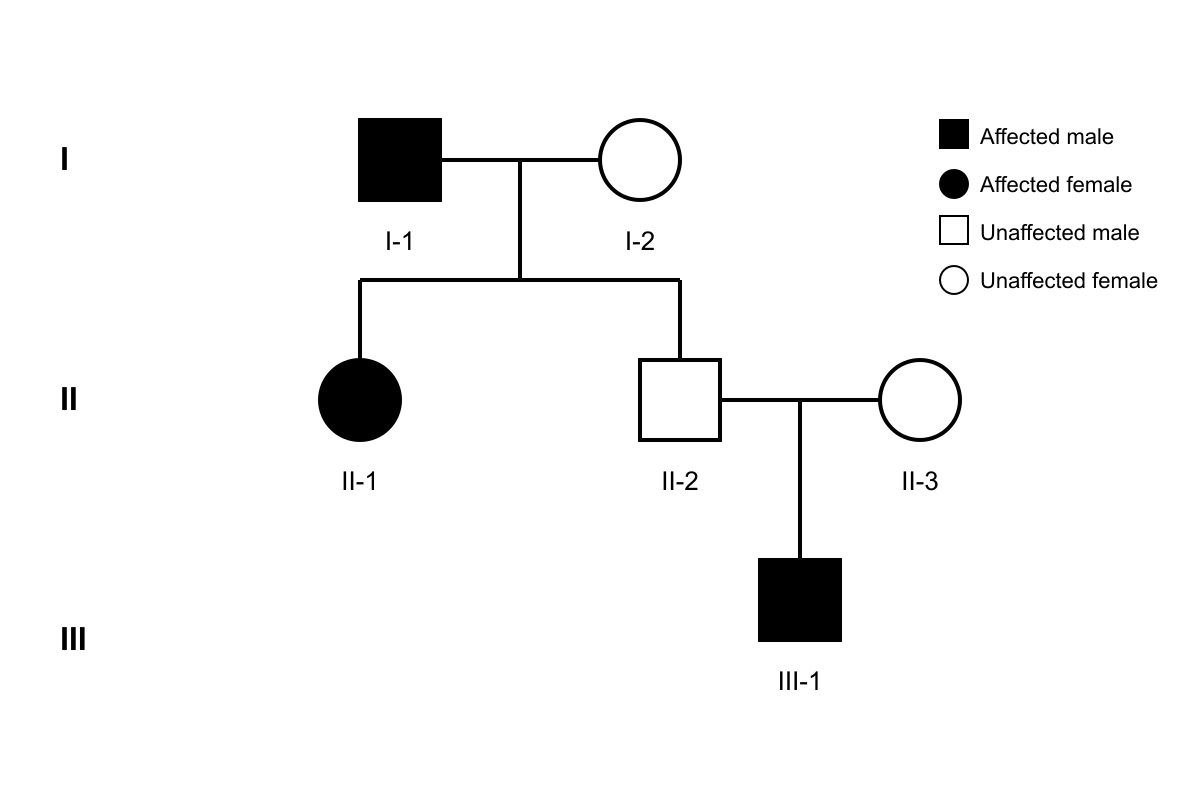
The pedigree shows a rare genetic disorder that is autosomal dominant but exhibits incomplete penetrance. Individual II-2 is phenotypically unaffected. What is the most likely conclusion about the genotype of individual II-2?
- II-2 is homozygous recessive and a de novo mutation occurred in III-1.
- II-2 is heterozygous for the dominant allele but is non-penetrant. (correct answer)
- The disorder is actually recessive, and II-2 and II-3 are both carriers.
- II-2 is homozygous dominant and passed the allele to all offspring.
Explanation: Individual I-1 is affected and passes the trait to his descendant, III-1. The trait skips generation II, as II-2 is unaffected. However, since II-2's child (III-1) is affected, II-2 must have passed the disease allele to III-1. This means II-2 possesses the dominant allele but does not show the phenotype. This phenomenon is known as incomplete penetrance. A new mutation is possible but less likely than inheritance with non-penetrance.
Question 2
The pedigree shows the inheritance of a rare autosomal recessive disorder. Individuals I-1 and I-2 have three children (II-1, II-2, and II-3). What is the probability that individual II-3, who is phenotypically normal, is a carrier of the recessive allele?
- 1/4
- 1/2
- 2/3 (correct answer)
- 1
Explanation: Since individuals I-1 and I-2 are unaffected but have an affected child (II-1), they must both be heterozygous carriers (Aa). The possible genotypes for their offspring are AA, Aa, and aa in a 1:2:1 ratio. Individual II-3 is phenotypically normal, so her genotype cannot be aa. The remaining possible genotypes are AA and Aa. There is one AA genotype and two Aa genotypes in this subset of outcomes. Therefore, the probability that II-3 is a carrier (Aa) is 2/3.
Question 3
An individual (II-1) is the phenotypically normal child of a mother (I-2) affected by a rare autosomal dominant disorder with 75% penetrance. The father (I-1) is unaffected. What is the probability that individual II-1 is a carrier of the disease allele?
- 20% (correct answer)
- 25%
- 33%
- 50%
Explanation: The affected mother (I-2) is likely heterozygous (Aa). The unaffected father (I-1) is homozygous recessive (aa). The probability of a child inheriting the dominant allele 'A' is 1/2. The probability of inheriting 'a' is 1/2. Individual II-1 is unaffected. This can occur in two ways: 1) The child inherited 'a' and is genotype aa (Probability = 1/2). 2) The child inherited 'A' (genotype Aa) but is non-penetrant (Probability of non-penetrance = 1 - 0.75 = 0.25). The joint probability of being Aa and non-penetrant is P(Aa) * P(non-penetrant|Aa) = (1/2) * (0.25) = 0.125. The total probability of being unaffected is P(aa) + P(Aa and non-penetrant) = 0.5 + 0.125 = 0.625. The conditional probability of being a carrier (Aa) given they are unaffected is P(Aa and unaffected) / P(unaffected) = 0.125 / 0.625 = 1/5 = 20%.
Question 4
An affected male (I-1) with an X-linked dominant disorder has three children with an unaffected female (I-2). Based on the principles of X-linked dominant inheritance, which statement must be true regarding his daughters?
- All of his daughters will be unaffected carriers of the trait.
- All of his daughters will be affected and heterozygous for the trait. (correct answer)
- There is a 50% chance each daughter will be an affected carrier.
- His daughters' carrier status depends on whether they inherit his Y chromosome.
Explanation: In X-linked dominant inheritance, an affected male (XAY) passes his single X chromosome to all of his daughters. His Y chromosome is passed to all of his sons. The unaffected mother (XaXa) passes a recessive allele (Xa) to all offspring. Therefore, all daughters must have the genotype X^AX^a. This makes them both affected (due to the dominant allele) and heterozygous carriers of that allele. Question 5
The pedigree shows an autosomal dominant trait. However, individual III-1, who has two unaffected parents, is affected. Which genetic event most plausibly explains the status of III-1, and what is the carrier status of their parent, II-2?
- Incomplete penetrance; II-2 is a non-penetrant carrier.
- De novo mutation; II-2 is not a carrier. (correct answer)
- Variable expressivity; II-2 is a carrier with a mild phenotype.
- Germline mosaicism; II-2 is not a carrier in their somatic cells.
Explanation: Individual III-1 is affected with a dominant trait, but both parents (II-1 and II-2) are unaffected. This strongly suggests a de novo (new) mutation occurred in the germline of one parent or during early embryonic development of III-1. In this case, neither parent would carry the allele in their somatic cells. Incomplete penetrance (A) would require one of the parents to have an affected ancestor, which is not shown. Variable expressivity (C) means the parent would be affected, just mildly, which contradicts the pedigree. Germline mosaicism (D) is a possibility but a de novo mutation is a more general and common explanation for this pattern.
Question 6
The following pedigree illustrates a family affected by a disease. Analysis confirms the disease is X-linked and recessive. Based on the information presented, which individual is an obligate carrier?
- I-1
- I-2 (correct answer)
- II-1
- II-4
Explanation: An obligate carrier is an individual who must carry the allele based on the pedigree. Individual I-2 is an unaffected female, but she has an affected son (II-3). For her son to be affected with an X-linked recessive trait (genotype XaY), he must have inherited the X^a allele from his mother. Since the mother (I-2) is unaffected, her genotype must be heterozygous (XAXa), making her a carrier. Question 7
A woman (II-2) is concerned about being a carrier for an X-linked recessive disorder because her brother (II-1) is affected. Her parents are both phenotypically normal. What is the probability that she is a carrier?
- 1/4
- 1/3
- 1/2 (correct answer)
- 2/3
Explanation: The woman's brother (II-1) is affected (XaY), so he must have inherited the X^a chromosome from his mother (I-2). Since the mother is unaffected, she must be a heterozygous carrier (XAXa). The father (I-1) is unaffected (XAY). The daughter (II-2) inherits one X from her mother and one from her father. She will receive X^A from her father. From her carrier mother (XAXa), she has a 1/2 chance of inheriting X^A and a 1/2 chance of inheriting X^a. Thus, her probability of being a carrier (genotype XAX^a) is 1/2. Question 8
The pedigree shows a rare autosomal recessive condition. An affected female (II-3) from this family marries an unaffected male (II-4). All of their children are phenotypically normal. Which individual is known to be a heterozygous carrier with 100% certainty?
- I-2
- II-1
- II-4
- III-1 (correct answer)
Explanation: Individual II-3 is affected, so her genotype is homozygous recessive (aa). She will pass one recessive allele (a) to every one of her children. Her son, III-1, is unaffected, which means he must possess at least one dominant allele (A). Since he inherited 'a' from his mother, his genotype must be Aa. Therefore, III-1 is an obligate heterozygous carrier.
Question 9
The pedigree shows a family with a history of hemophilia, an X-linked recessive condition. Individual II-2 is an unaffected female with an affected brother (II-1) and an affected maternal uncle (I-3). What is the probability that she is a carrier?
- 1/4
- 1/2 (correct answer)
- 2/3
- 1
Explanation: Individual II-2's brother (II-1) is affected, which means her mother (I-2) must be a carrier. The information about the maternal uncle (I-3) also confirms that the grandmother (not shown) must have been a carrier, which is consistent with I-2 being a carrier. Since II-2's mother (I-2) is a carrier (XAXa), there is a 50% chance she passed the recessive allele (Xa) to her daughter, II-2. The father (I-1) is unaffected (XAY) and gives his X^A to his daughter. Therefore, II-2 has a 1/2 probability of being a carrier (XAXa). Question 10
An affected female (II-1) with an X-linked recessive disorder and an unaffected male (II-2) have two children, a son (III-1) and a daughter (III-2). Which of the following statements about their children is correct?
- All of their children, regardless of sex, will be carriers.
- All of their sons will be affected, and all of their daughters will be carriers. (correct answer)
- Their sons have a 50% chance of being affected, and daughters have a 50% chance of being carriers.
- All of their sons will be unaffected, and all of their daughters will be affected.
Explanation: An affected female with an X-linked recessive disorder has the genotype X^aX^a. An unaffected male has the genotype X^AY. All sons inherit a Y chromosome from the father and one of the mother's X chromosomes. Therefore, all sons must inherit an X^a and will have genotype X^aY, making them affected. All daughters inherit an X^A from the father and an X^a from the mother. Therefore, all daughters will have genotype X^AX^a, making them phenotypically normal but heterozygous carriers.
Question 11
If individual III-4 in the pedigree is a carrier for a rare autosomal recessive trait, what must be true about her parents, II-5 and II-6?
- Both II-5 and II-6 must be carriers.
- Neither parent can be a carrier; it must be a new mutation.
- At least one of her parents must carry the recessive allele. (correct answer)
- Her father, II-5, must be a carrier, but her mother, II-6, must be homozygous normal.
Explanation: For an individual to be a heterozygous carrier (Aa), they must inherit the recessive allele ('a') from at least one parent. The other allele ('A') can come from either parent. It is not necessary for both parents to be carriers (e.g., an AA parent and an Aa parent can have an Aa child). However, it is impossible for an Aa child to be born to two AA parents. Therefore, at least one of the parents (II-5 or II-6) must carry the 'a' allele.
Question 12
A genetic counselor analyzes the pedigree for a rare recessive condition. She informs couple II-1 and II-2 that based on their family history, the probability of each of them being a carrier is 2/3. Given this information, what is the probability that their first child, III-1, will be a phenotypically normal carrier?
- 1/4
- 4/9 (correct answer)
- 1/2
- 5/9
Explanation: We are given P(II-1 is carrier Aa) = 2/3 and P(II-2 is carrier Aa) = 2/3. We can also deduce P(II-1 is AA) = 1/3 and P(II-2 is AA) = 1/3. A child can be a carrier (Aa) if born from an (AA x Aa) mating or an (Aa x Aa) mating. The probability of being a carrier is P(child is Aa) = P(AAxAa)P(child is Aa | AAxAa) + P(AaxAA)P(child is Aa | AaxAA) + P(AaxAa)P(child is Aa | AaxAa). This is P(II-1 AA)P(II-2 Aa)(1/2) + P(II-1 Aa)P(II-2 AA)(1/2) + P(II-1 Aa)P(II-2 Aa)(1/2) = (1/3)(2/3)(1/2) + (2/3)(1/3)(1/2) + (2/3)(2/3)*(1/2) = 1/9 + 1/9 + 2/9 = 4/9. A phenotypically normal carrier is simply a carrier (Aa), as the 'normal' phenotype is implied by the heterozygous genotype in a recessive disorder.
Question 13
The provided pedigree traces a rare autosomal dominant trait that is 90% penetrant. Individual II-1 is phenotypically normal. What is the approximate probability that both II-1 and her unaffected partner, III-2, are carriers of the disease allele, assuming the population carrier frequency is negligible?
- 0% (correct answer)
- 5%
- 9%
- 10%
Explanation: Individual II-1 is from an affected lineage, but her partner, III-2, marries into the family. Since the trait is rare and the population carrier frequency is stated as negligible, we can assume III-2 is not a carrier (genotype aa). Therefore, the probability that both are carriers is effectively zero. The question asks for the probability of a joint event where one of the events has a probability of zero. The calculation for II-1's carrier status is P(carrier | unaffected) = P(Aa and non-penetrant) / P(unaffected) = (0.50.1) / (0.5 + 0.50.1) = 0.05 / 0.55 = 1/11 or ~9%. However, since P(III-2 is carrier) is 0, P(II-1 is carrier AND III-2 is carrier) = P(II-1 is carrier) * 0 = 0.