GED Math Quiz: Probability
16 questions · exam conditions
0:00
ProbabilityQuestion 1 of 16

Refer to the two-way frequency table. A student is chosen at random. What is the probability that the student passed the exam given that they studied more than 3 hours?
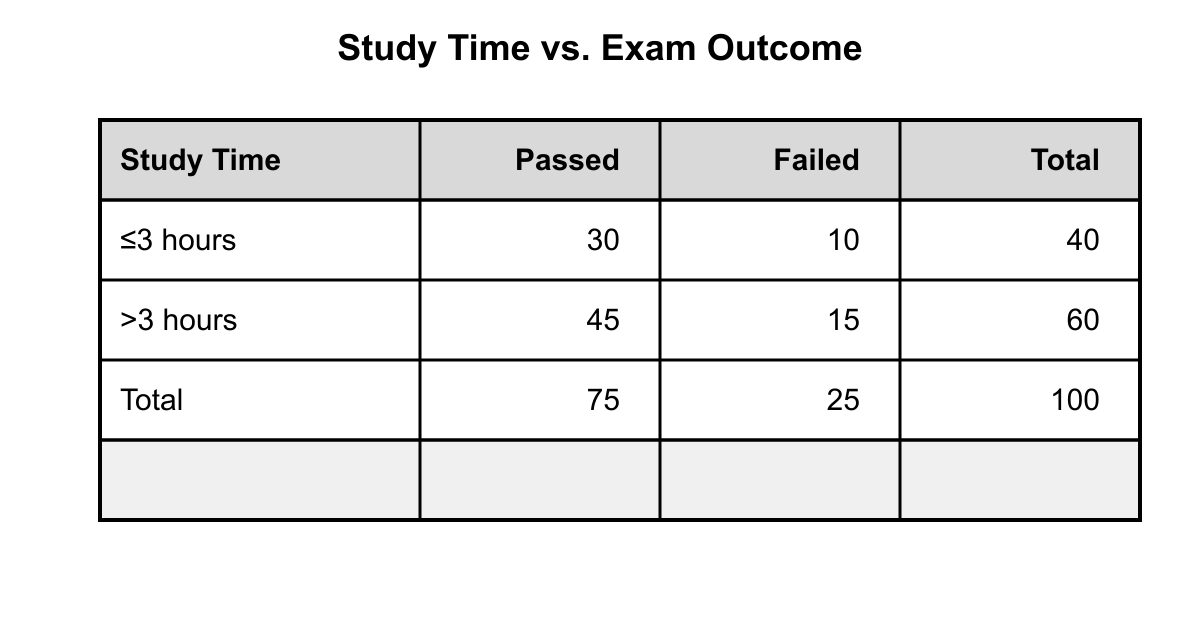
Question graphic
4560\dfrac{45}{60}
4575\dfrac{45}{75}
45100\dfrac{45}{100}
1560\dfrac{15}{60}
← Back to quizzes

GED Math Quiz

GED Math Quiz: Probability

Practice Probability in GED Math with focused quiz questions that help you check what you know, review explanations, and build confidence with test-style prompts.

What this quiz covers

This quiz focuses on Probability, giving you a quick way to practice the rules, question types, and explanations that matter most for GED Math.

How to use this quiz

Try each quiz question before looking at the correct answer. Use the explanations to review missed ideas, then come back to similar questions until the pattern feels familiar.

All questions

Question 1

Refer to the two-way frequency table. A student is chosen at random. What is the probability that the student passed the exam given that they studied more than 3 hours?

  1. 4560\dfrac{45}{60} (correct answer)
  2. 4575\dfrac{45}{75}
  3. 45100\dfrac{45}{100}
  4. 1560\dfrac{15}{60}

Explanation: Conditional probability: P(Pass | >3 hrs) = (students who studied >3 hrs AND passed) / (total who studied >3 hrs) = 45/60 = 3/4. Choice B uses total passers as denominator. C uses grand total. D inverts the ratio (failed/total).

Question 2

A box contains the colored chips shown in the figure. Three chips are drawn at random without replacement. Based on the figure, what is the probability that all three chips drawn are different colors?

  1. 15\dfrac{1}{5}
  2. 922\dfrac{9}{22}
  3. 27110\dfrac{27}{110}
  4. 311\dfrac{3}{11} (correct answer)

Explanation: 4 red, 3 blue, 5 green (total 12). Ways to pick one of each color: 4×3×5 = 60. Total ways to pick 3 from 12: C(12,3) = 220. Probability = 60/220 = 3/11. Choice A oversimplifies. B uses incorrect counting. C incorrectly multiplies individual probabilities.

Question 3

The spinner shown is divided into 8 equal sectors numbered 1 through 8. The spinner is spun twice. Using the figure above, what is the probability that the sum of the two spins is a prime number?

  1. 14\dfrac{1}{4}
  2. 2364\dfrac{23}{64} (correct answer)
  3. 38\dfrac{3}{8}
  4. 12\dfrac{1}{2}

Explanation: Total outcomes: 8×8 = 64. Possible sums: 2 to 16. Prime sums: 2, 3, 5, 7, 11, 13. Count ordered pairs: sum=2:1, sum=3:2, sum=5:4, sum=7:6, sum=11:6 (pairs where both ≤8 summing to 11: (3,8),(4,7),(5,6),(6,5),(7,4),(8,3)=6), sum=13: (5,8),(6,7),(7,6),(8,5)=4. Total = 1+2+4+6+6+4 = 23. Probability = 23/64. Distractor A (1/4=16/64) counts only some sums; C miscounts by ignoring order; D overestimates.

Question 4

A bag contains 8 red marbles, 6 blue marbles, and 4 green marbles. If you draw 2 marbles without replacement, what is the probability that both marbles are the same color?

  1. 38153\frac{38}{153}
  2. 41153\frac{41}{153} (correct answer)
  3. 44153\frac{44}{153}
  4. 47153\frac{47}{153}

Explanation: Total marbles = 18. P(both red) = 818×717=56306\frac{8}{18} \times \frac{7}{17} = \frac{56}{306}. P(both blue) = 618×517=30306\frac{6}{18} \times \frac{5}{17} = \frac{30}{306}. P(both green) = 418×317=12306\frac{4}{18} \times \frac{3}{17} = \frac{12}{306}. Total probability = 56+30+12306=98306=41153\frac{56+30+12}{306} = \frac{98}{306} = \frac{41}{153}. Choice A uses the wrong denominator calculation. Choice C adds an extra case incorrectly. Choice D miscalculates one of the individual probabilities.

Question 5

A password must contain exactly 6 characters: 3 letters followed by 3 digits. Letters can be repeated, but digits cannot be repeated. How many different passwords are possible?

  1. 11,664,000 (correct answer)
  2. 15,818,400
  3. 17,576,000
  4. 18,720,000

Explanation: For letters: 263=17,57626^3 = 17,576 possibilities (repetition allowed). For digits: 10×9×8=72010 \times 9 \times 8 = 720 possibilities (no repetition). Total passwords = 17,576×720=11,664,00017,576 \times 720 = 11,664,000. Choice B incorrectly uses permutations for letters. Choice C only counts letter combinations. Choice D uses 10310^3 for digits allowing repetition.

Question 6

Two dice are rolled. Given that the sum is even, what is the probability that both dice show even numbers?

  1. 13\frac{1}{3}
  2. 12\frac{1}{2} (correct answer)
  3. 23\frac{2}{3}
  4. 34\frac{3}{4}

Explanation: An even sum occurs when both dice are even OR both dice are odd. Even dice outcomes: (2,2), (2,4), (2,6), (4,2), (4,4), (4,6), (6,2), (6,4), (6,6) = 9 outcomes. Odd dice outcomes with even sum: (1,1), (1,3), (1,5), (3,1), (3,3), (3,5), (5,1), (5,3), (5,5) = 9 outcomes. Total even sums = 18. P(both even | sum even) = 918=12\frac{9}{18} = \frac{1}{2}. Choice A represents 927\frac{9}{27} (wrong denominator). Choice C is 1131 - \frac{1}{3}. Choice D incorrectly counts favorable outcomes.

Question 7

A license plate format is shown in the diagram: 3 letters (A–Z, no repeats) followed by 3 digits (0–9, repeats allowed), but the first digit cannot be 0. Using the format shown, how many distinct license plates are possible?

  1. 26310326^3 \cdot 10^3
  2. 2625249101026 \cdot 25 \cdot 24 \cdot 9 \cdot 10 \cdot 10 (correct answer)
  3. 26252410326 \cdot 25 \cdot 24 \cdot 10^3
  4. 26252499826 \cdot 25 \cdot 24 \cdot 9 \cdot 9 \cdot 8

Explanation: Letters without repeat: 26·25·24. First digit not 0: 9 choices. Next two digits: 10·10. Total = 26·25·24·9·10·10. A ignores both constraints. C ignores first-digit constraint. D assumes digits cannot repeat.

Question 8

The bar graph shown displays the number of defective and non-defective items produced by three factories. One item is selected at random from the combined output. Using the graph, what is the probability that the item came from Factory B given that it is defective?

  1. 15100\dfrac{15}{100}
  2. 1545\dfrac{15}{45} (correct answer)
  3. 15200\dfrac{15}{200}
  4. 45200\dfrac{45}{200}

Explanation: Defective items: A=20, B=15, C=10, total=45. P(B|Defective) = 15/45 = 1/3. Choice A uses B's total output. C uses grand total. D is P(Defective).

Question 9

In a game, you win if you roll a sum of 7 or 11 with two dice, and lose if you roll a sum of 2, 3, or 12. For any other sum, you continue playing. What is the probability that the game ends on the first roll?

  1. 14\frac{1}{4}
  2. 29\frac{2}{9}
  3. 518\frac{5}{18}
  4. 13\frac{1}{3} (correct answer)

Explanation: Game ends on first roll if sum is 2, 3, 7, 11, or 12. Ways to get sum 2: (1,1) = 1 way. Sum 3: (1,2), (2,1) = 2 ways. Sum 7: (1,6), (2,5), (3,4), (4,3), (5,2), (6,1) = 6 ways. Sum 11: (5,6), (6,5) = 2 ways. Sum 12: (6,6) = 1 way. Total ending outcomes = 1 + 2 + 6 + 2 + 1 = 12. Probability = 1236=13\frac{12}{36} = \frac{1}{3}. Choice A only counts winning outcomes. Choice B miscounts some sums. Choice C includes an extra sum incorrectly.

Question 10

The Venn diagram shown describes a class of 40 students. One student is selected at random. Based on the Venn diagram, what is the probability that the student takes Spanish but not French, given that the student takes at least one of the two languages?

  1. 1440\dfrac{14}{40}
  2. 1432\dfrac{14}{32} (correct answer)
  3. 1422\dfrac{14}{22}
  4. 1832\dfrac{18}{32}

Explanation: From the diagram: Spanish only = 14, French only = 10, Both = 8, Neither = 8. Total taking at least one = 14+10+8 = 32. P(Spanish only | at least one) = 14/32 = 7/16. Choice A uses total class as denominator (ignores conditional). C uses wrong denominator (14+8). D counts Spanish-only incorrectly.

Question 11

A jar contains 6 red, 4 blue, and 5 green jelly beans. If one jelly bean is selected at random, what is the probability that it is either red or green?

  1. 1115\frac{11}{15} (correct answer)
  2. 25\frac{2}{5}
  3. 35\frac{3}{5}
  4. 13\frac{1}{3}

Explanation: When you encounter probability questions asking for "either...or" scenarios, you're dealing with the addition principle. You need to find the probability of multiple favorable outcomes occurring. First, let's establish the total number of jelly beans: 6 red + 4 blue + 5 green = 15 total jelly beans. The probability of selecting either red or green means you want any jelly bean that isn't blue. There are 6 red + 5 green = 11 favorable outcomes. Using the basic probability formula: P(red or green)=favorable outcomestotal outcomes=1115P(\text{red or green}) = \frac{\text{favorable outcomes}}{\text{total outcomes}} = \frac{11}{15} Let's examine why the other answers are incorrect. Answer B (25\frac{2}{5}) equals 615\frac{6}{15}, which represents only the probability of selecting red—this ignores the green jelly beans entirely. Answer C (35\frac{3}{5}) equals 915\frac{9}{15}, suggesting there are only 9 favorable outcomes, which underestimates the actual count. Answer D (13\frac{1}{3}) equals 515\frac{5}{15}, which represents only the probability of selecting green—this ignores the red jelly beans. The correct answer is A: 1115\frac{11}{15}. Study tip: For "either...or" probability questions, always count all favorable outcomes carefully and remember that "or" typically means addition in probability. Double-check your work by ensuring your favorable outcomes plus unfavorable outcomes equal the total (here: 11 favorable + 4 blue = 15 total).

Question 12

In a class of 25 students, 15 play basketball, 12 play soccer, and 8 play both sports. If a student is randomly selected, what is the probability that the student plays exactly one of these sports?

  1. 1125\frac{11}{25} (correct answer)
  2. 1325\frac{13}{25}
  3. 1525\frac{15}{25}
  4. 1925\frac{19}{25}

Explanation: Students playing only basketball = 15 - 8 = 7. Students playing only soccer = 12 - 8 = 4. Students playing exactly one sport = 7 + 4 = 11. Probability = 1125\frac{11}{25}. Choice B incorrectly subtracts the overlap once instead of twice. Choice C uses only the basketball players. Choice D uses the total playing at least one sport.

Question 13

A spinner is divided into 8 equal sections numbered 1 through 8. If you spin twice, what is the probability of getting a sum that is greater than 10?

  1. 1564\frac{15}{64}
  2. 1864\frac{18}{64}
  3. 2164\frac{21}{64} (correct answer)
  4. 2664\frac{26}{64}

Explanation: Total possible outcomes = 8×8=648 \times 8 = 64. Sums greater than 10 are 11, 12, 13, 14, 15, 16. Ways to get sum 11: (3,8), (4,7), (5,6), (6,5), (7,4), (8,3) = 6 ways. Sum 12: (4,8), (5,7), (6,6), (7,5), (8,4) = 5 ways. Sum 13: (5,8), (6,7), (7,6), (8,5) = 4 ways. Sum 14: (6,8), (7,7), (8,6) = 3 ways. Sum 15: (7,8), (8,7) = 2 ways. Sum 16: (8,8) = 1 way. Total = 21 ways. Probability = 2164\frac{21}{64}. Other choices represent common counting errors.

Question 14

A survey found that 60% of people like coffee, 45% like tea, and 25% like both. If a person is selected randomly and is known to like tea, what is the probability that this person also likes coffee?

  1. 13\frac{1}{3}
  2. 512\frac{5}{12}
  3. 14\frac{1}{4}
  4. 59\frac{5}{9} (correct answer)

Explanation: This question tests conditional probability, which asks "what's the probability of A given that B has already occurred?" When you see phrases like "is known to" or "given that," you're dealing with conditional probability. The formula for conditional probability is P(A|B) = P(A and B) ÷ P(B). Here, you want the probability someone likes coffee given they like tea: P(Coffee|Tea) = P(Coffee and Tea) ÷ P(Tea). From the survey: 25% like both coffee and tea, and 45% like tea. So P(Coffee|Tea) = 25%45%=0.250.45=2545=59\frac{25\%}{45\%} = \frac{0.25}{0.45} = \frac{25}{45} = \frac{5}{9}. Think of it this way: among the 45% who like tea, what fraction of them also like coffee? It's 2545\frac{25}{45} of them, which simplifies to 59\frac{5}{9}. Choice A (13\frac{1}{3}) might come from incorrectly using 2575\frac{25}{75}, perhaps adding the percentages wrong. Choice B (512\frac{5}{12}) could result from using 2560\frac{25}{60} - dividing by the coffee percentage instead of the tea percentage. Choice C (14\frac{1}{4}) might come from just using the 25% who like both, forgetting this needs to be conditional on liking tea. For conditional probability problems, always identify what condition is "given" (this becomes your denominator) and what overlap you're looking for (this becomes your numerator). The key word "given" signals you need to narrow your focus to just that subgroup.

Question 15

A jar contains 5 red balls, 4 blue balls, and 3 yellow balls. If you draw 3 balls without replacement, what is the probability that you get exactly one ball of each color?

  1. 311\frac{3}{11} (correct answer)
  2. 611\frac{6}{11}
  3. 911\frac{9}{11}
  4. 512\frac{5}{12}

Explanation: Total ways to choose 3 balls from 12: C(12,3)=220C(12,3) = 220. Ways to choose 1 red from 5: C(5,1)=5C(5,1) = 5. Ways to choose 1 blue from 4: C(4,1)=4C(4,1) = 4. Ways to choose 1 yellow from 3: C(3,1)=3C(3,1) = 3. Favorable outcomes = 5×4×3=605 \times 4 \times 3 = 60. Probability = 60220=311\frac{60}{220} = \frac{3}{11}. Choice B doubles the correct probability. Choice C assumes too many favorable outcomes. Choice D uses wrong total count.

Question 16

A committee of 4 people must be selected from 6 men and 5 women. What is the probability that the committee will have exactly 2 men and 2 women?

  1. 1033\frac{10}{33}
  2. 1533\frac{15}{33}
  3. 2033\frac{20}{33} (correct answer)
  4. 2533\frac{25}{33}

Explanation: Total ways to choose 4 from 11 people = C(11,4)=330C(11,4) = 330. Ways to choose 2 men from 6 = C(6,2)=15C(6,2) = 15. Ways to choose 2 women from 5 = C(5,2)=10C(5,2) = 10. Favorable outcomes = 15×10=15015 \times 10 = 150. Probability = 150330=2033\frac{150}{330} = \frac{20}{33}. Choice A uses incorrect combination calculations. Choice B forgets to multiply the combinations together. Choice D uses the wrong total number of combinations.