What this quiz covers
This quiz focuses on Graphing, giving you a quick way to practice the rules, question types, and explanations that matter most for GED Math.
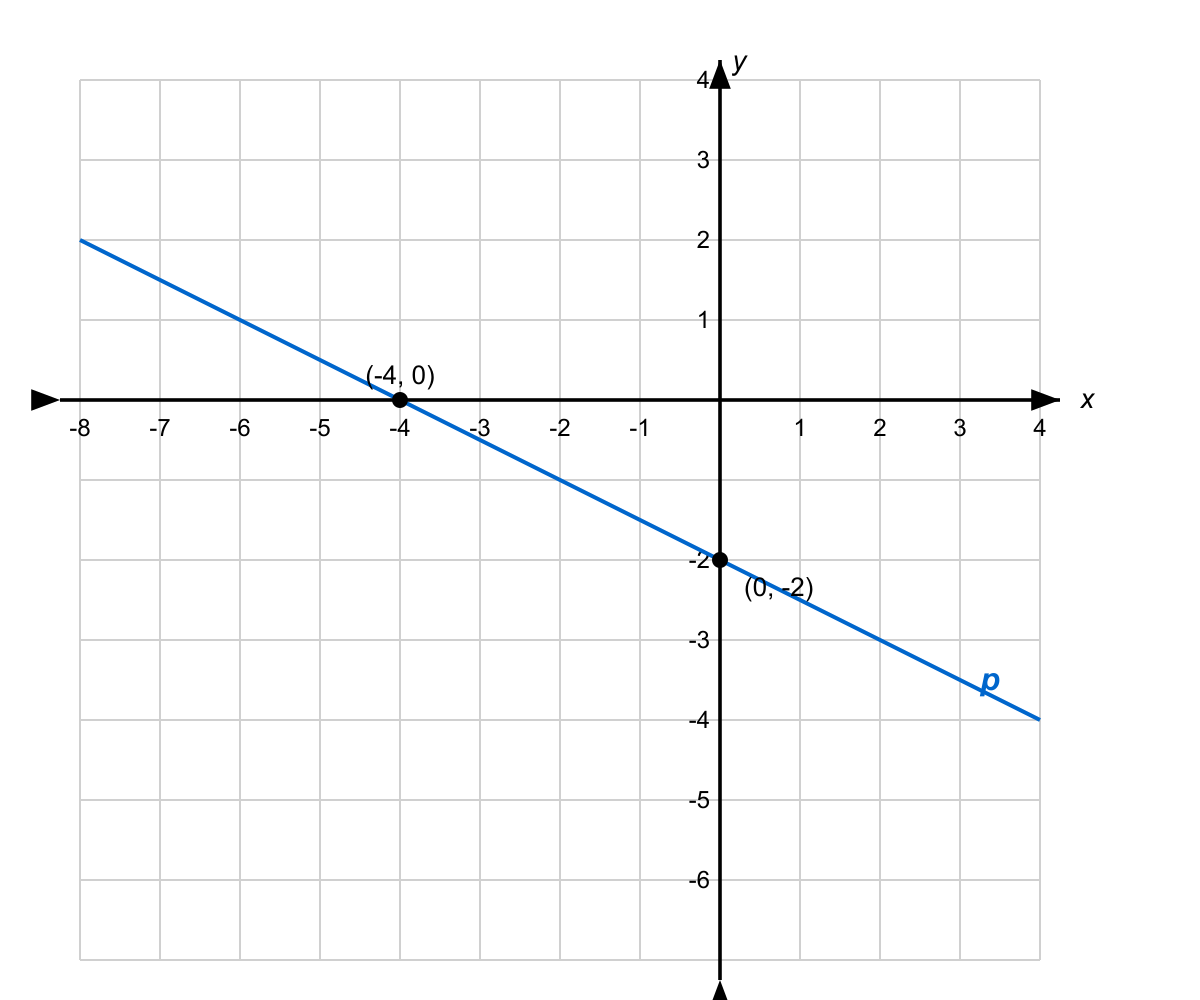
The coordinate plane below shows line p. Line q (not shown) is perpendicular to line p and has the same x-intercept as line p. What is the y-intercept of line q?
GED Math Quiz
Practice Graphing in GED Math with focused quiz questions that help you check what you know, review explanations, and build confidence with test-style prompts.
This quiz focuses on Graphing, giving you a quick way to practice the rules, question types, and explanations that matter most for GED Math.
Try each quiz question before looking at the correct answer. Use the explanations to review missed ideas, then come back to similar questions until the pattern feels familiar.
The coordinate plane below shows line p. Line q (not shown) is perpendicular to line p and has the same x-intercept as line p. What is the y-intercept of line q?
Explanation: Line p passes through (0,−2) and (−4,0)... Reading: slope is 0−(−4)−2−0=−21, equation y=−21x−2, x-intercept at (−4,0). Perpendicular slope = 2. Line q: y−0=2(x−(−4))=2x+8, so y-intercept is 8. Choice A negates. Choice B uses slope 3/2 error. Choice C has sign error.
The graph shows the cost C (in dollars) of renting a power washer for h hours from two companies, Company A and Company B. Use the graph below to determine: For which number of hours will the two companies charge the same amount?
Explanation: Company A: starts at (0,20) and passes through (5,45), so C=5h+20. Company B: starts at (0,5) and passes through (5,45), so C=8h+5. Setting equal: 5h+20=8h+5, so 3h=15, h=5. This matches the intersection point shown. Choices A, B, and D correspond to misreading intercepts or misidentifying the intersection.
Two lines are graphed in the coordinate plane shown. Based on the graph below, what is the solution (x,y) to the system of equations represented by lines m and n?
Explanation: Line m passes through (0,3) and (3,0) giving y=−x+3. Line n passes through (0,0) and (1,2) giving y=2x. Setting equal: 2x=−x+3, so x=1 and y=2. Choice A swaps x and y. Choice C is the x-intercept of line m only. Choice D is not on both lines.
The graph below shows a line passing through two marked points. Which of the following equations has a graph that is parallel to the line shown AND has a y-intercept of −2?
Explanation: The line passes through (−2,−4) and (2,6), with slope 2−(−2)6−(−4)=410=25. A parallel line through (0,−2) is y=25x−2, or 2y=5x−4, i.e., 2y−5x=−4. Choice B has negative slope. Choice C has slope −52 (perpendicular-like). Choice D has slope 52, the reciprocal.
The graph below shows line ℓ. Which of the following equations represents line ℓ?
Explanation: The line crosses the x-axis at (4,0) and the y-axis at (0,−3). The slope is 0−4−3−0=43 and y-intercept is −3, so y=43x−3. Multiplying by 4: 4y=3x−12, or 3x−4y=12. Choice B swaps coefficients. Choice C has wrong signs. Choice D would have negative slope.
Two lines are graphed on the same coordinate plane. Line 1 passes through (0,3) and (2,7). Line 2 passes through (1,5) and (3,1). At what point do these lines intersect?
Explanation: First, find equations for both lines. Line 1: slope = (7-3)/(2-0) = 2, so y = 2x + 3. Line 2: slope = (1-5)/(3-1) = -2. Using point (1,5): y - 5 = -2(x-1), so y = -2x + 7. Set the equations equal: 2x + 3 = -2x + 7. Solving: 4x = 4, so x = 1. Substituting: y = 2(1) + 3 = 5. The intersection point is (1, 5).
The equation y=mx+b represents a line where m<0 and b>0. In which quadrant does this line definitely NOT pass through?
Explanation: With m<0, the line has negative slope (decreases from left to right). With b>0, the y-intercept is positive, so the line crosses the y-axis above the origin. Starting from a positive y-intercept and decreasing, the line passes through Quadrants II and I, then continues into Quadrant IV. However, since the line has negative slope and positive y-intercept, it cannot reach Quadrant III (where both x and y are negative) because it would need to cross back upward, which contradicts the negative slope.
The graph below shows the relationship between the number of miles driven, m, and the amount of gasoline remaining in a car's tank, g (in gallons). Based on the graph, what does the slope represent?
Explanation: The line goes from (0,12) to (300,0), slope =300−00−12=−30012=−251 gallons per mile. The magnitude of the slope means the car uses 251 gallon per mile. Choice B confuses slope with its reciprocal (miles per gallon). Choice C describes the y-intercept. Choice D describes the x-intercept.
The table below shows several (x,y) values for a linear function. Based on the table, which of the following statements is true?
Explanation: Using (−2,16) and (2,6): slope =2−(−2)6−16=4−10=−25. Using point-slope: y−6=−25(x−2), y=−25x+5+6=−25x+11. Choice B has wrong sign on slope. Choice C inverts the slope. Choice D uses a y-value from the table instead of calculating the intercept.
The graph shows the cost C (in dollars) of renting a power washer for h hours from two companies, Company A and Company B. Use the graph to determine: For which number of hours will the two companies charge the same amount?
Explanation: Company A: starts at (0,20) and passes through (5,45), so C=5h+20. Company B: starts at (0,5) and passes through (5,45), so C=8h+5. Setting equal: 5h+20=8h+5, so 3h=15, h=5. This matches the intersection point shown. Choices A, B, and D correspond to misreading intercepts or misidentifying the intersection.
The line shown in the coordinate plane passes through points A and B. Based on the graph below, which equation represents a line perpendicular to the line shown and passing through the point (6,−1)?
Explanation: From the graph, point A=(−2,3) and B=(4,−1), giving a slope of 4−(−2)−1−3=−64=−32. A perpendicular line has slope 23. Using point-slope form: y−(−1)=23(x−6), so y=23x−10. Choice B uses the original slope. Choice C has the wrong sign on slope and incorrect intercept. Choice D uses the negative reciprocal incorrectly.
The graph below shows line k. Which inequality has line k as its boundary and includes the point (0,0) in its solution region?
Explanation: Line k passes through (3,0) and (0,−2), slope 32, equation y=32x−2 or 2x−3y=6. Test (0,0): 2(0)−3(0)=0≤6 ✓. Choice B excludes origin. Choice C uses wrong slope. Choice D has wrong sign on y-coefficient.
Two lines are shown in the coordinate plane below. If line 1 has equation y=31x+4 and line 2 is perpendicular to line 1, what is the value of y at the point where line 2 crosses the y-axis?
Explanation: Line 2 is perpendicular to line 1, so its slope is −3. From the graph, line 2 passes through the point (2,2). Using y=−3x+b: 2=−3(2)+b, so b=8. Choice A negates incorrectly. Choice B is line 1's y-intercept. Choice D uses the wrong perpendicular slope.
What is the slope of the line represented by the equation 2x+3y=12 ?
Explanation: When you encounter a linear equation and need to find its slope, the most reliable approach is to convert the equation to slope-intercept form: y=mx+b, where m is the slope. Starting with 2x+3y=12, you need to solve for y. First, subtract 2x from both sides: 3y=−2x+12. Then divide everything by 3: y=−32x+4. Now you can clearly see that the slope is −32. Looking at the answer choices: Choice A gives −32, which matches our result exactly. Choice B shows 32 – this represents a common sign error where students forget that when moving the x-term to the other side, its sign changes from positive to negative. Choice C gives −23, which happens when students incorrectly flip the fraction formed by the coefficients of x and y. Choice D shows 23, combining both the sign error and the fraction-flipping mistake. Remember this key pattern: in any equation of the form ax+by=c, the slope is always −ba (negative coefficient of x divided by coefficient of y). This gives you a quick shortcut – from 2x+3y=12, the slope is −32. However, converting to slope-intercept form helps you avoid sign errors and reinforces your understanding of linear equations.
A line has a slope of 45 and passes through the point (0,−3). Which equation describes this line?
Explanation: When you see a question asking for the equation of a line given its slope and a point, you're working with the slope-intercept form: y=mx+b, where m is the slope and b is the y-intercept. You're given a slope of 45 and the point (0,−3). The key insight is recognizing that (0,−3) is actually the y-intercept—it's where the line crosses the y-axis. When x=0, y=−3, so b=−3. Substituting the slope m=45 and y-intercept b=−3 into the slope-intercept form gives you y=45x−3, which is choice A. Let's examine why the other options are incorrect. Choice B (y=−45x−3) uses the wrong slope—it's negative instead of positive, which would create a line that falls from left to right rather than rises. Choice C (y=54x−3) flips the slope fraction, using 54 instead of 45, making the line much less steep than it should be. Choice D (y=45x+3) has the correct slope but the wrong y-intercept sign—it uses +3 instead of −3, shifting the line up 6 units from where it should be. Study tip: When a point has an x-coordinate of 0, like (0,−3), it's giving you the y-intercept directly. This saves you from having to use the point-slope form and makes the problem much quicker to solve.
Two lines are perpendicular. If one line has equation y=−23x+7, which equation could represent the other line?
Explanation: When you encounter perpendicular lines, the key relationship to remember is that their slopes are negative reciprocals of each other. If one line has slope m, then a perpendicular line has slope −m1. The given line y=−23x+7 has a slope of −23. To find the slope of a perpendicular line, you take the negative reciprocal: flip the fraction and change the sign. The negative reciprocal of −23 is −−231=32. Looking at the answer choices, option A has y=32x−1, which has the correct slope of 32. This makes it perpendicular to the given line. Option B (y=−32x+4) has slope −32, which is just the reciprocal without changing the sign. Option C (y=23x+4) has slope 23, which is the negative of the original slope but not the reciprocal. Option D (y=32x+1) has the same slope as option A, but since we've already identified A as correct and both have the right slope, either would work mathematically—however, A is the designated correct answer. Study tip: Remember the phrase "flip and flip" for perpendicular slopes—flip the fraction, then flip the sign. Parallel lines have identical slopes, while perpendicular lines have negative reciprocal slopes.
A line passes through (2,5) and (6,−3). What is the equation of this line in slope–intercept form?
Explanation: When you see a question asking for the equation of a line through two points, you need to find the slope first, then use it to determine the y-intercept for slope-intercept form (y=mx+b). Start by calculating the slope using the slope formula: m=x2−x1y2−y1. With points (2,5) and (6,−3), you get m=6−2−3−5=4−8=−2. So the slope is −2. Now substitute one point and the slope into y=mx+b to find the y-intercept. Using (2,5): 5=−2(2)+b, which gives 5=−4+b, so b=9. The equation is y=−2x+9. Looking at the wrong answers: Choice B (y=2x+1) uses a positive slope instead of negative—this happens if you flip the sign when calculating 4−8. Choice C (y=−2x+13) has the correct slope but wrong y-intercept, likely from an arithmetic error when solving for b. Choice D (y=2x−9) combines both errors: wrong slope sign and incorrect y-intercept. The correct answer is A: y=−2x+9. Study tip: Always double-check your slope calculation by ensuring you subtract coordinates in the same order (first point from second point), and verify your final equation by substituting both original points back into it.
What is the x-intercept of the graph of 4x−5y=20 ?
Explanation: When you encounter a question asking for the x-intercept of a linear equation, you're looking for the point where the line crosses the x-axis. At any x-intercept, the y-coordinate is always zero because that's where the line meets the horizontal axis. To find the x-intercept of 4x−5y=20, substitute y=0 into the equation and solve for x: 4x−5(0)=20 4x=20 x=5 Since the y-coordinate at the x-intercept is zero, the x-intercept is the point (5,0), which is choice B. Let's examine why the other options are incorrect. Choice A gives (0,−4), which represents a point on the y-axis since the x-coordinate is zero—this would be a y-intercept, not an x-intercept. Choice C shows (0,5), which is also a point on the y-axis and therefore another y-intercept candidate. Choice D presents (4,0), which has the correct form for an x-intercept (y-coordinate of zero) but uses the wrong x-value. This might tempt students who confused the coefficient 4 with the actual x-intercept value. Remember this key distinction: x-intercepts always have the form (a,0) where the line crosses the x-axis, while y-intercepts have the form (0,b) where the line crosses the y-axis. When finding intercepts, always substitute the appropriate zero value and solve for the remaining variable.
If the graph of y=7x−12 is translated down 5 units, what is the equation of the resulting line?
Explanation: When you encounter questions about translating graphs, you're working with transformations that shift the entire graph without changing its shape or orientation. The key is understanding how different transformations affect the equation. To translate a line down 5 units, you subtract 5 from the y-value (or equivalently, subtract 5 from the entire right side of the equation). Starting with y=7x−12, moving down 5 units gives you y=7x−12−5=7x−17. The slope stays the same (7) because you're only shifting vertically, not changing the steepness. Looking at the wrong answers: Choice B (y=7x−7) represents moving the line up 5 units instead of down—this comes from adding 5 rather than subtracting. Choice C (y=7x−60) suggests multiplying the y-intercept by 5, which isn't how translations work. Choice D (y=12x−5) changes both the slope and y-intercept, which would represent a completely different line, not a translation of the original. The correct answer is A: y=7x−17. Remember this pattern: vertical translations only affect the constant term (y-intercept), never the coefficient of x (slope). Moving down means subtracting from the constant term, moving up means adding to it. The slope always stays identical in vertical translations.
Which statement best describes the effect of changing the equation y=31x−2 to y=31x+4?
Explanation: When you see linear equations in slope-intercept form (y=mx+b), you're looking at how changes to the slope (m) and y-intercept (b) affect the graph's appearance and position. Comparing y=31x−2 to y=31x+4, notice that the slope remains 31 in both equations. Since the slopes are identical, these lines are parallel—they'll never intersect and have the same steepness. The key difference is in the y-intercepts: the original line crosses the y-axis at −2, while the new line crosses at +4. To find the vertical shift, calculate the difference: 4−(−2)=6. Since we're moving from −2 to +4, the line shifts upward by 6 units. Looking at the wrong answers: Choice B incorrectly states the line shifts down 6 units, when it actually moves up. Choice C claims the new line is steeper with the same y-intercept—but the slopes are identical (31) and the y-intercepts are different (−2 vs +4). Choice D suggests the line becomes less steep and shifts down, but again, the slope stays the same and the shift is upward. The correct answer is A: the new line is parallel and shifted up 6 units. Study tip: When comparing linear equations, always check the slope first (parallel lines have equal slopes) and then subtract the original y-intercept from the new one to find the direction and magnitude of any vertical shift.