GED Math Quiz: Functions
15 questions · exam conditions
0:00
FunctionsQuestion 1 of 15

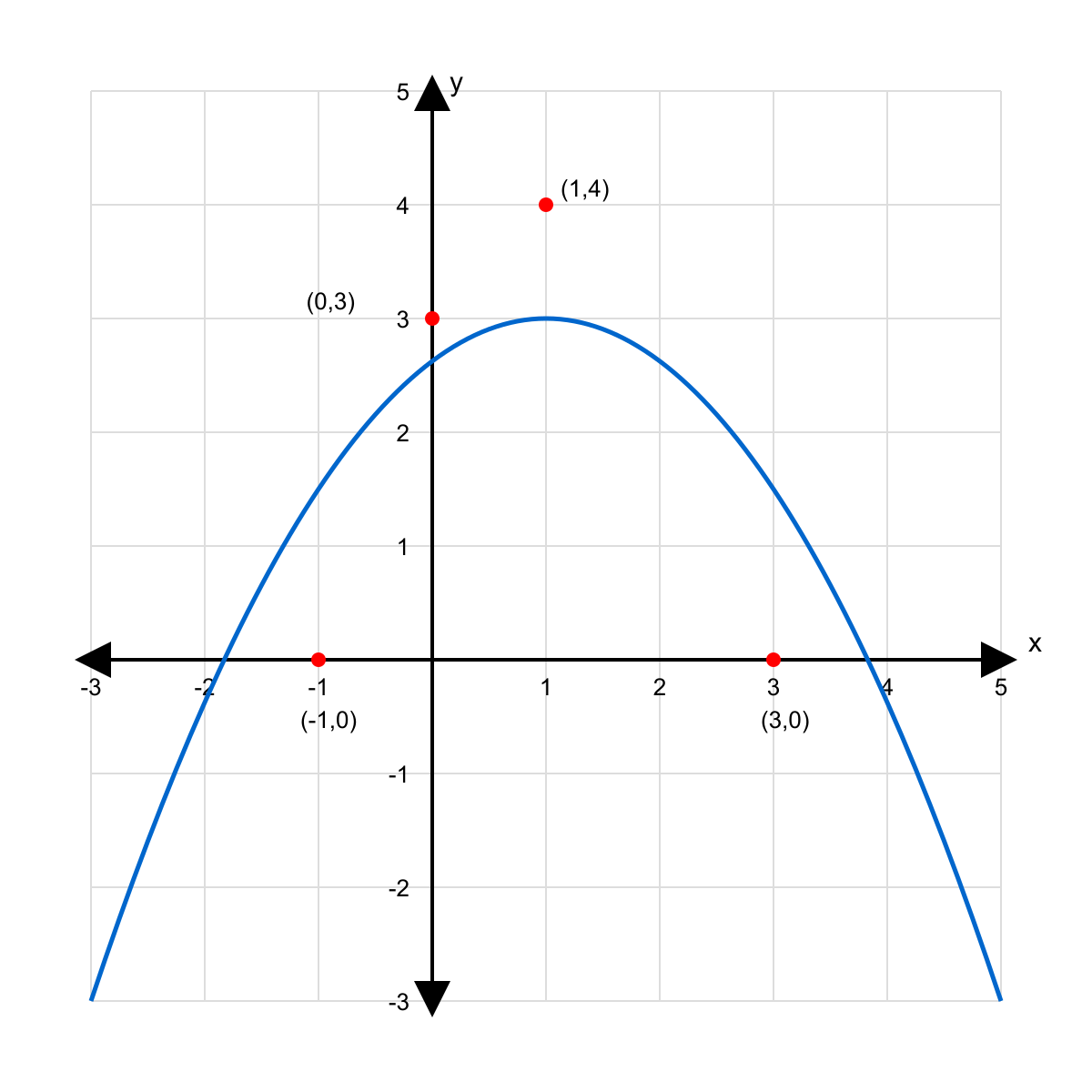
The graph shown represents the function f(x)=ax2+bx+cf(x) = ax^2 + bx + c. Which statement about the coefficients must be true?
Question graphic
a>0a > 0 and c>0c > 0
a<0a < 0 and c>0c > 0
a<0a < 0 and c<0c < 0
a>0a > 0 and c<0c < 0
← Back to quizzes

GED Math Quiz

GED Math Quiz: Functions

Practice Functions in GED Math with focused quiz questions that help you check what you know, review explanations, and build confidence with test-style prompts.

What this quiz covers

This quiz focuses on Functions, giving you a quick way to practice the rules, question types, and explanations that matter most for GED Math.

How to use this quiz

Try each quiz question before looking at the correct answer. Use the explanations to review missed ideas, then come back to similar questions until the pattern feels familiar.

All questions

Question 1

The graph shown represents the function f(x)=ax2+bx+cf(x) = ax^2 + bx + c. Which statement about the coefficients must be true?

  1. a>0a > 0 and c>0c > 0
  2. a<0a < 0 and c>0c > 0 (correct answer)
  3. a<0a < 0 and c<0c < 0
  4. a>0a > 0 and c<0c < 0

Explanation: The parabola opens downward, so a<0a < 0. The y-intercept is c=f(0)c = f(0), and the graph crosses the y-axis above the x-axis, so c>0c > 0. Choice A confuses direction of opening. Choice C gets both signs wrong on the y-intercept. Choice D reverses the opening direction.

Question 2

The graph shown represents the function f(x)f(x). Which of the following is the equation for f(x)f(x)?

  1. f(x)=(x+1)(x3)f(x) = -(x+1)(x-3) (correct answer)
  2. f(x)=(x1)(x+3)f(x) = -(x-1)(x+3)
  3. f(x)=(x+1)(x3)f(x) = (x+1)(x-3)
  4. f(x)=2(x+1)(x3)f(x) = -2(x+1)(x-3)

Explanation: The x-intercepts are at x=1x = -1 and x=3x = 3, giving factors (x+1)(x+1) and (x3)(x-3). The parabola opens downward, so leading coefficient is negative. The y-intercept from the graph is 33: check f(0)=(1)(3)=3f(0) = -(1)(-3) = 3 ✓. So f(x)=(x+1)(x3)f(x) = -(x+1)(x-3). Choice B swaps the x-intercept signs. Choice C has wrong opening direction. Choice D gives y-intercept of 6, not 3.

Question 3

The table below gives values of the quadratic function f(x)=ax2+bx+cf(x) = ax^2 + bx + c. What is the value of ab+ca - b + c?

  1. 66
  2. 2-2
  3. 1010 (correct answer)
  4. 22

Explanation: Note that f(1)=a(1)2+b(1)+c=ab+cf(-1) = a(-1)^2 + b(-1) + c = a - b + c. From the table, f(1)=10f(-1) = 10. Therefore ab+c=10a - b + c = 10. Choice A is f(1)=a+b+cf(1) = a + b + c. Choice B is f(0)f(0)-adjacent error. Choice D is simple sign confusion. This clever question tests understanding that f(1)f(-1) directly gives ab+ca-b+c.

Question 4

The function p(x)=2x+3p(x) = 2x + 3 represents the price in dollars for xx items. The function q(x)=x1q(x) = x - 1 represents the quantity sold when the price is xx dollars. What is the revenue when x=4x = 4 items are purchased?

  1. $22
  2. $33
  3. $44 (correct answer)
  4. $55

Explanation: When x=4x = 4 items, the price per item is p(4)=2(4)+3=11p(4) = 2(4) + 3 = 11 dollars. Revenue equals price per item times number of items: Revenue =11×4=44= 11 \times 4 = 44 dollars. Choice A likely confuses the setup and uses p(4)×q(11)=11×2=22p(4) \times q(11) = 11 \times 2 = 22. Choice B might result from p(4)+p(4)+p(4)=11+11+11=33p(4) + p(4) + p(4) = 11 + 11 + 11 = 33 (adding price three times instead of multiplying by 4). Choice D could come from misunderstanding the problem setup entirely.

Question 5

A quadratic function f(x)=x2+bx+cf(x) = x^2 + bx + c satisfies f(3)=4f(3) = 4 and f(1)=12f(-1) = 12. What is the value of f(0)f(0)?

  1. 3
  2. 5
  3. 7 (correct answer)
  4. 9

Explanation: Using the given conditions: f(3)=9+3b+c=4f(3) = 9 + 3b + c = 4 and f(1)=1b+c=12f(-1) = 1 - b + c = 12. From the first equation: 3b+c=53b + c = -5. From the second equation: b+c=11-b + c = 11. Subtracting the second from the first: 4b=164b = -16, so b=4b = -4. Substituting back into the second equation: c=11+b=11+(4)=7c = 11 + b = 11 + (-4) = 7. Therefore f(x)=x24x+7f(x) = x^2 - 4x + 7, and f(0)=00+7=7f(0) = 0 - 0 + 7 = 7. We can verify: f(3)=912+7=4f(3) = 9 - 12 + 7 = 4 ✓ and f(1)=1+4+7=12f(-1) = 1 + 4 + 7 = 12 ✓.

Question 6

A company's profit function is given by P(x)=2x2+16x24P(x) = -2x^2 + 16x - 24, where xx represents the number of units produced (in hundreds) and P(x)P(x) represents the profit in thousands of dollars.

Based on the profit function above, what is the maximum profit the company can achieve, and at what production level?

  1. Maximum profit of $8,000 when producing 400 units (correct answer)
  2. Maximum profit of $8,000 when producing 800 units
  3. Maximum profit of $4,000 when producing 400 units
  4. Maximum profit of $4,000 when producing 800 units

Explanation: For P(x)=2x2+16x24P(x) = -2x^2 + 16x - 24, the vertex occurs at x=b2a=162(2)=4x = -\frac{b}{2a} = -\frac{16}{2(-2)} = 4. The maximum profit is P(4)=2(16)+16(4)24=32+6424=8P(4) = -2(16) + 16(4) - 24 = -32 + 64 - 24 = 8. Since xx is in hundreds of units, this means 400 units, and since P(x)P(x) is in thousands of dollars, the maximum profit is $8,000. Choice B uses the correct profit but wrong production level (800 vs 400). Choices C and D use incorrect profit calculations, likely from arithmetic errors in evaluating $P(4)P(4) $.

Question 7

The graph shown represents a linear function f(x)f(x). What is the value of xx for which f(x)=f1(x)f(x) = f^{-1}(x) (the intersection with the line y=xy = x)?

  1. x=1x = 1
  2. x=2x = 2
  3. x=3x = 3 (correct answer)
  4. x=4x = 4

Explanation: From the graph, f(x)=12x+92f(x) = -\frac{1}{2}x + \frac{9}{2} (passes through (1,4)(1,4) and (5,2)(5,2)). Setting f(x)=xf(x) = x: 12x+92=x-\frac{1}{2}x + \frac{9}{2} = x, so 92=32x\frac{9}{2} = \frac{3}{2}x, giving x=3x = 3. Check: f(3)=1.5+4.5=3f(3) = -1.5 + 4.5 = 3. ✓ Distractors correspond to misreading the slope or y-intercept from the graph.

Question 8

The table shows values of a quadratic function f(x)f(x). What is the value of f(x)f(x) at its vertex?

  1. 9-9 (correct answer)
  2. 8-8
  3. 1-1
  4. 00

Explanation: The function values are symmetric: f(1)=0f(-1)=0 and f(5)=0f(5)=0, so the axis of symmetry is x=2x=2. The vertex is at x=2x=2. Using finite differences or the pattern, f(2)f(2) can be computed: from f(0)=5f(0)=-5 and f(4)=5f(4)=-5, with f(1)=8f(1)=-8 and f(3)=8f(3)=-8, the vertex at x=2x=2 gives f(2)=9f(2)=-9. Choice B picks the lowest value shown. Choice C picks the average of zeros incorrectly. Choice D picks a zero of the function.

Question 9

The graph shown represents two functions, f(x)f(x) (solid line) and g(x)g(x) (dashed parabola). For how many integer values of xx in the interval [3,4][-3, 4] is f(x)>g(x)f(x) > g(x)?

  1. 22
  2. 33
  3. 44 (correct answer)
  4. 55

Explanation: From the graph, f(x) = x + 2 and g(x) = x² - 2. They intersect where x + 2 = x² - 2, giving x² - x - 4 = 0, so x ≈ -1.56 and x ≈ 2.56. Between these intersection points, the linear function is above the parabola. Checking integer values in [-3, 4]: at x = -1: f(-1) = 1, g(-1) = -1, so f > g ✓. At x = 0: f(0) = 2, g(0) = -2, so f > g ✓. At x = 1: f(1) = 3, g(1) = -1, so f > g ✓. At x = 2: f(2) = 4, g(2) = 2, so f > g ✓. Therefore, 4 integer values satisfy f(x) > g(x).

Question 10

The graph shows the quadratic function f(x)f(x). If g(x)=f(x2)+3g(x) = f(x - 2) + 3, what are the coordinates of the vertex of g(x)g(x)?

  1. (1,1)(-1, 1)
  2. (3,1)(3, 1)
  3. (1,7)(-1, 7)
  4. (3,7)(3, 7) (correct answer)

Explanation: The vertex of f(x)f(x) is at (1,4)(1, 4). The transformation g(x)=f(x2)+3g(x) = f(x-2) + 3 shifts the graph right 2 and up 3. New vertex: (1+2,4+3)=(3,7)(1+2, 4+3) = (3, 7). Choice A shifts left and down (reverses both). Choice B shifts right but subtracts 3. Choice C shifts left but adds 3.

Question 11

A function is defined by f(x)=52xf(x)=5-2x. What is the value of f(4)f(-4)?

  1. 13 (correct answer)
  2. 3
  3. -3
  4. -13

Explanation: When you encounter a function notation problem like f(x)=52xf(x) = 5 - 2x, you're being asked to substitute a specific value for the variable and calculate the result. Function notation f(4)f(-4) means "find the output when the input is -4." To solve this, replace every xx in the function with -4: f(4)=52(4)f(-4) = 5 - 2(-4) Following order of operations, multiply first: 2(4)=82(-4) = -8 Then subtract: f(4)=5(8)=5+8=13f(-4) = 5 - (-8) = 5 + 8 = 13 Looking at the wrong answers reveals common mistakes. Choice B (3) results from incorrectly calculating 52(4)5 - 2(-4) as 52+4=75 - 2 + 4 = 7, then making an arithmetic error. Choice C (-3) comes from treating the negative input incorrectly, perhaps calculating 52(4)=35 - 2(4) = -3 by dropping the negative sign. Choice D (-13) occurs when you forget that subtracting a negative number means addition, calculating 58=135 - 8 = -13 instead of recognizing that 5(8)=5+85 - (-8) = 5 + 8. The correct answer is A (13). Remember this key strategy for function problems: substitute carefully and watch your signs. When you see a negative input like -4, pay extra attention to how it interacts with operations in the function. The most common error is mishandling the arithmetic when negative numbers are involved, so double-check your work by verifying each step of the calculation.

Question 12

If g(x)=3x7g(x)=3x-7, for which value of xx does g(x)=11g(x)=11?

  1. 2
  2. 4
  3. 6 (correct answer)
  4. 18

Explanation: This question tests function evaluation and solving linear equations. When you see g(x)=11g(x) = 11, you're being asked to find which input value makes the function output equal to 11. To solve this, substitute 11 for g(x)g(x) in the equation: 11=3x711 = 3x - 7. Now solve for xx by adding 7 to both sides: 18=3x18 = 3x. Finally, divide both sides by 3: x=6x = 6. You can verify this by substituting back: g(6)=3(6)7=187=11g(6) = 3(6) - 7 = 18 - 7 = 11 Looking at the wrong answers: Choice A gives us g(2)=3(2)7=1g(2) = 3(2) - 7 = -1, not 11. Choice B gives us g(4)=3(4)7=5g(4) = 3(4) - 7 = 5, still not 11. Choice D gives us g(18)=3(18)7=47g(18) = 3(18) - 7 = 47, which is far too large. These incorrect answers likely come from common algebraic mistakes like forgetting to add 7 to both sides, or confusing the input with the output. Remember that function notation like g(x)=11g(x) = 11 means "what input gives me an output of 11?" Don't let the notation intimidate you—it's just asking you to solve a regular equation. Always check your answer by plugging it back into the original function to make sure you get the desired output.

Question 13

The function g(x)=3x7g(x) = 3x - 7 represents the relationship between the input xx and output g(x)g(x). If g(a)=2g(a) = 2 and g(b)=14g(b) = 14, what is the value of g(a+b)g(a + b)?

  1. 16
  2. 23 (correct answer)
  3. 26
  4. 35

Explanation: First, find aa and bb. From g(a)=2g(a) = 2: 3a7=23a - 7 = 2, so 3a=93a = 9 and a=3a = 3. From g(b)=14g(b) = 14: 3b7=143b - 7 = 14, so 3b=213b = 21 and b=7b = 7. Therefore a+b=3+7=10a + b = 3 + 7 = 10. Finally, g(a+b)=g(10)=3(10)7=23g(a + b) = g(10) = 3(10) - 7 = 23. Choice A incorrectly adds g(a)+g(b)=2+14=16g(a) + g(b) = 2 + 14 = 16. Choice C likely results from calculation errors. Choice D uses 3(a+b)+73(a + b) + 7 instead of 3(a+b)73(a + b) - 7.

Question 14

A quadratic function has the form y=ax2+bx+cy = ax^2 + bx + c and has zeros at x=1x = -1 and x=5x = 5. If the function has a minimum value of 18-18, what is the value of aa?

  1. 12\frac{1}{2}
  2. 11
  3. 33
  4. 22 (correct answer)

Explanation: When you encounter a quadratic function problem with given zeros and a minimum/maximum value, you're working with the vertex form and factored form together. The zeros tell you where the parabola crosses the x-axis, while the minimum value gives you information about the vertex. Since the zeros are at x=1x = -1 and x=5x = 5, you can write the function in factored form: y=a(x+1)(x5)y = a(x + 1)(x - 5). The vertex occurs at the midpoint between the zeros, so x=1+52=2x = \frac{-1 + 5}{2} = 2. Since aa will be positive (the function has a minimum, not maximum), the vertex is at (2,18)(2, -18). To find aa, substitute the vertex coordinates into your factored form: 18=a(2+1)(25)=a(3)(3)=9a-18 = a(2 + 1)(2 - 5) = a(3)(-3) = -9a. Solving for aa: a=189=2a = \frac{-18}{-9} = 2. Let's check why the other answers don't work. Choice A (a=12a = \frac{1}{2}) would give a minimum value of 9-9, not 18-18. Choice B (a=1a = 1) would produce a minimum of 9-9 as well. Choice C (a=3a = 3) would create a minimum of 27-27, which is too low. Remember this key strategy: when you have zeros and a vertex value, use the factored form y=a(xr1)(xr2)y = a(x - r_1)(x - r_2) where r1r_1 and r2r_2 are the zeros. The vertex x-coordinate is always the average of the zeros, and you can substitute the vertex point to solve for aa.

Question 15

Consider the quadratic function h(t)=16t2+64t+80h(t) = -16t^2 + 64t + 80. This function models the height of an object over time. At what time(s) will the object be at a height of 128 feet?

  1. t=1t = 1 second and t=4t = 4 seconds only
  2. t=2t = 2 seconds and t=3t = 3 seconds only
  3. t=2t = 2 seconds only, at the maximum height
  4. t=1t = 1 second and t=3t = 3 seconds only (correct answer)

Explanation: This question tests your ability to solve quadratic equations in a real-world context. When you see a quadratic function modeling height over time, you're typically looking for specific values of time when the object reaches a particular height. To find when the object is at 128 feet, you need to set the height function equal to 128 and solve for tt: 16t2+64t+80=128-16t^2 + 64t + 80 = 128 Subtract 128 from both sides: 16t2+64t48=0-16t^2 + 64t - 48 = 0 Divide everything by -16 to simplify: t24t+3=0t^2 - 4t + 3 = 0 This factors as (t1)(t3)=0(t - 1)(t - 3) = 0, giving you t=1t = 1 and t=3t = 3 seconds. Let's examine why the other answers are wrong. Choice A includes t=4t = 4 seconds, but substituting this into the original equation gives h(4)=16(16)+64(4)+80=80h(4) = -16(16) + 64(4) + 80 = 80 feet, not 128. Choice B gives t=2t = 2 and t=3t = 3 seconds. While t=3t = 3 is correct, t=2t = 2 yields h(2)=16(4)+64(2)+80=144h(2) = -16(4) + 64(2) + 80 = 144 feet. Choice C suggests only t=2t = 2 at maximum height, but as we calculated, the height at t=2t = 2 is 144 feet, and the maximum occurs at the vertex, not necessarily when height equals 128. When solving quadratic equations in context, always check your solutions by substituting back into the original equation. This catches calculation errors and ensures your answers make sense within the problem's constraints.