All questions
Question 1
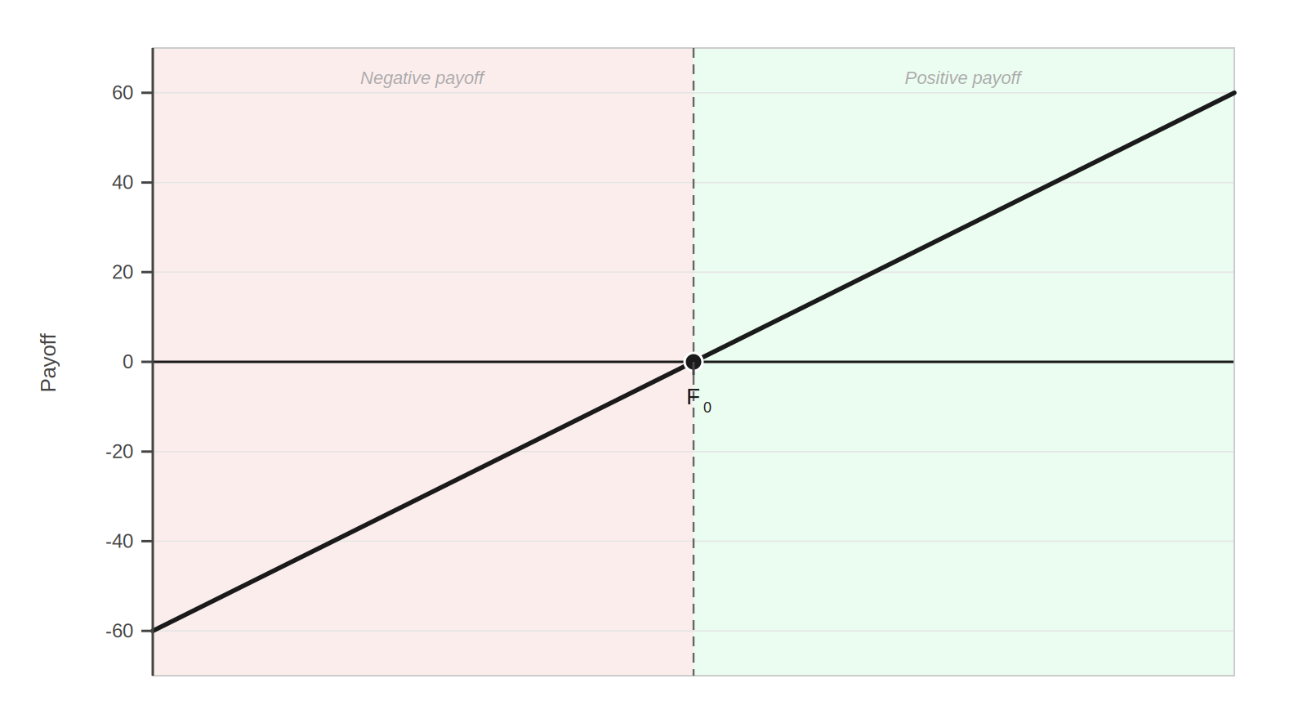
The payoff diagram below illustrates the profit/loss profile for a derivative position at expiration. Which position does the diagram represent?
- A short forward contract
- A long put option
- A long forward contract (correct answer)
- A short call option
Explanation: The diagram shows a linear payoff. The payoff is negative when the spot price at expiration (S_T) is below the forward price (F₀) and positive when S_T is above F₀. The payoff is calculated as (S_T - F₀). This is the characteristic payoff structure of a long forward or futures contract.
Question 2
A portfolio manager enters into a short forward contract to sell 10,000 shares of a non-dividend-paying stock in 90 days. The agreed-upon forward price is $50 per share. On the expiration date, the stock's spot price is $54 per share. What is the value of the portfolio manager's position on the expiration date?
- A gain of $40,000
- A loss of $40,000 (correct answer)
- A gain of $540,000
- A loss of $500,000
Explanation: The payoff for a short forward position is calculated as N × (F₀ - S_T), where N is the notional amount, F₀ is the forward price, and S_T is the spot price at expiration. In this case, Payoff = 10,000 × ($50 - 54)=10,000×(−4) = -$40,000. This represents a loss of $40,000 for the short position. Question 3
At the moment a forward contract is initiated between two parties, which of the following statements is most accurate regarding its price and value?
- Both the price and the value are zero, as no cash has been exchanged.
- The price is positive, representing the agreed-upon delivery price, while the value is zero. (correct answer)
- The value is positive, reflecting the expected profit, while the price is zero.
- Both the price and the value are positive and equal to the current spot price of the asset.
Explanation: There is a critical distinction between the price and the value of a forward contract. The forward price is the delivery price specified in the contract (F₀), which is a positive number. The forward contract is structured such that, at initiation, neither party has to pay the other to enter the agreement. Therefore, the initial value of the contract to both parties is zero.
Question 4
A speculator believes a currency will appreciate and wants to take a leveraged position to profit from this view, intending to close the position within a few weeks. Which instrument would generally be more advantageous for this purpose, and for what primary reason?
- A forward contract, because its customized nature allows for creating a position with higher leverage.
- A forward contract, because the absence of margin calls prevents the position from being closed out prematurely.
- A futures contract, because its standardization and exchange trading provide high liquidity for easy entry and exit. (correct answer)
- A futures contract, because the central clearinghouse guarantees a profit if the speculator's view is correct.
Explanation: When evaluating derivative instruments for short-term currency speculation, you need to consider liquidity, leverage availability, and ease of position management. The speculator's timeline of "a few weeks" is crucial here—they need the ability to enter and exit positions quickly and efficiently.
Futures contracts excel in this scenario because they're standardized and trade on organized exchanges with high daily volume. This standardization creates deep, liquid markets where you can easily open and close positions without significant bid-ask spreads or difficulty finding counterparties. For a speculator planning to exit within weeks, this liquidity is essential.
Option A is incorrect because forwards don't inherently offer higher leverage than futures—both derive their leverage from the same principle of controlling large currency amounts with small initial investments. Option B contains a fundamental misunderstanding: while forwards don't have daily margin calls, this actually works against short-term speculators who benefit from the transparent, mark-to-market pricing that margin calls reflect. Option D makes an impossible claim—no clearinghouse guarantees profits based on market direction. Clearinghouses only guarantee contract performance (that counterparties fulfill their obligations), not profitable outcomes.
The key insight is that forwards are designed for customized, longer-term hedging needs with specific counterparties, while futures serve the standardized, liquid trading that speculators require. When you see questions about short-term speculation versus long-term hedging, always consider liquidity needs first—speculators prioritize easy entry and exit over contract customization.
Question 5
A US coffee roaster plans to purchase a large quantity of coffee beans from Brazil. The roaster is concerned about the coffee price in Brazilian real (BRL) but also about the BRL/USD exchange rate. The company hedges its coffee price risk using coffee futures, which are priced in USD. This strategy fails to protect the roaster from which specific risk?
- Systemic risk, which is the risk of a collapse of the entire financial system.
- Operational risk, related to potential failures in the company's internal processes.
- Counterparty risk, as the futures exchange might default on its obligations.
- Basis risk, arising from the mismatch between the hedged instrument and the actual exposure. (correct answer)
Explanation: When companies hedge foreign transactions, they face the challenge of matching their hedging instruments precisely to their actual risk exposures. This question tests your understanding of basis risk and how imperfect hedges can leave companies vulnerable.
The coffee roaster's actual exposure is to coffee prices denominated in Brazilian reais, but they're hedging with USD-denominated coffee futures. This creates a currency mismatch that the hedge cannot address. If the real weakens against the dollar, the roaster might pay less in USD for the coffee, but their futures hedge (designed to protect against rising coffee prices) won't adjust for this currency benefit. Conversely, if the real strengthens, they'll pay more in USD terms even if coffee prices in reais remain stable. This mismatch between the hedged instrument (USD coffee futures) and the actual exposure (BRL coffee prices) exemplifies basis risk, making D correct.
A is wrong because systemic risk refers to threats to the entire financial system, not the specific mismatch between hedge and exposure. B is incorrect as operational risk involves internal process failures, not hedging mismatches. C misidentifies the issue as counterparty risk - futures exchanges have robust clearinghouse mechanisms that make default extremely unlikely, and this isn't the risk described in the scenario.
Remember that basis risk emerges whenever there's any mismatch between your hedge and your actual exposure - whether in currency, timing, quantity, or underlying asset quality. Perfect hedges are rare; always look for what specific element remains unhedged.
Question 6
A trader buys a single futures contract at a price of 100. The contract has a multiplier of $250. The position is held for three days. The settlement prices at the end of Day 1, Day 2, and Day 3 (at maturity) are 102, 99, and 101, respectively. Ignoring margin accounts and the time value of money, what is the trader's total profit or loss over the three-day period?
- A profit of $250 (correct answer)
- A loss of $250
- A loss of $750
- A profit of $500
Explanation: The total profit or loss on a futures contract held to maturity is the difference between the final settlement price and the initial futures price, multiplied by the contract size/multiplier. The intermediate price movements determine daily margin flows but do not change the total outcome. Total Profit/Loss = (Final Price - Initial Price) × Multiplier = (101 - 100) × $250 = 1 × $250 = 250profit.Alternatively,onecansumdailyprofits:Day1:(102−100)∗250=+500. Day 2: (99-102)*250 = -750.Day3:(101−99)∗250=+500. Total = $500 - $750 + $500 = $250 profit. Question 7
The payoff for a short position in a forward contract on one unit of an asset is given by the formula F₀ - S_T. If the forward price (F₀) is $100 and the spot price at maturity (S_T) is $120, what does this formula imply for the short position?
- A profit of $20, because the seller receives more than the asset's initial value.
- A profit of $120, because that is the market value of the underlying asset.
- A loss of $20, because the seller must deliver an asset worth $120 for only $100 in proceeds. (correct answer)
- A loss of $100, representing the full amount committed to in the contract.
Explanation: Forward contracts involve an obligation to buy or sell an asset at a predetermined price on a future date. When analyzing payoffs, you need to understand the perspective of each party and how the formula reflects their profit or loss.
For a short position (the seller), the payoff formula is F0−ST, where F0 is the forward price agreed upon today and ST is the spot price at maturity. With F0=$100 and ST=$120, the calculation gives us $100−$120=−$20. This negative result indicates a $20 loss for the short position holder.
The economic logic is clear: the seller must deliver an asset worth $120 in the market but only receives the contracted $100, creating a $20 opportunity cost or loss.
Answer A incorrectly suggests a profit, misunderstanding that a negative payoff represents a loss, not a gain. The seller doesn't benefit from the higher market price since they're locked into the lower contract price. Answer B confuses the payoff with the asset's market value—the $120 spot price isn't the seller's profit but rather what makes their position unprofitable. Answer D overstates the loss by claiming the full contract value as a loss, ignoring that the seller does receive the $100 contract payment.
Remember this key insight: in forward contract payoff formulas, negative results always indicate losses, and positive results indicate profits. The formula automatically accounts for the economic reality of being locked into a contract when market conditions move against you. Question 8
In a forward contract on a physical commodity, the party with the long position realizes a profit of $125,000 at expiration. Assuming no transaction costs and no default by either party, what is the financial outcome for the party with the short position?
- A loss of $125,000, as forwards are a zero-sum game between the two counterparties. (correct answer)
- A profit of $125,000, as both parties can profit if the market moves favorably.
- A loss of an amount unrelated to the long's profit, determined by market volatility.
- No profit or loss, as their initial contract value was zero.
Explanation: Forward and futures contracts are zero-sum games. The gain to one party is a direct loss to the other. If the long position (the buyer) profits by $125,000, it means the spot price at expiration was $125,000 higher than the agreed-upon forward price (scaled by the notional amount). The short position (the seller) must sell the asset at the lower forward price instead of the higher spot price, incurring a loss of exactly $125,000.
Question 9
A corporation needs to hedge the purchase of a precisely specified quantity of industrial-grade copper with unique purity requirements, for delivery on a non-standard date (e.g., 107 days from today). Which derivative instrument is most suitable for this purpose and why?
- A futures contract, because it is traded on a liquid exchange, ensuring a fair price and the ability to close the position easily if needed.
- A forward contract, because its terms, such as quantity, quality, and expiration date, can be customized to precisely match the corporation's exposure. (correct answer)
- A futures contract, because the daily marking-to-market process reduces credit risk, which is paramount for a large corporate transaction.
- A forward contract, because it requires no initial margin, making it a more capital-efficient hedging tool for the corporation.
Explanation: Forward contracts are private agreements between two parties and can be customized to meet the specific needs of the hedger regarding the underlying asset's specifications, the contract size, and the delivery date. Futures contracts are standardized in all these aspects, making them unsuitable for hedging such a specific exposure without introducing significant basis risk.
Question 10
An investor shorts one S&P 500 futures contract at a price of 4,500. The contract multiplier is $250. Over the next day, concerns about inflation cause the futures price to settle at 4,550. What is the financial result for the investor on this day?
- A profit of $12,500, as the index value increased.
- A loss of $1,137,500, which is the new notional value of the contract.
- A profit of $50, as this is the raw point change in the index.
- A loss of $12,500, due to the price moving against the short position. (correct answer)
Explanation: When you encounter futures trading problems, focus on two key elements: the direction of your position and how price movements affect your profit or loss. Short positions profit when prices fall and lose when prices rise.
Here's the calculation: The investor shorted at 4,500 and the price moved to 4,550, creating an unfavorable move of 50 points. With a contract multiplier of $250, the loss equals $50 \times \250 = $12,500. Since the investor is short, the price increase works against them.
Looking at the wrong answers: Choice A incorrectly suggests a profit of 12,500simplybecausetheindexincreased,butthisignoresthatshortpositionslosemoneywhenpricesrise.ChoiceBconfusesthedailylosswiththecontract′stotalnotionalvalue(1,137,500 = 4,550 × $250), which represents the contract's full value, not the day's change. Choice C gives the raw 50-point move without applying the contract multiplier, missing that futures contracts amplify gains and losses through their multiplier.
Answer D correctly identifies both the loss amount ($12,500) and explains why: the price moved against the short position.
Study tip: Always remember the futures P&L formula: (Exit Price - Entry Price) × Contract Multiplier × Number of Contracts. For short positions, flip the signs—you profit when the exit price is below your entry price. Don't confuse daily changes with total contract values, and always apply the multiplier to convert index points into dollar amounts. Question 11
Consider a long forward contract and a long futures contract on the same underlying asset with the same maturity date and initial contract price. Assume the underlying asset price trends steadily upward over the life of the contracts. How does the timing of cash flows differ between the two positions?
- Both contracts have a single cash flow at maturity, but the futures contract may require an initial cash deposit for margin.
- The forward contract has a single cash flow at expiration, while the futures contract experiences periodic positive cash flows from margin account settlements. (correct answer)
- The futures contract has a single large cash outflow at initiation, while the forward contract has a single large cash inflow at expiration.
- Both contracts have identical periodic cash flows throughout their lives, as their economic exposure is the same.
Explanation: A forward contract typically involves no cash flow until the expiration date, when the contract is settled. A futures contract, however, is marked-to-market daily. As the asset price trends upward, the long futures position will realize daily profits. These profits are credited to the margin account and can typically be withdrawn, resulting in periodic positive cash flows throughout the contract's life. The forward holder does not realize this gain until expiration.
Question 12
An airline wishes to hedge its exposure to rising fuel costs by locking in the price of 100,000 gallons of jet fuel. It enters into a long forward contract at a price of $2.50 per gallon. At settlement, the spot price of jet fuel is $2.20 per gallon. From a purely financial perspective on the derivative contract, what is the outcome for the airline?
- A gain of $30,000, because it purchased fuel below the market price.
- A loss of $30,000, as it is obligated to buy at a price higher than the current market price. (correct answer)
- A gain of $250,000, representing the value of the fuel secured.
- A loss of $220,000, representing the market value of the fuel at settlement.
Explanation: The payoff for a long forward position is N × (S_T - F₀). Here, N = 100,000 gallons, S_T = $2.20, and F₀ = 2.50.Thepayoffis100,000×(2.20 - 2.50)=100,000×(−0.30) = -$30,000. The airline experiences a financial loss on the forward contract because the price of fuel fell. Note that while this is a loss on the hedge, the airline benefits from lower fuel costs in the physical market; the question asks only about the derivative outcome. Question 13
An oil producer sells crude oil forward at a fixed price of $80 per barrel to hedge its production. The company's cost of production is $65 per barrel. At the maturity of the forward contract, the spot price for crude oil is $90 per barrel. What is the producer's effective realized price per barrel, including the impact of the hedge?
- $65 per barrel
- $80 per barrel (correct answer)
- $90 per barrel
- $15 per barrel
Explanation: The producer has two components to its position: the physical oil and the short forward contract. The producer sells the physical oil in the spot market for 90/barrel.Theshortforwardcontracthasapayoffof(F0−ST)=(80 - 90)=−10 per barrel. The effective price is the revenue from the physical sale plus the profit/loss from the hedge: 90+(−10) = $80. The hedge successfully locked in the selling price at the forward rate of $80. Question 14
A U.S.-based company imports goods from Germany and must pay €5 million in 90 days. To hedge against adverse movements in the EUR/USD exchange rate, the company enters into a 90-day forward contract to buy €5 million at a forward rate of $1.08/€. At the end of the 90 days, the spot exchange rate is $1.11/€. What was the net economic impact of the hedge on the company's payment?
- The company had an opportunity loss of $150,000 because the euro became more expensive.
- The company experienced no impact, as the hedge exactly offset the change in the spot rate.
- The company had a gain of $5,550,000, which is the dollar value of the euros at the spot rate.
- The company saved $150,000 compared to what it would have paid at the spot rate. (correct answer)
Explanation: When a company faces foreign exchange risk from future payments, forward contracts lock in exchange rates to eliminate uncertainty. The key to analyzing hedge effectiveness is comparing the hedged cost to what the unhedged cost would have been.
Let's calculate both scenarios. With the forward contract, the company pays: €5,000,000×$1.08/€=$5,400,000
Without the hedge, paying at the spot rate would cost: €5,000,000×$1.11/€=$5,550,000
The company saved $5,550,000−$5,400,000=$150,000 by using the forward contract.
Answer A incorrectly frames this as an "opportunity loss." While the euro did appreciate, the company protected itself against exactly this risk—that's the hedge's purpose. Answer B is wrong because the hedge doesn't need to "exactly offset" rate changes; it simply locks in a predetermined rate regardless of spot movements. Answer C confuses the total payment amount with the hedge's impact. The $5,550,000 represents what the company would have paid without hedging, not a gain.
Answer D correctly identifies that the company saved $150,000 compared to the unhedged alternative.
Study tip: For foreign exchange hedging problems, always calculate both the hedged cost (using the forward rate) and the unhedged cost (using the final spot rate), then compare them. The hedge's value is the difference between these amounts, not whether you "guessed right" about currency direction. Question 15
A trader buys a single futures contract at a price of 100. The contract has a multiplier of $250. The position is held for three days. The settlement prices at the end of Day 1, Day 2, and Day 3 (at maturity) are 102, 99, and 101, respectively. Ignoring margin accounts and the time value of money, what is the trader's total profit or loss over the three-day period?
- A profit of $250 (correct answer)
- A loss of $250
- A loss of $750
- A profit of $500
Explanation: The total profit or loss on a futures contract held to maturity is the difference between the final settlement price and the initial futures price, multiplied by the contract size/multiplier. The intermediate price movements determine daily margin flows but do not change the total outcome. Total Profit/Loss = (Final Price - Initial Price) × Multiplier = (101 - 100) × $250 = 1 × $250 = 250profit.Alternatively,onecansumdailyprofits:Day1:(102−100)∗250=+500. Day 2: (99-102)*250 = -750.Day3:(101−99)∗250=+500. Total = $500 - $750 + $500 = $250 profit. Question 16
A trader takes a long position in one crude oil futures contract on the NYMEX, which represents 1,000 barrels of oil. The initial margin requirement is $6,000 and the maintenance margin is $4,500. The contract is entered at a futures price of $80.00 per barrel. At the end of the first day, the settlement price is $78.20. What is the balance in the trader's margin account at the end of Day 1, and what action is required?
- $4,200; the trader must deposit $1,800 to restore the initial margin. (correct answer)
- $7,800; the trader can withdraw $1,800 from the account.
- $4,200; no action is required as the balance is below the initial margin.
- $1,800; the trader must deposit $4,200 to restore the initial margin.
Explanation: The trader's position changed by ($78.20 - 80.00)=−1.80 per barrel. For one contract of 1,000 barrels, this is a loss of $1.80 × 1,000 = $1,800. The margin account balance becomes the initial margin minus the loss: $6,000 - $1,800 = $4,200. Since $4,200 is below the maintenance margin of $4,500, a margin call is triggered. The trader must deposit funds to bring the account balance back up to the initial margin level of $6,000. The required deposit is $6,000 - $4,200 = $1,800. Question 17
A speculator holds a short position in a futures contract. If the underlying asset's price rises significantly, which of the following statements best describes the payoff structure and risk for the speculator?
- The potential loss is limited to the initial margin posted, while the potential profit is theoretically unlimited.
- The potential loss is theoretically unlimited, while the potential profit is limited to the forward price declining to zero. (correct answer)
- Both the potential profit and loss are theoretically unlimited due to the leverage inherent in futures.
- The potential loss is limited to the forward price, while the potential profit is also limited to the forward price.
Explanation: For a short futures position, the holder profits if the asset price falls. The maximum profit occurs if the asset price drops to zero, so the profit is limited to the initial futures price times the notional. Conversely, if the asset price rises, the short position incurs losses. Since there is no theoretical upper limit to how high the asset price can rise, the potential loss for a short position is theoretically unlimited.
Question 18
A corn farmer expects to harvest 50,000 bushels of corn in three months and wishes to lock in a selling price. The farmer observes that 3-month corn futures contracts, each for 5,000 bushels, are trading at $4.50 per bushel. Which of the following actions should the farmer take to hedge this price risk?
- Take a long position in 10 futures contracts.
- Take a short position in 10 futures contracts. (correct answer)
- Take a short position in 50,000 futures contracts.
- Take a long position in a forward contract for $4.50.
Explanation: The farmer is long the physical asset (corn) and wants to hedge against a price decrease. To do this, the farmer should take an opposite position in the derivatives market, which is a short position. This locks in the selling price. The total quantity to hedge is 50,000 bushels, and each contract is for 5,000 bushels, so the farmer needs to short 50,000 / 5,000 = 10 contracts.
Question 19
A portfolio manager enters into a short forward contract to sell 10,000 shares of a non-dividend-paying stock in 90 days. The agreed-upon forward price is $50 per share. On the expiration date, the stock's spot price is $54 per share. What is the value of the portfolio manager's position on the expiration date?
- A gain of $40,000
- A loss of $40,000 (correct answer)
- A gain of $540,000
- A loss of $500,000
Explanation: The payoff for a short forward position is calculated as N × (F₀ - S_T), where N is the notional amount, F₀ is the forward price, and S_T is the spot price at expiration. In this case, Payoff = 10,000 × ($50 - 54)=10,000×(−4) = -$40,000. This represents a loss of $40,000 for the short position. Question 20
A corporation needs to hedge the purchase of a precisely specified quantity of industrial-grade copper with unique purity requirements, for delivery on a non-standard date (e.g., 107 days from today). Which derivative instrument is most suitable for this purpose and why?
- A futures contract, because it is traded on a liquid exchange, ensuring a fair price and the ability to close the position easily if needed.
- A forward contract, because its terms, such as quantity, quality, and expiration date, can be customized to precisely match the corporation's exposure. (correct answer)
- A futures contract, because the daily marking-to-market process reduces credit risk, which is paramount for a large corporate transaction.
- A forward contract, because it requires no initial margin, making it a more capital-efficient hedging tool for the corporation.
Explanation: Forward contracts are private agreements between two parties and can be customized to meet the specific needs of the hedger regarding the underlying asset's specifications, the contract size, and the delivery date. Futures contracts are standardized in all these aspects, making them unsuitable for hedging such a specific exposure without introducing significant basis risk.