All questions
Question 1
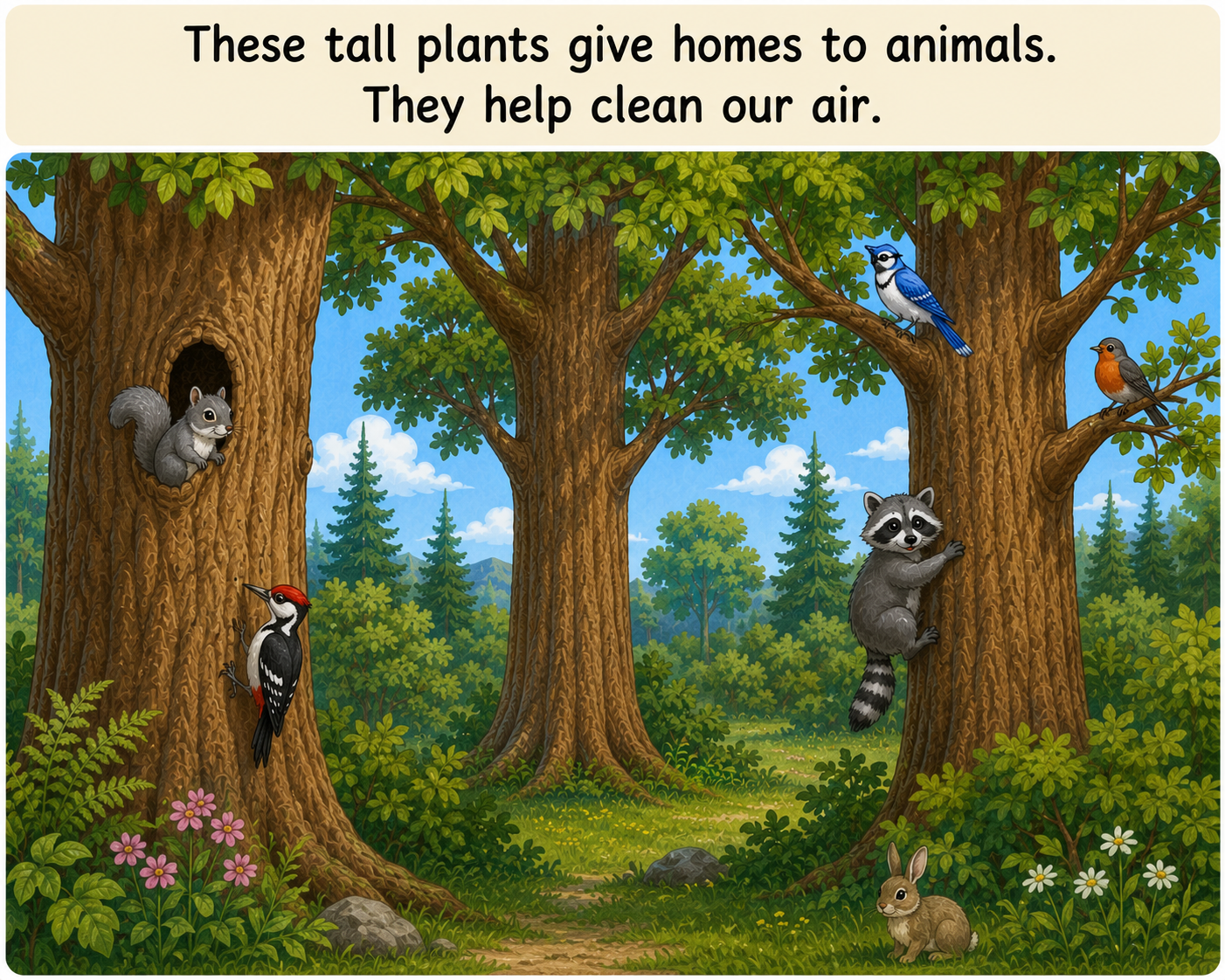
The text says: These tall plants give homes to animals. They help clean our air.
Look at the picture and listen to the words. What is Elena learning about?
- Flowers
- Grass
- Trees (correct answer)
- Bushes
Explanation: The picture shows tall plants with thick brown trunks and animals climbing them, and the words say they give animals homes and clean the air. Those are trees. Choice C is correct.
Question 2
The text says: This animal lives in Africa. It eats leaves from tall trees.
Look at the picture and listen to the words. What animal is it?
- A giraffe (correct answer)
- A zebra
- A leopard
- A horse
Explanation: The picture shows a tall animal with black spots and a long neck eating leaves from a tree, and the words say it lives in Africa and eats leaves from tall trees. That is a giraffe. Choice A is correct.
Question 3
The text says: The kids went outside to play after the storm.
Look at the picture and listen to the words. What kind of storm happened?
- A thunderstorm
- A windstorm
- A snowstorm (correct answer)
- A rainstorm
Explanation: The picture shows children in heavy coats, hats, and mittens, with white snow falling and covering the ground. That means a snowstorm happened. Choice C is correct.
Question 4
The text says: This person keeps us safe. This person helps people follow the rules.
Look at the picture and listen to the text. What job does this helper have?
- A firefighter
- A doctor
- A police officer (correct answer)
- A teacher
Explanation: The picture shows a uniform, a badge, and a car with flashing lights, and the text says this person keeps everyone safe and helps people follow the rules. That is a police officer. Choice C is correct.
Question 5
Ben is reading about different tools people use. The illustration shows a person holding a long wooden handle with a flat metal piece at the end. The person is using it to move dirt in a garden. The text reads 'This tool helps people dig holes and move soil when they want to plant flowers or vegetables.'
Based on the illustration and text, what tool is Ben reading about?
- A hammer for hitting nails into wood
- A rake for gathering leaves in the yard
- A shovel for digging dirt in gardens (correct answer)
- A brush for painting walls and fences
Explanation: The correct answer is C. The picture shows a long handle with a flat metal end being used to move dirt, and the text describes digging holes and moving soil - this is a shovel. The other tools don't match what is shown in the picture and text.
Question 6
Ava looks at a picture in her book about ocean animals. She sees a large gray animal with a long tail swimming in blue water. The animal has a fin on its back and appears to be very big compared to the fish swimming nearby. The text says 'This animal is a mammal that lives in the ocean and breathes air, not water.'
When Ava uses both the picture and text information, what type of ocean animal is she learning about?
- A shark that has fins and swims fast in the ocean
- A whale that is a mammal and breathes air (correct answer)
- A dolphin that jumps out of water and plays
- A sea turtle that swims slowly in the ocean
Explanation: The correct answer is B. The picture shows a very large gray animal with fins, and the text says it's a mammal that breathes air - this describes a whale. A is wrong because sharks are fish, not mammals. C is wrong because the animal described is much larger than a dolphin. D is wrong because sea turtles are reptiles, not mammals.
Question 7
Hannah looks at a picture book about different types of weather equipment. The illustration shows a colorful arc stretching across the sky with stripes of different colors. The sky has both sunshine and clouds, and there are water droplets in the air. The text reads 'This beautiful sight appears when sunlight and water droplets come together in just the right way.'
When Hannah combines the picture clues with the text information, what weather phenomenon is she reading about?
- A rainbow with colorful stripes (correct answer)
- Lightning that flashes during storms
- Hail that falls as ice balls
- Fog that makes air cloudy
Explanation: When you encounter reading questions that ask you to combine picture clues with text information, you're practicing an important skill called making connections between visual and written details.
Let's look at the clues Hannah found. The picture shows "a colorful arc stretching across the sky with stripes of different colors" during a time when there's "both sunshine and clouds" with "water droplets in the air." The text explains this happens "when sunlight and water droplets come together in just the right way." All these clues point directly to a rainbow, making A) the correct answer.
Now let's see why the other choices don't fit. B) Lightning that flashes during storms doesn't match because lightning appears as bright, jagged lines or flashes, not colorful arcs with stripes. The passage describes a gentle, beautiful scene, not a stormy one. C) Hail that falls as ice balls is wrong because hail consists of round ice pieces that fall down, not colorful arcs that stretch across the sky. D) Fog that makes air cloudy doesn't work either because fog appears as a gray or white mist, not as colorful stripes in an arc shape.
When you read, always pay attention to descriptive words that paint a picture in your mind. Words like "colorful arc," "stripes," "sunshine and water droplets" are specific clues that help you identify what's being described. Practice matching these word pictures with things you know from real life.
Question 8
Jack finds a book about different types of food. The illustration shows round, red objects hanging from green plants. They look shiny and smooth, and some have been picked and placed in a basket. The text reads 'These healthy foods grow on trees and are often eaten as snacks or used to make juice and pies.'
Using both the picture clues and the text, what type of food is Jack learning about?
- Apples that are red fruits growing on trees and used for various foods (correct answer)
- Oranges that are round citrus fruits growing on trees in warm climates
- Carrots that are orange vegetables growing underground in garden soil
- Grapes that are small purple fruits growing in bunches on climbing vines
Explanation: When you encounter reading questions that ask you to use both picture clues and text together, you're practicing an important skill called "using multiple sources of evidence." This means looking at what you see AND what you read to figure out the answer.
Let's examine the clues step by step. The picture shows round, red objects hanging from green plants, and they're shiny and smooth. The text tells us these foods "grow on trees" and are "often eaten as snacks or used to make juice and pies." When you put these clues together, they all point to apples.
Choice A is correct because it matches every detail: apples are red, round, grow on trees, and are commonly used for snacks, juice, and pies.
Choice B mentions oranges, but the passage specifically describes red objects, not orange ones. While oranges do grow on trees, the color doesn't match the picture clues.
Choice C talks about carrots, which are orange vegetables that grow underground. This contradicts both the color (red vs. orange) and where they grow (trees vs. underground).
Choice D describes grapes, but grapes grow in bunches on vines, not as individual round objects hanging from trees. The growing pattern doesn't match what's described.
Remember this strategy: always use both the picture AND the words to find your answer. Don't rely on just one source of information. Look for details that match in both places, and eliminate choices that contradict either the visual or text clues.
Question 9
Noah finds a book about different seasons. On one page, he sees trees with no leaves on their branches, and the ground has white covering everywhere. A person in the picture is wearing a thick coat and scarf. The text reads 'During this season, many animals sleep for a long time, and plants stop growing.'
Using the illustration and text together, which season is Noah reading about?
- Spring, when new plants grow and animals wake up
- Summer, when it's warm and plants grow very quickly
- Fall, when leaves change colors and fall off trees
- Winter, when it's cold and living things rest until spring (correct answer)
Explanation: The correct answer is D. The illustration shows bare trees, white ground cover, and heavy winter clothing, while the text describes animals sleeping for long periods and plants stopping growth - all winter characteristics. A is wrong because spring involves new growth and animals waking, opposite of the text description. B is wrong because summer has full leaves and active plant growth, not bare trees. C is wrong because fall shows colorful changing leaves, not completely bare branches.
Question 10
Carlos looks at a picture in his science book. The illustration shows a small plant with green leaves growing up from brown soil in a pot. There's a yellow circle in the sky shining down on the plant. The text reads 'This living thing needs water, air, and light to grow healthy and strong.'
When Carlos combines the picture clues with the text information, what is providing the light that the plant needs?
- The brown soil that contains important plant nutrients
- The green leaves that make food through natural processes
- The yellow circle in the sky that provides natural light (correct answer)
- The clay pot that holds and supports the growing plant
Explanation: The correct answer is C. The illustration shows a yellow circle in the sky shining on the plant, and the text mentions that plants need light to grow - the yellow circle represents the sun providing light. A is wrong because soil provides nutrients, not light, even though it's mentioned in the illustration. B is wrong because leaves use light to make food but don't provide light themselves. D is wrong because pots provide support and containment, not light for plant growth.
Question 11
Maya is reading about different ways to travel. She sees a picture of a vehicle with two round wheels, handlebars for steering, and pedals near the bottom. A person is sitting on it and using their legs to make it move. The text says 'This vehicle doesn't need gas or electricity, and it's good exercise for the person using it.'
Based on the illustration and text together, what type of vehicle is Maya reading about?
- A motorcycle that has an engine
- A scooter that has small wheels
- A car that has four wheels
- A bicycle that people power with legs (correct answer)
Explanation: When you're trying to identify something from both pictures and words, you need to look for clues that match in both sources. This question asks you to be a detective and use all the evidence together.
Let's examine what the passage tells us: the vehicle has two round wheels, handlebars for steering, pedals near the bottom, and a person uses their legs to make it move. Most importantly, it doesn't need gas or electricity and provides exercise. All of these clues point directly to answer D - a bicycle that people power with legs. The description perfectly matches how bicycles work: you pedal with your legs to move forward, and it's great exercise!
Now let's see why the other answers don't fit. Answer A says it's a motorcycle with an engine, but the passage specifically states the vehicle doesn't need gas or electricity - motorcycles have engines that need fuel. Answer B describes a scooter with small wheels, but the passage mentions the person uses pedals and their legs to move it, while scooters are typically pushed with one foot. Answer C suggests a car with four wheels, but the passage clearly states there are only two wheels, not four.
Remember this reading strategy: when a question gives you both pictures and text, use ALL the details from both sources. Don't just focus on one clue - gather all the evidence like a detective. This helps you eliminate wrong answers and find the choice that matches every detail you're given.
Question 12
Lisa is reading about different places people live. She sees a picture showing a building that reaches high into the sky with many windows and floors stacked on top of each other. The text says 'Many families live in different parts of this tall building, and they use an elevator to reach their homes.'
When Lisa uses both the picture clues and the text information, where do these families most likely live?
- In a farmhouse surrounded by fields and crops
- In an apartment building with multiple floors and units (correct answer)
- In a single house with a yard for one family
- In a tent at a campground for short trips
Explanation: The correct answer is B. The illustration shows a tall building with many windows and floors, while the text mentions multiple families living in different parts and using an elevator - all describing an apartment building. A is wrong because farmhouses aren't tall buildings with multiple floors and elevators. C is wrong because single houses don't have multiple families or require elevators. D is wrong because tents aren't tall buildings with windows, floors, and elevators.
Question 13
Emma is reading about different weather. She sees a picture of dark clouds in the sky, and water drops are falling down. People in the picture are holding objects over their heads and walking quickly. The text says 'People should stay inside when this type of weather happens, but if they go out, they need protection.'
Using both the illustration and the text, what weather condition is Emma learning about?
- Sunny weather with bright light and clear skies
- Windy weather with strong gusts blowing things around
- Rainy weather with water drops needing umbrella protection (correct answer)
- Cloudy weather with gray skies but no precipitation
Explanation: The correct answer is C. The illustration shows dark clouds and water drops falling, plus people using protection over their heads, while the text mentions needing protection when going outside - all indicating rain. A is wrong because sunny weather doesn't have dark clouds or falling water drops. B is wrong because wind doesn't create falling water drops or require overhead protection. D is wrong because cloudy weather without precipitation wouldn't have falling water drops or require protection.