All questions
Question 1
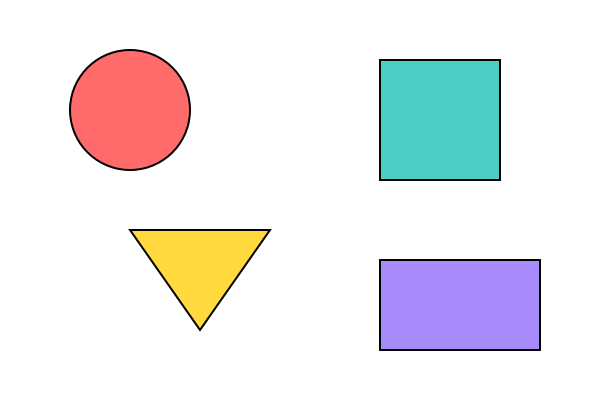
Refer to the picture. Jake counts the shapes by pointing and saying "2, 3, 4, 5." He points to each shape exactly once. What should Jake do differently to count correctly?
- He should point to each shape two times instead of once
- He should start by saying the number word "1" first (correct answer)
- He should point to the shapes in a different order than before
- He should say the number words faster while he points
Explanation: Jake is pointing to each shape once (good one-to-one correspondence) but he's starting with "2" instead of "1." Proper counting requires starting with "1" and saying consecutive number names. Choice B is correct. Choice A is wrong because pointing twice would break one-to-one correspondence. Choice C is wrong because the order doesn't matter as long as each shape gets counted once. Choice D is wrong because speed doesn't affect correctness of one-to-one correspondence.
Question 2
Emma lines up 6 toy bears. She points to each bear once and says "1, 2, 3, 4, 5, 6." Then her little brother takes away 2 bears. Now Emma wants to count the remaining bears. Which statement about her counting is correct?
- She should point to each remaining bear once and count to 4 (correct answer)
- She should point to each remaining bear twice and count to 8
- She should point to each remaining bear once and count to 6
- She should point to some bears twice to make up for the missing ones
Explanation: Emma started with 6 bears and 2 were taken away, leaving 4 bears (6 - 2 = 4). One-to-one correspondence means pointing to each object exactly once while saying consecutive number names. With 4 bears, she'll count to 4. Choice A is correct. Choice B violates one-to-one correspondence by pointing twice. Choice C is wrong because she only has 4 bears now, not 6. Choice D violates one-to-one correspondence and doesn't make logical sense.
Question 3
Use the diagram to answer this question. Tommy is learning to count the dots. He points to each dot as he counts: "1, 2, 3, 4, 5, 6, 7, 8." But there are only 6 dots shown. What counting mistake is Tommy making?
- He is pointing to some dots more than one time each (correct answer)
- He is saying number words that are out of order
- He is counting some dots but forgetting to point at them
- He is starting his count from the wrong number word
Explanation: Tommy counted to 8 but there are only 6 dots, meaning he counted 2 extra. Since he's pointing as he counts, he must be pointing to some dots more than once, violating one-to-one correspondence. Choice A is correct. Choice B is wrong because he said 1,2,3,4,5,6,7,8 which is the correct order. Choice C is wrong because that would give a count that's too low, not too high. Choice D is wrong because he started from 1, which is correct.
Question 4
Use the diagram to solve this problem. Two children count the same group of buttons. Sarah points to each button exactly once and says "1, 2, 3, 4, 5, 6." Alex points to each button exactly once but says "1, 2, 4, 5, 6, 7." Who counted correctly?
- Sarah counted correctly because she said the right number words in order (correct answer)
- Alex counted correctly because he pointed to each button exactly once
- Both children counted correctly because they both pointed once to each button
- Neither child counted correctly because they got different final answers
Explanation: One-to-one correspondence requires both pointing to each object exactly once AND saying the standard number names in order (1, 2, 3, 4, 5, 6...). Sarah did both correctly. Alex pointed correctly but skipped "3" and added an extra "7," violating the standard order requirement. Choice A is correct. Choice B is wrong because pointing correctly is only part of one-to-one correspondence. Choice C is wrong because Alex didn't use proper number sequence. Choice D is wrong because Sarah did count correctly.
Question 5
Look at the objects in the picture. Ben counts them by pointing and saying "1, 2, 3, 4, 5, 6, 7." Then he realizes he skipped one object and didn't point to it. If Ben counts again correctly, what number should he say for the last object?
- Ben should say "7" for the last object he counts
- Ben should say "8" for the last object he counts (correct answer)
- Ben should say "6" for the last object he counts
- Ben should say "9" for the last object he counts
Explanation: Ben counted 7 but skipped one object, so there are actually 8 objects total. When counting correctly with one-to-one correspondence, the last number name said equals the total count. Therefore, he should say "8" for the last object. Choice B is correct. Choice A is wrong because that's what he said before when he miscounted. Choice C is wrong because that would mean he has fewer objects than his first count. Choice D is wrong because there's no indication of 9 objects.
Question 6
Look at the picture. Maya counts the flowers by pointing to each one and saying "1, 2, 3, 4, 5, 6." But when she counts again, she gets "1, 2, 3, 4, 5." What mistake did Maya probably make the second time?
- She skipped one flower and didn't point to it at all (correct answer)
- She counted too fast and said the wrong number names
- She pointed to one flower twice instead of once
- She forgot to start counting from the number one
Explanation: Maya got 6 the first time and 5 the second time, which means she counted one fewer object. This happens when you skip an object entirely. Choice A is correct because missing an object breaks one-to-one correspondence. Choice B is wrong because saying wrong numbers would give a random result, not consistently one less. Choice C is wrong because pointing twice would give a higher count, not lower. Choice D is wrong because not starting from 1 would affect which numbers she says, but she still got to 5.
Question 7
Lisa has 5 crackers in a row. She wants to count them correctly. She points to the first cracker and says "1." What must she do next to follow one-to-one correspondence?
- Point to the first cracker again and say "2" next
- Point to the second cracker and say "2" next (correct answer)
- Point to the last cracker and say "5" next
- Say "2, 3, 4, 5" without pointing to any more crackers
Explanation: One-to-one correspondence means each object gets paired with exactly one number name, and each number name gets paired with exactly one object. Since she said "1" for the first cracker, she must say "2" for the second cracker. Choice B is correct. Choice A violates one-to-one correspondence by counting the same object twice. Choice C skips objects and number names. Choice D breaks the pairing between number names and objects.
Question 8
Maria counts blocks by saying "1, 2, 3" while pointing to 3 different blocks. Then she continues and says "4, 5" but points to the same block twice. How many blocks does Maria actually have?
- Maria actually has 5 blocks because she counted to 5
- Maria actually has 4 blocks because she made one mistake (correct answer)
- Maria actually has 3 blocks because she only counted 3 correctly
- Maria actually has 2 blocks because she pointed twice at the end
Explanation: Maria pointed to 3 different blocks correctly, then pointed to 1 more block (but counted it twice as "4, 5"). So she has 3 + 1 = 4 blocks total. Her count of 5 is wrong because she violated one-to-one correspondence by counting the last block twice. Choice B is correct. Choice A is wrong because her count was incorrect. Choice C is wrong because she did have a 4th block. Choice D is wrong because pointing twice doesn't make the block disappear.
Question 9
Anna counts 4 toy cars by saying "1, 2, 3, 4" and pointing to each car once. Then she adds 1 more car. When she counts all the cars again, she should say the number names up to which number?
- She should say number names from 1 up to 4 again
- She should say number names from 1 up to 5 total (correct answer)
- She should say number names from 4 up to 5 only
- She should say number names from 0 up to 5 total
Explanation: Anna now has 5 cars total (4 + 1 = 5). To count 5 objects using one-to-one correspondence, she must say one number name for each object: "1, 2, 3, 4, 5." Choice B is correct. Choice A is wrong because she has 5 cars now, not 4. Choice C is wrong because she must start counting from 1 and count all objects. Choice D is wrong because counting starts from 1, not 0.