Elementary School Math Quiz: Measure And Sketch Angles
7 questions · exam conditions
0:00
Measure And Sketch AnglesQuestion 1 of 7

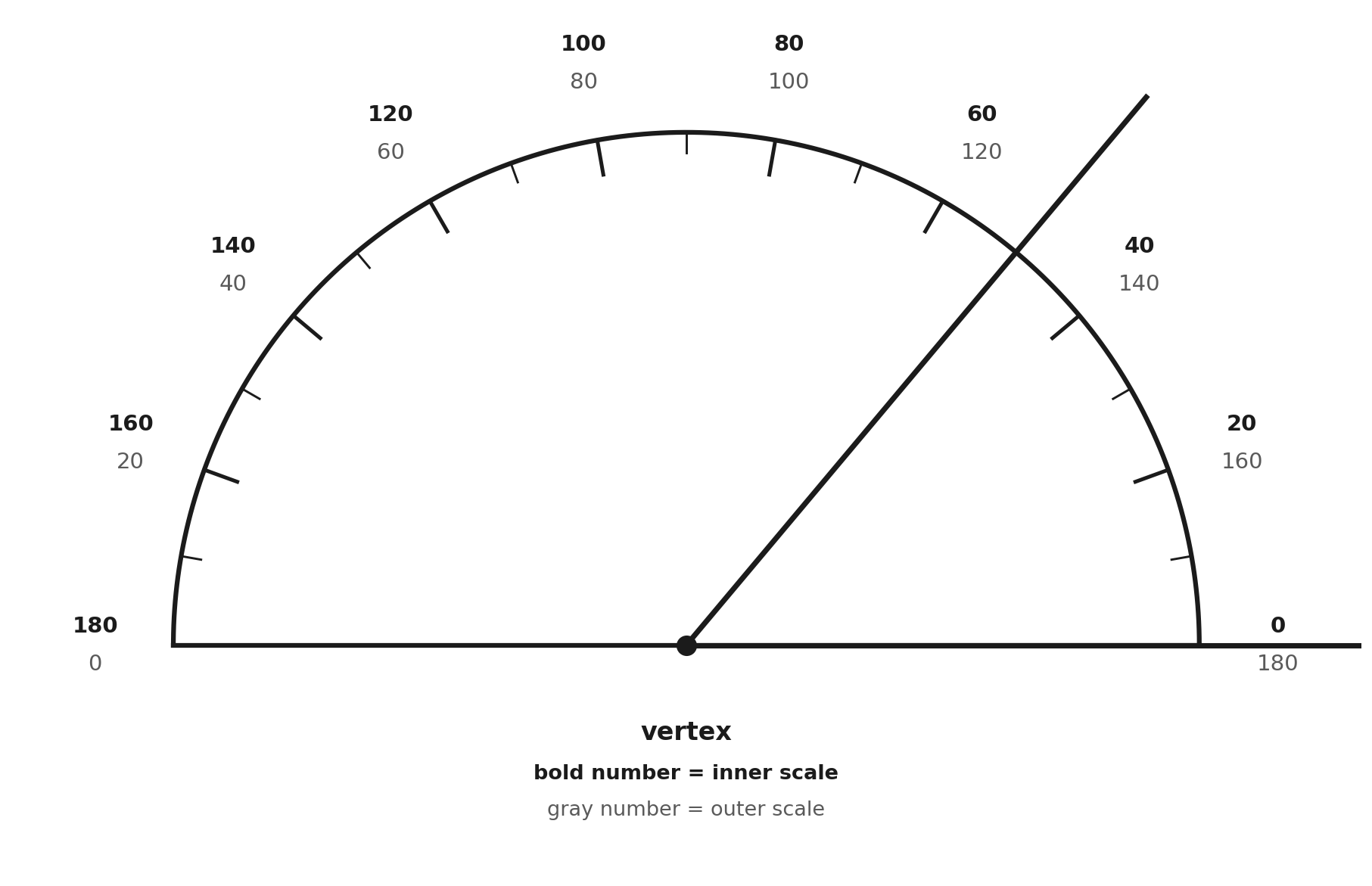
When using a protractor to measure the angle in the figure, which statement best describes the correct measurement process?

Question graphic
Place the center point on the vertex and read where the second ray crosses the inner scale only
Place the center point on the vertex, align one ray with zero, and read where the second ray crosses the same scale
Place the center point anywhere on the first ray and read the outer scale measurement
Place the protractor so both rays touch the curved edge and read the difference between the numbers
← Back to quizzes

Elementary School Math Quiz

Elementary School Math Quiz: Measure And Sketch Angles

Practice Measure And Sketch Angles in Elementary School Math with focused quiz questions that help you check what you know, review explanations, and build confidence with test-style prompts.

What this quiz covers

This quiz focuses on Measure And Sketch Angles, giving you a quick way to practice the rules, question types, and explanations that matter most for Elementary School Math.

How to use this quiz

Try each quiz question before looking at the correct answer. Use the explanations to review missed ideas, then come back to similar questions until the pattern feels familiar.

All questions

Question 1

When using a protractor to measure the angle in the figure, which statement best describes the correct measurement process?

  1. Place the center point on the vertex and read where the second ray crosses the inner scale only
  2. Place the center point on the vertex, align one ray with zero, and read where the second ray crosses the same scale (correct answer)
  3. Place the center point anywhere on the first ray and read the outer scale measurement
  4. Place the protractor so both rays touch the curved edge and read the difference between the numbers
Explanation: The correct process requires placing the protractor's center point on the vertex, aligning one ray with the zero mark, and reading where the second ray crosses the same scale you started from. Choice A ignores proper alignment and scale consistency. Choice C places the center incorrectly. Choice D describes an invalid measurement technique.

Question 2

Maya measures an angle with a protractor and finds it is 72°72°. What is the measure of an angle that is 18°18° larger than the one she measured?

  1. 54°
  2. 90° (correct answer)
  3. 108°
  4. 126°
Explanation: The correct answer is B, 90°, because 72° plus 18° equals 90°. Choice A, 54°, comes from subtracting instead of adding. Choices C and D come from addition errors.

Question 3

Angle XYZ is made up of two adjacent angles measuring 55°55° and 70°70°. What is the measure of angle XYZ?

  1. 35°35°
  2. 55°55°
  3. 125°125° (correct answer)
  4. 145°145°
Explanation: Angle XYZ measures 125° because 55° + 70° = 125°. Choice A is far too small to represent the sum of both parts. Choice B repeats just one of the two given angles. Choice D overshoots the correct sum by 20°.

Question 4

Look at the protractor measurement shown below. Carlos needs to sketch an angle that is 25°25° less than twice the measured angle. What should be the measure of Carlos's angle?

  1. 135°135°
  2. 145°145°
  3. 155°155° (correct answer)
  4. 165°165°
Explanation: The protractor shows an angle measuring 90°90°. Twice this angle is 90°×2=180°90° × 2 = 180°. An angle that is 25°25° less than this would be 180°25°=155°180° - 25° = 155°. Choice A incorrectly calculates 90°×245°90° × 2 - 45°. Choice B incorrectly calculates 90°×235°90° × 2 - 35°. Choice D incorrectly calculates 90°×215°90° × 2 - 15°.

Question 5

Examine the angle shown in the diagram below. Lisa wants to divide this angle into three equal parts. What would be the measure of each smaller angle?

  1. 35°35°
  2. 40°40° (correct answer)
  3. 45°45°
  4. 50°50°
Explanation: The angle shown measures 120°120°. Dividing this into three equal parts: 120°÷3=40°120° ÷ 3 = 40°. Choice A incorrectly calculates 105°÷3105° ÷ 3. Choice C incorrectly calculates 135°÷3135° ÷ 3. Choice D incorrectly calculates 150°÷3150° ÷ 3.

Question 6

One angle measures 70° and another angle measures 95°. If these two angles are placed adjacent to each other, sharing a common ray, what is the measure of the combined angle?

  1. 155°
  2. 165° (correct answer)
  3. 175°
  4. 185°
Explanation: The combined angle measures 165° because 70° + 95° = 165°. Choice A is 10° too low. Choice C is 10° too high. Choice D adds 20° too much to the actual sum.

Question 7

Lisa is practicing angle measurement and sketching. She measures an angle as 84°84°, then sketches an angle that is 96°96°. What is the difference between the measures of the two angles?

  1. 10°
  2. 12° (correct answer)
  3. 18°
  4. 20°
Explanation: The correct answer is B, 12°, because 96°84°=12°96° - 84° = 12°. Choice A is close but comes from a small subtraction slip. Choice C and Choice D are both larger misses, possibly from misreading one of the two angle measures.