All questions
Question 1
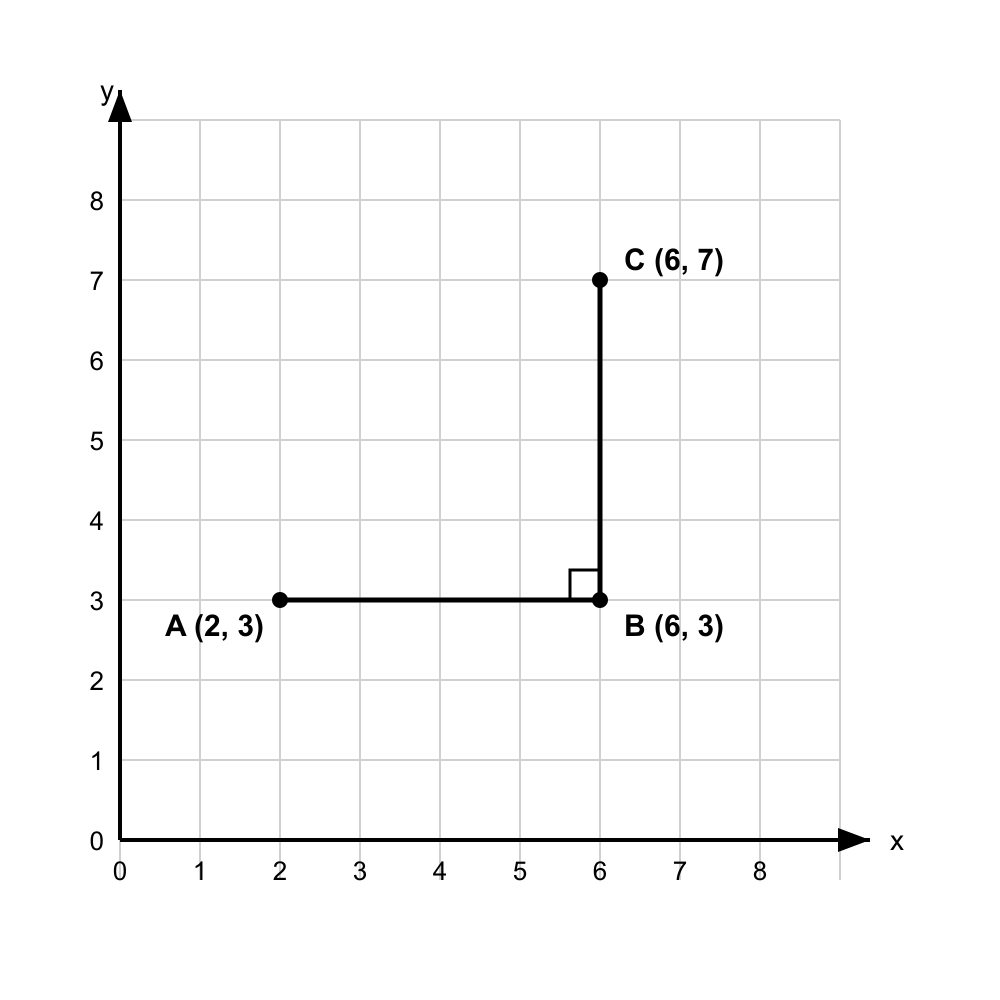
Segment AB connects point A at (2,3) to point B at (6,3), and segment BC connects point B to point C at (6,7). What type of angle is formed at point B?
- An acute angle
- An obtuse angle
- A right angle (correct answer)
- A straight angle
Explanation: A right angle is correct because segment AB is horizontal and segment BC is vertical, and a horizontal and a vertical segment always meet at 90°. An acute angle is incorrect because the angle formed is not smaller than 90°. An obtuse angle is incorrect because the angle formed is not greater than 90°. A straight angle is incorrect because the two segments do not lie along the same line.
Question 2
The figure shows triangle DEF. Which two sides of the triangle are perpendicular to each other?
- Side DE and side EF (correct answer)
- Side DE and side DF
- Side EF and side DF
- No two sides are perpendicular
Explanation: When a question asks about perpendicular sides, it's asking which two sides meet to form a right angle — a perfect square corner that measures exactly 90°. A helpful trick is to imagine placing the corner of a piece of paper or an index card into the angle: if it fits snugly with no gap and no overlap, those sides are perpendicular.
In triangle DEF, the sides that come together at vertex E form a square corner. Since side DE and side EF meet at that right angle, they are the perpendicular pair.
Now look at why the others don't work. Side DE and side DF meet at vertex D, but that angle is smaller than a square corner (an acute angle), so it isn't a right angle. Side EF and side DF meet at vertex F, and that angle is also not 90° — it's tilted, not a clean corner. The choice claiming no two sides are perpendicular is wrong because there is a right angle in this triangle, right at vertex E.
A quick strategy: perpendicular lines always create a right angle, so hunt for the vertex that looks like the corner of a square or a book. Only the two sides forming that corner can be the answer. On these problems, check each vertex one at a time and ask, "Does this look like a perfect square corner?" — that keeps you from getting fooled by angles that are close but not quite 90°. Question 3
Refer to the figure. Four angles are labeled A, B, C, and D. Which angle is an obtuse angle?
- Angle A
- Angle B
- Angle C (correct answer)
- Angle D
Explanation: Whenever you see a question asking you to classify angles, remember there are three main types based on comparing them to a right angle, which measures exactly 90° and looks like the corner of a square. An acute angle is smaller than 90° (it looks narrow and pointy), a right angle is exactly 90°, and an obtuse angle is larger than 90° but smaller than 180° (it looks wide and open, but not a straight line).
The angle that opens up wider than a square's corner — spreading out past 90° but not forming a straight line — is the obtuse angle, which is angle C. Picture it flattening out and getting wider; that "extra wide" opening is the clue.
The angle that forms a perfect square corner is a right angle, not obtuse, so that choice is wrong because it measures exactly 90°. The angle that looks narrow and pinched, smaller than a corner, is an acute angle — it measures less than 90°, so it's too small to be obtuse. Any angle that looks like a completely flat, straight line would be a straight angle at 180°, which is also not obtuse because obtuse angles must stay under 180°.
A handy trick: hold up the corner of a piece of paper (that's your 90° tester) against each angle. If the angle opens wider than the paper corner but isn't a straight line, it's obtuse. This quick comparison works every time on angle-classifying questions. Question 4
Refer to the figure. Four figures made of line segments are labeled A, B, C, and D. Which figure contains a pair of parallel line segments?
- Figure A
- Figure B
- Figure C (correct answer)
- Figure D
Explanation: When you're asked to spot parallel line segments, remember what "parallel" really means: two lines or segments that run in the exact same direction and stay the same distance apart forever. No matter how far you extend them, parallel lines will never cross or touch. A helpful mental picture is railroad tracks or the two long edges of a ruler.
The figure with the pair of parallel line segments is the correct one because it contains two sides that point the same way and keep an equal gap between them the whole length — they'd never meet even if you stretched them out.
The other figures fall short for different reasons. The figure whose segments come to a point or lean toward each other shows lines that would eventually cross, so those are intersecting, not parallel. The figure with sides that meet at a square corner shows perpendicular segments — lines that cross at a right angle — which is a different relationship entirely. And the figure where the segments slant so that the space between them grows wider or narrower isn't parallel either, because parallel lines must keep the same distance apart at every point.
A quick strategy: for each figure, imagine stretching the segments out like long roads. If they'd never touch, they're parallel. If they'd cross, they're intersecting (and if they cross at a perfect corner, they're perpendicular). Watching for that "same distance apart, never touching" clue will help you find parallel lines every time.
Question 5
The figure shows quadrilateral JKLM. Which statement about the figure is true?
- Side JK is perpendicular to side ML
- Side JK is parallel to side ML (correct answer)
- Side JK is parallel to side KL
- Side JM is perpendicular to side JK
Explanation: Whenever you compare sides of a quadrilateral, remember two key words: parallel means the lines run in the same direction and never cross (like railroad tracks), while perpendicular means the lines meet to form a square corner, a right angle (90°).
In quadrilateral JKLM, the top side JK and the bottom side ML run side by side in the same direction and would never meet no matter how far you extended them. That makes them parallel, so the statement that side JK is parallel to side ML is true.
The claim that side JK is perpendicular to side ML is wrong because these two sides don't cross at all, let alone form a right angle — top and bottom sides that stay the same distance apart are parallel, not perpendicular. Saying side JK is parallel to side KL mixes up neighboring sides: JK and KL actually meet at corner K, so they intersect and can't be parallel. Finally, side JM perpendicular to side JK would require a perfect square corner at J; unless the figure clearly shows a right-angle mark there, these slanted sides meet at an angle that isn't 90°.
A helpful tip: sides that touch at a corner can never be parallel — they've already met! Only sides that are across from each other can be parallel. And always look for the little square symbol in the corner to confirm perpendicular lines before you choose that answer. Question 6
The figure shows trapezoid PQRS. Which side is parallel to side PQ?
- Side SR (correct answer)
- Side PS
- Side QR
- No side is parallel to side PQ
Explanation: When you see a question about a trapezoid, remember what makes a shape a trapezoid in the first place: it has exactly one pair of parallel sides. Parallel sides are two sides that run in the same direction and never meet, like the two rails of a train track.
The trick is knowing how the letters name the sides. In trapezoid PQRS, the letters go around the shape in order, so the sides are PQ, QR, RS, and SP. The side directly across from PQ is SR (the same as RS). In a trapezoid drawn this way, the top and bottom sides are the parallel pair, so side SR is parallel to side PQ.
Now look at why the others don't work. Side QR shares the corner point Q with PQ — two sides that touch at a corner form an angle, so they can't be parallel. Side PS also connects to PQ at point P, so it slants away and meets PQ rather than running alongside it. The choice saying no side is parallel contradicts the definition of a trapezoid; every trapezoid must have one parallel pair, so this can never be true here.
A helpful strategy: sides that share a letter (a corner point) can never be parallel, because they meet at that corner. To find the parallel partner, look for the side made of the two letters you haven't used yet — that's the one across from your starting side. Question 7
A building's corner forms an angle where two walls meet. A carpenter checks the corner with a square tool, and the tool fits perfectly into the corner with no gaps. What type of angle is formed at this corner?
- Acute angle
- Obtuse angle
- Straight angle
- Right angle (correct answer)
Explanation: A carpenter's square that fits exactly into a corner with no gaps confirms the corner measures exactly 90 degrees, which makes it a right angle. An acute angle would be too narrow for the square to fit, and an obtuse or straight angle would leave a gap on one side of the square instead of matching it exactly. Question 8
Refer to the figure. Point K is an endpoint, and the figure passes through point L and continues on forever. Which name correctly describes the figure?
- Ray LK
- Ray KL (correct answer)
- Line segment KL
- Line KL
Explanation: When you name figures in geometry, three key words tell you exactly what you're looking at: a line segment has two endpoints and stops on both sides, a ray has one endpoint and continues forever in one direction, and a line has no endpoints and continues forever in both directions. The trick with rays is that the order of the letters matters: you always name the endpoint first, then a point the ray passes through.
Here, point K is the endpoint and the figure shoots off forever through L. That means it's a ray, and since K is the endpoint, you name it starting with K: Ray KL.
Now look at why the others don't fit. "Ray LK" is a ray, but it names L as the endpoint — that's backward, since K is the actual endpoint. "Line segment KL" is wrong because a segment stops at both ends, but your figure keeps going forever past L, so it isn't a segment. "Line KL" is wrong because a line has no endpoints and extends forever in both directions — but your figure has a clear stopping point at K, so it can't be a line.
A helpful memory trick: for a ray, picture the endpoint as the "starting point" of a flashlight beam. You always say the flashlight (the endpoint) first, then the direction the light travels. Name the endpoint first, every time. Question 9
Examine the rectangle shown. The rectangle has vertices at W, X, Y, and Z. If you draw both diagonals of the rectangle, how many line segments and how many right angles are visible in the complete figure?
- Six line segments total, with four right angles at the corners of the rectangle (correct answer)
- Six line segments total, with eight right angles including diagonal intersections
- Four line segments total, with four right angles at the rectangle corners only
- Eight line segments total, with four right angles at the rectangle corners only
Explanation: The rectangle has 4 sides (line segments) plus 2 diagonals (line segments) = 6 line segments total. A rectangle has exactly 4 right angles at its corners. The diagonals intersect but do not create additional right angles. Choice B incorrectly assumes diagonal intersections create right angles. Choice C undercounts line segments by not including diagonals. Choice D overcounts line segments.
Question 10
Refer to the figure of the house-shaped pentagon. How many right angles does the figure have?
- 5
- 4
- 3
- 2 (correct answer)
Explanation: Whenever you're asked to count right angles in a shape, remember that a right angle is exactly 90° — a perfect "square corner" like the corner of a piece of paper or a book. The trick is to check each corner one at a time and ask, "Does this look like a perfectly square corner, or is it wider or more pointed?"
Picture a house-shaped pentagon: it has a rectangular bottom (the walls and floor) with a triangular roof on top. The two bottom corners, where the floor meets each side wall, are true square corners — those are your 90° right angles. That gives you exactly 2 right angles.
Now look at the roof. The two upper corners (where a wall meets the slanted roof) are obtuse — wider than a square corner — and the peak at the very top is a pointed angle. None of those three are right angles.
That's why counting 5 is wrong: it assumes every corner of the pentagon is square, but the roof corners aren't. Choosing 4 or 3 means you mistakenly counted one or two of the slanted roof corners as right angles — but slanted lines can't form square corners. Only the flat bottom corners qualify.
A helpful strategy: when a figure has slanted or "leaning" sides, those sides almost never make right angles. Focus on where flat horizontal lines meet straight vertical lines — that's where true 90° corners hide. You can even use the corner of a paper to test each angle. Question 11
Angle DEF measures 120\u00b0, angle GHI measures 95\u00b0, angle ABC measures 40\u00b0, and angle JKL measures 180\u00b0. Which angle is an acute angle?
- ∠GHI
- ∠DEF
- ∠ABC (correct answer)
- ∠JKL
Explanation: An acute angle measures less than 90°. Angle ABC measures 40°, which fits that description. Choice A, angle GHI, measures 95°, which makes it an obtuse angle rather than acute. Choice B, angle DEF, measures 120°, which is also obtuse. Choice D, angle JKL, measures 180°, which makes it a straight angle. Only Choice C, angle ABC, measures less than 90° and is truly acute.
Question 12
Sarah identifies a triangle where one angle measures 95° and another measures 35°. She claims the triangle contains both an obtuse angle and a right angle. What is wrong with Sarah's reasoning?
- The triangle actually contains two obtuse angles, since 95° and 35° are both obtuse
- The third angle measures 50°, which is acute, so there is no right angle present (correct answer)
- The triangle has three angles that are all acute
- The angle measuring 35° is obtuse, not acute, making her classification incorrect overall
Explanation: Sarah's error is that the third angle equals 180 minus 95 minus 35, which is 50 degrees, an acute angle, not a right angle. So the triangle has one obtuse angle (95 degrees) and two acute angles (35 and 50 degrees), not an obtuse angle and a right angle. Choice A is wrong because 35 degrees is acute, not obtuse. Choice C is wrong because 95 degrees is obtuse, so not all three angles are acute. Choice D is wrong because 35 degrees is acute, not obtuse.