Elementary School Math Quiz: Create And Interpret Fractional Line Plots
5 questions · exam conditions
0:00
Create And Interpret Fractional Line PlotsQuestion 1 of 5

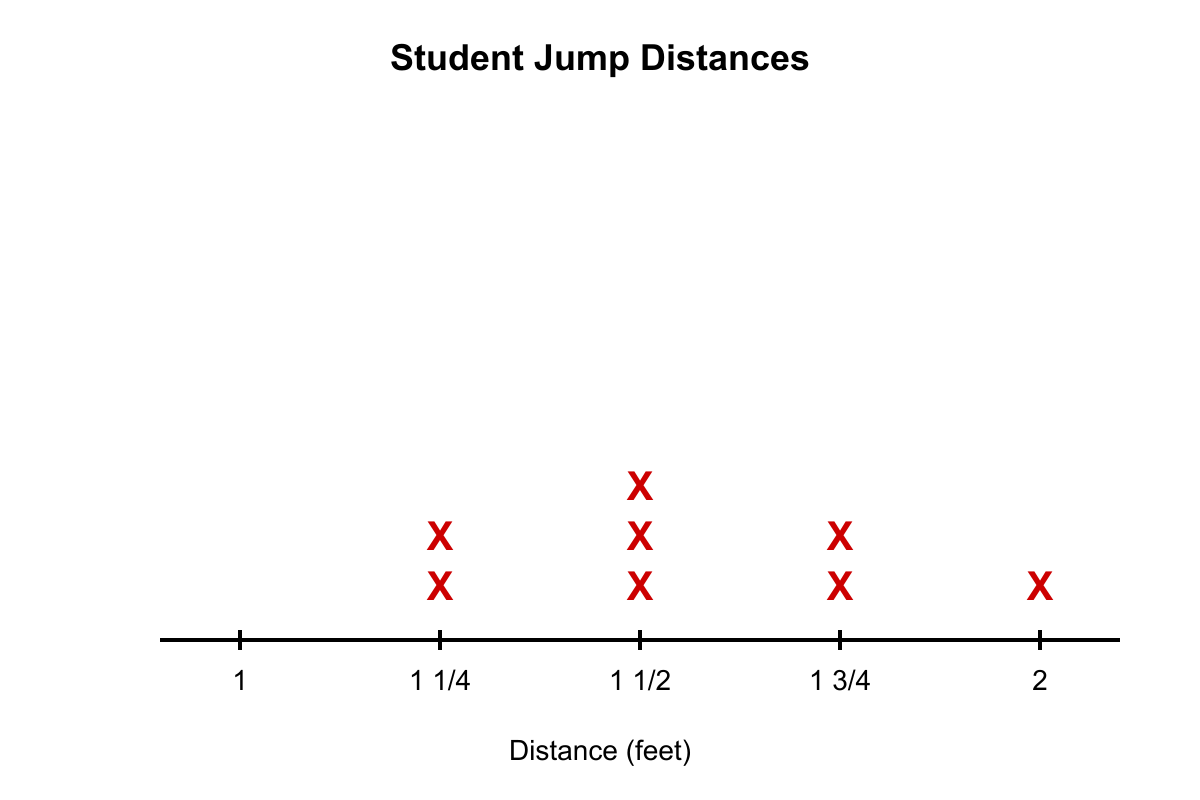
Based on the line plot of student jump distances, how many students jumped farther than 1141\frac{1}{4} feet but not more than 1341\frac{3}{4} feet?

Question graphic
5 students
7 students
3 students
4 students
← Back to quizzes

Elementary School Math Quiz

Elementary School Math Quiz: Create And Interpret Fractional Line Plots

Practice Create And Interpret Fractional Line Plots in Elementary School Math with focused quiz questions that help you check what you know, review explanations, and build confidence with test-style prompts.

What this quiz covers

This quiz focuses on Create And Interpret Fractional Line Plots, giving you a quick way to practice the rules, question types, and explanations that matter most for Elementary School Math.

How to use this quiz

Try each quiz question before looking at the correct answer. Use the explanations to review missed ideas, then come back to similar questions until the pattern feels familiar.

All questions

Question 1

Based on the line plot of student jump distances, how many students jumped farther than 1141\frac{1}{4} feet but not more than 1341\frac{3}{4} feet?

  1. 5 students (correct answer)
  2. 7 students
  3. 3 students
  4. 4 students
Explanation: The correct answer is A, 5 students, based on counting the data points on the line plot that fall in the given range. Choice B overcounts by including students outside the range. Choice C undercounts by leaving out students who belong in the range. Choice D is close but still misses one student who should be included.

Question 2

A carpenter measured a set of wood screws: two screws measured 14\frac{1}{4} inch, three screws measured 12\frac{1}{2} inch, three screws measured 58\frac{5}{8} inch, four screws measured 34\frac{3}{4} inch, and two screws measured 78\frac{7}{8} inch. If the screws measuring 12\frac{1}{2} inch and 78\frac{7}{8} inch are removed from the collection, what length appears most frequently among the remaining screws?

  1. 58\frac{5}{8} inch
  2. 34\frac{3}{4} inch (correct answer)
  3. 14\frac{1}{4} inch
  4. 78\frac{7}{8} inch
Explanation: After removing the 1/2-inch and 7/8-inch screws, the remaining lengths are 1/4 inch (2 screws), 5/8 inch (3 screws), and 3/4 inch (4 screws), so 3/4 inch appears most often. Choice A has the second-highest count, not the highest. Choice C has the fewest screws remaining. Choice D was removed from the collection and can't be the answer.

Question 3

The line plot shows the weights of packages in pounds. What is the total weight of all packages that weigh less than 11 pound?

  1. 2122\frac{1}{2} pounds
  2. 3343\frac{3}{4} pounds (correct answer)
  3. 4144\frac{1}{4} pounds
  4. 1121\frac{1}{2} pounds
Explanation: The correct answer is B, 3343\frac{3}{4} pounds, based on adding the weights of every package on the line plot that weighs less than 1 pound. Choice A misses some of the data points shown. Choice C adds in a package that weighs 1 pound or more, which should not be included. Choice D only accounts for a few of the values instead of the full set below 1 pound.

Question 4

Students measured their hand spans in inches. According to the line plot shown, what fraction of students had hand spans of 5345\frac{3}{4} inches or greater?

  1. 23\frac{2}{3} of the students because 8 out of 12 students qualify (correct answer)
  2. 12\frac{1}{2} of the students when including the boundary measurement
  3. 35\frac{3}{5} of the students based on the frequency distribution shown
  4. 58\frac{5}{8} of the students after counting all qualifying measurements
Explanation: The correct answer is A, 23\frac{2}{3} of the students, based on counting the 8 out of 12 students on the line plot whose hand spans meet the threshold. Choice B undercounts by leaving out some qualifying students. Choice C and Choice D are both close but come from miscounting one or two data points on the plot.

Question 5

A baker recorded cookie thicknesses: 7 cookies were thicker than 12\frac{1}{2} inch, and 4 cookies were exactly 12\frac{1}{2} inch thick. How many more cookies were thicker than 12\frac{1}{2} inch than were exactly 12\frac{1}{2} inch thick?

  1. 3 more cookies (correct answer)
  2. 5 more cookies
  3. 2 more cookies
  4. 4 more cookies
Explanation: Subtracting the number of cookies exactly 12\frac{1}{2} inch thick from the number thicker than 12\frac{1}{2} inch gives 74=37 - 4 = 3 more cookies. Choice B overstates the difference, as if there were more thick cookies than were actually recorded. Choice C understates the difference by one, missing part of the gap between the two groups. Choice D also understates the difference by one in the other direction. Choice A correctly matches the true difference between the two cookie counts.