All questions
Question 1
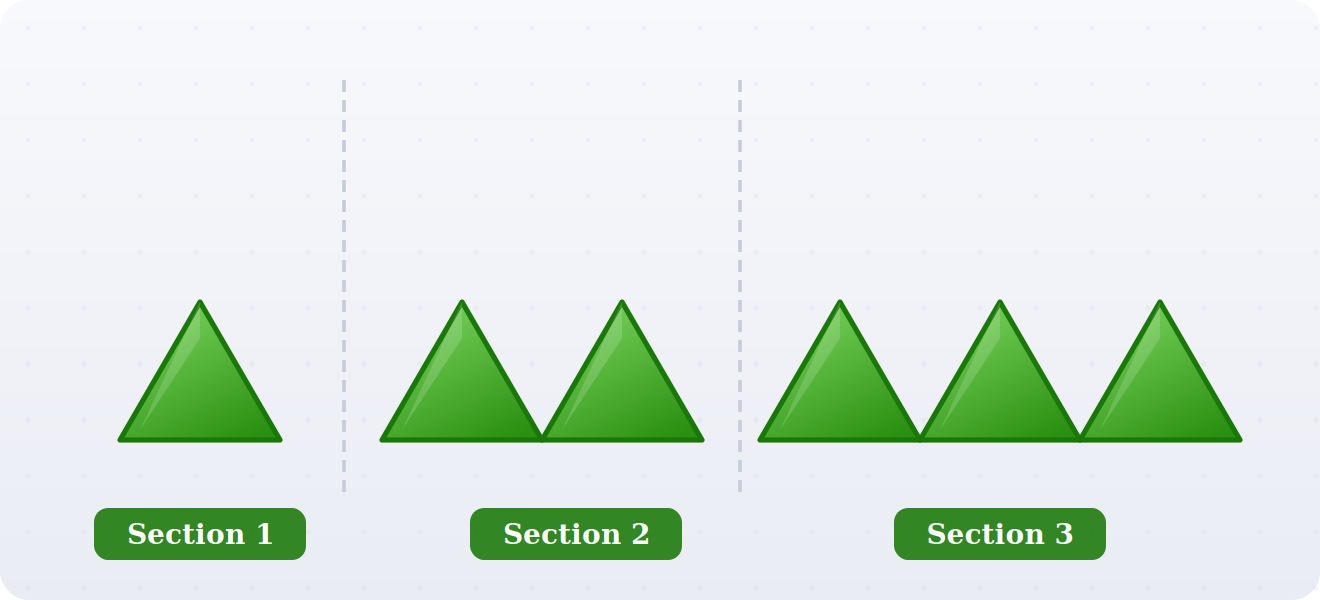
Observe the pattern shown. Sarah continues this pattern by adding one more section. How many triangular pieces will be in Sarah's next section?
- The next section will have 3 triangular pieces total
- The next section will have 4 triangular pieces total (correct answer)
- The next section will have 5 triangular pieces total
- The next section will have 6 triangular pieces total
Explanation: Looking at the pattern, the first section has 1 triangle, the second section has 2 triangles, and the third section has 3 triangles. Following this pattern, the fourth section should have 4 triangular pieces. Options A, C, and D don't follow the established arithmetic sequence of adding one triangle per section.
Question 2
Use the shapes shown. Anna wants to make a hexagon (6-sided shape) using some of these triangular pieces. What is the fewest number of triangles Anna needs to make a regular hexagon?
- Anna needs at least 3 triangular pieces for the hexagon
- Anna needs at least 4 triangular pieces for the hexagon
- Anna needs at least 6 triangular pieces for the hexagon (correct answer)
- Anna needs at least 8 triangular pieces for the hexagon
Explanation: A regular hexagon can be divided into 6 identical equilateral triangles, all meeting at the center point. Therefore, Anna needs exactly 6 triangular pieces to make a regular hexagon. Options A and B use too few pieces to form a complete hexagon, while option D uses more pieces than necessary.
Question 3
The figure shows a rectangle. Which set of smaller shapes could be put together to make this rectangle?
- Two circles side by side
- Two squares side by side (correct answer)
- One triangle and one circle
- One circle and one square
Explanation: When you see a question about building shapes from smaller shapes, picture the big shape in your mind and think about what pieces would fit together perfectly with no gaps and no overlaps. A rectangle has four straight sides and four square corners, so any pieces you use to build it must also have straight sides that match up.
If you take two squares and place them side by side, their straight edges line up perfectly. Together they form a longer shape with four straight sides and four square corners — that's a rectangle! This is why B is correct. Think of two square crackers pushed together on a plate: they make a rectangle shape.
Now look at why the other choices don't work. A is wrong because circles are round with no straight sides or corners — two circles side by side would leave curved gaps and couldn't form straight edges. C is wrong for the same reason: a circle is round, so even though a triangle has straight sides, the circle part would ruin the rectangle shape. D fails too because the circle is round and cannot line up with the square's straight edges to make a smooth rectangle.
A helpful tip: when building bigger shapes from smaller ones, always check that the edges match. Straight shapes (squares, rectangles, triangles) can fit against other straight shapes, but round shapes (circles) can't make flat sides. Rectangles and squares are "friends" because their straight edges love to line up!
Question 4
Refer to the figure. Sam wants to cover the rectangle completely using the shape shown. How many of the small shapes does he need?
- 2
- 3
- 4 (correct answer)
- 5
Explanation: When you're asked to cover a shape completely with a smaller shape, you're really being asked about area — how many copies of the small shape fit inside the big one without gaps or overlaps. The trick is to imagine laying the small shapes down side by side, like tiles on a floor, until the whole rectangle is filled.
For this problem, picture the rectangle divided into equal parts that match the size of the small shape. If the rectangle is twice as long and twice as tall as the small shape, you'd need 2 across and 2 down, which makes 2×2=4 small shapes to cover it completely. That matches choice C.
Choice A (2) is too few — two small shapes would only cover half the rectangle, either the top row or the bottom row, leaving space uncovered. Choice B (3) also leaves a gap; three shapes can't fill a rectangle that needs an even 2-by-2 arrangement. Choice D (5) is too many — once you've placed 4 shapes, the rectangle is already full, so a 5th shape wouldn't fit without overlapping.
A helpful strategy for covering-and-tiling questions: count how many small shapes fit across the length, then how many fit down the width, and multiply. This "rows times columns" trick is the foundation for area and multiplication later on, so practicing it now with pictures builds a strong math habit. Question 5
In the figure, six triangles are joined together at a center point. What larger shape do they form?
- Square
- Rectangle
- Triangle
- Hexagon (correct answer)
Explanation: When shapes are joined together at a center point like slices of a pizza, you can figure out the larger shape by counting the outer edges. Each triangle contributes one edge to the outside of the new shape, so six triangles will make a shape with six sides.
A shape with six equal sides is called a hexagon, which makes D correct. Think of a honeycomb cell or a snowflake — those are hexagons, and they're often built from six triangles meeting in the middle.
Now let's look at the other choices. A square (A) has only 4 sides, so it would need just 4 triangles meeting at the center, not 6. A rectangle (B) also has 4 sides, so the same problem applies — plus rectangles have longer sides and shorter sides, which wouldn't happen with 6 equal triangles. A triangle (C) has only 3 sides, which would require joining just 3 shapes, not 6.
A helpful trick: when triangles meet at a center point, count the triangles to find the number of sides of the bigger shape. 3 triangles → triangle, 4 triangles → square, 5 triangles → pentagon, 6 triangles → hexagon. Learning to match the number of pieces to the name of the shape will help you quickly answer these "shapes made of shapes" questions!
Question 6
In the diagram, a hexagon is made of smaller shapes. How many triangles make up the hexagon?
- 4
- 5
- 6 (correct answer)
- 8
Explanation: When you see a shape made up of smaller shapes, the trick is to count carefully one piece at a time. A regular hexagon can be split into equal triangles by drawing lines from the center out to each corner. Since a hexagon has 6 corners (or sides), those lines create 6 equal triangular slices — kind of like slicing a pizza into 6 pieces.
So the hexagon is made up of 6 triangles, which matches choice C.
Choice A (4) is too few — you might get this if you only counted the triangles on one half of the hexagon and forgot the other side. Choice B (5) is also too few — this often happens when you skip a triangle by accident, so always point to each one as you count. Choice D (8) is too many — this can happen if you count some triangles twice or include shapes that aren't actually triangles.
A helpful tip: when counting shapes inside a bigger shape, touch or mark each small shape as you count so you don't miss any or count the same one twice. Remember, a hexagon has 6 sides, and when split from the center, it makes 6 triangles — the number matches!
Question 7
Based on the figure, how many small squares were put together to make the larger rectangle?
- 4
- 5
- 6 (correct answer)
- 8
Explanation: When you see a rectangle made of smaller squares, the trick is to count carefully in rows and columns. A common shortcut is to count how many squares fit across one row, then how many rows there are, and multiply.
Picture a rectangle built from equal-sized squares arranged in 2 rows of 3 squares each. Counting each little square gives you 2×3=6 squares in total, which matches choice C.
Choice A (4) is what you'd get if you only counted the corner squares or thought the rectangle was a 2×2 arrangement — but that would make a square, not a longer rectangle. Choice B (5) usually happens when a student miscounts and skips one square, or counts only the squares along the edges. Choice D (8) is a trap for students who count some squares twice, or who imagine an extra row that isn't there (2×4=8).
A helpful strategy for these "how many squares" questions: gently touch or mark each square as you count so you don't skip or double-count. Then check your work by counting the rows and columns separately and multiplying — if both methods give the same number, you can trust your answer. Question 8
The figure shows three shapes. Which two shapes could be joined with full sides touching to make a rectangle?
- The circle and the triangle
- The two squares (correct answer)
- The circle and one square
- The triangle and the circle
Explanation: When you're putting shapes together to make a new shape, think about the sides that will touch. For two shapes to join into a rectangle, they need to have straight sides of the same length that can line up perfectly against each other.
A rectangle has four straight sides and four square corners. If you take two squares of the same size and push them together so one full side of each is touching, you get a shape that is twice as long as it is tall — that's a rectangle! So B is the winner: two squares side-by-side form a rectangle.
Now look at why the others don't work. Choice A pairs a circle and a triangle. A circle has no straight sides at all — it's curved all the way around — so nothing can line up flat against it to form straight rectangle edges. Choice C has the same problem: a circle can't give you the straight edge a rectangle needs. Choice D again uses the circle, which rules it out immediately, and a triangle only has three sides and pointy corners, not the four square corners a rectangle needs.
A helpful tip to remember: rectangles are made of straight sides and square corners. Whenever a question asks you to build a rectangle (or square) from smaller shapes, cross out any choice that includes a circle right away — curves can't make straight-sided shapes. Then check that the flat sides you're joining are the same length so they match up neatly.
Question 9
Look at the shape. Emma wants to make this same shape using only squares. All the squares must be the same size. What is the smallest number of squares Emma needs?
- Emma needs exactly 4 squares to make this shape
- Emma needs exactly 6 squares to make this shape
- Emma needs exactly 8 squares to make this shape (correct answer)
- Emma needs exactly 10 squares to make this shape
Explanation: The L-shaped figure shown has an area equivalent to 8 unit squares when covered by a grid. Students must visualize how to tile the L-shape with squares of equal size. Options A and B underestimate the area, while option D overestimates it. The correct answer requires careful counting or area analysis.
Question 10
In the diagram, a large triangle is divided into 4 equal parts. What shape is each of the smaller parts?
- Square
- Circle
- Rectangle
- Triangle (correct answer)
Explanation: When a shape is divided into equal parts, the smaller parts often have the same shape as the original — this is especially true for triangles! If you take a big triangle and connect the midpoints of its three sides, you create 4 smaller triangles that are all the same size and shape as each other.
So when a large triangle is split into 4 equal parts this way, each little part is still a triangle, making D the correct answer. Each small piece has 3 sides and 3 corners, just like the big shape it came from.
Let's look at why the others don't fit. A square (A) has 4 equal sides and 4 corners — but you can't get 4-sided shapes by cutting a 3-sided triangle into equal triangular parts. A circle (B) is round with no corners or straight sides at all, so it can't come from slicing a triangle with straight lines. A rectangle (C) also has 4 sides and 4 corners, which doesn't match what you get when you divide a triangle into equal pieces.
A helpful tip to remember: when a shape is split into equal parts using straight lines from its corners or midpoints, the smaller pieces usually look like tiny versions of the big shape. Triangles make triangles, and squares can be split into smaller squares. Picture the shape in your mind before choosing — matching the number of sides is a great clue!
Question 11
In the diagram, four small squares are put together with full sides touching. What larger shape do they make?
- A bigger square (correct answer)
- A triangle
- A circle
- A pentagon
Explanation: When you put shapes together, the new shape depends on how the sides line up. A square has 4 equal sides and 4 square corners. If you take four small squares and place them so their full sides touch — two on top and two on the bottom — you get a shape that is 2 squares wide and 2 squares tall. Since the width equals the height, and all the corners are still square corners, the new shape is a bigger square.
Choice B, a triangle, has only 3 sides and pointy corners, so it can't be made from squares lined up evenly. Choice C, a circle, has no straight sides or corners at all — squares can never form a round shape because their edges are straight. Choice D, a pentagon, has 5 sides, but when you put 4 equal squares in a 2-by-2 pattern, you only get 4 sides on the outside, not 5.
A helpful tip: whenever you combine equal squares in a pattern where the number across matches the number down (like 2 by 2, or 3 by 3), you always get a bigger square. If the rows and columns are different (like 2 by 3), you get a rectangle instead. Try drawing it out on grid paper to see the pattern!
Question 12
Refer to the figure showing two shapes joined together. What larger shape is made when the two triangles are put together with their long sides touching?
- Circle
- Square (correct answer)
- Hexagon
- Triangle
Explanation: When you put two shapes together, imagine sliding them so their matching sides touch perfectly. This is called composing shapes — making a new, bigger shape out of smaller ones. For triangles, the "long side" is usually the longest edge, called the hypotenuse when the triangle has a square corner (a right angle).
Picture two identical right triangles. Each one looks like half of a box that has been cut diagonally. When you flip one triangle over and press its long side against the long side of the other, the two diagonal cuts line up and disappear. What's left has four straight sides, all the same length, with four square corners — that's a square! So the answer is B.
Choice A, circle, can't be right because circles have no straight sides or corners, and triangles are made of only straight lines. Choice C, hexagon, means a shape with six sides, but joining two triangles along one side each removes those sides, leaving only four sides — not six. Choice D, triangle, would only work if you joined the triangles a different way (like tip-to-tip), and even then the result wouldn't automatically be a triangle; two triangles joined on their longest sides always form a four-sided shape.
A helpful tip: when a question asks about combining shapes, count the sides that will be left on the outside after the shapes touch. The touching sides get hidden, and the leftover sides tell you the new shape's name.
Question 13
Refer to the figure of a large square. Which set of shapes can be combined to make this square?
- Two rectangles of the same size (correct answer)
- Three triangles
- One circle and one square
- Five triangles in a line
Explanation: When you see a question about combining shapes to make a bigger shape, picture how the pieces would fit together like a puzzle. Ask yourself: do the smaller shapes have the right edges and angles to line up perfectly and fill the space without gaps or overlaps?
A square has four equal sides and four square corners. If you draw a line straight down the middle of a square (either side-to-side or top-to-bottom), you split it into two equal rectangles. Put those two rectangles back together along their long edges, and you get your square back! That's why A is correct.
Now let's check the others. B says three triangles — a square is usually made from just two triangles (by cutting corner to corner), not three, so three triangles won't fit neatly into a square shape. C combines a circle and a square, but a circle has curved edges that can never fill the straight corners of a big square — the curves would leave gaps. D describes five triangles in a line, which would make a long, stretched-out shape (like a zigzag strip), not a square with equal sides.
A helpful tip: when you're combining shapes, count the sides and think about the corners. Squares and rectangles have straight edges and square corners, so they fit together well. Circles don't fit into square spaces because of their curves. Try drawing a square on paper and cutting it in different ways — you'll see how two rectangles or two triangles are the most common pieces hiding inside!
Question 14
Kevin has 4 identical diamond shapes. He arranges them to make one large diamond that looks exactly like the small ones, but bigger. How are the small diamonds positioned in Kevin's arrangement?
- The small diamonds are arranged in a single row
- The small diamonds are arranged in a square pattern
- The small diamonds are arranged with points touching center (correct answer)
- The small diamonds are arranged in a circular pattern
Explanation: To make a larger diamond that looks exactly like the smaller ones, the 4 small diamonds must be arranged with their points meeting at the center, creating a larger diamond with the same proportions. Options A and D would not create a diamond shape, and option B would create a different shape entirely.
Question 15
Tom has 6 triangular pieces. He uses all of them to make 2 identical shapes. Each new shape he makes looks like a house with a pointed roof. How many triangles did Tom use for each house shape?
- 2 triangles were used for each house shape
- 3 triangles were used for each house shape (correct answer)
- 4 triangles were used for each house shape
- 5 triangles were used for each house shape
Explanation: Tom has 6 triangles total and makes 2 identical house shapes. Since he uses all triangles and the houses are identical, each house uses 6 ÷ 2 = 3 triangles. Option A would only use 4 triangles total, option C would need 8 triangles total, and option D would need 10 triangles total.