All questions
Question 1
Carlos drew a quadrilateral with these properties: opposite sides are parallel, opposite sides are equal in length, but it has no right angles. His friend Maya says this shape belongs to two different categories of quadrilaterals. Which two categories is Maya referring to?
- Rectangle and square, because it has equal opposite sides and parallel opposite sides like both shapes
- Square and rhombus, because it has parallel sides like a square and no right angles like some rhombuses
- Rhombus and rectangle, because it has some properties of each but isn't exactly either one
- Quadrilateral and parallelogram, because it has 4 sides and opposite sides that are parallel and equal (correct answer)
Explanation: When you encounter a question about classifying shapes, think about the hierarchy of quadrilaterals. Every shape belongs to multiple categories, starting with the most general and getting more specific.
Let's analyze Carlos's shape: it has opposite sides that are parallel and equal in length, but no right angles. This means it's a parallelogram (which requires parallel opposite sides) that's slanted rather than having square corners.
The correct answer is D because Carlos's shape is definitely a quadrilateral (any 4-sided figure) and a parallelogram (opposite sides parallel and equal). These are the two categories that perfectly describe his shape based on the given properties.
Answer A is incorrect because rectangles must have right angles, and Carlos's shape has none. Squares also need right angles plus all sides equal, which doesn't match the description.
Answer B is wrong because squares require right angles, which this shape lacks. While some rhombuses don't have right angles, a rhombus needs all four sides to be equal length, but we only know opposite sides are equal.
Answer C fails for similar reasons - rectangles need right angles, and we can't confirm this is a rhombus without knowing if all sides are equal length.
Remember: when classifying quadrilaterals, start with the broadest categories first. Every four-sided shape is a quadrilateral, and if it has the right properties, it's also a parallelogram. More specific shapes like rectangles, squares, and rhombuses have additional requirements beyond the basic parallelogram properties.
Question 2
Chen says, "A square is not a rectangle." Is he correct?
- Yes, because rectangles have no right angles.
- Yes, because squares have 3 sides.
- No, because a square has 4 right angles. (correct answer)
- No, because a square has no parallel sides.
Explanation: This question tests 3rd grade geometry: classifying quadrilaterals by shared attributes and recognizing that shapes in different categories may share properties (CCSS.3.G.1). Chen is incorrect—a square IS a special type of rectangle! Both squares and rectangles have 4 sides, 4 right angles, and opposite sides that are parallel and equal. The only difference is that squares have the extra property of all 4 sides being equal, while rectangles can have different length and width. Choice C is correct because it correctly identifies that squares have 4 right angles (which is one of the properties that makes them rectangles) and implies Chen is wrong. Choices A and B give wrong reasons with false information (squares have 4 sides, not 3; rectangles DO have right angles). Choice D is wrong because squares DO have parallel sides. To help students: Use nested boxes or Venn diagrams to show that all squares fit inside the rectangle category. Have students list properties and see that squares check every box for being a rectangle, plus more!
Question 3
How are rectangles and squares alike in their angles?
- They both have only 1 right angle.
- They both have no parallel sides.
- They both have 3 sides.
- They both have 4 right angles. (correct answer)
Explanation: This question tests 3rd grade geometry: classifying quadrilaterals by shared attributes and recognizing that shapes in different categories may share properties (CCSS.3.G.1). Both rectangles and squares are special quadrilaterals that always have 4 right angles (90-degree angles that look like perfect corners). This is one of their defining features—every corner in a rectangle or square forms a right angle, like the corners of a book or piece of paper. Choice A is correct because having 4 right angles is a shared attribute of all rectangles and squares. Choice B is incorrect because both shapes have 4 sides, not 3, and choices C and D are wrong because rectangles and squares do have parallel sides and have 4 right angles, not just 1. To help students: Use corner checkers to verify all 4 angles in rectangles and squares are right angles. Create comparison charts showing what rectangles and squares have in common (4 sides, 4 right angles, opposite sides parallel) versus what makes them different (squares also have 4 equal sides). Watch for students who think a tilted square loses its right angles—demonstrate that orientation doesn't change angle measures.
Question 4
Which statement is FALSE?
- All squares are quadrilaterals.
- All squares are rectangles.
- All rectangles are squares. (correct answer)
- All rhombuses are quadrilaterals.
Explanation: Questions like this test how shapes are classified based on their properties. The trick is remembering that shape categories work like a family tree: a shape can belong to a bigger group without every member of that bigger group belonging to it. Think of it this way — all dogs are animals, but not all animals are dogs.
Let's apply that to shapes. A quadrilateral is any 4-sided figure. A rectangle is a quadrilateral with 4 right angles. A square is a special rectangle where all 4 sides are also equal. A rhombus is a quadrilateral with 4 equal sides.
Now look at C: "All rectangles are squares." This is FALSE because a rectangle only needs 4 right angles — its sides don't have to be equal. A rectangle that is 3 inches by 5 inches has right angles but is clearly not a square. So C is the false statement you're looking for.
Choice A is true because every square has 4 sides, making it a quadrilateral. Choice B is true because a square has 4 right angles (plus equal sides), so it fits the definition of a rectangle. Choice D is true because a rhombus has 4 sides, so it belongs to the quadrilateral family.
Study tip: When you see "All are " questions, ask yourself which shape is the special one and which is the general one. The special shape (square) is always the general one (rectangle), but not the other way around. Draw a quick example to test it!
Question 5
Which shape is a quadrilateral that is NOT a rhombus, rectangle, or square?
- A trapezoid with only one pair of parallel sides (correct answer)
- A shape with 4 right angles and opposite sides equal
- A shape with 4 equal sides and 4 right angles
- A shape with 4 equal sides
Explanation: When you're sorting quadrilaterals (four-sided shapes), it helps to remember that rhombuses, rectangles, and squares all belong to a special family called parallelograms, which means both pairs of opposite sides are parallel. A trapezoid is different — it has only one pair of parallel sides, so it doesn't fit into that family at all.
That's why choice A is correct: a trapezoid with only one pair of parallel sides is a quadrilateral, but it can't be a rhombus, rectangle, or square because those all require two pairs of parallel sides.
Choice B describes a shape with 4 right angles and opposite sides equal — that's the definition of a rectangle, so it's excluded. Choice C describes a shape with 4 equal sides and 4 right angles — that's a square, which is actually all three (rhombus, rectangle, and square). Choice D describes a shape with 4 equal sides, which is the definition of a rhombus.
A helpful tip: when a question asks which shape is NOT part of a group, check the definitions carefully. Ask yourself, "How many pairs of parallel sides does this shape have?" If it has only one pair, it's a trapezoid and stands apart from the parallelogram family. Drawing a quick sketch of each choice can make these differences pop out fast.
Question 6
Maya drew Shapes A-E. Why are they all quadrilaterals?
- They all have 4 right angles. (correct answer)
- They are all the same size.
- They all have 4 sides.
- They all have equal sides.
Explanation: This question tests 3rd grade geometry: classifying quadrilaterals by shared attributes and recognizing that shapes in different categories may share properties (CCSS.3.G.1). A quadrilateral is any closed shape with exactly 4 straight sides and 4 vertices (corners). This is the most basic classification that includes squares, rectangles, parallelograms, rhombuses, trapezoids, and irregular 4-sided shapes. Choice A is correct because having 4 sides is what makes all these shapes quadrilaterals, regardless of their other properties. Choice B is wrong because not all quadrilaterals have right angles (like rhombuses or trapezoids). Choice C is incorrect because not all quadrilaterals have equal sides. Choice D is wrong because size doesn't determine shape classification. To help students: Have them trace their finger around each shape counting sides—if they count to 4, it's a quadrilateral! Create a "quadrilateral hunt" where students find and sort different 4-sided shapes. Emphasize that "quad" means 4 and "lateral" means sides.
Question 7
Which statement is true about rectangles and squares?
- All rectangles are squares.
- All squares are rectangles. (correct answer)
- Rectangles have no right angles.
- Squares have 5 sides.
Explanation: This question tests 3rd grade geometry: classifying quadrilaterals by shared attributes and recognizing that shapes in different categories may share properties (CCSS.3.G.1). A quadrilateral is any shape with exactly 4 sides. Rectangles, squares, and rhombuses are special types of quadrilaterals with additional properties. Rectangles have 4 right angles, rhombuses have 4 equal sides, and squares have both (4 equal sides and 4 right angles). The question presents statements about rectangles and squares to identify the true one, focusing on their relationship. Choice B is correct because all squares meet the rectangle criteria (4 right angles) plus equal sides, illustrating the hierarchy where squares are a subset of rectangles. Choice A represents a common misconception where students reverse the hierarchy, thinking all rectangles are squares, often because they equate 'special' with 'general' without understanding additional properties. To help students: Use attribute charts to sort shapes by properties (number of sides, equal sides, right angles, parallel sides). Have students use geoboards or dot paper to create examples and non-examples. Watch for: Students who focus only on orientation (rotated shapes look different) or who overgeneralize (thinking all rectangles are squares). Emphasize that squares are special rectangles with the extra property of all equal sides—help them see hierarchical relationships with Venn diagrams.
Question 8
Which statement about squares and rectangles is true?
- All rectangles are squares.
- A square is a type of rectangle. (correct answer)
- Squares have no right angles.
- A rectangle has 3 sides.
Explanation: This question tests 3rd grade geometry: classifying quadrilaterals by shared attributes and recognizing that shapes in different categories may share properties (CCSS.3.G.1). The relationship between squares and rectangles is hierarchical: every square is a rectangle because it has all the properties of a rectangle (4 sides, 4 right angles, opposite sides equal and parallel), but not every rectangle is a square because rectangles don't require all 4 sides to be equal. Think of it like this: all puppies are dogs, but not all dogs are puppies—squares are a special type of rectangle with the extra property of 4 equal sides. Choice B is correct because it accurately states that a square is a type of rectangle. Choice A reverses this relationship incorrectly, while choices C and D contain false information about basic properties. To help students: Use nested boxes or Venn diagrams to show squares inside the rectangle category. Have students test shapes: 'Is it a rectangle? Now check—is it also a square?' Create examples like a 4×4 square (rectangle AND square) versus a 3×5 rectangle (rectangle but NOT square).
Question 9
Maya drew three shapes on her paper. Shape 1 has 4 equal sides and 4 right angles. Shape 2 has 4 sides where opposite sides are equal and 4 right angles. Shape 3 has 4 equal sides but no right angles. Which statement about Maya's shapes is correct?
- All three shapes are rectangles because they each have 4 sides
- Only Shape 1 and Shape 2 are quadrilaterals because they have right angles
- All three shapes are quadrilaterals, but only Shape 1 is also a square (correct answer)
- Shape 1 is a square, Shape 2 is a rectangle, but Shape 3 is not a quadrilateral
Explanation: All three shapes have 4 sides, making them all quadrilaterals. Shape 1 (4 equal sides + 4 right angles) is a square. Shape 2 (opposite sides equal + 4 right angles) is a rectangle. Shape 3 (4 equal sides, no right angles) is a rhombus, which is still a quadrilateral. Choice A is wrong because having 4 sides makes them quadrilaterals, not rectangles. Choice B is wrong because right angles don't determine if something is a quadrilateral. Choice D is wrong because Shape 3 is still a quadrilateral.
Question 10
Look at the Venn diagram showing the relationship between different types of quadrilaterals. If a shape is placed in the area where all three circles overlap, what must be true about that shape?
- It must have 4 sides, 4 right angles, but sides that are not all equal in length
- It must have 4 equal sides, 4 right angles, and be called a square by mathematicians (correct answer)
- It must have 4 sides and 4 angles, but no right angles and no equal sides
- It must be a rectangle with 4 equal sides, but it cannot be called a square
Explanation: The overlapping area of all three circles (Quadrilaterals, Rectangles, Rhombuses) contains shapes that have all properties: 4 sides (quadrilateral), 4 right angles (rectangle), and 4 equal sides (rhombus). This describes a square. Choice A describes only a rectangle, not the overlap area. Choice C describes a general quadrilateral, not the overlap. Choice D is contradictory because a rectangle with 4 equal sides is exactly what we call a square.
Question 11
Look at the sorting chart where shapes are organized by their attributes. Based on the pattern shown, which shape should go in the empty box marked with a question mark?
- A rectangle that is not a square, because it fits the pattern of 4 sides with right angles
- A triangle with all equal sides, because it continues the pattern of shapes with all equal sides
- A rhombus that is not a square, because it has 4 equal sides but completes a different pattern (correct answer)
- A pentagon with all equal sides, because it follows the pattern of increasing the number of sides
Explanation: Looking at the chart pattern, the empty box is in the '4 Equal Sides' column and 'No Right Angles' row. A rhombus that is not a square has 4 equal sides and no right angles, fitting this category perfectly. Choice A is wrong because rectangles don't have 4 equal sides. Choice B is wrong because triangles don't have 4 sides. Choice D is wrong because pentagons don't have 4 sides and don't fit the 4-sided pattern of the chart.
Question 12
Study the shapes in the table. Based on their properties, which statement correctly groups them?
- Shapes A, C, and D belong to the quadrilateral family, while Shape B does not belong
- Shapes A and D are both rectangles, while Shapes B and C are not rectangles at all
- All four shapes are quadrilaterals, but Shapes A and D share more specific rectangle properties (correct answer)
- Shapes B and C are rhombuses, while Shapes A and D are squares with different orientations
Explanation: All shapes have 4 sides, making them quadrilaterals. Shape A (square) and Shape D (rectangle) both have 4 right angles, which are rectangle properties. Shapes B and C are also quadrilaterals but don't have all right angles. Choice A is wrong because Shape B is still a quadrilateral. Choice B is wrong because Shape A is a square (special rectangle), not just any rectangle. Choice D is wrong because Shape A is a square but Shape D is only a rectangle, and orientation doesn't change the shape type.
Question 13
All of these shapes are quadrilaterals because they all have what?
- 3 sides (correct answer)
- all equal sides
- 4 sides
- 4 right angles
Explanation: This question tests 3rd grade geometry: classifying quadrilaterals by shared attributes and recognizing that shapes in different categories may share properties (CCSS.3.G.1). A quadrilateral is defined as any closed shape with exactly 4 straight sides and 4 vertices (corners). This includes squares, rectangles, rhombuses, parallelograms, trapezoids, and irregular 4-sided shapes. The question asks what property ALL quadrilaterals share, regardless of their specific type. Choice A (4 sides) is correct because this is the defining characteristic of all quadrilaterals—every shape in this category must have exactly 4 sides. Choice C (4 right angles) represents a common error where students think all quadrilaterals are rectangles or squares, but many quadrilaterals like rhombuses or trapezoids don't have right angles. To help students: Sort shapes by number of sides first, then by other attributes. Use a chart with columns for 3 sides (triangles), 4 sides (quadrilaterals), 5 sides (pentagons), etc. Watch for: Students who focus on familiar shapes (rectangles/squares) and overgeneralize their properties to all quadrilaterals.
Question 14
Refer to the figure. Sam drew this shape and said, "This is a rectangle." Is Sam correct, and why?
- Yes, because it has 4 right angles and opposite sides are equal. (correct answer)
- No, because a rectangle must have all 4 sides equal.
- No, because a rectangle cannot have any equal sides.
- Yes, because any shape with 4 sides is a rectangle.
Explanation: A rectangle needs 4 right angles and opposite sides equal in length. The figure shows both, so Sam is correct. A rectangle does NOT need all four sides equal (that would be a square).
Question 15
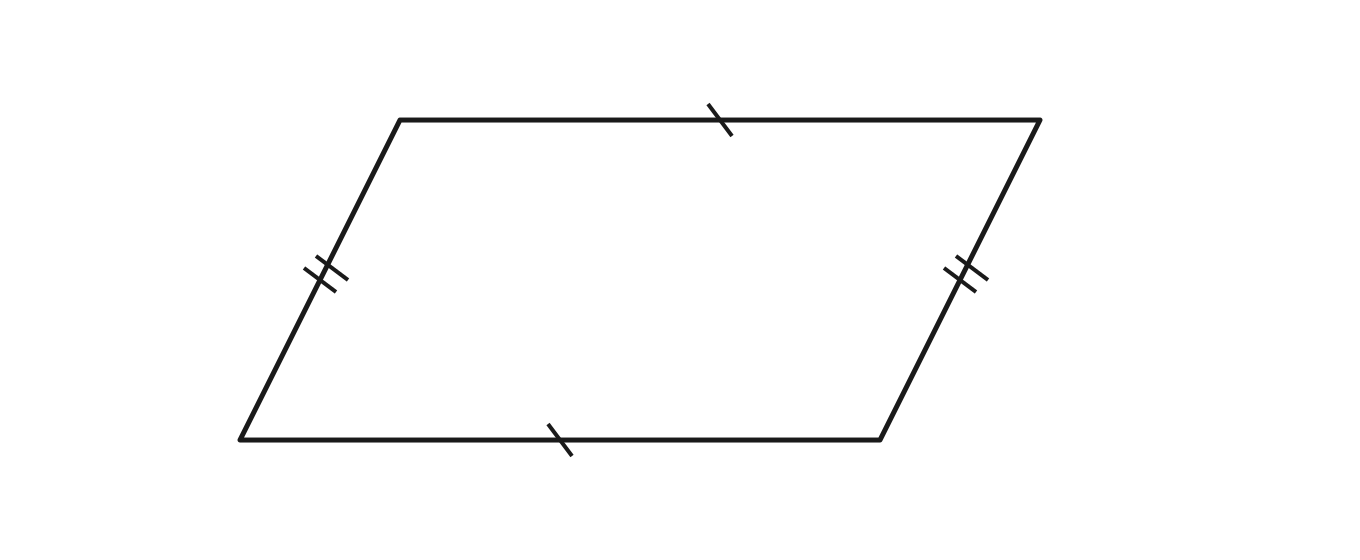
Refer to the figure. Which statement best describes the shape?
- It is a quadrilateral, but it is not a rhombus, rectangle, or square. (correct answer)
- It is a rhombus because it has 4 sides.
- It is a rectangle because it has 4 corners.
- It is not a quadrilateral because the sides are not all equal.
Explanation: The shape has 4 straight sides, so it is a quadrilateral. Because it has no right angles and its sides are not all equal, it is not a rhombus, rectangle, or square.
Question 16
Refer to the figure. Which shape is a rhombus but NOT a square?
- Shape W (correct answer)
- Shape X
- Shape Y
- Shape Z
Explanation: A rhombus has 4 equal sides. A square is a rhombus with 4 right angles. Shape W has 4 equal sides but no right angles, so it is a rhombus but not a square. Shape X is a square. Shape Y is a rectangle. Shape Z is a general quadrilateral with unequal sides.
Question 17
A shape has 4 sides that are all equal in length, but it has NO right angles. What is the best name for this shape?
- Triangle
- Square
- Rectangle
- Rhombus (correct answer)
Explanation: When a question describes a shape by its sides and angles, your job is to match those clues to the exact definition of a shape. Pay attention to both features: side length AND angle type.
Here, you're told the shape has 4 equal sides and no right angles. A shape with 4 equal sides is called a rhombus. A square also has 4 equal sides, but a square must have 4 right angles (corners that look like the corner of a book). Since this shape has no right angles, it can't be a square — it's a "tilted" or "slanted" version, which is a rhombus. That makes D the best answer.
Let's check the others. A) Triangle is wrong because a triangle has only 3 sides, not 4. B) Square is a tempting trap because squares do have 4 equal sides — but squares require 4 right angles, and this shape has none. C) Rectangle is wrong for two reasons: rectangles need 4 right angles, and their sides don't have to be equal (usually two sides are longer than the other two).
A helpful way to remember: a square is a special rhombus that happens to have right angles, and a rhombus is like a square that got "pushed over" to the side. When you see "4 equal sides" but "no right angles," think rhombus. Always read the angle clue carefully — it's often what separates the correct shape from a close look-alike.
Question 18
Emma is sorting shapes into a category called "Shapes with 4 right angles." Which group of shapes should she put in this category?
- Rhombuses and squares only
- Rectangles and squares only (correct answer)
- All quadrilaterals
- Only squares
Explanation: When a question asks about shapes with a specific property, the trick is to check every shape type against that exact property — in this case, having 4 right angles (four 90° corners).
Think about what shapes always have four right angles. A rectangle is defined as a quadrilateral with 4 right angles, so it fits. A square is a special kind of rectangle — it has 4 right angles and 4 equal sides — so it also fits. That makes B the correct group.
Now look at the traps. Choice A includes rhombuses, but a rhombus only needs 4 equal sides; its angles can be slanted (like a "pushed-over" square). Only when a rhombus happens to have right angles does it become a square, so rhombuses in general don't belong. Choice C, all quadrilaterals, is too broad — quadrilaterals just need 4 sides, so shapes like trapezoids or parallelograms with tilted corners would be wrongly included. Choice D, only squares, is too narrow because it forgets that rectangles (non-square ones) also have 4 right angles.
A helpful way to remember: a square is always a rectangle (it fits the rectangle rule plus extra), but a rectangle is not always a square. When you see "right angles," picture the corner of a piece of paper — then ask which shapes must have that corner at every vertex. Rectangles and squares always do; rhombuses and other quadrilaterals only sometimes do.
Question 19
Maya says, "Every square is also a rectangle." Ben says, "Every rectangle is also a square." Who is correct?
- Only Maya is correct, because a square fits all the rules for a rectangle. (correct answer)
- Only Ben is correct, because every rectangle has 4 equal sides like a square.
- Both are correct, because squares and rectangles share all the same attributes.
- Neither is correct, because squares and rectangles are completely different shapes.
Explanation: When you see questions comparing shapes, think about the rules (attributes) each shape must follow, not just what they look like. A rectangle has four sides, four right angles (square corners), and opposite sides that are equal. A square has all those same rules — plus one extra: all four sides must be equal.
Since a square meets every requirement of a rectangle (4 right angles, opposite sides equal — because all sides are equal, opposite sides certainly are too), every square counts as a rectangle. So Maya is right. But a rectangle doesn't have to have four equal sides — a long, skinny rectangle is still a rectangle, and it's clearly not a square. So Ben is wrong. That makes A the correct choice.
Looking at the other options: B is wrong because it claims every rectangle has 4 equal sides, which isn't true — only squares do. C is wrong because squares and rectangles don't share all attributes; the "equal sides" rule belongs only to squares. D is wrong because these shapes are closely related, not "completely different" — squares are a special kind of rectangle.
A helpful way to remember this: think of shapes like a family tree. A square is a "special" rectangle, the way a poodle is a special kind of dog. Every poodle is a dog, but not every dog is a poodle. Whenever a shape has extra rules, it fits inside the bigger group — but the bigger group doesn't fit inside it.
Question 20
Look at the diagram. Which two shapes share the most attributes with each other?
- The rectangle and the triangle because they both have straight sides and angles
- The square and the rhombus because they both have 4 equal sides and are quadrilaterals (correct answer)
- The rectangle and the pentagon because they both have more than 3 sides and vertices
- The square and the triangle because they both can have all sides the same length
Explanation: The square and rhombus share the most attributes: both have 4 equal sides, both have 4 vertices, both have 4 angles, and both are quadrilaterals. Choice A is wrong because the triangle and rectangle don't share as many specific attributes. Choice C is wrong because having more than 3 sides is less specific than the shared quadrilateral properties. Choice D is wrong because this shared attribute is less significant than all the quadrilateral properties the square and rhombus share.