All questions
Question 1
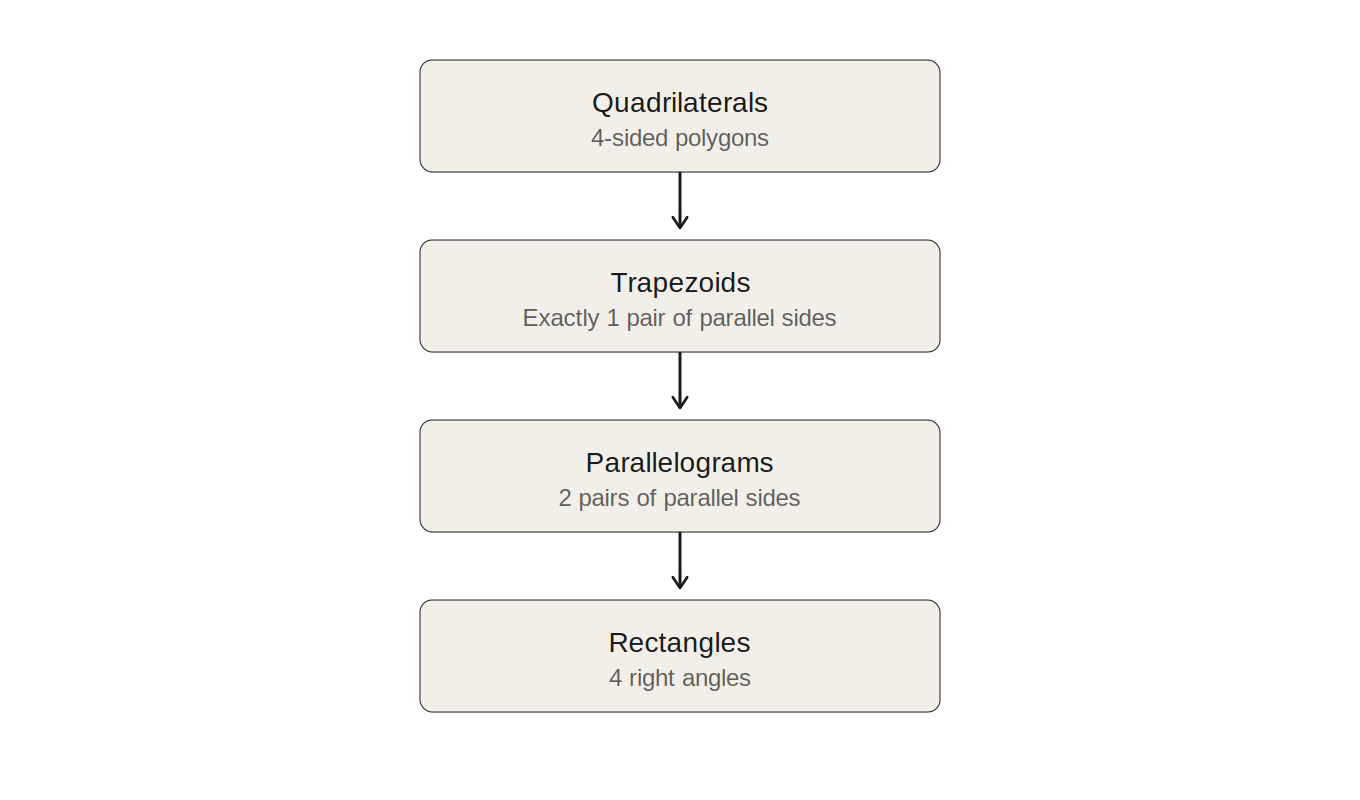
A class sorts shapes using this hierarchy:
- Quadrilaterals
- Trapezoids: exactly 1 pair of parallel sides
- Parallelograms: 2 pairs of parallel sides
- Rectangles: 4 right angles
Which statement is the ONE incorrect classification statement?
- A rectangle belongs to the parallelogram category.
- A trapezoid belongs to the quadrilateral category.
- A parallelogram belongs to the quadrilateral category.
- A trapezoid belongs to the parallelogram category. (correct answer)
Explanation: Shapes are classified by their properties, including the number of parallel sides and angles. A hierarchy is a layered system organizing shapes where top levels are inclusive and lower levels add restrictions. Properties like exactly one pair of parallel sides place a shape in trapezoid, connecting it to quadrilateral but not parallelogram. For example, a trapezoid with one pair of parallel sides is a quadrilateral but doesn't qualify as a parallelogram, which needs two pairs. A misconception is that trapezoids are parallelograms because both have parallel sides, but trapezoids have only one pair by definition. Hierarchies are useful for distinguishing between similar shapes through property-based sorting. They enhance understanding of geometric relationships and prevent misclassification.
Question 2
A teacher shows this rule for sorting: "Properties determine classification, so shapes can be organized in a hierarchy."
Categories and key properties:
- Quadrilateral: 4 sides
- Parallelogram: 2 pairs of parallel sides
- Rectangle: 4 right angles
- Rhombus: 4 equal sides
- Square: 4 equal sides and 4 right angles
Which statement about the hierarchy is incorrect?
- A square belongs to the rectangle category because it has 4 right angles.
- A rectangle belongs to the quadrilateral category because it has 4 sides.
- A rhombus belongs to the parallelogram category because it has 2 pairs of parallel sides.
- A parallelogram belongs to the trapezoid category because it has parallel sides. (correct answer)
Explanation: Shapes are classified by their properties, such as parallel sides, to fit them into categories. A hierarchy is a structured model that shows how categories include subcategories based on extra properties, like a chart. Properties relate to categories by meeting definitions; two pairs of parallel sides define a parallelogram, distinct from a trapezoid's exactly one pair. An example is a parallelogram, which has two pairs and thus isn't a trapezoid. A misconception is that parallelograms are types of trapezoids due to shared parallel sides, but they differ in count. Hierarchies are useful for precise classifications in geometry. They encourage logical reasoning by highlighting differences and similarities.
Question 3
A bulletin board shows that shapes can be organized in a hierarchy based on properties:
Quadrilateral (4 sides)
- Trapezoid (exactly 1 pair of parallel sides)
- Parallelogram (2 pairs of parallel sides)
- Rectangle (4 right angles)
- Rhombus (4 equal sides)
- Square (4 equal sides and 4 right angles)
Shape D is described as: 4 sides, 2 pairs of parallel sides, and 4 equal sides. It does NOT have 4 right angles. Which statement correctly classifies Shape D?
- Shape D is a square because it has 4 equal sides.
- Shape D is a rhombus, a parallelogram, and a quadrilateral. (correct answer)
- Shape D is a rectangle, a trapezoid, and a quadrilateral.
- Shape D is only a quadrilateral because it does not have right angles.
Explanation: Shapes are classified by their properties, like parallel sides and equal lengths, helping us group them accurately. A hierarchy is a tiered structure where categories branch out based on additional defining traits, resembling a decision tree. Properties connect to categories through requirements; four equal sides and two pairs of parallel sides make a rhombus. For example, a shape with those but no right angles is a rhombus, not a square. A common misconception is that equal sides alone make a square, ignoring angles. Hierarchies are useful for demonstrating inclusive classifications in geometry. They aid in critical thinking by showing logical progressions in shape properties.
Question 4
A student made a chart to classify shapes by properties. The teacher says some shapes belong to multiple categories because of shared properties.
Student's classifications:
- Shape E: "trapezoid"
- Given properties of Shape E: 4 sides; 2 pairs of parallel sides; no information about right angles; sides are not all equal.
What is the error in the student's classification?
- Shape E cannot be a trapezoid because it has 2 pairs of parallel sides, so it is a parallelogram. (correct answer)
- Shape E cannot be a quadrilateral because it has parallel sides.
- Shape E must be a square because it has 2 pairs of parallel sides.
- Shape E must be a trapezoid because it has 4 sides.
Explanation: Shapes are classified by their properties, such as pairs of parallel sides, to determine their categories. A hierarchy is an arrangement that places broader categories at the top and specifics below, based on property layers. Properties link categories by specifying exact conditions; two pairs of parallel sides define a parallelogram, not a trapezoid. An example is a four-sided shape with two pairs of parallel sides—it's a parallelogram, not a trapezoid which has exactly one pair. A misconception is that more parallel sides still qualify as a trapezoid, but definitions are precise. Hierarchies are useful for avoiding classification errors in math. They help students grasp relationships and build foundational knowledge.
Question 5
A classroom poster says shapes can be organized in a hierarchy based on properties.
Hierarchy (based on properties):
- Quadrilateral: 4 sides
- Parallelogram: 2 pairs of parallel sides
- Rectangle: 4 right angles
- Rhombus: 4 equal sides
- Square: 4 equal sides and 4 right angles
Shape A has 4 sides, 2 pairs of parallel sides, and 4 right angles, but its sides are not all the same length. Which categories does Shape A belong to?
- Shape A belongs to quadrilateral, parallelogram, rectangle, and square.
- Shape A belongs to quadrilateral, parallelogram, and rectangle. (correct answer)
- Shape A belongs to quadrilateral and rhombus only.
- Shape A belongs to quadrilateral, rectangle, and rhombus.
Explanation: Shapes are classified by their properties, such as the number of sides, angles, and parallel lines, which help us organize them into categories. A hierarchy is a system where broader categories include more specific ones based on additional properties, like a family tree for shapes. These properties connect to categories by defining requirements; for instance, having four sides places a shape in the quadrilateral category, and adding parallel sides moves it to parallelogram. For example, a shape with four sides, two pairs of parallel sides, and four right angles but unequal sides is a rectangle, fitting into quadrilateral, parallelogram, and rectangle categories. A common misconception is that all rectangles must have equal sides, but actually, rectangles only require right angles and parallel sides, not equal lengths. Hierarchies are useful because they show relationships between shapes, helping us understand that a shape can belong to multiple categories. Overall, this organization makes it easier to compare and identify shapes in math and real life.
Question 6
The art club labels four paper shapes with their properties:
- Shape C: 4 sides; 2 pairs of parallel sides; all 4 sides equal; angles are not right angles.
Using the hierarchy (quadrilateral → parallelogram → rectangle/rhombus → square), which categories does Shape C belong to?
- Shape C belongs to quadrilateral, parallelogram, and rhombus. (correct answer)
- Shape C belongs to quadrilateral, parallelogram, rectangle, and square.
- Shape C belongs to quadrilateral, trapezoid, and rectangle.
- Shape C belongs to quadrilateral and rectangle only.
Explanation: Shapes are classified by their properties, such as side lengths and parallel sides, to sort them into meaningful groups. A hierarchy is a layered system where categories are arranged from general to specific based on accumulated properties, like a pyramid. These properties connect categories by requiring certain traits; equal sides place a shape in the rhombus category under parallelogram. An example is a shape with four equal sides, two pairs of parallel sides, but no right angles—it's a rhombus, parallelogram, and quadrilateral. People often misconception that rhombuses must have right angles, but they don't; that's for squares. Hierarchies are useful for showing how shapes inherit properties from parent categories. They promote better understanding of geometry by illustrating overlaps and distinctions.
Question 7
A student draws Shape C with these properties:
- 4 sides
- 2 pairs of parallel sides
- all 4 sides are equal
- NOT all angles are right angles
Using the hierarchy (quadrilateral → parallelogram → rectangle/rhombus → square), which categories does Shape C belong to?
- Shape C belongs to quadrilateral, parallelogram, rhombus, and square.
- Shape C belongs to quadrilateral, parallelogram, and rhombus. (correct answer)
- Shape C belongs to quadrilateral, rectangle, and rhombus.
- Shape C belongs to quadrilateral and rectangle.
Explanation: Shapes are classified based on properties like side lengths, angles, and parallel lines to group them logically. A hierarchy is an arrangement showing how categories nest within each other, with top levels being more inclusive. Properties directly tie to categories, such as equal sides qualifying a shape as a rhombus if it also has parallel sides. For example, a shape with four equal sides, two pairs of parallel sides, but no right angles is a quadrilateral, parallelogram, and rhombus, but not a rectangle or square. A misconception is assuming all rhombuses have right angles, but many do not unless they are squares. Hierarchies help clarify these distinctions and promote accurate classification. They are useful for teaching how adding properties creates more specific shape types.
Question 8
A teacher writes these categories and properties:
- Quadrilateral: 4 sides
- Parallelogram: 2 pairs of parallel sides
- Rectangle: 4 right angles
- Rhombus: 4 equal sides
- Square: 4 right angles and 4 equal sides
Shape D is a square. Which set of categories must also be true for Shape D because properties determine the hierarchy?
- Shape D must be a quadrilateral, a parallelogram, a rectangle, and a rhombus. (correct answer)
- Shape D must be a trapezoid and a kite.
- Shape D must be a rhombus but not a rectangle.
- Shape D must be a rectangle but not a parallelogram.
Explanation: Shapes are classified by their properties, including sides, angles, and equality. A hierarchy is an arrangement where categories build upon each other, inheriting traits from higher levels. Properties like right angles and equal sides ensure a square connects to rectangle, rhombus, parallelogram, and quadrilateral. For example, a square with four right angles and equal sides must also be a rectangle and rhombus due to these shared properties. A misconception is that squares are separate from rectangles, but squares are special rectangles with added equal sides. Hierarchies are useful for demonstrating that specific shapes include all properties of their parent categories. They facilitate deeper insights into geometric interconnections.
Question 9
Two shapes are compared using a property hierarchy:
- Quadrilaterals
- Parallelograms (2 pairs of parallel sides)
- Rectangles (4 right angles)
- Rhombuses (4 equal sides)
Shape F is a rectangle that is not a square. Shape G is a rhombus that is not a square. Which statement correctly compares them using the hierarchy?
- Both Shape F and Shape G are parallelograms and quadrilaterals, but only Shape F is a rectangle and only Shape G is a rhombus. (correct answer)
- Both Shape F and Shape G are squares because they are both parallelograms.
- Neither Shape F nor Shape G is a parallelogram because only squares are parallelograms.
- Shape F is a rhombus and Shape G is a rectangle because they both have 4 sides.
Explanation: Shapes are classified by their properties, including parallel sides, equal sides, and angles. A hierarchy is an organized structure showing how shapes relate through shared and unique traits. Properties distinguish shapes like rectangles from rhombuses while connecting both to parallelograms. For example, a non-square rectangle has right angles and is a parallelogram, while a non-square rhombus has equal sides and is also a parallelogram. A misconception is that rectangles and rhombuses are unrelated, but both fall under parallelograms. Hierarchies are useful for comparing shapes and highlighting differences. They encourage analytical thinking about geometric properties.
Question 10
A teacher posts this property-based hierarchy:
- Quadrilaterals: 4 sides
- Parallelograms: 2 pairs of parallel sides
- Rectangles: 4 right angles
- Rhombuses: 4 equal sides
Shape A has 4 sides, 2 pairs of parallel sides, and 4 right angles, but its sides are not all equal. Which statement correctly classifies Shape A in the hierarchy?
- Shape A belongs to quadrilateral, parallelogram, rectangle, and square.
- Shape A belongs to quadrilateral, parallelogram, and rectangle. (correct answer)
- Shape A belongs to quadrilateral and rhombus only.
- Shape A belongs to parallelogram and square only.
Explanation: Shapes are classified by their properties, such as the number of sides, angles, and parallel lines. A hierarchy is a structured organization where general categories encompass more specific ones based on additional defining traits. Properties like having four sides place a shape in the quadrilateral category, while extra features like parallel sides or right angles move it into subcategories like parallelograms or rectangles. For example, a shape with four sides, two pairs of parallel sides, and four right angles but unequal sides is classified as a quadrilateral, parallelogram, and rectangle. A common misconception is that if a shape isn't a square, it can't be a rectangle, but rectangles include shapes with right angles regardless of side lengths as long as they aren't all equal. Hierarchies are useful because they illustrate how shapes share properties across levels. They also help in understanding inclusive relationships, making it easier to reason about geometric figures.
Question 11
A student compares Shape G and Shape H using a property-based hierarchy:
- Quadrilateral: 4 sides
- Rectangle: 4 right angles
- Rhombus: 4 equal sides
- Square: both a rectangle and a rhombus
Shape G has 4 right angles and 2 long sides and 2 short sides (not all equal). Shape H has 4 equal sides but does not have 4 right angles. Which statement correctly compares them in the hierarchy?
- Shape G is a rectangle and Shape H is a rhombus, and both are quadrilaterals. (correct answer)
- Shape G and Shape H are both squares because each has at least one square property.
- Shape G is a rhombus and Shape H is a rectangle, and neither is a quadrilateral.
- Shape G is only a quadrilateral and Shape H is only a quadrilateral.
Explanation: Shapes are classified by their properties, which help sort them into categories. A hierarchy is a structured chart showing how categories include subcategories based on increasing specificity. Properties connect to categories, like right angles for rectangles and equal sides for rhombuses. For instance, a shape with four right angles but unequal sides is a rectangle, while one with equal sides but no right angles is a rhombus, both being quadrilaterals. A misconception is that any shape with some square-like traits is a square, but it needs all properties. Hierarchies are helpful for comparing shapes and understanding inclusions. They promote logical thinking in geometry by mapping property relationships.
Question 12
A chart lists categories and properties:
- Quadrilateral: 4 sides
- Parallelogram: 2 pairs of parallel sides
- Rectangle: 4 right angles
- Square: 4 equal sides and 4 right angles
Which claim about the hierarchy is incorrect?
- Every square is a rectangle because it has 4 right angles.
- Every rectangle is a quadrilateral because it has 4 sides.
- Every parallelogram is a quadrilateral because it has 4 sides.
- Every quadrilateral is a parallelogram because it has 4 sides. (correct answer)
Explanation: Shapes are classified based on properties that define their categories in a systematic way. A hierarchy organizes these categories into levels, where lower levels inherit from upper ones. Properties like parallel sides link shapes to specific categories such as parallelograms. For example, while every parallelogram is a quadrilateral, not every quadrilateral is a parallelogram, as it may lack two pairs of parallel sides. A common misconception is assuming all quadrilaterals have parallel sides, but many do not. Hierarchies are useful for spotting incorrect claims and reinforcing true relationships. They aid in education by providing a clear framework for shape classification.
Question 13
A teacher posts this shape hierarchy based on properties:
- Quadrilateral: 4 sides
- Parallelogram: 2 pairs of parallel sides
- Rectangle: 4 right angles
- Rhombus: 4 equal sides
- Square: 4 equal sides and 4 right angles
Shape A has 4 sides, 2 pairs of parallel sides, 4 right angles, and all 4 sides are equal. Which categories does Shape A belong to?
- Shape A belongs to quadrilateral, parallelogram, rectangle, rhombus, and square. (correct answer)
- Shape A belongs to quadrilateral, rectangle, and square only.
- Shape A belongs to quadrilateral, parallelogram, and rhombus only.
- Shape A belongs to quadrilateral and square only.
Explanation: Shapes are classified into categories based on their specific properties, such as the number of sides, angles, or parallel lines. A hierarchy is a structured organization where broader categories encompass more specific subcategories, illustrating how shapes relate through shared traits. Properties like having four sides connect a shape to the quadrilateral category, while additional traits like parallel sides or right angles place it in narrower groups. For example, a shape with four sides, two pairs of parallel sides, four right angles, and all sides equal fits into quadrilateral, parallelogram, rectangle, rhombus, and square. A common misconception is that a square cannot be a rectangle, but squares meet all rectangle properties plus equal sides. Hierarchies are useful because they help visualize inclusions and exclusions among shape types. Overall, this system promotes better understanding of geometry by showing how properties build upon each other.
Question 14
A student is using this hierarchy:
- Quadrilateral: 4 sides
- Parallelogram: 2 pairs of parallel sides
- Rectangle: 4 right angles
- Rhombus: 4 equal sides
- Square: both a rectangle and a rhombus
The student labels Shape E as a square. Shape E has 4 equal sides, but its angles are not right angles. Which statement correctly describes the error?
- Shape E cannot be a quadrilateral because it has equal sides.
- Shape E cannot be a square because a square must have 4 right angles. (correct answer)
- Shape E must be a rectangle because it has 4 equal sides.
- Shape E must be a square because equal sides are the only property that matters.
Explanation: Shapes are classified by properties that determine their categories in geometry. A hierarchy is a system of nested groups where specific shapes are subsets of broader ones based on shared attributes. Connecting properties to categories means a shape must meet all criteria, like right angles for rectangles. For example, a shape with four equal sides but no right angles is a rhombus, not a square, which requires both. A misconception is that equal sides alone make a square, overlooking the angle requirement. Hierarchies are useful for correcting such errors and showing relationships. They enhance understanding by illustrating property dependencies across levels.
Question 15
A bulletin board shows a hierarchy where some shapes fit into more than one category:
- Quadrilateral: 4 sides
- Parallelogram: 2 pairs of parallel sides
- Rectangle: 4 right angles
- Rhombus: 4 equal sides
- Square: both a rectangle and a rhombus
Shape B is a rectangle (it has 4 right angles), but its sides are not all equal. Which statement correctly classifies Shape B?
- Shape B is a square because it has 4 right angles.
- Shape B is a rhombus because rectangles always have equal sides.
- Shape B is a quadrilateral and a rectangle, and it is also a parallelogram. (correct answer)
- Shape B is only a quadrilateral because it does not have all equal sides.
Explanation: Shapes are classified by their properties, which determine the categories they belong to in geometry. A hierarchy is a layered system where general categories include specialized ones, like how all parallelograms are quadrilaterals but not vice versa. Specific properties, such as right angles or equal sides, link shapes to categories like rectangle or rhombus. For instance, a rectangle with four right angles but unequal sides is also a quadrilateral and parallelogram, though not a rhombus or square. One misconception is that rectangles must have equal sides, but they only require right angles and parallel sides. Hierarchies are valuable for organizing knowledge and revealing relationships between shapes. They also aid in logical reasoning about why some shapes inherit properties from broader groups.
Question 16
A poster shows this hierarchy:
- Quadrilaterals
- Parallelograms (2 pairs of parallel sides)
- Rectangles (4 right angles)
- Rhombuses (4 equal sides)
- Squares (4 right angles and 4 equal sides)
A student claims: "Every rhombus is also a rectangle." Which claim about the hierarchy is incorrect?
- The student's claim is incorrect because a rhombus does not have to have 4 right angles. (correct answer)
- The student's claim is correct because a rhombus always has 2 pairs of parallel sides.
- The student's claim is incorrect because rectangles are not quadrilaterals.
- The student's claim is incorrect because a rhombus cannot be a parallelogram.
Explanation: Shapes are classified by their properties, like parallel sides and angle measures. A hierarchy is a tiered structure that groups shapes from general to specific based on accumulating properties. Properties such as four equal sides link a shape to rhombus, but without four right angles, it doesn't connect to rectangle. For example, a rhombus with non-right angles is a parallelogram but not a rectangle. A misconception is that every rhombus is a rectangle due to shared parallel sides, but rectangles require right angles which rhombuses don't always have. Hierarchies are useful for clarifying that not all subcategories inherit every property. They aid in avoiding errors by emphasizing precise definitions in classification.
Question 17
A bulletin board shows that shapes can be organized in a hierarchy based on properties, and some shapes fit into more than one group:
- Quadrilateral: 4 sides
- Parallelogram: 2 pairs of parallel sides
- Rectangle: 4 right angles
- Square: 4 right angles and 4 equal sides
Shape W has 4 sides, 2 pairs of parallel sides, and 4 right angles. Its side lengths are 8 cm and 5 cm. Which categories does Shape W belong to?
- Quadrilateral, parallelogram, and rectangle. (correct answer)
- Quadrilateral and square only.
- Parallelogram and square only.
- Quadrilateral only because it does not have 4 equal sides.
Explanation: Shapes are classified by their properties, including parallelism and right angles, to place them in categories. A hierarchy is a structured organization where general categories lead to specific ones via added properties. Properties connect to categories by meeting all necessary conditions; 4 right angles and parallel sides define a rectangle. Shape W with 4 sides, parallel pairs, right angles, but unequal sides like 8 cm and 5 cm belongs to quadrilateral, parallelogram, and rectangle, as per choice A. A misconception is that unequal sides prevent rectangle classification, but only adjacent sides need differ. Hierarchies are useful for multi-level classifications. They improve comprehension of shape relationships in geometry.
Question 18
A student sorts shapes using a property hierarchy:
- Quadrilateral: 4 sides
- Trapezoid: exactly 1 pair of parallel sides
- Parallelogram: 2 pairs of parallel sides
- Rectangle: 4 right angles
- Rhombus: 4 equal sides
- Square: 4 equal sides and 4 right angles
Shape B has 4 sides and exactly 1 pair of parallel sides. It does not have 4 right angles. Which statement correctly classifies Shape B?
- Shape B is a trapezoid and a quadrilateral. (correct answer)
- Shape B is a parallelogram and a quadrilateral.
- Shape B is a rectangle and a quadrilateral.
- Shape B is a square and a quadrilateral.
Explanation: Shapes are classified by their properties, including the number of parallel sides and angles, allowing us to group them logically. A hierarchy is a structured arrangement where general categories branch into more specific ones as properties are added, similar to a flowchart. Properties connect to categories by specifying criteria; for example, exactly one pair of parallel sides defines a trapezoid under the quadrilateral umbrella. Take a shape with four sides and exactly one pair of parallel sides but no right angles—it fits as a trapezoid and quadrilateral. One misconception is that any shape with parallel sides is a parallelogram, but parallelograms require two pairs, not just one. Hierarchies are useful for visualizing how shapes share traits while differing in specifics. They also aid in problem-solving by clarifying classifications in geometry.
Question 19
A poster shows these categories based on properties:
- Quadrilateral: 4 sides
- Parallelogram: 2 pairs of parallel sides
- Rectangle: a parallelogram with 4 right angles
Shape D has 4 sides and exactly one pair of parallel sides. Which statement correctly classifies Shape D?
- Shape D is a parallelogram because it has at least one pair of parallel sides.
- Shape D is a rectangle because it has 4 sides.
- Shape D is a quadrilateral, but it is not a parallelogram or a rectangle. (correct answer)
- Shape D is a square because it has parallel sides.
Explanation: Shapes are classified according to their properties, which define their place in geometric groups. A hierarchy organizes categories from general to specific, highlighting how some shapes fit multiple levels. Properties such as parallel sides link shapes to categories like parallelograms, requiring exact matches. For instance, a shape with four sides but only one pair of parallel sides is a quadrilateral, but not a parallelogram or rectangle. One misconception is that any shape with parallel sides is a parallelogram, but it needs two pairs. Hierarchies assist in precise sorting and avoiding overgeneralizations. They are beneficial for learning how properties build complex classifications.
Question 20
Use this hierarchy based on properties:
- Quadrilaterals
- Parallelograms (2 pairs of parallel sides)
- Rectangles (4 right angles)
- Rhombuses (4 equal sides)
Shape B has 4 sides, 2 pairs of parallel sides, and all 4 sides are equal, but it does not have any right angles. Which categories does Shape B belong to?
- Shape B belongs to quadrilateral, parallelogram, and rhombus. (correct answer)
- Shape B belongs to quadrilateral, rectangle, and square.
- Shape B belongs to quadrilateral and rectangle only.
- Shape B belongs to quadrilateral, rhombus, and square.
Explanation: Shapes are classified by their properties, including side lengths, angles, and parallel sides. A hierarchy is an organizational system where broader shape categories include narrower ones that add specific attributes. Properties such as equal sides connect a shape to categories like rhombus, while the absence of right angles excludes it from rectangle or square. For instance, a shape with four equal sides and two pairs of parallel sides but no right angles fits into quadrilateral, parallelogram, and rhombus. One misconception is that all rhombuses must have right angles, but rhombuses can have angles that are not right as long as sides are equal. Hierarchies are useful for showing inheritance of properties from parent to child categories. They promote logical thinking about how shapes relate and differ based on traits.