All questions
Question 1
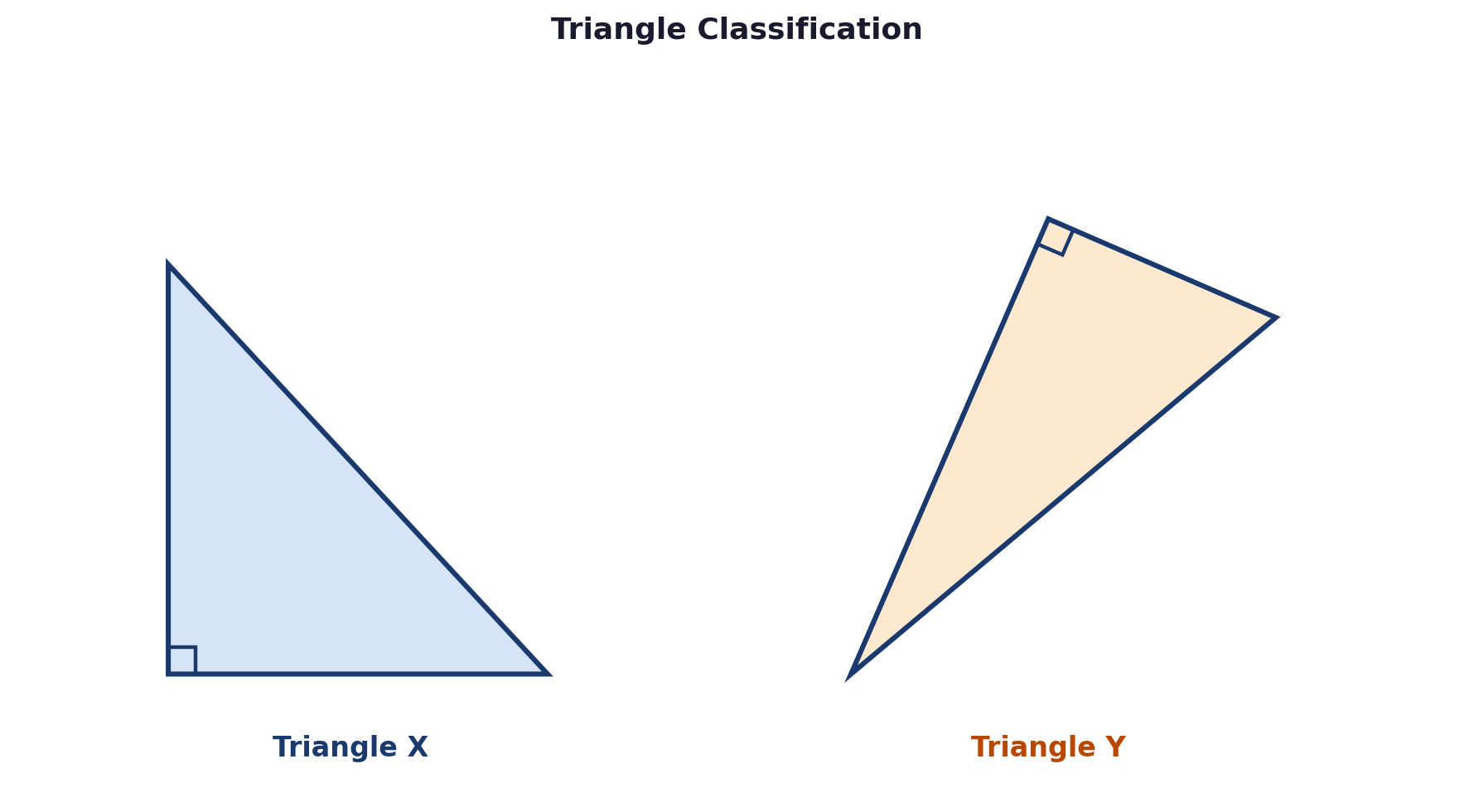
Study the triangles in the figure. Based on the angle markings shown, which statement correctly classifies these triangles?
- Triangle X is a right triangle, and Triangle Y is not
- Triangle Y is a right triangle, and Triangle X is not
- Both Triangle X and Triangle Y are right triangles (correct answer)
- Neither Triangle X nor Triangle Y is a right triangle
Explanation: Looking at the angle markings, Triangle X has a right angle marked with a square symbol at one vertex, making it a right triangle. Triangle Y also has a right angle marked with a square symbol at one of its vertices, making it a right triangle as well. Both triangles have exactly one 90-degree angle, which is the defining characteristic of right triangles.
Question 2
Lisa is sorting quadrilaterals into groups. She puts all shapes with at least one pair of parallel sides in Group 1, and all shapes with at least one right angle in Group 2. A rectangle would belong in which group(s)?
- Only Group 1, because of the parallel sides
- Only Group 2, because of the right angles
- Both Group 1 and Group 2, because of both features (correct answer)
- Neither group, because rectangles are a special shape
Explanation: The correct answer is C because a rectangle has both parallel sides and right angles, so it belongs in both groups. Choice A leaves out the right-angle feature. Choice B leaves out the parallel-sides feature. Choice D is incorrect because being a specific shape does not exclude a rectangle from having both of the listed features.
Question 3
Five points, A, B, C, D, and E, form three triangles: ABC, ADE, and BCE. In triangle ABC, sides BA and BC meet at a right angle at vertex B. In triangle BCE, sides CB and CE meet at a right angle at vertex C. In triangle ADE, no two sides meet at a right angle. Which statement correctly identifies the triangles that have perpendicular sides?
- Only triangle ADE has sides that meet at right angles
- Only triangles ABC and ADE have sides meeting at right angles
- Only triangles ABC and BCE have sides meeting at right angles (correct answer)
- Triangles ABC, ADE, and BCE all have sides meeting at right angles
Explanation: Triangle ABC has a right angle where sides BA and BC meet at vertex B. Triangle BCE has a right angle where sides CB and CE meet at vertex C. Triangle ADE has no two sides that meet at a right angle. So only triangles ABC and BCE have perpendicular sides. Choice A leaves out triangle ABC. Choice B mistakenly includes ADE, which has no right angle. Choice D mistakenly includes all three triangles.
Question 4
Examine the quadrilaterals shown in the figure. Which quadrilateral has both parallel sides AND perpendicular sides?
- Quadrilateral P has both parallel and perpendicular sides (correct answer)
- Quadrilateral Q has both parallel and perpendicular sides
- Quadrilateral R has both parallel and perpendicular sides
- None of these quadrilaterals have both features
Explanation: Quadrilateral P is a rectangle, which has two pairs of parallel sides (opposite sides are parallel) and four right angles (perpendicular sides meet at 90-degree angles). Quadrilateral Q is a parallelogram with no right angles, so it has parallel sides but no perpendicular sides. Quadrilateral R is a trapezoid with no right angles, so it has one pair of parallel sides but no perpendicular sides.
Question 5
Look at the quadrilateral shown in the figure below. Which statement best describes this figure based on its angles and line relationships?
- It is a rectangle because it has four right angles and opposite sides are parallel (correct answer)
- It is a parallelogram because it has two pairs of parallel sides but no right angles
- It is a trapezoid because it has exactly one pair of parallel sides and no right angles
- It is a rhombus because all sides are equal and it has two pairs of parallel sides
Explanation: The figure shows a rectangle with four right angles (90°) marked and opposite sides that are parallel. Choice A correctly identifies both the right angles and parallel sides. Choice B is wrong because the figure does have right angles. Choice C is wrong because the figure has two pairs of parallel sides, not one. Choice D is wrong because while the sides may be equal, the defining characteristic shown is the right angles.
Question 6
A triangle has angles measuring 30°, 60°, and 90°. A small square symbol at one vertex marks the 90° angle. Which statement best describes this triangle?
- Right triangle because it has a 90-degree angle (correct answer)
- Acute triangle because all angles are less than 90 degrees
- Obtuse triangle because it has an angle greater than 90 degrees
- Equilateral triangle because all three sides are equal
Explanation: A triangle with a 90° angle is a right triangle, regardless of its other two angle measures. Choice B is incorrect because a triangle with a 90° angle cannot have all angles less than 90°. Choice C is incorrect because an obtuse triangle has an angle greater than 90°, not equal to it. Choice D is incorrect because a triangle with angles of 30°, 60°, and 90° does not have three equal sides. Question 7
Line AB passes through the points (0,2) and (4,6). Line CD passes through the points (0,5) and (4,9). Which statement correctly describes the relationship between lines AB and CD?
- The lines are perpendicular
- The lines are parallel (correct answer)
- The lines are intersecting but not perpendicular
- The lines are coincident
Explanation: The lines are parallel because both lines rise the same amount over the same distance across (4 up for every 4 over), but they start at different points, so they never meet. Perpendicular is incorrect because the lines do not meet at a right angle. Intersecting but not perpendicular is incorrect because these lines never meet at all. Coincident is incorrect because the two lines start at different points, so they are not the same line.
Question 8
Look at the triangles shown in the diagram below. Which triangle has perpendicular sides?
- Triangle P because it has two sides that meet at a right angle (correct answer)
- Triangle Q because all its angles are equal to each other
- Triangle R because it has one angle greater than 90 degrees
- Triangle S because all its angles are less than 90 degrees
Explanation: Triangle P has a right angle marked with a square symbol, showing two sides meet at exactly 90°. When two lines meet at 90°, they are perpendicular. Triangle Q has equal angles but no right angles (choice B). Triangle R has an obtuse angle, not a right angle (choice C). Triangle S has only acute angles, not right angles (choice D).
Question 9
Line segment PQ and line segment RS intersect and form a right angle (90 degrees) where they cross. What is the relationship between line segment PQ and line segment RS?
- They are parallel because they have the same slope and never intersect
- They are perpendicular because they intersect at a right angle (correct answer)
- They are intersecting but not perpendicular because they meet at an obtuse angle
- They are the same line because they overlap completely
Explanation: Two line segments that cross and form a 90-degree angle are perpendicular, which matches segments PQ and RS. Choice A describes lines that never meet, which isn't the case here since they do intersect. Choice C describes an obtuse angle, not the right angle formed here. Choice D describes segments that lie exactly on top of each other, which is different from segments that simply cross at a point.