All questions
Question 1
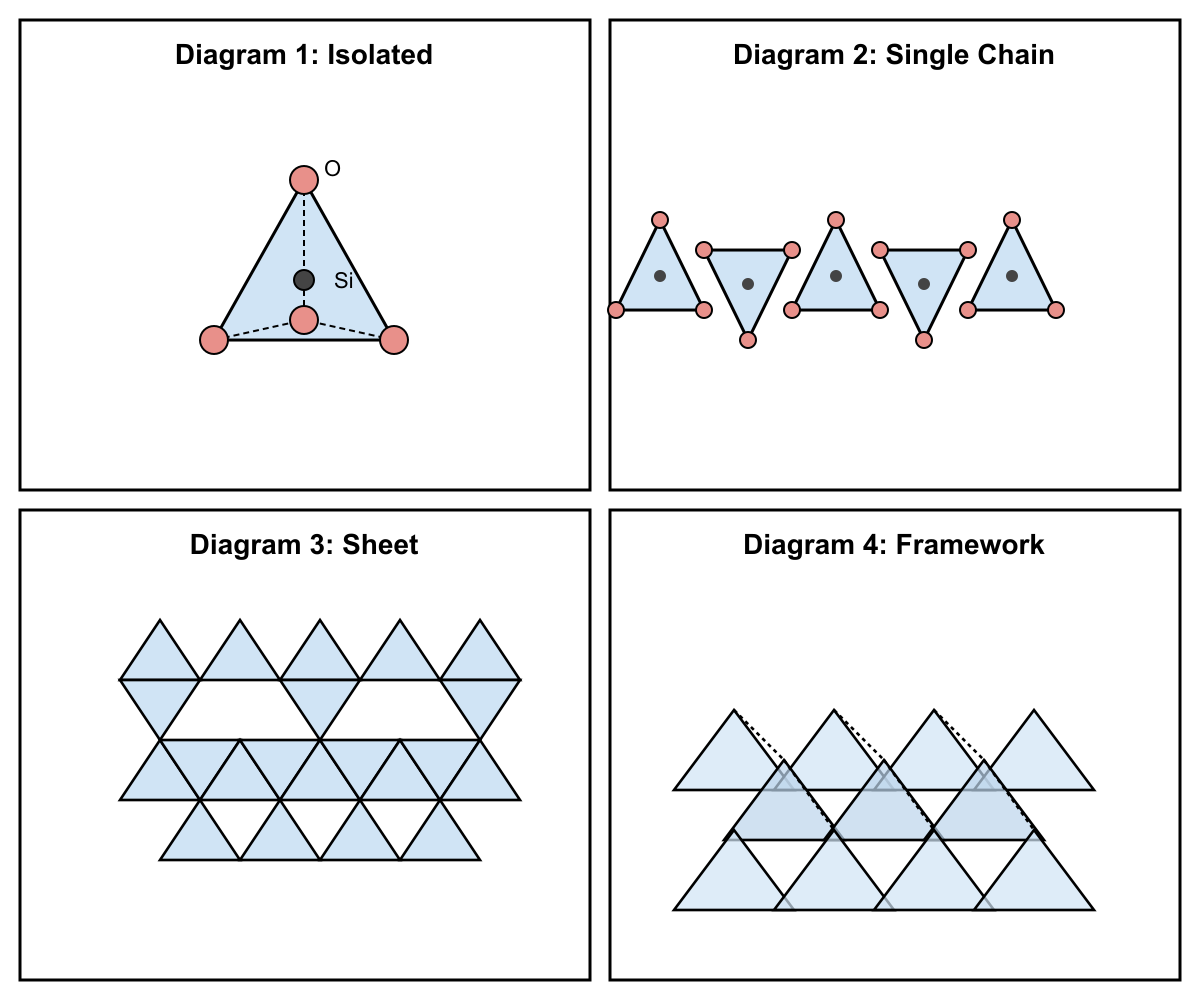
The provided diagrams illustrate four main ways silica tetrahedra polymerize to form silicate minerals. A mineral sample is found to be very soft and easily peels into thin, flexible layers. Which structural diagram best represents the atomic arrangement within this mineral?
- Diagram 1, because the isolated tetrahedra can easily slide past one another to form layers.
- Diagram 2, because the weak bonds holding the chains together allow them to separate into layers.
- Diagram 3, because the strong bonds within the sheets and weak bonds between them result in perfect basal cleavage. (correct answer)
- Diagram 4, because the uniform framework can be easily split along any plane to form thin layers.
Explanation: The correct answer is C. The physical properties described—very soft, peels into thin, flexible layers—are characteristic of sheet silicates, like mica. Diagram 3 correctly illustrates the sheet structure where tetrahedra are linked in two dimensions. The reasoning in option C is also correct: the bonds within these sheets are very strong, but the bonds between the sheets are very weak, leading to the perfect cleavage that allows the mineral to be peeled into layers.
A is incorrect; isolated tetrahedra (Diagram 1) are found in minerals like olivine, which are relatively hard and do not form sheets.
B is incorrect; chain structures (Diagram 2) result in two directions of cleavage, not one perfect sheet-like cleavage.
D is incorrect; framework structures (Diagram 4) have strong bonds in all directions and tend to fracture rather than cleave.
Question 2
A geoscientist uses X-ray diffraction (XRD) to analyze a powdered mineral sample. The technique produces a unique pattern of peaks at specific angles. This pattern is considered a definitive 'fingerprint' for identifying the mineral because it is directly determined by the:
- mineral's chemical formula and the atomic mass of its constituent elements.
- dimensions and geometry of the mineral's unit cell and the arrangement of atoms within it. (correct answer)
- mineral's hardness and cleavage, which affect how the X-rays are scattered.
- presence of trace element impurities that create unique diffraction signatures.
Explanation: The correct answer is B. X-ray diffraction works by passing X-rays through a crystalline material. The ordered planes of atoms in the crystal lattice diffract the X-rays at specific angles, according to Bragg's Law. The angles of diffraction are determined by the spacing between the atomic planes. Therefore, the resulting pattern is a direct representation of the mineral's internal crystal structure—specifically, the size, shape, and symmetry of its unit cell and how atoms are arranged within it.
A is incomplete; the chemical formula doesn't describe the 3D arrangement of the atoms.
C reverses cause and effect; hardness and cleavage are consequences of the crystal structure, they do not determine the XRD pattern.
D is incorrect because while impurities can cause minor shifts in the pattern, the fundamental pattern itself is determined by the primary crystal structure of the mineral.
Question 3
In silicate minerals, the way silica tetrahedra are linked by sharing oxygen atoms determines the mineral group and its properties. As the degree of oxygen sharing (polymerization) increases, the ratio of silicon to oxygen in the chemical formula changes. Which of the following silicate structures has the highest ratio of silicon to oxygen?
- Isolated tetrahedra structures (e.g., olivine)
- Single-chain structures (e.g., pyroxene)
- Sheet structures (e.g., mica)
- Framework structures (e.g., quartz) (correct answer)
Explanation: The correct answer is D. This question requires understanding the effect of polymerization on the Si:O ratio. In isolated tetrahedra (nesosilicates), the unit is (SiO₄)⁴⁻, a ratio of 1:4. In single chains (inosilicates), two oxygens are shared, giving a repeating unit of (SiO₃)²⁻, a ratio of 1:3. In sheets (phyllosilicates), three oxygens are shared, giving (Si₂O₅)²⁻, a ratio of 1:2.5. In framework structures (tectosilicates), all four oxygens are shared, giving (SiO₂), a ratio of 1:2. The highest Si:O ratio (or lowest O:Si ratio) is 1:2, found in framework silicates like quartz.
Question 4
The mineral kyanite is an aluminosilicate with the peculiar property of having a hardness of ~5 when scratched parallel to the long axis of its bladed crystals, but a hardness of ~7 when scratched perpendicular to it. This property, known as anisotropy, is best explained by:
- Variations in chemical composition throughout the crystal, with harder elements concentrated in specific directions.
- The presence of microscopic fractures along the long axis that make it easier to scratch in that direction.
- The internal arrangement of atoms and the strength of atomic bonds being different in different crystallographic directions. (correct answer)
- The influence of the Earth's magnetic field during crystal growth, which aligns atoms to create directional hardness.
Explanation: The correct answer is C. Anisotropy is the variation of physical properties with direction. In crystals, this is a direct result of the ordered but non-uniform internal arrangement of atoms. In kyanite, the atomic bonds are stronger in some directions than in others. Scratching perpendicular to the long axis encounters stronger bonds (hardness ~7), while scratching parallel to it encounters weaker bonds (hardness ~5).
A is incorrect because the chemical composition is uniform throughout a single crystal.
B is incorrect because this directional hardness is an intrinsic property of the crystal structure, not the result of flaws or fractures.
D is incorrect as the Earth's magnetic field does not influence the atomic structure of minerals in this way.
Question 5
Diamond and graphite are polymorphs of carbon. Despite this, diamond is extremely hard while graphite is very soft. Which statement best explains this difference by linking their crystal structures to their properties?
- Diamond's carbon atoms are more massive than graphite's, leading to a denser and harder structure.
- Graphite contains impurities that weaken its structure, whereas diamond is pure carbon, resulting in superior hardness.
- Diamond has a three-dimensional framework of strong covalent bonds, while graphite has carbon atoms arranged in sheets with weak bonds between them. (correct answer)
- The metallic bonds in diamond's cubic structure are stronger than the ionic bonds in graphite's hexagonal structure.
Explanation: The correct answer is C. The vast difference in hardness between diamond and graphite is a classic example of how crystal structure controls physical properties. Diamond's structure is a rigid, three-dimensional lattice where each carbon atom is covalently bonded to four others, creating exceptional strength in all directions. Graphite's structure consists of sheets of covalently bonded carbon atoms, but these sheets are held together by very weak van der Waals forces, allowing them to slide past each other easily, which results in softness and perfect cleavage.
A is incorrect because polymorphs are made of the same element, so the atoms have the same mass (barring negligible isotopic variation). Density differences are due to packing, not atomic mass.
B is incorrect because both minerals are typically of high purity. The difference in hardness is intrinsic to their structures, not caused by impurities.
D is incorrect because it misidentifies the bond types; both minerals feature covalent bonding within their primary structures, not metallic or ionic bonds.
Question 6
A sample of olivine, (Mg,Fe)₂SiO₄, is observed to have a darker green color and higher specific gravity than another sample. This variation is most likely because its crystal structure contains a higher proportion of:
- Si⁴⁺ ions substituting for Mg²⁺ ions, which increases the density.
- Fe²⁺ ions substituting for Mg²⁺ ions, since iron is denser than magnesium. (correct answer)
- Al³⁺ ions substituting for Si⁴⁺ ions, which alters the silicate structure from isolated tetrahedra to chains.
- OH⁻ hydroxyl groups substituting for O²⁻ ions, making it a hydrous variety with a darker color.
Explanation: The correct answer is B. Olivine is a solid solution series between a magnesium-rich endmember (forsterite) and an iron-rich endmember (fayalite). Iron (Fe²⁺) and magnesium (Mg²⁺) ions have similar sizes and the same charge, so they can freely substitute for one another in the olivine crystal structure. Iron is a heavier atom than magnesium, so a higher proportion of iron results in a higher specific gravity. Iron also typically imparts a darker color to minerals.
A proposes a substitution that is not charge-balanced and doesn't occur in olivine.
C describes a substitution common in other silicate groups (like feldspars) but not olivine.
D describes hydration, which would form a different mineral (e.g., serpentine) and would likely decrease, not increase, the specific gravity.
Question 7
A hypothetical mineral is described as having a crystal structure consisting of a 3D network of atoms linked by weak, non-directional metallic bonds. Based on this structure, which set of physical properties would be most expected?
- High hardness, conchoidal fracture, and high melting point.
- Perfect cleavage in one direction, low hardness, and a pearly luster.
- Low hardness, malleability, and high electrical conductivity. (correct answer)
- Salty taste, cubic cleavage, and solubility in water.
Explanation: The correct answer is C. The description of the crystal structure points to a metallic substance. Metallic bonds involve a 'sea' of delocalized electrons, which makes them non-directional. This allows atoms to slide past one another without breaking bonds, resulting in malleability and ductility. The free movement of electrons also accounts for high electrical conductivity. Metallic bonds are generally weaker than covalent bonds, leading to low to moderate hardness.
A describes properties typical of a covalent network solid like diamond or quartz.
B describes properties of a sheet silicate like mica.
D describes properties of an ionically bonded mineral like halite.
Question 8
Muscovite mica is known for its perfect basal cleavage, allowing it to be split into incredibly thin, transparent sheets. This property is a direct consequence of its crystal structure, which consists of:
- A three-dimensional framework of silica tetrahedra with bonds of equal strength, allowing splitting at any point.
- Sheets of strongly bonded silica tetrahedra that are linked by weak ionic bonds between the sheets. (correct answer)
- Isolated silica tetrahedra held together by a matrix of positive ions, creating uniform weakness throughout the crystal.
- Double chains of silica tetrahedra that are weakly bonded, causing the mineral to split parallel to the chain direction.
Explanation: The correct answer is B. Micas are sheet silicates (phyllosilicates). Their structure is characterized by layers of silica tetrahedra that are strongly bonded within the sheet. These complex sheets are then stacked and held together by much weaker ionic bonds (often involving potassium ions). This great contrast in bond strength is what creates the perfect single direction of cleavage between the sheets.
A describes the structure of framework silicates like quartz, which leads to fracture, not cleavage.
C describes the structure of isolated tetrahedra silicates like olivine, which has poor cleavage.
D describes the structure of double-chain silicates like amphiboles, which have two cleavage directions, not one.
Question 9
Unlike mica, which has one perfect cleavage, or halite, which has three, quartz commonly exhibits conchoidal fracture. What aspect of quartz's crystal structure accounts for this property?
- Its hexagonal crystal system dictates that any breakage must be irregular and curved.
- The presence of numerous impurities disrupts the crystal lattice, preventing the formation of flat cleavage planes.
- The silicon and oxygen atoms are arranged in a 3D framework with covalent bonds of nearly equal strength in all directions. (correct answer)
- Its atoms are arranged amorphously, lacking a long-range ordered crystal structure, similar to glass.
Explanation: The correct answer is C. Quartz is a framework silicate, meaning its silica tetrahedra are linked in all three dimensions. This creates a strong network of covalent bonds that have approximately the same strength in every direction. Lacking any specific planes of weakness, the mineral does not cleave when it breaks. Instead, it fractures, often in a curved pattern called conchoidal fracture.
A incorrectly links the crystal system directly to the breakage pattern; other hexagonal minerals have cleavage.
B suggests an external cause (impurities) when the property is intrinsic to the pure structure.
D is a common misconception. While glass (which is amorphous) also shows conchoidal fracture, quartz is fully crystalline; its fracture pattern is due to its uniform bond strength, not a lack of structure.
Question 10
Aragonite and calcite are polymorphs of calcium carbonate (CaCO₃). Aragonite, which forms under higher pressures, has a specific gravity of 2.95, while calcite has a specific gravity of 2.71. What does this difference imply about their respective crystal structures?
- Aragonite's crystal structure has a more compact atomic packing, resulting in a higher density than calcite. (correct answer)
- Calcite's structure incorporates water molecules, which lowers its overall density compared to the anhydrous aragonite.
- The carbon atoms in aragonite are a heavier isotope of carbon, leading to a greater mass per unit volume.
- Aragonite has stronger covalent bonds while calcite has weaker ionic bonds, which affects atomic spacing.
Explanation: The correct answer is A. Since both minerals have the same chemical formula (CaCO₃), the difference in density (specific gravity) must arise from a difference in their crystal structures. A higher density means that the same mass of atoms is packed into a smaller volume. Therefore, aragonite must have a more compact crystal structure than calcite. This is consistent with Le Chatelier's principle, as high-pressure environments favor the formation of denser structures.
B is incorrect; neither mineral is hydrous.
C is incorrect because while isotopes exist, they would not account for such a significant and consistent difference in density between the two mineral forms.
D incorrectly characterizes the bonding and oversimplifies the relationship between bond type and density.
Question 11
A hypothetical mineral is described as having a crystal structure consisting of a 3D network of atoms linked by weak, non-directional metallic bonds. Based on this structure, which set of physical properties would be most expected?
- High hardness, conchoidal fracture, and high melting point.
- Perfect cleavage in one direction, low hardness, and a pearly luster.
- Low hardness, malleability, and high electrical conductivity. (correct answer)
- Salty taste, cubic cleavage, and solubility in water.
Explanation: The correct answer is C. The description of the crystal structure points to a metallic substance. Metallic bonds involve a 'sea' of delocalized electrons, which makes them non-directional. This allows atoms to slide past one another without breaking bonds, resulting in malleability and ductility. The free movement of electrons also accounts for high electrical conductivity. Metallic bonds are generally weaker than covalent bonds, leading to low to moderate hardness.
A describes properties typical of a covalent network solid like diamond or quartz.
B describes properties of a sheet silicate like mica.
D describes properties of an ionically bonded mineral like halite.
Question 12
While the internal crystal structure of quartz is always a highly ordered arrangement of silicon and oxygen, large, well-formed hexagonal quartz crystals (euhedral) are much rarer than irregular quartz grains (anhedral). What is the primary reason for this observation?
- The internal crystal structure of most quartz has significant defects that prevent the expression of an external form.
- Rapid cooling during formation often causes quartz to solidify as an amorphous glass rather than a crystal.
- Most crystals grow in a confined space, competing with other crystals, which impedes the development of ideal crystal faces. (correct answer)
- The hexagonal crystal form is only stable at very high pressures, reverting to an irregular shape under surface conditions.
Explanation: The correct answer is C. A mineral's internal crystal structure is always present, regardless of its external shape. However, for that structure to be expressed as a well-formed crystal (euhedral), the mineral needs to grow in an environment where it has unrestricted space, such as a cavity or a liquid melt. In most geological settings, like a cooling magma chamber that forms granite, many different mineral crystals are growing simultaneously and competing for space. This interference prevents them from developing their ideal crystal faces, resulting in irregular, interlocking grains (anhedral).
A is incorrect; the internal structure is generally consistent. Defects exist but don't prevent form on this scale.
B describes the formation of volcanic glass (obsidian), not the formation of anhedral crystals within an igneous rock.
D is incorrect; the hexagonal form of quartz is stable at surface conditions.
Question 13
When struck, a diamond shatters (brittle tenacity), but a piece of native gold flattens (malleable tenacity). How do their crystal structures and bonding explain this fundamental difference?
- The carbon atoms in diamond are smaller than gold atoms, creating a tighter lattice that is more prone to shattering under stress.
- Gold has a much simpler cubic crystal structure than diamond's complex cubic lattice, which allows for greater flexibility and deformation.
- Diamond is a polymorph formed under high pressure, which inherently makes its structure brittle, whereas gold forms at low pressure.
- Diamond's directional covalent bonds lock atoms into a rigid lattice that breaks when forced, while gold's non-directional metallic bonds allow atoms to slide past one another. (correct answer)
Explanation: When you encounter questions about mineral properties like tenacity (how a mineral responds to stress), the key is connecting the observed behavior to the underlying atomic structure and bonding types.
Diamond's brittleness and gold's malleability stem from fundamentally different bonding mechanisms. Diamond consists of carbon atoms held together by strong, directional covalent bonds in a rigid three-dimensional network. Each carbon atom forms four covalent bonds pointing toward the corners of a tetrahedron. This creates an extremely strong but inflexible structure—when you apply force, the bonds either hold or break catastrophically, causing the crystal to shatter along specific planes.
Gold, in contrast, exhibits metallic bonding where electrons form a "sea" around positively charged metal atoms. These bonds are non-directional, meaning they don't lock atoms into fixed positions. When stress is applied, gold atoms can slide past one another while maintaining bonding, allowing the metal to deform without breaking.
Looking at the wrong answers: A) focuses incorrectly on atomic size rather than bonding type—atomic size doesn't determine brittleness versus malleability. B) mischaracterizes both structures (diamond has a complex tetrahedral arrangement, gold has face-centered cubic) and suggests crystal complexity determines flexibility, which isn't accurate. C) incorrectly attributes the difference to formation pressure rather than bonding—many high-pressure minerals aren't brittle.
Remember this pattern: directional bonds (covalent, ionic) typically create brittle materials because they can't accommodate atomic movement, while non-directional bonds (metallic) allow atoms to reorganize under stress, creating malleable or ductile behavior.
Question 14
Both halite (NaCl) and diamond (C) can belong to the cubic crystal system, yet diamond is vastly harder (10 on Mohs scale) than halite (2.5 on Mohs scale). Which statement provides the best structural explanation for this significant difference in hardness?
- Diamond is a pure element, whereas halite is a compound, and elemental minerals are always harder than compound minerals.
- The sodium and chlorine ions in halite are much larger than carbon atoms, creating larger distances and weaker bonds in the lattice.
- The cubic structure of diamond is more perfectly formed and contains fewer defects than the cubic structure of halite.
- Halite's structure is held together by relatively weak ionic bonds, while diamond's structure is a network of very strong covalent bonds. (correct answer)
Explanation: When you encounter questions about mineral hardness, remember that hardness is fundamentally determined by the strength and type of chemical bonds holding the crystal structure together, not the crystal system itself.
Diamond's exceptional hardness comes from its three-dimensional network of covalent bonds. Each carbon atom forms four strong covalent bonds with neighboring carbon atoms in a tetrahedral arrangement, creating an incredibly robust framework throughout the entire crystal. These covalent bonds involve shared electrons and are among the strongest chemical bonds in nature.
In contrast, halite's structure consists of alternating sodium (Na⁺) and chloride (Cl⁻) ions held together by ionic bonds. While ionic bonds can be strong, they're generally weaker than the covalent bonds in diamond's network structure. Additionally, ionic crystals like halite have planes of weakness where the structure can cleave more easily along faces where like-charged ions come into proximity.
Choice A is incorrect because being an element versus a compound doesn't determine hardness—many compounds are harder than some elemental minerals. Choice B focuses on atomic size differences, but size alone doesn't explain the dramatic hardness difference; bond strength is the key factor. Choice C suggests structural perfection differences, but both minerals can form well-ordered crystals with similar defect levels.
The answer is D: the fundamental difference lies in bond types—halite's ionic bonds versus diamond's covalent network.
Study tip: For mineral property questions, always consider bond type first. Covalent network structures (like diamond, quartz) tend to be much harder than ionic structures (like halite, calcite).
Question 15
A mineralogist states, 'The presence of a well-defined, repeating crystal structure is a necessary condition for a substance to be classified as a mineral.' Which of the following statements correctly evaluates this claim and its implications?
- The statement is incorrect; some substances like opal are amorphous and are still classified as minerals.
- The statement is correct, and therefore, any substance with a crystal structure, such as a sugar crystal, is a mineral.
- The statement is correct, but a crystal structure alone is not sufficient; the substance must also be naturally occurring and generally inorganic. (correct answer)
- The statement is incorrect; the defining characteristic of a mineral is its fixed chemical composition, not its crystal structure.
Explanation: The correct answer is C. This question tests the definition of a mineral and the logic of necessary versus sufficient conditions. The statement is correct: a crystalline structure is a required (necessary) characteristic for a substance to be a mineral. However, it is not the only requirement. As stated in C, a mineral must also be naturally occurring, have a definite (but not necessarily fixed) chemical composition, and be generally inorganic. Therefore, having a crystal structure is necessary but not sufficient.
A is incorrect because opal, being amorphous, is technically a mineraloid, not a mineral, precisely because it lacks a crystal structure.
B makes a common logical error, confusing a necessary condition for a sufficient one. A sugar crystal has a crystal structure but is organic, so it is not a mineral.
D is incorrect because both a specific chemical composition and an ordered crystal structure are required parts of the definition of a mineral.
Question 16
Diamond and graphite are polymorphs of carbon. Despite this, diamond is extremely hard while graphite is very soft. Which statement best explains this difference by linking their crystal structures to their properties?
- Diamond's carbon atoms are more massive than graphite's, leading to a denser and harder structure.
- Graphite contains impurities that weaken its structure, whereas diamond is pure carbon, resulting in superior hardness.
- Diamond has a three-dimensional framework of strong covalent bonds, while graphite has carbon atoms arranged in sheets with weak bonds between them. (correct answer)
- The metallic bonds in diamond's cubic structure are stronger than the ionic bonds in graphite's hexagonal structure.
Explanation: The correct answer is C. The vast difference in hardness between diamond and graphite is a classic example of how crystal structure controls physical properties. Diamond's structure is a rigid, three-dimensional lattice where each carbon atom is covalently bonded to four others, creating exceptional strength in all directions. Graphite's structure consists of sheets of covalently bonded carbon atoms, but these sheets are held together by very weak van der Waals forces, allowing them to slide past each other easily, which results in softness and perfect cleavage.
A is incorrect because polymorphs are made of the same element, so the atoms have the same mass (barring negligible isotopic variation). Density differences are due to packing, not atomic mass.
B is incorrect because both minerals are typically of high purity. The difference in hardness is intrinsic to their structures, not caused by impurities.
D is incorrect because it misidentifies the bond types; both minerals feature covalent bonding within their primary structures, not metallic or ionic bonds.
Question 17
The plagioclase feldspar series ranges from pure albite (NaAlSi₃O₈) to pure anorthite (CaAl₂Si₂O₈). Intermediate members contain both sodium (Na⁺) and calcium (Ca²⁺) ions. For this ionic substitution to occur and maintain a stable crystal structure, what must be true?
- The substituting ions (Na⁺, Ca²⁺) must have similar ionic radii, and another substitution (Al³⁺ for Si⁴⁺) must occur to maintain charge neutrality. (correct answer)
- The mineral must be a polymorph, allowing different elements to fit into the same chemical formula.
- The substituting ions must have identical atomic masses to avoid disrupting the density of the crystal lattice.
- The crystal structure must have large, empty channels that can accommodate various ions without affecting the lattice framework.
Explanation: The correct answer is A. This phenomenon is called a solid solution series, based on isomorphic substitution. Two key conditions must be met for this to occur. First, the ions substituting for each other must have similar sizes (ionic radii) to fit into the same site in the crystal lattice. Na⁺ and Ca²⁺ have similar radii. Second, the overall electrical charge of the crystal must remain neutral. Since Ca²⁺ has a +2 charge and Na⁺ has a +1 charge, another substitution must happen simultaneously to balance the charge. In plagioclase, this is accomplished by Al³⁺ substituting for Si⁴⁺.
B incorrectly uses the term polymorph, which refers to minerals with the same composition but different structures.
C is incorrect because ionic radius and charge are the critical factors for substitution, not atomic mass.
D describes a different type of structure, like that of zeolites, not the substitution mechanism in feldspars.
Question 18
Aragonite and calcite are polymorphs of calcium carbonate (CaCO₃). Aragonite, which forms under higher pressures, has a specific gravity of 2.95, while calcite has a specific gravity of 2.71. What does this difference imply about their respective crystal structures?
- Aragonite's crystal structure has a more compact atomic packing, resulting in a higher density than calcite. (correct answer)
- Calcite's structure incorporates water molecules, which lowers its overall density compared to the anhydrous aragonite.
- The carbon atoms in aragonite are a heavier isotope of carbon, leading to a greater mass per unit volume.
- Aragonite has stronger covalent bonds while calcite has weaker ionic bonds, which affects atomic spacing.
Explanation: The correct answer is A. Since both minerals have the same chemical formula (CaCO₃), the difference in density (specific gravity) must arise from a difference in their crystal structures. A higher density means that the same mass of atoms is packed into a smaller volume. Therefore, aragonite must have a more compact crystal structure than calcite. This is consistent with Le Chatelier's principle, as high-pressure environments favor the formation of denser structures.
B is incorrect; neither mineral is hydrous.
C is incorrect because while isotopes exist, they would not account for such a significant and consistent difference in density between the two mineral forms.
D incorrectly characterizes the bonding and oversimplifies the relationship between bond type and density.
Question 19
The external crystal form of a perfectly grown mineral is a macroscopic expression of its internal atomic arrangement. This relationship exists primarily because:
- the crystal's faces develop parallel to the planes of densest atomic packing within its unit cell. (correct answer)
- the rate of crystal growth is identical in all directions, preserving the initial shape of the first unit cell.
- the chemical formula of the mineral dictates a specific geometric shape that must be maintained at all scales.
- cleavage planes extend outwards during growth, defining the flat surfaces of the final crystal.
Explanation: The correct answer is A. The shape of a euhedral (well-formed) crystal reflects its internal symmetry and structure. Crystal faces grow slowest, and therefore are most prominently preserved, on planes that have the highest density of atoms. This is a fundamental principle of crystallography. The overall shape is a reflection of the unit cell's symmetry and these preferred growth planes.
B is incorrect; crystal growth rates are often different in different directions, which is what leads to varied habits (e.g., prismatic, bladed, tabular).
C is an oversimplification; the 3D structure, not just the formula, determines the shape. Polymorphs have the same formula but different shapes.
D confuses crystal faces with cleavage planes. While they can sometimes be parallel, they are distinct concepts; faces are related to growth, and cleavage is related to breakage along weak bonds.
Question 20
The mineral fluorite (CaF₂) consistently breaks into fragments with eight sides, a shape known as an octahedron. This indicates that fluorite has four distinct directions of cleavage. What does this imply about its underlying cubic crystal structure?
- The structure contains four sets of parallel atomic planes that are held together by significantly weaker bonds than bonds in other directions. (correct answer)
- The cubic unit cell is distorted into an octahedral shape under stress, causing the mineral to break accordingly.
- The mineral is composed of eight different chemical domains that separate upon impact.
- The bonds along the three main axes of the cubic structure are weak, resulting in four cleavage planes.
Explanation: The correct answer is A. Cleavage always occurs along planes of atomic weakness. The fact that fluorite has four directions of cleavage means there are four distinct sets of parallel planes in its crystal lattice where the atomic bonds are weaker than in other directions. These planes in the cubic system of fluorite happen to form an octahedron.
B is incorrect; the unit cell remains cubic. The cleavage shape is a result of breaking across specific planes within that cubic lattice.
C offers an incorrect explanation for cleavage.
D is geometrically flawed. Weakness along the three axes of a cube would result in three cleavage directions at 90 degrees (cubic cleavage), not four directions (octahedral cleavage). Octahedral planes cut across the corners of the cubic unit cell.