All questions
Question 1
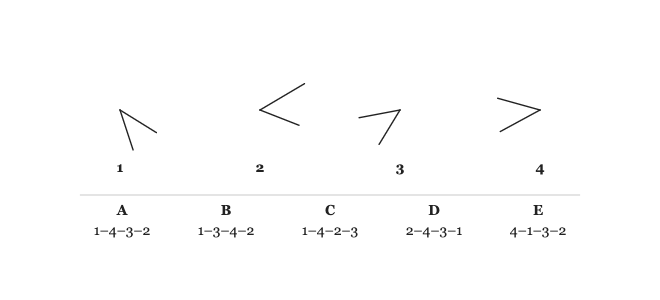
The figure shows four angles, labeled 1-4, each with a different measure. Your task is to examine each INTERIOR angle and rank each in terms of degrees from SMALL to LARGE.
Choose the option that has the correct ranking of smallest angle to largest.
- 1-4-3-2 (correct answer)
- 1-3-4-2
- 1-4-2-3
- 2-4-3-1
- 4-1-3-2
Explanation: Correct order: 1-4-3-2 (measures smallest → largest: 40°, 44°, 48°, 52°). Anchor the extremes first. Angle 1 is the narrowest (40°, opening down and to the right). Angle 2 is the widest (52°, opening toward the right). Locking these in first cuts the problem down to ordering the middle two. The tight middle. Angles 4 (44°) and 3 (48°) differ by only 4° — the decisive pair. Strategy: they open in nearly the same direction, so you can visually align their bisectors side-by-side and compare the openings directly.
Question 2
The figure shows four angles, labeled 1-4, each with a different measure. Your task is to examine each INTERIOR angle and rank each in terms of degrees from SMALL to LARGE.
Choose the answer that has the correct ranking of smallest angle to largest.
- 3-4-1-2
- 1-4-3-2 (correct answer)
- 1-2-3-4
- 2-3-4-1
- 1-3-4-2
Explanation: Correct order: 1-4-3-2 (measures smallest → largest: 65°, 69°, 73°, 77°). Anchor the extremes first. Angle 1 is the narrowest (65°, opening upward). Angle 2 is the widest (77°, opening toward the left). Locking these in first cuts the problem down to ordering the middle two. The tight middle. Angles 4 (69°) and 3 (73°) differ by only 4° — the decisive pair. Strategy: they point in different directions, so mentally rotate each one so its bisector points up, then compare the resulting openings.
Question 3
The figure shows four angles, labeled 1-4, each with a different measure. Your task is to examine each INTERIOR angle and rank each in terms of degrees from SMALL to LARGE.
Select the option that displays the correct ranking of smallest angle to largest.
- 3-1-2-4
- 4-1-2-3
- 1-2-4-3
- 4-2-1-3 (correct answer)
- 3-2-1-4
Explanation: Correct order: 4-2-1-3 (measures smallest → largest: 110°, 112°, 114°, 116°). Anchor the extremes first. Angle 4 is the narrowest (110°, opening upward). Angle 3 is the widest (116°, opening toward the left). Locking these in first cuts the problem down to ordering the middle two. The tight middle. Angles 2 (112°) and 1 (114°) differ by only 2° — the decisive pair. Strategy: they're rotated far apart — focus only on the opening at the vertex, ignoring which way the arms extend.
Question 4
The figure shows four angles, labeled 1-4, each with a different measure. Your task is to examine each INTERIOR angle and rank each in terms of degrees from SMALL to LARGE.
Choose the answer that displays the correct ranking of smallest angle to largest.
- 3-2-4-1
- 4-2-3-1 (correct answer)
- 4-1-3-2
- 1-3-2-4
- 4-3-2-1
Explanation: Correct order: 4-2-3-1 (measures smallest → largest: 50°, 52°, 54°, 56°). Anchor the extremes first. Angle 4 is the narrowest (50°, opening down and to the left). Angle 1 is the widest (56°, opening downward). Locking these in first cuts the problem down to ordering the middle two. The tight middle. Angles 2 (52°) and 3 (54°) differ by only 2° — the decisive pair. Strategy: they point in different directions, so mentally rotate each one so its bisector points up, then compare the resulting openings.
Question 5
The figure shows four angles, labeled 1-4, each with a different measure. Your task is to examine each INTERIOR angle and rank each in terms of degrees from SMALL to LARGE.
Choose the option that provides the correct ranking of smallest angle to largest.
- 4-1-2-3
- 3-1-4-2
- 4-3-1-2
- 1-3-2-4
- 3-1-2-4 (correct answer)
Explanation: Correct order: 3-1-2-4 (measures smallest → largest: 42°, 44°, 46°, 48°). Anchor the extremes first. Angle 3 is the narrowest (42°, opening downward). Angle 4 is the widest (48°, opening down and to the right). Locking these in first cuts the problem down to ordering the middle two. The tight middle. Angles 1 (44°) and 2 (46°) differ by only 2° — the decisive pair. Strategy: they point in different directions, so mentally rotate each one so its bisector points up, then compare the resulting openings.
Question 6
The figure shows four angles, labeled 1-4, each with a different measure. Your task is to examine each INTERIOR angle and rank each in terms of degrees from SMALL to LARGE.
Choose the option that denotes the correct ranking of smallest angle to largest.
- 3-2-1-4
- 4-2-1-3
- 2-1-4-3
- 4-1-2-3 (correct answer)
- 3-1-2-4
Explanation: Correct order: 4-1-2-3 (measures smallest → largest: 82°, 86°, 90°, 94°). Anchor the extremes first. Angle 4 is the narrowest (82°, opening upward). Angle 3 is the widest (94°, opening downward). Locking these in first cuts the problem down to ordering the middle two. The tight middle. Angles 1 (86°) and 2 (90°) differ by only 4° — the decisive pair. Strategy: they're rotated far apart — focus only on the opening at the vertex, ignoring which way the arms extend.
Question 7
The figure shows four angles, labeled 1-4, each with a different measure. Your task is to examine each INTERIOR angle and rank each in terms of degrees from SMALL to LARGE.
Select the option that denotes the correct ranking of smallest angle to largest.
- 2-1-3-4 (correct answer)
- 2-3-1-4
- 2-1-4-3
- 4-1-3-2
- 1-2-3-4
Explanation: Correct order: 2-1-3-4 (measures smallest → largest: 48°, 52°, 56°, 60°). Anchor the extremes first. Angle 2 is the narrowest (48°, opening downward). Angle 4 is the widest (60°, opening up and to the right). Locking these in first cuts the problem down to ordering the middle two. The tight middle. Angles 1 (52°) and 3 (56°) differ by only 4° — the decisive pair. Strategy: they're rotated far apart — focus only on the opening at the vertex, ignoring which way the arms extend.
Question 8
The figure shows four angles, labeled 1-4, each with a different measure. Your task is to examine each INTERIOR angle and rank each in terms of degrees from SMALL to LARGE.
Choose the answer that denotes the correct ranking of smallest angle to largest.
- 3-1-4-2
- 2-4-1-3
- 3-4-1-2 (correct answer)
- 1-4-3-2
- 3-2-1-4
Explanation: Correct order: 3-4-1-2 (measures smallest → largest: 103°, 107°, 111°, 115°). Anchor the extremes first. Angle 3 is the narrowest (103°, opening up and to the right). Angle 2 is the widest (115°, opening toward the right). Locking these in first cuts the problem down to ordering the middle two. The tight middle. Angles 4 (107°) and 1 (111°) differ by only 4° — the decisive pair. Strategy: they're rotated far apart — focus only on the opening at the vertex, ignoring which way the arms extend. Watch out: Angle 1 has the longest arms in the set but is 111° — not the largest. Arm length is a visual distractor; focus on the gap at the vertex, not how far the arms reach.
Question 9
The figure shows four angles, labeled 1 through 4, each with a different measure. Your task is to examine each INTERIOR angle and rank each in terms of degrees from SMALLEST to LARGEST.
Select the option that has the correct ranking of smallest angle to largest.
- 4-1-2-3
- 3-1-2-4
- 1-2-3-4
- 3-2-1-4 (correct answer)
- 4-2-1-3
Explanation: Correct order: 3-2-1-4 (measures smallest → largest: 88°, 90°, 92°, 94°). Anchor the extremes first. Angle 3 is the narrowest (88°, opening toward the left). Angle 4 is the widest (94°, opening up and to the left). Locking these in first cuts the problem down to ordering the middle two. The tight middle. Angles 2 (90°) and 1 (92°) differ by only 2° — the decisive pair. Strategy: they're rotated far apart — focus only on the opening at the vertex, ignoring which way the arms extend.
Question 10
The figure shows four angles, labeled 1 through 4, each with a different measure. Your task is to examine each INTERIOR angle and rank each in terms of degrees from SMALLEST to LARGEST.
Choose the option that displays the correct ranking of smallest angle to largest.
- 1-4-3-2 (correct answer)
- 1-3-4-2
- 1-4-2-3
- 2-4-3-1
- 4-1-3-2
Explanation: Correct order: 1-4-3-2 (measures smallest → largest: 125°, 127°, 129°, 131°). Anchor the extremes first. Angle 1 is the narrowest (125°, opening toward the right). Angle 2 is the widest (131°, opening downward). Locking these in first cuts the problem down to ordering the middle two. The tight middle. Angles 4 (127°) and 3 (129°) differ by only 2° — the decisive pair. Strategy: they point in different directions, so mentally rotate each one so its bisector points up, then compare the resulting openings.
Question 11
The figure shows four angles, labeled 1 through 4, each with a different measure. Your task is to examine each INTERIOR angle and rank each in terms of degrees from SMALLEST to LARGEST.
Select the option that displays the correct ranking of smallest angle to largest.
- 1-2-3-4
- 4-3-2-1
- 1-3-2-4 (correct answer)
- 2-3-1-4
- 1-4-2-3
Explanation: Correct order: 1-3-2-4 (measures smallest → largest: 145°, 147°, 149°, 151°). Anchor the extremes first. Angle 1 is the narrowest (145°, opening toward the left). Angle 4 is the widest (151°, opening up and to the right). Locking these in first cuts the problem down to ordering the middle two. The tight middle. Angles 3 (147°) and 2 (149°) differ by only 2° — the decisive pair. Strategy: they're rotated far apart — focus only on the opening at the vertex, ignoring which way the arms extend.
Question 12
The figure shows four angles, labeled 1 through 4, each with a different measure. Your task is to examine each INTERIOR angle and rank each in terms of degrees from SMALLEST to LARGEST.
Choose the answer that displays the correct ranking of smallest angle to largest.
- 2-3-1-4
- 4-3-2-1
- 2-4-3-1
- 3-4-1-2
- 4-3-1-2 (correct answer)
Explanation: Correct order: 4-3-1-2 (measures smallest → largest: 35°, 37°, 39°, 41°). Anchor the extremes first. Angle 4 is the narrowest (35°, opening toward the right). Angle 2 is the widest (41°, opening down and to the left). Locking these in first cuts the problem down to ordering the middle two. The tight middle. Angles 3 (37°) and 1 (39°) differ by only 2° — the decisive pair. Strategy: they're rotated far apart — focus only on the opening at the vertex, ignoring which way the arms extend.
Question 13
The figure shows four angles, labeled 1 through 4, each with a different measure. Your task is to examine each INTERIOR angle and rank each in terms of degrees from SMALLEST to LARGEST.
Select the answer that displays the correct ranking of smallest angle to largest.
- 1-2-4-3
- 4-2-1-3 (correct answer)
- 4-3-1-2
- 3-1-2-4
- 4-1-2-3
Explanation: Correct order: 4-2-1-3 (measures smallest → largest: 98°, 100°, 102°, 104°). Anchor the extremes first. Angle 4 is the narrowest (98°, opening toward the left). Angle 3 is the widest (104°, opening down and to the left). Locking these in first cuts the problem down to ordering the middle two. The tight middle. Angles 2 (100°) and 1 (102°) differ by only 2° — the decisive pair. Strategy: they're rotated far apart — focus only on the opening at the vertex, ignoring which way the arms extend.
Question 14
The figure shows four angles, labeled 1-4, each with a different measure. Your task is to examine each INTERIOR angle and rank each in terms of degrees from SMALL to LARGE.
Select the answer that provides the correct ranking of smallest angle to largest.
- 3-2-1-4
- 1-2-3-4 (correct answer)
- 1-4-3-2
- 4-3-2-1
- 1-3-2-4
Explanation: Correct order: 1-2-3-4 (measures smallest → largest: 22°, 26°, 30°, 34°). Anchor the extremes first. Angle 1 is the narrowest (22°, opening down and to the right). Angle 4 is the widest (34°, opening toward the left). Locking these in first cuts the problem down to ordering the middle two. The tight middle. Angles 2 (26°) and 3 (30°) differ by only 4° — the decisive pair. Strategy: they're rotated far apart — focus only on the opening at the vertex, ignoring which way the arms extend.
Question 15
The figure shows four angles, labeled 1 through 4, each with a different measure. Your task is to examine each INTERIOR angle and rank each in terms of degrees from SMALLEST to LARGEST.
Choose the option that has the correct ranking of smallest angle to largest.
- 3-2-4-1
- 1-2-3-4
- 3-1-2-4
- 2-1-4-3
- 1-2-4-3 (correct answer)
Explanation: Correct order: 1-2-4-3 (measures smallest → largest: 119°, 123°, 127°, 131°). Anchor the extremes first. Angle 1 is the narrowest (119°, opening down and to the right). Angle 3 is the widest (131°, opening upward). Locking these in first cuts the problem down to ordering the middle two. The tight middle. Angles 2 (123°) and 4 (127°) differ by only 4° — the decisive pair. Strategy: they're rotated far apart — focus only on the opening at the vertex, ignoring which way the arms extend. Watch out: Angle 1 has the longest arms in the set but is 119° — not the largest. Arm length is a visual distractor; focus on the gap at the vertex, not how far the arms reach.
Question 16
The figure shows four angles, labeled 1 through 4, each with a different measure. Your task is to examine each INTERIOR angle and rank each in terms of degrees from SMALLEST to LARGEST.
Choose the answer that has the correct ranking of smallest angle to largest.
- 1-4-3-2
- 3-4-1-2 (correct answer)
- 3-2-1-4
- 2-1-4-3
- 3-1-4-2
Explanation: Correct order: 3-4-1-2 (measures smallest → largest: 35°, 39°, 43°, 47°). Anchor the extremes first. Angle 3 is the narrowest (35°, opening toward the left). Angle 2 is the widest (47°, opening upward). Locking these in first cuts the problem down to ordering the middle two. The tight middle. Angles 4 (39°) and 1 (43°) differ by only 4° — the decisive pair. Strategy: they point in different directions, so mentally rotate each one so its bisector points up, then compare the resulting openings.
Question 17
The figure shows four angles, labeled 1-4, each with a different measure. Your task is to examine each INTERIOR angle and rank each in terms of degrees from SMALL to LARGE.
Select the answer that has the correct ranking of smallest angle to largest.
- 2-3-1-4
- 4-1-3-2
- 2-1-3-4 (correct answer)
- 3-1-2-4
- 2-4-3-1
Explanation: Correct order: 2-1-3-4 (measures smallest → largest: 95°, 100°, 105°, 110°). Anchor the extremes first. Angle 2 is the narrowest (95°, opening toward the left). Angle 4 is the widest (110°, opening toward the right). Locking these in first cuts the problem down to ordering the middle two. The tight middle. Angles 1 (100°) and 3 (105°) differ by only 5° — the decisive pair. Strategy: they're rotated far apart — focus only on the opening at the vertex, ignoring which way the arms extend.
Question 18
The figure shows four angles, labeled 1-4, each with a different measure. Your task is to examine each INTERIOR angle and rank each in terms of degrees from SMALL to LARGE.
Select the option that provides the correct ranking of smallest angle to largest.
- 2-3-1-4 (correct answer)
- 2-1-3-4
- 2-3-4-1
- 4-3-1-2
- 3-2-1-4
Explanation: Correct order: 2-3-1-4 (measures smallest → largest: 58°, 62°, 66°, 70°). Anchor the extremes first. Angle 2 is the narrowest (58°, opening up and to the left). Angle 4 is the widest (70°, opening up and to the right). Locking these in first cuts the problem down to ordering the middle two. The tight middle. Angles 3 (62°) and 1 (66°) differ by only 4° — the decisive pair. Strategy: they're rotated far apart — focus only on the opening at the vertex, ignoring which way the arms extend.
Question 19
The figure shows four angles, labeled 1 through 4, each with a different measure. Your task is to examine each INTERIOR angle and rank each in terms of degrees from SMALLEST to LARGEST.
Choose the option that provides the correct ranking of smallest angle to largest.
- 1-2-3-4
- 4-2-3-1
- 2-3-4-1
- 4-3-2-1 (correct answer)
- 1-3-2-4
Explanation: Correct order: 4-3-2-1 (measures smallest → largest: 70°, 72°, 74°, 76°). Anchor the extremes first. Angle 4 is the narrowest (70°, opening up and to the left). Angle 1 is the widest (76°, opening down and to the left). Locking these in first cuts the problem down to ordering the middle two. The tight middle. Angles 3 (72°) and 2 (74°) differ by only 2° — the decisive pair. Strategy: they're rotated far apart — focus only on the opening at the vertex, ignoring which way the arms extend. Watch out: Angle 2 has the longest arms in the set but is 74° — not the largest. Arm length is a visual distractor; focus on the gap at the vertex, not how far the arms reach.
Question 20
The figure shows four angles, labeled 1-4, each with a different measure. Your task is to examine each INTERIOR angle and rank each in terms of degrees from SMALL to LARGE.
Select the answer that denotes the correct ranking of smallest angle to largest.
- 2-4-3-1
- 1-4-2-3
- 2-1-4-3
- 4-1-3-2
- 1-4-3-2 (correct answer)
Explanation: Correct order: 1-4-3-2 (measures smallest → largest: 148°, 152°, 156°, 160°). Anchor the extremes first. Angle 1 is the narrowest (148°, opening toward the left). Angle 2 is the widest (160°, opening down and to the right). Locking these in first cuts the problem down to ordering the middle two. The tight middle. Angles 4 (152°) and 3 (156°) differ by only 4° — the decisive pair. Strategy: they're rotated far apart — focus only on the opening at the vertex, ignoring which way the arms extend. Watch out: Angle 4 has the longest arms in the set but is 152° — not the largest. Arm length is a visual distractor; focus on the gap at the vertex, not how far the arms reach.