All questions
Question 1
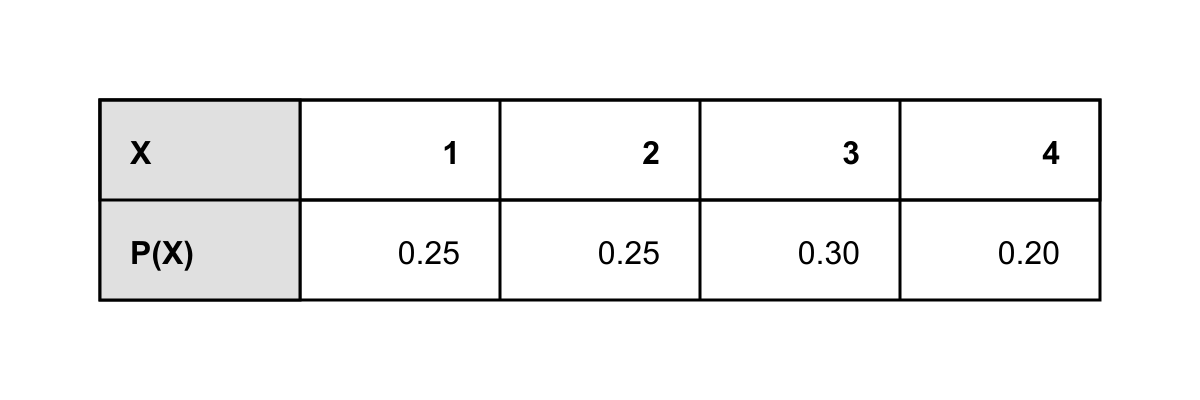
The probability distribution table for discrete random variable X is shown. What is P(X≥3∣X≥2)?
- 0.750.50 (correct answer)
- 1.000.50
- 0.750.30
- 0.500.25
Explanation: From the table: P(X≥2)=0.25+0.30+0.20=0.75. P(X≥3)=0.30+0.20=0.50. Conditional probability = 0.50/0.75=2/3. (B) forgets conditioning. (C) uses P(X=3) only. (D) miscomputes both. Question 2
Refer to the grid shown below. A particle starts at point A (lower-left) and moves to point B (upper-right) by taking unit steps only right or up. If each valid path is equally likely, what is the probability that the particle passes through point C?
- 3518 (correct answer)
- 21
- 356
- 3512
Explanation: A to B requires 4 rights and 3 ups: (37)=35 paths. A to C (2 right, 1 up): (13)=3 paths. C to B (2 right, 2 up): (24)=6 paths. Paths through C: 3×6=18. Probability = 18/35. (B) assumes symmetry. (C) forgets to multiply by C-to-B paths. (D) uses wrong binomial coefficient. Question 3
If P(A)=0.4,P(B)=0.5, and P(A∣B)=0.2, what is P(A∪B)?
- 0.7
- 0.8 (correct answer)
- 0.9
- 0.1
Explanation: Since P(A|B)=0.2 and P(B)=0.5, P(A∩B)=0.2 × 0.5 = 0.1. Then P(A∪B)=0.4 + 0.5 - 0.1 = 0.8. The tempting 0.9 just adds P(A)+P(B) without subtracting the overlap.
Question 4
A bag has 3 red, 4 blue, and 5 green marbles. Drawing 3 without replacement, what is P(all different colors)?
- 113 (correct answer)
- 245
- 221
- 443
Explanation: There are 12 marbles total. Favorable draws are one red, one blue, and one green: 3 times 4 times 5 = 60 ways. Total ways to draw 3 marbles is 12 choose 3 = 220, so 60/220 = 3/11. The tempting wrong answer 1/22 comes from multiplying 3/12 times 4/11 times 5/10 for one fixed color order, but the colors can come in any of 6 orders, so multiply by 6.
Question 5
A fair coin is tossed until a head appears or until 3 tosses are made. What is the expected number of tosses?
- 1.50
- 2.00
- 1.75 (correct answer)
- 1.875
Explanation: With probability 1/2, the first toss is heads and X=1. With probability 1/4, you get tails then heads and X=2. Otherwise, the first two tosses are tails, so the third toss happens regardless and X=3. Expected tosses = 1(1/2) + 2(1/4) + 3(1/4) = 0.5 + 0.5 + 0.75 = 1.75. The tempting 2.00 wrongly treats the process as continuing until a head with no three-toss limit.
Question 6
Two fair dice are rolled. Given that at least one die shows 3, what is the probability the sum is at least 5?
- 119 (correct answer)
- 117
- 65
- 32
Explanation: Count the 11 equally likely rolls with at least one 3: (3,1) through (3,6) plus the five remaining ordered pairs like (1,3). Only (3,1) and (1,3) have sum 4, so 9 of the 11 rolls have sum at least 5. A tempting mistake is 5/6, which ignores the ordered outcomes and the fact that (1,3) and (3,1) are distinct.
Question 7
From a standard deck, two cards are drawn without replacement. What is P(both hearts or both queens)?
- 2211
- 171
- 22120
- 22114 (correct answer)
Explanation: There are 1,326 possible two-card hands. Both hearts: choose 2 of 13 hearts gives 78 hands. Both queens: choose 2 of 4 queens gives 6 hands. These cannot overlap because only one queen of hearts exists, so add: 78 + 6 = 84, and 84/1,326 reduces to 14/221. The tempting wrong answer is 20/221, which comes from treating every card as a heart or queen instead of requiring both cards to be hearts or both to be queens.
Question 8
A dental student must pass 4 independent practical exams, each with a 0.8 probability of passing. What is the probability that the student passes exactly 3 out of the 4 exams?
- 0.4096 (correct answer)
- 0.2048
- 0.8192
- 0.1536
- 0.0256
Explanation: This is a binomial probability: P(exactly 3 passes) = C(4,3) × (0.8)³ × (0.2)¹ = 4 × 0.512 × 0.2 = 0.4096. Choice B (0.2048) results from using C(4,3) = 2 instead of 4. Choice C (0.8192) comes from calculating P(at least 3). Choice D (0.1536) results from computational errors. Choice E (0.0256) comes from calculating (0.8)³ × (0.2) without the binomial coefficient.
Question 9
In a dental school, 70% of students pass the written exam and 80% pass the practical exam. If 60% pass both exams, what is the probability that a randomly selected student passes at least one exam?
- 0.90 (correct answer)
- 0.56
- 0.75
- 0.86
- 1.50
Explanation: P(at least one) = P(written) + P(practical) - P(both) = 0.7 + 0.8 - 0.6 = 0.9. Choice B (0.56) results from multiplying P(written) × P(practical). Choice C (0.75) comes from averaging the individual probabilities. Choice D (0.86) results from incorrect addition. Choice E (1.50) comes from adding all probabilities without subtraction.
Question 10
A single fair die is rolled twice. What is the probability that the sum of the two rolls is at least 10?
- 61 (correct answer)
- 41
- 185
- 31
Explanation: When you encounter probability questions involving dice rolls, you need to systematically count favorable outcomes and divide by total possible outcomes. With two dice rolls, there are 6×6=36 total possible outcomes.
To find the probability of getting a sum of at least 10, identify all ways to achieve sums of 10, 11, or 12. For sum = 10: (4,6), (5,5), (6,4) — that's 3 outcomes. For sum = 11: (5,6), (6,5) — that's 2 outcomes. For sum = 12: (6,6) — that's 1 outcome. Total favorable outcomes: 3 + 2 + 1 = 6.
Therefore, the probability is 366=61, making choice A correct.
Choice B (41) equals 369, which would suggest 9 favorable outcomes — this likely comes from incorrectly counting or including impossible combinations. Choice C (185) equals 3610, suggesting 10 favorable outcomes — this might result from double-counting some combinations or including sums of 9. Choice D (31) equals 3612, indicating 12 favorable outcomes — this error often occurs when students mistakenly include all sums from 9 to 12 instead of just 10 to 12.
Remember to list outcomes systematically when dealing with "at least" or "at most" probability questions. Draw a table if needed, and always double-check that your favorable outcomes actually satisfy the given condition. The key is being methodical rather than rushing through the counting. Question 11
A password consists of 3 different consonant letters followed by 2 distinct digits (0–9). All consonants and digits may be used at most once. If order matters in both parts, how many different passwords are possible?
- 21×20×19×10×9
- 21×20×19×(210)
- 18!21!×8!10! (correct answer)
- 18!21!×(210)
Explanation: This is a permutation problem where order matters and repetition is not allowed. When you see "order matters" and items are used "at most once," think about arranging distinct objects in sequence.
For the consonants: You need to select and arrange 3 different consonants from 21 available consonants (26 letters minus 5 vowels). Since order matters and no repetition is allowed, you have 21 choices for the first position, 20 for the second, and 19 for the third. This gives 21×20×19, which equals 18!21! (since you're taking the first 3 terms of 21 factorial).
For the digits: You need to select and arrange 2 distinct digits from 10 available digits (0-9). With order mattering and no repetition, you have 10 choices for the first digit and 9 for the second. This gives 10×9, which equals 8!10!.
The total number of passwords is the product: 18!21!×8!10!.
Answer A incorrectly keeps the digits as 10×9 instead of using factorial notation, though mathematically it's equivalent to the correct answer. Answer B uses (210) for the digits, which only counts the ways to choose 2 digits but ignores their order. Answer D makes the same mistake as B by using combinations instead of permutations for the digits.
Remember: when order matters and no repetition is allowed, use permutations. The notation (n−r)!n! represents selecting and arranging r objects from n total objects. Question 12
A medical research study involves testing a new dental treatment on patients. The probability that a patient responds positively to Treatment A is 0.6, to Treatment B is 0.4, and to both treatments is 0.25. If a patient is selected at random and responds positively to Treatment A, what is the probability that this patient also responds positively to Treatment B?
- 125 (correct answer)
- 41
- 83
- 52
- 157
Explanation: This is a conditional probability problem. We need P(B|A) = P(A and B)/P(A) = 0.25/0.6 = 25/60 = 5/12. Choice B (1/4) results from using P(A and B) directly. Choice C (3/8) comes from incorrectly calculating (0.6 × 0.4)/0.64. Choice D (2/5) results from using P(B)/P(A). Choice E (7/15) comes from adding probabilities incorrectly.
Question 13
A dental laboratory has three quality control inspectors. Inspector X catches defects 80% of the time, Inspector Y catches defects 75% of the time, and Inspector Z catches defects 70% of the time. If a defective item is independently examined by all three inspectors, what is the probability that at least one inspector will catch the defect?
- 0.985 (correct answer)
- 0.875
- 0.750
- 0.925
- 0.420
Explanation: Use the complement: P(at least one catches) = 1 - P(none catch) = 1 - (0.2)(0.25)(0.3) = 1 - 0.015 = 0.985. Choice B (0.875) comes from incorrectly using 1 - (0.2)(0.25) = 0.95 then multiplying by some factor. Choice C (0.750) results from taking the maximum individual probability. Choice D (0.925) comes from averaging the individual probabilities. Choice E (0.420) results from multiplying all the detection probabilities together.
Question 14
A bag contains 8 red marbles, 6 blue marbles, and 4 green marbles. Three marbles are drawn consecutively without replacement. What is the probability that the first marble is red, the second is blue, and the third is green?
- 1534 (correct answer)
- 2048
- 76532
- 81624
- 45916
Explanation: Total marbles = 18. P(Red first, Blue second, Green third) = (8/18) × (6/17) × (4/16) = 192/4896 = 4/153. Choice B results from incorrect denominator calculation. Choice C comes from using wrong total counts. Choice D results from not reducing the fraction properly. Choice E comes from computational errors in the multiplication.
Question 15
In a dental clinic, the probability that a patient needs a filling is 0.3, needs a crown is 0.15, and needs both a filling and a crown is 0.08. Given that a randomly selected patient needs a crown, what is the probability that this patient also needs a filling?
- 158 (correct answer)
- 154
- 52
- 308
- 83
Explanation: This is conditional probability: P(filling|crown) = P(filling and crown)/P(crown) = 0.08/0.15 = 8/15. Choice B (4/15) results from incorrectly using P(crown)/P(filling). Choice C (2/5) comes from using P(filling) directly without conditioning. Choice D (8/30) results from not simplifying the fraction. Choice E (3/8) comes from reversing the conditional probability calculation.
Question 16
Two dental laboratories independently produce crowns with defect rates of 5% and 8% respectively. If one crown is randomly selected from each laboratory, what is the probability that at least one crown is defective?
- 0.124 (correct answer)
- 0.040
- 0.130
- 0.876
- 0.960
Explanation: P(at least one defective) = 1 - P(both good) = 1 - (0.95)(0.92) = 1 - 0.874 = 0.126 ≈ 0.124. Choice B (0.040) results from multiplying the defect rates. Choice C (0.130) comes from adding the defect rates. Choice D (0.876) is P(both good). Choice E (0.960) results from 1 - (0.05 × 0.08).
Question 17
A box contains 12 dental tools: 5 extractors, 4 scalers, and 3 explorers. If 3 tools are selected randomly without replacement, what is the probability that exactly 2 are extractors and 1 is a scaler?
- 112 (correct answer)
- 225
- 223
- 334
- 61
Explanation: P(2 extractors, 1 scaler) = [C(5,2) × C(4,1) × C(3,0)]/C(12,3) = (10 × 4 × 1)/220 = 40/220 = 2/11. Choice B (5/22) results from computational errors in combinations. Choice C (3/22) comes from using wrong combination values. Choice D (4/33) results from incorrect total combinations. Choice E (1/6) comes from oversimplified probability calculation.
Question 18
In a clinical trial, 60% of patients respond to Treatment A, 40% respond to Treatment B, and 25% respond to both. If a patient responds to at least one treatment, what is the probability that the patient responds to Treatment A?
- 54 (correct answer)
- 53
- 2512
- 157
- 85
Explanation: P(responds to at least one) = 0.6 + 0.4 - 0.25 = 0.75. P(A|at least one) = P(A)/P(at least one) = 0.6/0.75 = 4/5. Choice B (3/5) is P(A) without conditioning. Choice C (12/25) results from incorrect calculation. Choice D (7/15) comes from using wrong probability values. Choice E (5/8) results from computational errors.
Question 19
A dental clinic has a 95% success rate for root canals. If 6 independent root canal procedures are performed, what is the probability that exactly 5 are successful?
- 0.2321 (correct answer)
- 0.7351
- 0.9500
- 0.0277
- 0.1353
Explanation: P(exactly 5 successful) = C(6,5) × (0.95)⁵ × (0.05)¹ = 6 × 0.7738 × 0.05 = 0.2321. Choice B (0.7351) results from calculating (0.95)⁵. Choice C (0.9500) is the individual success rate. Choice D (0.0277) comes from computational errors. Choice E (0.1353) results from using wrong binomial coefficient.
Question 20
A medical device has a 2% failure rate. If 10 such devices are used independently, what is the probability that exactly 2 devices fail?
- 0.0153 (correct answer)
- 0.0036
- 0.2000
- 0.8171
- 0.1667
Explanation: P(exactly 2 fail) = C(10,2) × (0.02)² × (0.98)⁸ = 45 × 0.0004 × 0.8508 = 0.0153. Choice B (0.0036) results from not including the binomial coefficient. Choice C (0.2000) is 10 × 0.02. Choice D (0.8171) is approximately (0.98)¹⁰. Choice E (0.1667) results from computational errors.