All questions
Question 1
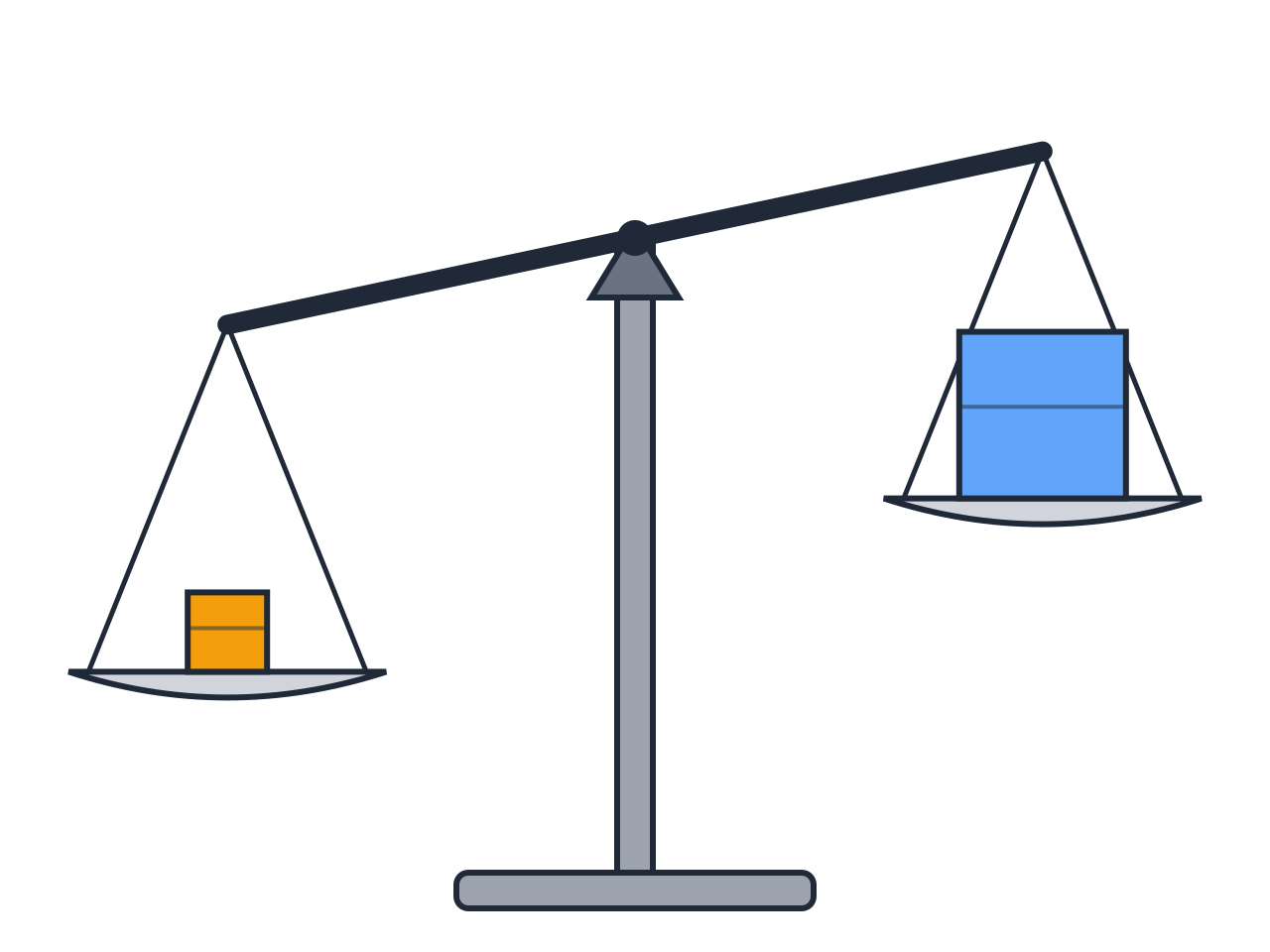
Look at the scale. Which box is heavier?
- the big box
- the small box (correct answer)
- they weigh the same
- you can't tell
Explanation: The side of the scale with the small box goes down. The side that goes down is heavier, so the small box is heavier, even though it is smaller.
Question 2
Jake has two books on his desk. Book A is thicker than Book B, but Book B is longer and wider than Book A. His teacher asks him to name different ways the books can be measured. What is the BEST list of measurable attributes for both books?
- How interesting they are, what grade level they're written for, and how many students like them
- What subject they teach, what language they're written in, and what color the covers are
- How long, how wide, how thick, and how heavy each book is compared to the other (correct answer)
- Where they were printed, when they were published, and who wrote them originally
Explanation: Choice C is correct because length, width, thickness, and weight are all measurable attributes that can be quantified with numbers and units for physical comparison. Choice A is wrong because interest level, grade level, and student preferences are not measurable attributes of the physical books. Choice B is wrong because subject, language, and color are not measurable attributes in the mathematical sense. Choice D is wrong because location, publication date, and authorship are not measurable physical attributes.
Question 3
Sara says, 'My hamster is very long and very soft.' Which word tells how big the hamster is?
- long (correct answer)
- soft
- and
- hamster
Explanation: The word 'long' tells us about the hamster's size. 'Soft' tells us how it feels, not its size.
Question 4
Each container is filled to the top using the same small scoop. Look at the picture. Which container holds the most water?
- the bottle
- the jar (correct answer)
- the cup
- they all hold the same
Explanation: The bottle takes 2 full scoops of water. The jar takes 4. The cup takes 1. The jar takes the most scoops, so it holds the most water.
Question 5
Kevin wants to put his dad's tools in order from shortest to longest. What should he compare?
- how long each tool is (correct answer)
- what color each tool is
- how loud each tool is
- who uses each tool
Explanation: To put tools in order from shortest to longest, Kevin compares how long each tool is. Color, sound, and who uses a tool do not tell how long it is.
Question 6
Look at the four balls. Which sentence tells how heavy they are?
- The ping pong ball is the most fun to play with
- The bowling ball is the heaviest and the ping pong ball is the lightest (correct answer)
- The tennis ball is fuzzy and the basketball has good grip
- The balls are used for different games
Explanation: Heaviest and lightest tell how heavy something is. Being fun, fuzzy or used for games does not tell how heavy a ball is.
Question 7
Which words tell how big a chair is?
- tall and wide (correct answer)
- brown and pretty
- made of wood
- belongs to our class
Explanation: Tall and wide tell how big the chair is. Brown, pretty, made of wood and belongs to our class do not tell its size.