All questions
Question 1
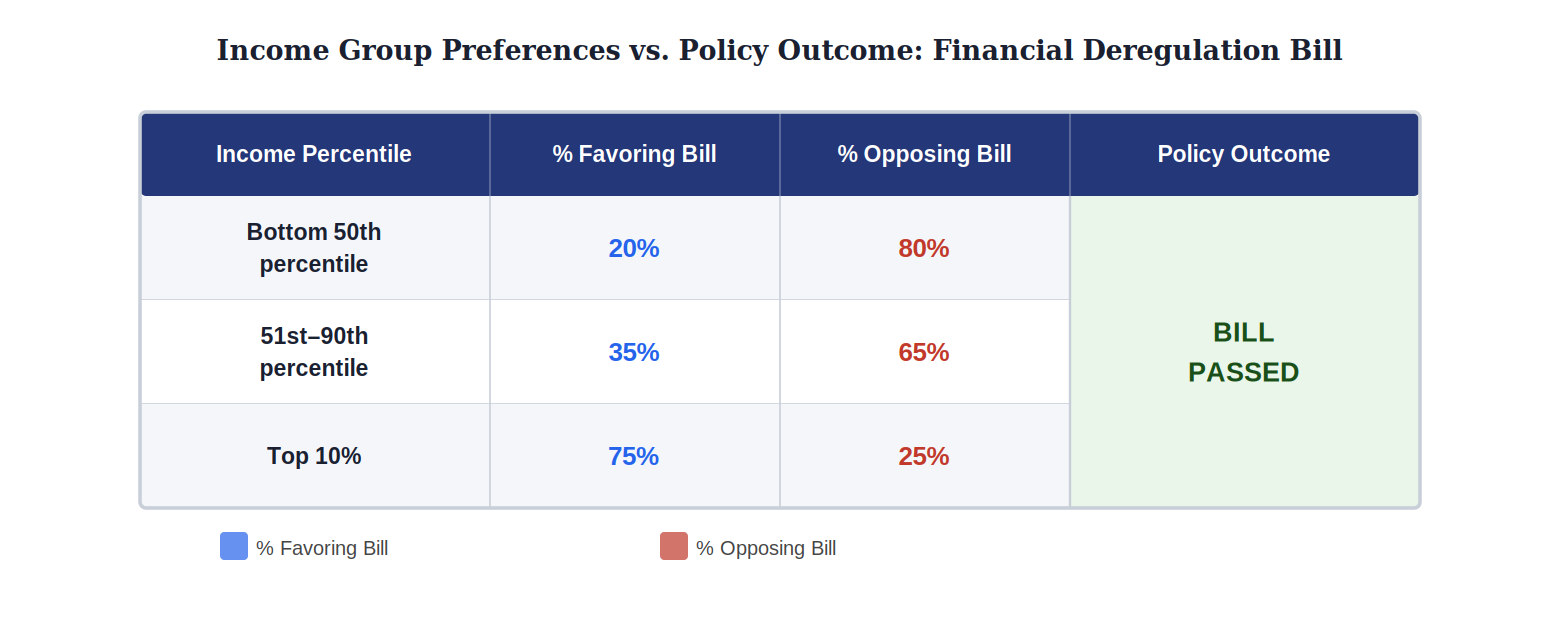
A study examines the passage of a specific financial deregulation bill. The data in the table shows the preferences of different income groups and the final policy outcome. Based on the table, which concept of representation is most clearly demonstrated?
- Majoritarian pluralism, where the outcome reflects the preference of the median voter.
- Elite theory, where a unified economic elite dictates policy against the wishes of all other groups.
- Biased pluralism, where policy outcomes strongly align with the preferences of the most affluent citizens. (correct answer)
- Partisan sorting, where the policy outcome is determined solely by the platform of the ruling party.
Explanation: The table shows a policy that was passed despite being opposed by the bottom 90% of the population. The policy was strongly favored only by the top 10%. This pattern, where policy outcomes reflect the preferences of the wealthy even when they conflict with the preferences of the majority, is the central finding of research on biased pluralism and unequal responsiveness (associated with scholars like Martin Gilens). (A) is incorrect because the median voter (in the 50th percentile) opposed the bill, but it passed. (B) is too strong; while the outcome favors elites, 'elite theory' often implies a monolithic ruling class, whereas biased pluralism sees a contest of interests that is heavily skewed toward the affluent. (D) is not supported by the data provided, as we have no information about the ruling party's platform or voter alignment.
Question 2
A common argument posits that the principle of 'one person, one vote' ensures political equality in a democracy. Which of the following findings from political science provides the most substantial critique of this argument in the context of high economic inequality?
- Voter turnout rates are often low, meaning that the preferences of the electorate may not reflect the preferences of the entire population.
- The translation of citizen preferences into policy is heavily mediated by institutions like lobbying and campaign finance, which are skewed by wealth. (correct answer)
- Electoral systems like the Electoral College can produce outcomes where the winner of the popular vote does not win the election.
- Incumbent politicians have significant advantages in elections, making it difficult for challengers to win regardless of voter preferences.
Explanation: The question asks for a critique of 'one person, one vote' specifically related to economic inequality. While voting is formally equal, representation involves more than just casting a ballot. Choice (B) provides the most direct and powerful critique: the process of influencing policy between elections is profoundly unequal. Wealthy individuals and groups have vastly greater resources to lobby, fund campaigns, and shape public discourse, meaning that their preferences carry more weight with policymakers, regardless of the formal equality of the vote. (A), (C), and (D) are all valid critiques of democratic practice, but they are not as directly tied to the specific problem of economic inequality creating unequal representation as (B) is.
Question 3
Some scholars argue that high economic inequality contributes to affective polarization (the tendency of ordinary partisans to dislike and distrust members of the other party). What is the most plausible mechanism linking these two phenomena?
- As the rich get richer, they are better able to fund moderate, cross-party candidates, which angers ideological purists in both parties.
- Economic anxiety among the non-affluent can be channeled by political entrepreneurs into resentment against both elites and 'out-groups' associated with the opposing party. (correct answer)
- Growing economic equality reduces social tensions, thereby forcing parties to create artificial social divisions to motivate their voters.
- The shared economic prosperity across all classes fostered by inequality leads to a focus on divisive cultural issues as the main source of political conflict.
Explanation: This question requires linking two major concepts: inequality and polarization. The most supported mechanism is that economic stagnation and insecurity for the majority (a feature of rising inequality) create fertile ground for populist and polarizing rhetoric. Political leaders can redirect this economic frustration into partisan animosity, blaming the other party and its associated social groups (immigrants, minorities, 'elites') for the economic problems (B). (A) is the opposite of what typically happens; funding often flows to more ideologically aligned candidates. (C) and (D) are based on a false premise; high inequality is associated with less, not more, shared prosperity and equality.
Question 4
Consider the formulation of a national tax policy. According to theories of unequal representation, in a country with high wealth concentration, which type of tax policy is most likely to be enacted and sustained, even if it lacks majority public support?
- A highly progressive income tax with many brackets for top earners, designed to fund expansive social programs.
- A flat consumption tax (VAT) that applies equally to all goods and services, including necessities.
- A significant reduction in taxes on capital gains and inheritances, coupled with cuts in corporate tax rates. (correct answer)
- A revenue-neutral carbon tax where all funds collected are returned to citizens as a universal dividend.
Explanation: This question asks students to apply theories of unequal representation to a specific policy area. These theories predict that policies will systematically favor the interests of the wealthy. The wealthy derive a large portion of their income from investments and pass on wealth through inheritances. Therefore, policies that reduce taxes on capital gains, inheritances, and corporate profits (C) directly benefit this group. Such policies are often unpopular with the general public who would benefit more from social spending or lower taxes on wages. (A) is the opposite of what the theory would predict. (B) is regressive and hurts the poor, but the most direct benefit to the assets of the wealthy comes from (C). (D) is a complex policy with varied support, but its primary target is not wealth accumulation in the same direct way as (C).
Question 5
A political scientist observes that in Country X, which has high and rising economic inequality, the legislature consistently passes policies favored by the top 10% of earners, even when these policies are opposed by a majority of the bottom 90%. Which of the following provides the most sophisticated explanation for this phenomenon, consistent with leading theories of biased representation?
- The bottom 90% of earners are rationally ignorant and do not vote, thereby ceding political control to the more engaged top 10%.
- Policymakers primarily respond to the organized interests and superior resources of affluent citizens, whose preferences often diverge from the general populace. (correct answer)
- The electoral system of 'first-past-the-post' inherently favors candidates funded by wealthy donors, leading to their policy preferences being enacted.
- The political parties in Country X have failed to offer distinct policy platforms, leaving voters from the bottom 90% with no meaningful choices.
Explanation: This question asks for the best explanation of unequal policy representation. Choice B correctly identifies the core argument of 'biased pluralism' and affluence bias theories (e.g., Gilens and Page), which state that policymakers are more responsive to the preferences of affluent individuals and organized business interests due to their greater resources for lobbying, campaign contributions, and information provision. (A) is a plausible but incomplete explanation; while unequal participation is a factor, it doesn't fully account for the systematic bias even when lower-income citizens do vote. (C) is a potential factor but is too narrow; unequal representation occurs in various electoral systems, not just 'first-past-the-post'. (D) describes party convergence, which can be a symptom of elite influence but is not the root cause of the bias described, which centers on resources and organization.
Question 6
In a study of legislative politics, a researcher finds a strong positive correlation between the amount of money a corporation spends on lobbying for a particular bill and the likelihood of that bill passing. The researcher concludes that lobbying expenditures directly cause legislative success.
Which of the following represents the most significant challenge to the researcher's causal conclusion presented in the passage?
- The study fails to account for the fact that many corporations lobby against bills as well as for them.
- Lobbyists may be 'betting on a sure thing' by spending the most money on bills that were already likely to pass due to legislator preferences. (correct answer)
- The correlation does not prove causation because it ignores the role of grassroots movements in opposing corporate interests.
- The study likely used a non-random sample of corporations, thus biasing the results in favor of large firms.
Explanation: This question tests the student's ability to identify potential confounding variables and challenges to causal inference. The researcher's conclusion is that money causes success. The strongest challenge to this is the possibility of reverse causation or selection bias. Choice (B) describes this perfectly: corporations may strategically allocate their resources to bills that already have a high chance of passing for other reasons (e.g., they align with the majority party's ideology). In this case, the money is following success, not causing it. (A) is a valid point about lobbying but doesn't undermine the specific causal claim about pro-bill lobbying. (C) identifies an opposing force but doesn't refute the internal logic of the researcher's claim; it just suggests another factor is at play. (D) points to a potential sampling issue but is less fundamental than the selection-bias problem described in (B).
Question 7
Political scientists distinguish between unequal political participation and unequal political influence. Which of the following scenarios best illustrates the concept of unequal influence operating independently of unequal participation?
- Wealthy citizens vote at higher rates than poor citizens, and their preferred candidates are more likely to win elections.
- A low-income social movement and a corporate lobby group both stage protests of equal size, but lawmakers only meet with the corporate lobbyists.
- In a local election with low turnout, a small, highly organized group of affluent homeowners determines the outcome of a zoning referendum.
- A get-out-the-vote campaign is highly effective in a low-income neighborhood, but the elected official still prioritizes policies that benefit a wealthy district. (correct answer)
Explanation: This question requires distinguishing two related concepts. Unequal influence means that even when participation is equal, some groups have more sway over policy. Scenario (D) best illustrates this: participation from the low-income group is high ('highly effective' GOTV campaign), but their preferences are still ignored in favor of the wealthy. This isolates influence from participation. (A) and (C) are primarily examples of unequal participation leading to a particular outcome. (B) involves participation (protests), but the key differentiator is access, which is a mechanism of influence. However, (D) provides the clearest case where participation is explicitly equalized (or even heightened for the low-income group), yet influence remains unequal.
Question 8
The theory of 'biased pluralism' offers a critique of classic pluralism. How does biased pluralism primarily conceptualize the functioning of the American political system?
- As a system where a single, unified power elite drawn from corporate, military, and political sectors dominates all major policy decisions.
- As an arena where all interest groups have a relatively equal chance to organize and influence policy, leading to outcomes that reflect broad compromises.
- As a competitive system of interest groups, but one where the 'heavenly chorus' of corporate and affluent interests sings with a much louder accent. (correct answer)
- As a political landscape primarily driven by the ideological commitments of partisan activists, with interest groups playing a secondary role.
Explanation: This question requires a nuanced understanding of different theories of power. 'Biased pluralism' accepts the pluralist idea of a competitive interest group system but argues that the system is heavily skewed. Choice (C) perfectly captures this by using E.E. Schattschneider's famous metaphor ('the heavenly chorus sings with a strong upper-class accent'), indicating that while many groups exist, those representing business and the wealthy have far more resources and influence. (A) describes C. Wright Mills's 'power elite' theory, not biased pluralism. (B) describes classic pluralism, the theory that biased pluralism critiques. (D) describes a theory focused on partisan polarization, which is a different analytical framework from interest group competition.
Question 9
How might the representational challenges faced by low-income racial minorities differ from those faced by the low-income members of a nation's racial majority, even when their economic interests are similar?
- Low-income racial minorities may face compounded disadvantage due to intersectional forces, where their political preferences are marginalized on both economic and racial grounds. (correct answer)
- Low-income members of the racial majority are more likely to benefit from class-based solidarity, making their political organization more effective than that of minorities.
- The representational challenges are unlikely to differ significantly because politicians primarily respond to economic status, rendering racial identity politically secondary.
- Low-income racial minorities are often geographically concentrated, which gives them disproportionately strong representation in legislatures due to single-member districts.
Explanation: This question requires an understanding of intersectionality. The political marginalization of low-income racial minorities is not just an additive effect of being low-income and being a minority. As choice (A) correctly states, these identities can intersect to create compounded disadvantages. Their preferences may be ignored not just because they are poor, but also because they conflict with the interests or prejudices of the racial majority, even the poor members of that majority. (B) is a common misconception; class-based solidarity is often fractured by racial divisions. (C) is incorrect because it ignores a vast body of research showing that race is a primary factor in politics, independent of class. (D) misinterprets the effect of geographic concentration; while it can lead to descriptive representation, it often results in 'packing' that limits minorities' influence overall and does not guarantee responsiveness to their economic interests.
Question 10
In the context of the United States, how did the Supreme Court's decision in Citizens United v. FEC (2010) alter the relationship between economic inequality and political representation?
- It allowed corporations and unions to spend unlimited amounts on independent political expenditures, enhancing the ability of moneyed interests to influence elections. (correct answer)
- It established strict limits on corporate lobbying, thereby reducing the influence of wealthy interests on the legislative process.
- It mandated the public financing of congressional elections, aiming to equalize the political playing field for candidates regardless of their personal wealth.
- It upheld the Bipartisan Campaign Reform Act's prohibitions on 'soft money', reinforcing the separation between wealth and political campaigns.
Explanation: When you encounter questions about landmark campaign finance cases, focus on how they affect the flow of money in politics and who gains or loses influence as a result.
Citizens United v. FEC fundamentally transformed American campaign finance by striking down restrictions on independent political expenditures by corporations and unions. The Court ruled that these entities have First Amendment rights to spend unlimited amounts on communications that advocate for or against candidates, as long as they don't coordinate directly with campaigns. This decision significantly amplified the political voice of wealthy interests and corporations, who now had a legal pathway to spend vast sums influencing elections through Super PACs and other independent expenditure vehicles.
Option A correctly captures this core impact - the decision enhanced moneyed interests' ability to influence elections through unlimited independent spending. Option B is backwards; the case actually reduced restrictions rather than establishing strict limits on corporate political activity. Option C confuses Citizens United with public financing proposals that the Court has never mandated - the decision moved in the opposite direction by opening spending floodgates. Option D mischaracterizes the ruling entirely; Citizens United actually weakened campaign finance restrictions rather than upholding them, and it dealt with independent expenditures, not the soft money issues addressed by McCain-Feingold.
Remember that Citizens United is fundamentally a deregulation case - it removed barriers to political spending rather than creating them. When studying campaign finance law, always ask whether a decision increases or decreases the ability of wealthy actors to spend money in politics.
Question 11
Country A and Country B both have high levels of income inequality. However, Country A has a very high rate of unionization and centralized wage bargaining, while Country B has very low union density and decentralized bargaining. How would these institutional differences likely affect policy responsiveness to low-income citizens?
- Responsiveness would be lower in Country A because powerful unions often act as a special interest, capturing policy for their members at the expense of the non-unionized poor.
- Responsiveness would be lower in Country A because frequent labor strikes and wage negotiations would create political instability, distracting from the needs of the poor.
- There would be no significant difference in responsiveness, as the primary determinant of unequal representation is campaign finance, which is unaffected by unionization rates.
- Responsiveness would be higher in Country A because strong, centralized unions can act as a countervailing power, aggregating the preferences of low- and middle-income workers and forcing political concessions. (correct answer)
Explanation: This question tests your understanding of how labor institutions affect political representation and policy responsiveness in democratic systems. When analyzing questions about institutional effects on representation, focus on how different structures aggregate and amplify citizen preferences in the political process.
Strong, centralized unions serve as "countervailing power" against concentrated economic interests. In Country A, high unionization creates an organized voice for workers that can effectively lobby for policies benefiting low- and middle-income citizens. Centralized bargaining means unions coordinate across industries, giving them greater political leverage to push for broader social policies like minimum wage increases, healthcare, and social insurance. This institutional structure helps overcome the collective action problem that typically prevents lower-income citizens from organizing effectively.
Option A incorrectly assumes unions primarily serve as narrow special interests. While unions do advocate for their members, research shows they typically support policies that benefit all low- and middle-income workers, not just union members. Option B misunderstands the relationship between labor activity and political attention—strong unions actually increase focus on worker issues, not decrease it. Option C ignores substantial research showing that labor institutions significantly affect representation patterns, independent of campaign finance systems.
The key insight is that institutional design matters for representation. Countries with strong labor movements tend to have more responsive policies toward lower-income citizens because unions provide organizational capacity and political voice that individuals lack.
Remember: when analyzing political representation, look for institutions that help aggregate and amplify the preferences of otherwise politically weak groups.
Question 12
In democracies, political parties are traditionally seen as key institutions for representing the interests of different societal groups. How has the rise of economic inequality and the role of private finance in politics affected this representational function of parties?
- It has forced parties to become more ideologically distinct to appeal to their respective voter bases, enhancing representation.
- It has led to a 'race for the center,' with both parties adopting identical policies to appeal to the median voter.
- It has created cross-pressures where parties must appeal to masses of voters with one message while soliciting donations from wealthy elites who often hold different policy preferences. (correct answer)
- It has made political parties obsolete, as individual wealthy donors can now directly influence policy without partisan intermediaries.
Explanation: This question analyzes the complex role of parties in an era of inequality. Parties are caught in a dilemma. To win elections, they need votes, often from middle- and low-income citizens. To fund their campaigns, they increasingly need large donations from wealthy individuals and corporations. As choice (C) accurately describes, the policy preferences of these two groups often conflict, creating a cross-pressure where the party's public platform may differ from its legislative priorities, which are more attuned to donor interests. (A) is incorrect; while parties are polarized, their policy actions may not align with their base's economic interests. (B) describes the classic Downsian model, which is widely seen as an inadequate description of politics under high inequality where the 'median donor' may be more important than the median voter. (D) is an overstatement; parties remain central organizing structures in politics.
Question 13
The spatial sorting of citizens by income—with affluent households concentrating in certain municipalities and legislative districts—can impact representation. Which of the following is the most likely political consequence of this geographic segregation?
- It enhances representation for all, as legislators can more easily identify and serve the uniform interests of their homogeneous constituencies.
- It creates 'safe' districts for both parties, which reduces partisan competition but ensures descriptive representation for both rich and poor.
- It severs the social and political ties between different income groups, making it harder for legislators to comprehend and balance cross-class interests. (correct answer)
- It equalizes political influence by allowing low-income communities to consolidate their voting power and elect representatives dedicated solely to their interests.
Explanation: This question explores the link between geographic and economic inequality. When legislators represent districts that are overwhelmingly rich or overwhelmingly poor, they have less direct exposure to the needs and perspectives of other classes. This can lead to a breakdown in empathy and understanding, making it more difficult to forge policy compromises that serve the broader public interest (C). Legislators from affluent areas may not grasp the urgency of problems facing the poor, and vice versa. (A) is a naive view; it ignores the need for national policy to address inter-district inequality. (B) is partially true about safe districts but wrong that it ensures representation for the poor, who may be packed into districts with little aggregate power. (D) is incorrect; while it may lead to descriptive representation, it often results in concentrating poverty and marginalizing these districts' influence in the legislature as a whole.
Question 14
Imagine a scenario where a legislature passes a significant increase in the minimum wage, a policy strongly supported by low-income citizens but opposed by most affluent citizens and business groups. This outcome seems to contradict the standard model of unequal representation. Which of the following would be the most plausible political science explanation for this exception?
- The model of unequal representation is fundamentally flawed and wealthy citizens actually have very little direct influence over policy.
- Legislators systematically misunderstand the preferences of affluent citizens, mistakenly believing they supported the minimum wage increase.
- Affluent citizens and business groups voluntarily chose to support the policy out of a sense of civic duty and altruism.
- The issue became highly salient in an election year, and the electoral connection compelled politicians to respond to majority opinion to ensure their re-election. (correct answer)
Explanation: This question tests your understanding of when and why the typical pattern of unequal representation—where wealthy interests usually dominate policy outcomes—might be disrupted in democratic systems.
The correct answer is D because electoral incentives can override the usual influence of wealthy groups when issues become highly salient to voters. When minimum wage becomes a major campaign issue, politicians face a direct trade-off: they can either respond to wealthy donors and business groups (who oppose the increase) or respond to the much larger number of voters who support it. In high-salience situations, especially during election years, the electoral connection theory suggests politicians will prioritize the preferences of the majority to secure re-election, since votes ultimately matter more than donations if the issue is prominent enough.
Option A is wrong because decades of political science research consistently demonstrate that wealthy citizens and organized interests do have disproportionate influence over most policy areas—this is well-established, not fundamentally flawed. Option B incorrectly suggests legislators misunderstand elite preferences, but politicians are typically very aware of what wealthy constituents and business groups want. Option C relies on an implausible assumption that affluent citizens would systematically act against their economic interests out of altruism on a major policy issue.
Remember this key principle: unequal representation is the norm, but high-salience issues during election periods can temporarily shift power back toward majority preferences. Look for electoral timing and issue prominence when you see exceptions to typical influence patterns.
Question 15
Persistent and severe unequal political representation, where a large segment of the population feels the government consistently ignores their interests, poses a long-term threat to a democracy. What is the most likely ultimate consequence of this situation?
- A gradual decline in democratic legitimacy and trust in political institutions, potentially leading to support for anti-democratic movements. (correct answer)
- An increase in political efficacy and participation among marginalized groups as they are forced to organize more effectively to be heard.
- The spontaneous emergence of a new, highly responsive political party that perfectly represents the interests of the ignored majority.
- A more efficient policy-making process, as elite-led governance is less prone to the indecision of majoritarian politics.
Explanation: This question asks about the long-term consequences of the skill being tested. When a democratic system fails to be responsive to a large portion of its citizens over a long period, those citizens are likely to lose faith in the system itself. This erosion of legitimacy (A) is a core threat to democratic stability. People may begin to believe the 'game is rigged' and become open to authoritarian or populist leaders who promise to overthrow the corrupt system. (B) is a possible short-term reaction, but persistent failure is more likely to lead to cynicism and withdrawal than sustained, effective organization. (C) is a hopeful but unlikely scenario; the same structural barriers that cause unequal representation also make it very difficult for a new party to emerge and succeed. (D) is an anti-democratic argument that mistakes responsiveness for inefficiency; democratic legitimacy requires that the process is seen as fair and representative.
Question 16
A democratic nation with high economic inequality is considering a constitutional amendment to establish a system of publicly financed elections, banning private donations to political campaigns. If this reform were enacted and proved effective, which link in the chain of political representation would it most directly be expected to alter?
- It would equalize citizens' access to political information, reducing the knowledge gap between high- and low-income voters.
- It would reduce the resource disparity among interest groups, making it easier for labor unions to compete with corporate lobbies.
- It would decrease the dependency of candidates on wealthy donors, potentially making elected officials more responsive to the median voter. (correct answer)
- It would increase voter turnout among low-income citizens by eliminating the perception that the political system is corrupt.
Explanation: The question asks for the most direct effect of publicly financed elections. This reform is aimed at severing the link between private wealth and campaign funding. Therefore, its most direct impact would be on the relationship between candidates/elected officials and their donors. By removing the need for private fundraising, it reduces the leverage that wealthy donors have over politicians (C). (A) is an indirect, potential downstream effect, not the primary mechanism. (B) is incorrect because the reform targets candidate financing, not the funding of interest group lobbying activities, which would still be privately funded. (D) is a possible secondary effect on voter attitudes, but the primary institutional mechanism is related to candidate behavior and responsiveness.
Question 17
In a study of legislative politics, a researcher finds a strong positive correlation between the amount of money a corporation spends on lobbying for a particular bill and the likelihood of that bill passing. The researcher concludes that lobbying expenditures directly cause legislative success.
Which of the following represents the most significant challenge to the researcher's causal conclusion presented in the passage?
- The study fails to account for the fact that many corporations lobby against bills as well as for them.
- Lobbyists may be 'betting on a sure thing' by spending the most money on bills that were already likely to pass due to legislator preferences. (correct answer)
- The correlation does not prove causation because it ignores the role of grassroots movements in opposing corporate interests.
- The study likely used a non-random sample of corporations, thus biasing the results in favor of large firms.
Explanation: This question tests the student's ability to identify potential confounding variables and challenges to causal inference. The researcher's conclusion is that money causes success. The strongest challenge to this is the possibility of reverse causation or selection bias. Choice (B) describes this perfectly: corporations may strategically allocate their resources to bills that already have a high chance of passing for other reasons (e.g., they align with the majority party's ideology). In this case, the money is following success, not causing it. (A) is a valid point about lobbying but doesn't undermine the specific causal claim about pro-bill lobbying. (C) identifies an opposing force but doesn't refute the internal logic of the researcher's claim; it just suggests another factor is at play. (D) points to a potential sampling issue but is less fundamental than the selection-bias problem described in (B).
Question 18
A major methodological challenge in empirical studies of unequal representation, such as the work of Martin Gilens, is accurately measuring the policy preferences of different income groups. Which of the following describes the most significant difficulty in this process?
- It is impossible to get wealthy individuals to respond to surveys, so their preferences must be inferred indirectly.
- Lower-income individuals often express unstable or incoherent policy preferences, making their views difficult to codify.
- Many survey questions on specific policies are abstract, and responses may not reflect genuine, deeply held preferences or trade-offs. (correct answer)
- The policy preferences of all income groups are largely identical, making it statistically impossible to detect differential responsiveness.
Explanation: This question gets at the methodological nuances of this field of study. A key critique and challenge is whether standard survey questions truly capture what people want from government. As (C) notes, a person might say they support or oppose a bill in a survey, but this might be a low-salience 'non-attitude' that doesn't reflect what they would want if they had more information or had to consider budget trade-offs. This makes it difficult to be certain that a policy outcome is truly 'unresponsive' to public will. (A) is an overstatement; while response rates may differ, researchers can and do survey the wealthy. (B) is a paternalistic and generally unsupported claim; the issue is not incoherence but the difficulty of measurement for all groups. (D) is empirically false; on many key economic issues, the preferences of the rich and poor diverge significantly.
Question 19
The spatial sorting of citizens by income—with affluent households concentrating in certain municipalities and legislative districts—can impact representation. Which of the following is the most likely political consequence of this geographic segregation?
- It enhances representation for all, as legislators can more easily identify and serve the uniform interests of their homogeneous constituencies.
- It creates 'safe' districts for both parties, which reduces partisan competition but ensures descriptive representation for both rich and poor.
- It severs the social and political ties between different income groups, making it harder for legislators to comprehend and balance cross-class interests. (correct answer)
- It equalizes political influence by allowing low-income communities to consolidate their voting power and elect representatives dedicated solely to their interests.
Explanation: This question explores the link between geographic and economic inequality. When legislators represent districts that are overwhelmingly rich or overwhelmingly poor, they have less direct exposure to the needs and perspectives of other classes. This can lead to a breakdown in empathy and understanding, making it more difficult to forge policy compromises that serve the broader public interest (C). Legislators from affluent areas may not grasp the urgency of problems facing the poor, and vice versa. (A) is a naive view; it ignores the need for national policy to address inter-district inequality. (B) is partially true about safe districts but wrong that it ensures representation for the poor, who may be packed into districts with little aggregate power. (D) is incorrect; while it may lead to descriptive representation, it often results in concentrating poverty and marginalizing these districts' influence in the legislature as a whole.
Question 20
Beyond direct lobbying and campaign contributions, how do networks of privately-funded think tanks and policy institutes contribute to the link between economic inequality and representation?
- By providing objective, non-partisan research that clarifies complex policy issues for all citizens and lawmakers equally.
- By serving as a neutral forum where policymakers from opposing parties can meet to forge bipartisan compromises on contentious issues.
- By primarily focusing on mobilizing grassroots citizen movements to ensure that the voices of the underprivileged are heard in policy debates.
- By generating policy proposals, expert testimony, and media commentary that systematically reflect the interests and ideological leanings of their affluent funders. (correct answer)
Explanation: This question tests your understanding of how economic inequality translates into political influence through institutional channels beyond traditional lobbying. Think tanks and policy institutes represent a key mechanism by which wealthy interests shape policy discourse and outcomes.
The correct answer is D because privately-funded think tanks create an "intellectual infrastructure" that systematically advances their funders' interests. Wealthy donors establish and fund these organizations precisely to generate research, policy proposals, and expert commentary that supports their preferred policies. These institutes then place their scholars on television, testify before Congress, and publish reports that appear credible and academic while promoting specific ideological viewpoints. This creates a pipeline from private wealth to public policy that operates through seemingly neutral "expertise."
Option A is wrong because these think tanks are not objective or non-partisan—they're specifically funded to advance particular viewpoints that align with their donors' interests. Option B incorrectly suggests they serve as neutral meeting spaces for bipartisan compromise, when they're actually designed to promote specific policy positions. Option C is the opposite of reality—these institutes primarily amplify elite voices rather than mobilizing grassroots movements for the underprivileged.
When studying political inequality, focus on the multiple pathways through which economic resources convert into political influence. Think tanks represent "soft power"—they don't directly lobby but shape the intellectual environment in which policy debates occur, making certain ideas seem more legitimate and feasible than others.