All questions
Question 1
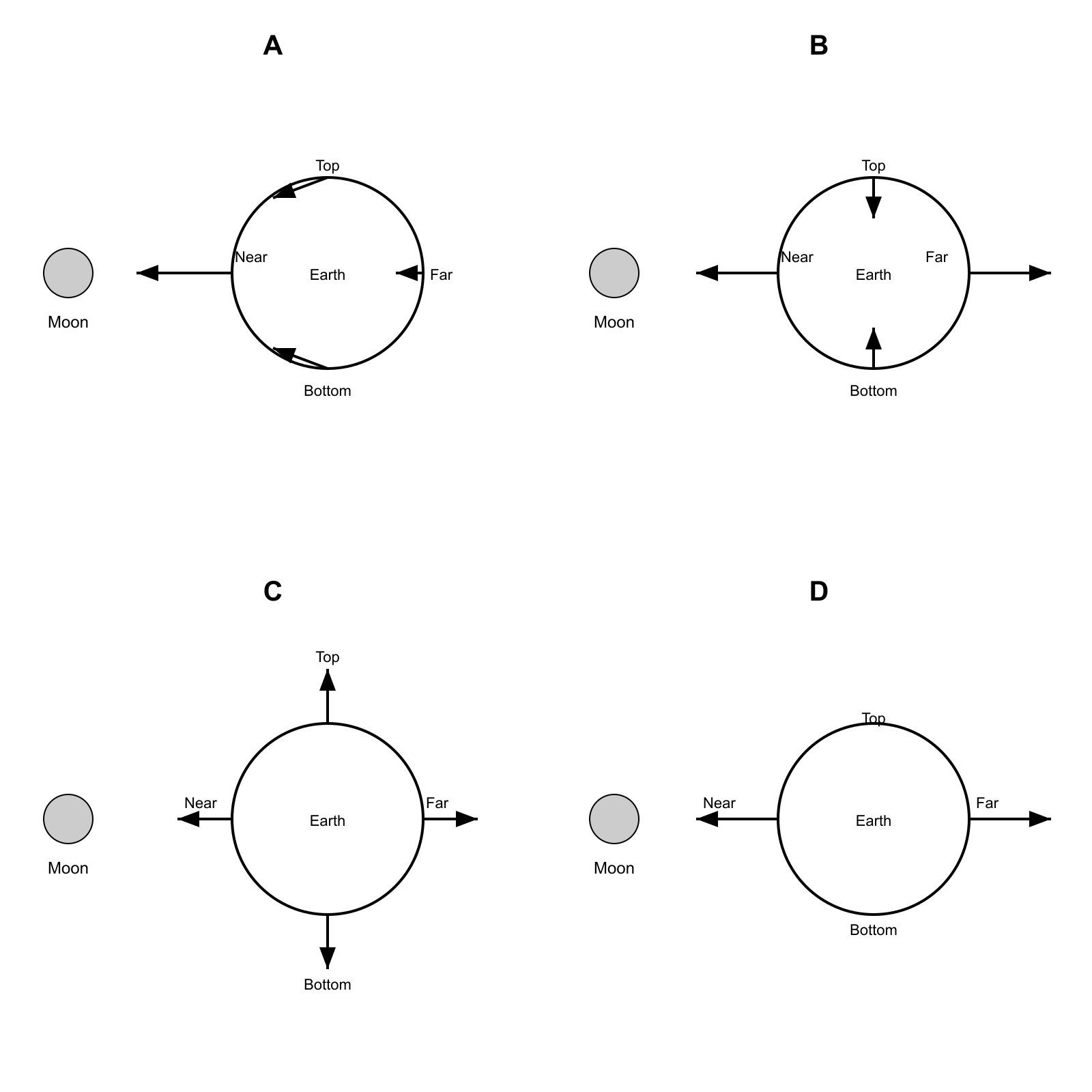
The diagrams show four possible representations of the Moon's tidal forces on Earth. Which diagram correctly illustrates the direction and relative magnitude of the tidal force at various points on Earth's surface, relative to its center?
- A diagram where all force vectors point towards the Moon, with the vector on the near side being the longest and the vector on the far side being the shortest.
- A diagram with a vector pointing away from Earth's center on the near side, a vector pointing away on the far side, and smaller vectors pointing inward on the top and bottom. (correct answer)
- A diagram where all force vectors point radially outward from the center of the Earth, representing a centrifugal force.
- A diagram where the vectors on the near side and far side are equal and opposite, pointing away from Earth, and there are no forces on the top and bottom.
Explanation: Correct: Tidal force is the differential gravitational force. Relative to the Earth's center, the near side is pulled harder (outward vector), the far side is pulled less (effectively leaving it behind, represented as an outward vector), and the top and bottom are pulled slightly inward (as the force vector is aimed at the Moon, not parallel, so it has an inward component relative to the Earth's center). This pattern of forces stretches the Earth along the Earth-Moon line and squeezes it along the perpendicular direction.
A: This diagram shows the total gravitational force, not the tidal (differential) force.
C: This incorrectly depicts the tidal force as a simple centrifugal force, ignoring the differential nature of gravity.
D: This is an oversimplification. While it correctly shows the stretching, it misses the squeezing effect and misrepresents the relative magnitudes (the near-side force is slightly stronger than the far-side force).
Question 2
A newly discovered exoplanet, 'Kepler-X', orbits its parent star in a highly elliptical path. Its orbital period is short, subjecting it to intense and varying gravitational fields. Which of the following is the most direct and significant consequence of the tidal forces acting on Kepler-X due to this eccentric orbit?
- The planet's atmosphere is compressed at periastron, causing a significant increase in surface pressure and temperature.
- The planet's interior experiences frictional heating due to continuous stretching and squeezing, potentially driving volcanic activity. (correct answer)
- The planet's rotational axis undergoes rapid precession, leading to extreme and unpredictable seasonal shifts.
- The planet's magnetic field is periodically stripped away by the star's field at periastron, exposing the surface to stellar winds.
Explanation: Correct: The varying tidal force caused by the highly elliptical orbit will constantly deform the planet's shape, creating internal friction. This process, known as tidal heating, is a major source of internal energy and can lead to volcanism, as seen on Jupiter's moon Io.
A: While the planet's atmosphere might be slightly affected, tidal forces primarily deform the planet's body, not just its atmosphere. The primary heating mechanism is internal friction, not atmospheric compression.
C: Axial precession (wobble) is primarily caused by the gravitational torque on a planet's equatorial bulge from its star and any moons, but it is a much slower process and not the most direct consequence of tidal flexing from an eccentric orbit.
D: A planet's magnetic field interacts with the stellar magnetic field, but tidal forces are gravitational and do not directly strip the field away. Magnetospheric compression can occur, but it is a separate phenomenon from tidal effects.
Question 3
The tidal bulge raised on Earth by the Moon does not point directly at the Moon. Instead, due to Earth's rotation and friction, the bulge is carried slightly ahead of the Moon's orbital position. What is the primary consequence of this misalignment?
- It causes the Moon's orbit to become more eccentric over time.
- It exerts a net gravitational torque on the Moon, causing it to speed up and spiral outwards. (correct answer)
- It causes a slight increase in Earth's rotational speed due to conservation of energy.
- It focuses solar radiation onto the Moon, increasing its surface temperature.
Explanation: Correct: The gravitational pull from the leading tidal bulge has a small forward component on the Moon. This component acts as a constant, gentle push, adding energy to the Moon's orbit. This increased energy causes the Moon to speed up and, counter-intuitively, move into a higher, more distant orbit. This is the same interaction that, via Newton's third law, exerts a braking torque on Earth, slowing its rotation.
A: Tidal forces tend to circularize orbits; this misalignment does not increase eccentricity.
C: The torque on Earth from the Moon's pull on the bulge slows Earth's rotation, it does not speed it up.
D: The tidal bulge is a feature of Earth's oceans and crust; it has no effect on focusing solar radiation onto the Moon.
Question 4
The tidal force exerted by the Moon on Earth is proportional to 1/d3, where d is the distance between their centers. Paleontological evidence suggests that 620 million years ago, the Moon was approximately 10% closer to Earth than it is today. Approximately how much stronger was the Moon's tidal force on Earth at that time?
- 11% stronger
- 21% stronger
- 37% stronger (correct answer)
- 100% stronger
Explanation: Correct: Let the current distance be d0. The past distance dp was 10% closer, so dp=0.9d0. The tidal force is proportional to 1/d3. The ratio of the past force (Fp) to the present force (F0) is (1/dp3)/(1/d03)=(d0/dp)3=(d0/(0.9d0))3=(1/0.9)3≈(1.111)3≈1.37. This means the force was about 37% stronger.
A: This would be the result of an incorrect linear assumption (10% closer means 10% stronger).
B: This is the approximate result if the student incorrectly used an inverse square law ((1/0.9)2≈1.23, or 23% stronger), a very common mistake confusing tidal force with gravitational force.
D: This implies the force was double, which would require a much closer distance. Question 5
The tidal interaction between Earth and the Moon is causing Earth's rotation to slow, a phenomenon known as tidal braking. According to the principle of conservation of angular momentum, what is the simultaneous effect on the Moon's orbit?
- The Moon's orbit is gradually decaying, bringing it closer to Earth over time.
- The Moon is slowly moving into a higher orbit, increasing its distance from Earth. (correct answer)
- The Moon's orbital eccentricity is increasing, making its orbit more elliptical.
- The Moon's orbital inclination is changing, moving it out of the ecliptic plane.
Explanation: Correct: The Earth-Moon system's total angular momentum must be conserved. As Earth's rotational angular momentum decreases (it slows down), the Moon's orbital angular momentum must increase to compensate. A higher orbit corresponds to greater orbital angular momentum. Therefore, the Moon is slowly receding from Earth at a rate of about 3.8 cm per year.
A: This would imply a loss of orbital angular momentum, violating conservation.
C: Tidal forces tend to circularize orbits over time, not make them more eccentric, unless other bodies are involved in resonances.
D: While the orbital inclination does change over long timescales due to other perturbations, it is not the primary consequence of the angular momentum transfer from Earth's spin.
Question 6
A newly discovered exoplanet, 'Kepler-X', orbits its parent star in a highly elliptical path. Its orbital period is short, subjecting it to intense and varying gravitational fields. Which of the following is the most direct and significant consequence of the tidal forces acting on Kepler-X due to this eccentric orbit?
- The planet's atmosphere is compressed at periastron, causing a significant increase in surface pressure and temperature.
- The planet's interior experiences frictional heating due to continuous stretching and squeezing, potentially driving volcanic activity. (correct answer)
- The planet's rotational axis undergoes rapid precession, leading to extreme and unpredictable seasonal shifts.
- The planet's magnetic field is periodically stripped away by the star's field at periastron, exposing the surface to stellar winds.
Explanation: Correct: The varying tidal force caused by the highly elliptical orbit will constantly deform the planet's shape, creating internal friction. This process, known as tidal heating, is a major source of internal energy and can lead to volcanism, as seen on Jupiter's moon Io.
A: While the planet's atmosphere might be slightly affected, tidal forces primarily deform the planet's body, not just its atmosphere. The primary heating mechanism is internal friction, not atmospheric compression.
C: Axial precession (wobble) is primarily caused by the gravitational torque on a planet's equatorial bulge from its star and any moons, but it is a much slower process and not the most direct consequence of tidal flexing from an eccentric orbit.
D: A planet's magnetic field interacts with the stellar magnetic field, but tidal forces are gravitational and do not directly strip the field away. Magnetospheric compression can occur, but it is a separate phenomenon from tidal effects.
Question 7
Two hypothetical moons, one a solid, rigid sphere of rock (Moon R) and the other a loosely consolidated 'rubble pile' of ice (Moon I), have the same mass and density. They are placed in identical, slowly decaying orbits around a planet. How will their fates differ as they approach the planet's Roche limit?
- Moon R will be disrupted at a greater distance from the planet than Moon I because its rigidity makes it more brittle.
- Moon I will be disrupted at a greater distance from the planet than Moon R because it lacks tensile strength and is held together only by gravity. (correct answer)
- Both will be disrupted at the exact same distance, as the Roche limit depends only on their shared density and the planet's properties.
- Neither will be disrupted; their identical mass ensures they have sufficient self-gravity to survive until impact.
Explanation: Correct: The classical Roche limit calculation assumes the satellite is held together only by self-gravity (a 'fluid' or 'rubble pile' body). A solid body with material strength (tensile strength) can survive closer to the planet because its internal forces help resist the tidal disruption. Therefore, the rubble pile (Moon I), which has no tensile strength, will be pulled apart by tidal forces at a greater distance than the rigid rocky moon (Moon R).
A: This reverses the logic. Rigidity provides additional strength against tidal forces.
C: This is a common simplification. The standard Roche limit formula is for a fluid satellite. The limit for a rigid body is at a smaller orbital radius.
D: Disruption is a definite possibility if the orbit passes within the Roche limit.
Question 8
An astronomer observes that a tidally locked moon in an exoplanetary system exhibits signs of significant, ongoing geological activity consistent with tidal heating. What can be inferred about the moon's orbit?
- The orbit must have a non-zero eccentricity that is being maintained by some external mechanism. (correct answer)
- The orbit must be perfectly circular to maintain a stable tidal lock and constant heating.
- The moon must be orbiting in the opposite direction of its planet's spin (a retrograde orbit).
- The moon must be very massive, as only large moons can generate sufficient internal friction.
Explanation: Correct: Tidal heating is caused by the flexing of a body due to changes in the tidal force. In a perfectly circular orbit, a tidally locked moon would present the same face to its planet, and the tidal bulge would be static, generating no friction. Therefore, the orbit must be eccentric. Furthermore, because tidal forces tend to circularize orbits over time, the eccentricity must be actively maintained by an external influence, such as an orbital resonance with another moon.
B: This is incorrect. A circular orbit would lead to negligible tidal heating once the body is tidally locked.
C: A retrograde orbit does not, by itself, cause tidal heating. It can lead to strong tidal interactions and orbital decay, but eccentricity is the key for heating.
D: While mass is a factor, the orbital characteristics are the primary determinant of whether tidal heating occurs. A small moon in a highly eccentric orbit can be heated more than a massive moon in a circular one.
Question 9
Imagine a hypothetical planet, 'Tethys', identical to Earth but with a retrograde rotation (spinning clockwise as viewed from above its north pole, opposite to its orbit). It has a moon identical to our Moon in a prograde orbit. How would the long-term effects of tidal forces on Tethys and its moon differ from the Earth-Moon system?
- Tidal forces would cause Tethys to speed up its rotation, and the moon would move closer to the planet. (correct answer)
- The tidal interaction would be much weaker, leading to no significant change in rotation or orbit over billions of years.
- The moon would become tidally locked to Tethys, but Tethys's rotation would remain unaffected due to the retrograde motion.
- Tidal forces would have no effect, as the retrograde rotation would perfectly cancel the tidal bulge lag.
Explanation: Correct: With retrograde rotation, the planet's surface moves against the moon's orbital motion. The tidal bulge, dragged by the planet's spin, would lag behind the moon instead of leading it. The moon's gravity pulling on this lagging bulge would exert a torque that speeds up the planet's rotation. Simultaneously, the bulge would exert a braking force on the moon, removing energy from its orbit and causing it to spiral inward toward the planet. This is the situation for Neptune's moon Triton.
B: The interaction would actually be stronger and more dynamic than in the Earth-Moon system.
C: The moon would still attempt to lock, but the orbital decay is a much more dramatic and faster process.
D: The retrograde rotation is the cause of the tidal bulge lag in this scenario, it doesn't cancel it.
Question 10
A comet consisting of loosely bound ice and rock is on a trajectory that takes it very close to a massive gas giant planet. Which of the following observations would provide the most definitive evidence that the comet passed within the planet's Roche limit?
- The comet's orbital velocity increases significantly as it approaches the planet.
- The comet's trajectory is permanently altered into a new, more elliptical orbit.
- The comet develops a bright, extended coma and tail due to solar heating.
- The comet breaks apart into a chain of smaller fragments aligned with its orbit. (correct answer)
Explanation: Correct: The Roche limit is the distance at which the tidal forces of a larger body overcome the self-gravity of a smaller body, causing it to disintegrate. The breakup of the comet into a 'string of pearls' (like Comet Shoemaker-Levy 9) is the classic sign of such a tidal disruption.
A: An increase in velocity (a 'gravity assist') is expected for any close gravitational encounter and does not depend on crossing the Roche limit.
B: An altered trajectory is also a standard outcome of a close gravitational encounter.
C: A coma and tail are formed by the sublimation of ices due to heat from the Sun, not directly by tidal forces from a planet.
Question 11
Jupiter's moon Io is the most volcanically active body in the solar system, powered by tidal heating. Its sibling moon Callisto, which is larger and also orbits Jupiter, shows no signs of such activity. Both moons are tidally locked. Which of the following best explains this discrepancy?
- Callisto is too far from Jupiter for tidal forces to be significant, whereas Io is close enough for strong tidal effects.
- Io's orbit is kept eccentric by orbital resonance with Europa and Ganymede, causing continuous flexing, while Callisto's orbit is nearly circular. (correct answer)
- Io's smaller mass makes it more susceptible to deformation by Jupiter's gravity, while Callisto's larger mass provides greater internal rigidity.
- Callisto is fully tidally locked, which eliminates internal friction, whereas Io is not yet tidally locked, causing its interior to heat up.
Explanation: Correct: Tidal heating requires continuous flexing, which is caused by a changing tidal force. This change is produced by an eccentric (non-circular) orbit. Io is in the Laplace resonance with Europa and Ganymede, which constantly perturbs its orbit and maintains its eccentricity. Callisto is not in such a resonance and has a nearly circular orbit, so despite being subjected to Jupiter's gravity, it does not experience significant flexing and tidal heating.
A: While Io is much closer, the key is not just the strength of the force but its variation. If Io had a perfectly circular orbit, tidal heating would be negligible.
C: While mass and composition play a role, the primary driver for the difference in activity is the orbital eccentricity.
D: Both moons are tidally locked. Tidal locking itself does not prevent tidal heating; in fact, the heating is a consequence of tidal forces acting on a locked body in an eccentric orbit.
Question 12
Two neutron stars in a close, eccentric binary system spiral towards each other. How do tidal forces contribute to the observed phenomena just before they merge?
- Tidal forces cause both stars to spin down rapidly, preventing any electromagnetic signal from being emitted.
- Tidal forces create a stable bridge of matter between the stars, halting the inspiral process.
- Tidal forces cancel out the emission of gravitational waves, making the final moments of the merger undetectable.
- Tidal flexing and resonance can crack the crusts of the neutron stars, potentially generating precursor gamma-ray or X-ray flashes. (correct answer)
Explanation: When analyzing neutron star mergers, you need to consider how the extreme gravitational environment affects these ultra-dense objects in their final moments. Neutron stars have solid crusts overlying fluid interiors, and this structure becomes crucial as tidal forces intensify during inspiral.
As neutron stars spiral closer together, tidal forces grow exponentially stronger. These forces don't just gently deform the stars—they create violent flexing that can literally crack the rigid neutron star crusts. When the crust fractures, it can trigger starquakes and suddenly release magnetic field energy, producing observable electromagnetic precursors like gamma-ray or X-ray flashes. Additionally, tidal resonances can occur when the orbital frequency matches internal oscillation modes of the neutron stars, amplifying these crustal stresses. This makes option D correct—tidal effects generate detectable electromagnetic signals before the final merger.
Option A incorrectly suggests tidal forces cause spin-down and eliminate signals, but tidal forces actually increase rotational energy and create more emission opportunities. Option B describes an impossible scenario where matter bridges would halt inspiral—any matter transfer would actually accelerate the process due to angular momentum loss. Option C completely misunderstands gravitational wave physics; tidal forces are consequences of the same spacetime curvature that produces gravitational waves, so they cannot cancel wave emission.
Remember that neutron star mergers are multi-messenger events. When you see questions about compact object mergers, think about how different physical processes (gravitational, electromagnetic, tidal) work together rather than in isolation to create the complete observational picture.
Question 13
Planet Alpha has mass M and a moon with mass m in a circular orbit of radius R. Planet Beta has mass (2M) and a moon with the same mass m in a circular orbit of radius 2R. What is the ratio of the tidal force exerted by the planet on its moon for system Beta compared to system Alpha (FT,Beta/FT,Alpha)?
- 1/4 (correct answer)
- 1/2
- 1
- 2
Explanation: Correct: The tidal force exerted by a planet of mass Mplanet on a moon of radius rmoon at a distance d is proportional to Mplanet⋅rmoon/d3. Since the moons are identical, their radii are the same. We need to compare Mplanet/d3 for both systems. For Alpha: M/R3. For Beta: (2M)/(2R)3=2M/(8R3)=(1/4)M/R3. The ratio of Beta's tidal force to Alpha's is ((1/4)M/R3)/(M/R3))=1/4.
B: This result would be obtained if the student used an inverse square law (2M/(2R)2=2M/4R2=(1/2)M/R2).
C: This implies the forces are equal, which ignores the changes in both mass and distance.
D: This would be the result if the student correctly used the mass but ignored the distance factor. Question 14
In the Earth-Moon system, the Sun's gravitational pull on Earth is more than 175 times stronger than the Moon's. Yet, the Moon's tidal effect is more than twice as strong as the Sun's. What is the fundamental reason for this apparent contradiction?
- The Moon is much closer, so the difference in its gravitational pull across Earth's diameter is greater than the Sun's. (correct answer)
- The Moon's gravitational force resonates with the natural frequency of Earth's oceans, amplifying its effect.
- The Sun's light pressure pushes against the tidal bulge raised by the Moon, partially counteracting the Sun's own tidal force.
- Earth's magnetic field selectively channels the lunar gravitational field but deflects the solar gravitational field.
Explanation: Correct: Tidal forces are not about the absolute strength of gravity, but about the gradient or differential of the gravitational field across an object. Because the Moon is so much closer to Earth, the percentage difference in its pull on the near side versus the far side is much larger than the percentage difference for the much more distant Sun. The tidal force scales with 1/d3, which penalizes the Sun's great distance more than its large mass benefits it, compared to the Moon.
B: While ocean basins do have resonances that affect local tides, this is not the fundamental reason the Moon's global tidal effect is stronger.
C & D: These are physically incorrect statements. Light pressure is far too weak, and magnetic fields do not interact with gravity in this way. Question 15
Two identical rocky planets, Planet A and Planet B, orbit identical G-type stars. Planet A is in a 0.1 AU orbit, and Planet B is in a 0.5 AU orbit. Which planet is more likely to be tidally locked with its star, and what is the primary reason?
- Planet B, because its longer orbital period allows more time for the tidal forces to synchronize its rotation.
- Planet A, because the tidal force is vastly stronger at closer distances, leading to a much shorter locking timescale. (correct answer)
- Neither, because rocky planets are too rigid to be tidally locked by the weak gravity of a G-type star.
- Both are equally likely, as the tidal locking timescale depends on the planet's mass, not its orbital distance.
Explanation: Correct: The strength of the tidal force is proportional to 1/d3, and the timescale for tidal locking is even more sensitive to distance (proportional to roughly d6). Planet A, being 5 times closer, experiences a tidal force that is 53=125 times stronger than Planet B. This results in an extremely rapid tidal locking process for Planet A, while Planet B would take vastly longer to lock, if ever.
A: This is incorrect reasoning. While the process takes time, the strength of the force is the dominant factor determining the timescale.
C: This is incorrect. Many close-orbiting exoplanets ('hot Jupiters' and 'super-Earths') are expected to be, and are observed to be, tidally locked.
D: The locking timescale is highly dependent on orbital distance, as well as the planet's mass, radius, and internal structure. Question 16
A comet consisting of loosely bound ice and rock is on a trajectory that takes it very close to a massive gas giant planet. Which of the following observations would provide the most definitive evidence that the comet passed within the planet's Roche limit?
- The comet's orbital velocity increases significantly as it approaches the planet.
- The comet's trajectory is permanently altered into a new, more elliptical orbit.
- The comet develops a bright, extended coma and tail due to solar heating.
- The comet breaks apart into a chain of smaller fragments aligned with its orbit. (correct answer)
Explanation: Correct: The Roche limit is the distance at which the tidal forces of a larger body overcome the self-gravity of a smaller body, causing it to disintegrate. The breakup of the comet into a 'string of pearls' (like Comet Shoemaker-Levy 9) is the classic sign of such a tidal disruption.
A: An increase in velocity (a 'gravity assist') is expected for any close gravitational encounter and does not depend on crossing the Roche limit.
B: An altered trajectory is also a standard outcome of a close gravitational encounter.
C: A coma and tail are formed by the sublimation of ices due to heat from the Sun, not directly by tidal forces from a planet.
Question 17
Jupiter's moon Io is the most volcanically active body in the solar system, powered by tidal heating. Its sibling moon Callisto, which is larger and also orbits Jupiter, shows no signs of such activity. Both moons are tidally locked. Which of the following best explains this discrepancy?
- Callisto is too far from Jupiter for tidal forces to be significant, whereas Io is close enough for strong tidal effects.
- Io's orbit is kept eccentric by orbital resonance with Europa and Ganymede, causing continuous flexing, while Callisto's orbit is nearly circular. (correct answer)
- Io's smaller mass makes it more susceptible to deformation by Jupiter's gravity, while Callisto's larger mass provides greater internal rigidity.
- Callisto is fully tidally locked, which eliminates internal friction, whereas Io is not yet tidally locked, causing its interior to heat up.
Explanation: Correct: Tidal heating requires continuous flexing, which is caused by a changing tidal force. This change is produced by an eccentric (non-circular) orbit. Io is in the Laplace resonance with Europa and Ganymede, which constantly perturbs its orbit and maintains its eccentricity. Callisto is not in such a resonance and has a nearly circular orbit, so despite being subjected to Jupiter's gravity, it does not experience significant flexing and tidal heating.
A: While Io is much closer, the key is not just the strength of the force but its variation. If Io had a perfectly circular orbit, tidal heating would be negligible.
C: While mass and composition play a role, the primary driver for the difference in activity is the orbital eccentricity.
D: Both moons are tidally locked. Tidal locking itself does not prevent tidal heating; in fact, the heating is a consequence of tidal forces acting on a locked body in an eccentric orbit.
Question 18
An astronomer observes that a tidally locked moon in an exoplanetary system exhibits signs of significant, ongoing geological activity consistent with tidal heating. What can be inferred about the moon's orbit?
- The orbit must have a non-zero eccentricity that is being maintained by some external mechanism. (correct answer)
- The orbit must be perfectly circular to maintain a stable tidal lock and constant heating.
- The moon must be orbiting in the opposite direction of its planet's spin (a retrograde orbit).
- The moon must be very massive, as only large moons can generate sufficient internal friction.
Explanation: Correct: Tidal heating is caused by the flexing of a body due to changes in the tidal force. In a perfectly circular orbit, a tidally locked moon would present the same face to its planet, and the tidal bulge would be static, generating no friction. Therefore, the orbit must be eccentric. Furthermore, because tidal forces tend to circularize orbits over time, the eccentricity must be actively maintained by an external influence, such as an orbital resonance with another moon.
B: This is incorrect. A circular orbit would lead to negligible tidal heating once the body is tidally locked.
C: A retrograde orbit does not, by itself, cause tidal heating. It can lead to strong tidal interactions and orbital decay, but eccentricity is the key for heating.
D: While mass is a factor, the orbital characteristics are the primary determinant of whether tidal heating occurs. A small moon in a highly eccentric orbit can be heated more than a massive moon in a circular one.
Question 19
Planet Alpha has mass M and a moon with mass m in a circular orbit of radius R. Planet Beta has mass (2M) and a moon with the same mass m in a circular orbit of radius 2R. What is the ratio of the tidal force exerted by the planet on its moon for system Beta compared to system Alpha (FT,Beta/FT,Alpha)?
- 1/4 (correct answer)
- 1/2
- 1
- 2
Explanation: Correct: The tidal force exerted by a planet of mass Mplanet on a moon of radius rmoon at a distance d is proportional to Mplanet⋅rmoon/d3. Since the moons are identical, their radii are the same. We need to compare Mplanet/d3 for both systems. For Alpha: M/R3. For Beta: (2M)/(2R)3=2M/(8R3)=(1/4)M/R3. The ratio of Beta's tidal force to Alpha's is ((1/4)M/R3)/(M/R3))=1/4.
B: This result would be obtained if the student used an inverse square law (2M/(2R)2=2M/4R2=(1/2)M/R2).
C: This implies the forces are equal, which ignores the changes in both mass and distance.
D: This would be the result if the student correctly used the mass but ignored the distance factor. Question 20
The tidal bulge raised on Earth by the Moon does not point directly at the Moon. Instead, due to Earth's rotation and friction, the bulge is carried slightly ahead of the Moon's orbital position. What is the primary consequence of this misalignment?
- It causes the Moon's orbit to become more eccentric over time.
- It exerts a net gravitational torque on the Moon, causing it to speed up and spiral outwards. (correct answer)
- It causes a slight increase in Earth's rotational speed due to conservation of energy.
- It focuses solar radiation onto the Moon, increasing its surface temperature.
Explanation: Correct: The gravitational pull from the leading tidal bulge has a small forward component on the Moon. This component acts as a constant, gentle push, adding energy to the Moon's orbit. This increased energy causes the Moon to speed up and, counter-intuitively, move into a higher, more distant orbit. This is the same interaction that, via Newton's third law, exerts a braking torque on Earth, slowing its rotation.
A: Tidal forces tend to circularize orbits; this misalignment does not increase eccentricity.
C: The torque on Earth from the Moon's pull on the bulge slows Earth's rotation, it does not speed it up.
D: The tidal bulge is a feature of Earth's oceans and crust; it has no effect on focusing solar radiation onto the Moon.