All questions
Question 1
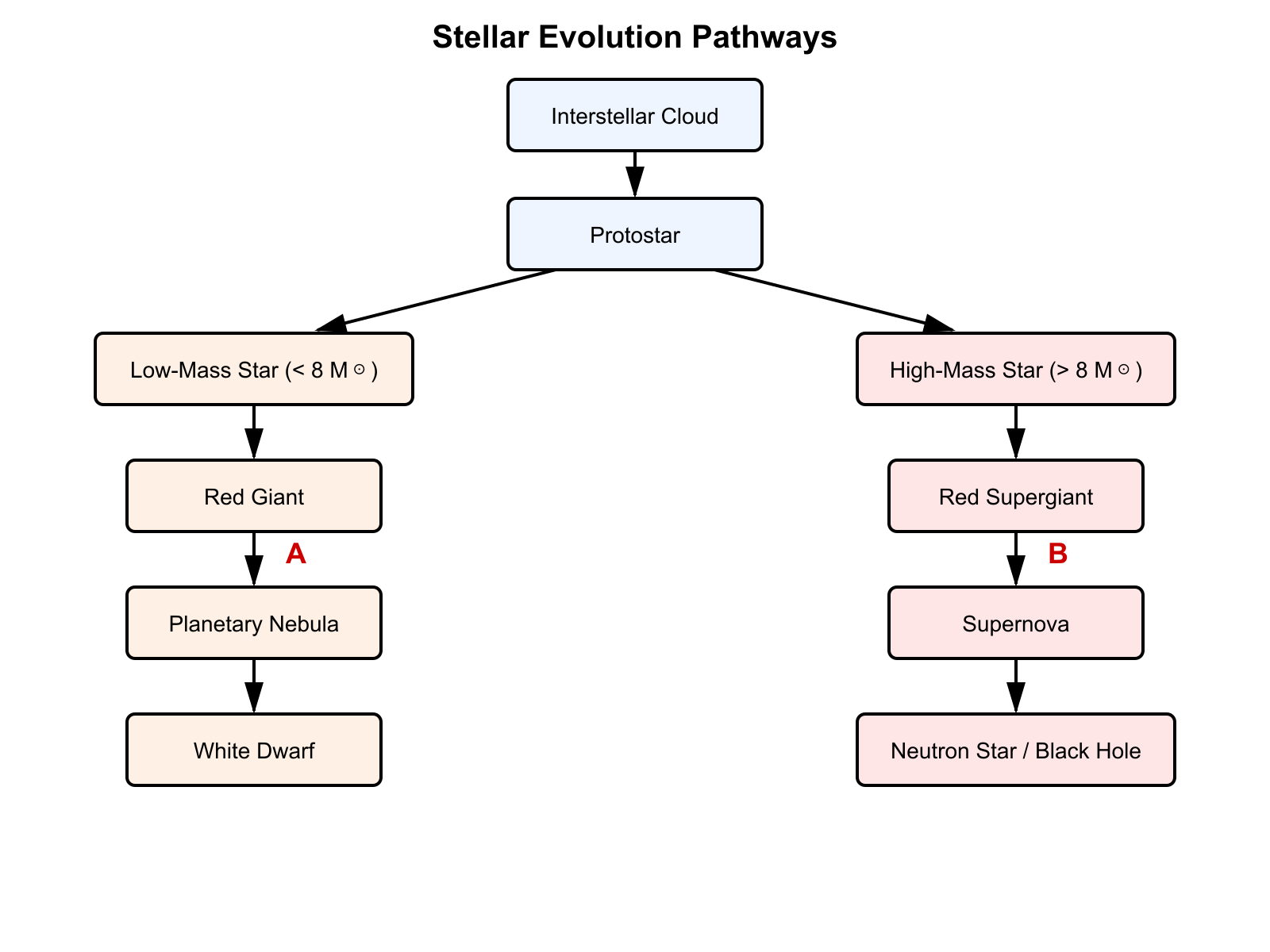
Refer to the simplified diagram of stellar evolution below. Which statement best describes the critical physical processes occurring at the transitions labeled A and B?
- At A, the star's iron core collapses; at B, the star experiences a helium flash in its core.
- At A, the star's outer envelope is ejected by thermal pulses; at B, the star's iron core collapses due to photodisintegration. (correct answer)
- At A, the star begins helium fusion; at B, the star begins carbon fusion.
- At A and B, the star's core runs out of fuel, causing the outer layers to be peacefully shed into space.
Explanation: Transition A represents the end of the Asymptotic Giant Branch (AGB) phase for a low-mass star. The star's outer hydrogen and helium layers are expelled by a combination of strong stellar winds and the energetic thermal pulses from the helium-burning shell, forming a planetary nebula. Transition B represents the final moments of a high-mass star. Its core has fused elements up to iron. When the iron core's mass exceeds what can be supported by electron degeneracy pressure, photodisintegration removes energy, leading to a catastrophic gravitational collapse that triggers a supernova.
Question 2
In low-mass stars, the third dredge-up event during the AGB phase is distinct from the first dredge-up on the red giant branch. What is the fundamental difference in the material brought to the surface?
- The first dredge-up brings helium to the surface, while the third dredge-up brings heavier elements like iron.
- The first dredge-up brings products of hydrogen burning, while the third dredge-up brings products of helium burning. (correct answer)
- The first dredge-up only occurs in stars more massive than 2 M⊙, while the third dredge-up occurs in all low-mass stars.
- The third dredge-up is driven by core collapse, while the first dredge-up is driven by the helium flash.
Explanation: The first dredge-up occurs as the star ascends the red giant branch. The deepening convective envelope reaches down and mixes material from the region of hydrogen shell burning to the surface, altering the C/N abundance ratios. The third dredge-up occurs during thermal pulses on the AGB. The convection driven by a helium shell flash reaches down to the region where helium has been fused into carbon (via the triple-alpha process) and brings this newly made carbon to the surface. This is how carbon stars are formed.
Question 3
The ignition of helium fusion is a critical juncture in stellar evolution. How does the onset of this process differ between a star with an initial mass of 1 M⊙ and one with an initial mass of 10 M⊙?
- In the 1 M⊙ star, helium ignites explosively in a degenerate core, while in the 10 M⊙ star, it ignites gradually in a non-degenerate core. (correct answer)
- Helium fusion begins in a shell for the 1 M⊙ star, while for the 10 M⊙ star, it begins in the central core.
- The 1 M⊙ star cannot achieve the temperature for helium fusion, while the 10 M⊙ star fuses helium smoothly after hydrogen exhaustion.
- Ignition of helium fusion causes the 10 M⊙ star to contract, while it causes the 1 M⊙ star to expand significantly.
Explanation: In a low-mass star like a 1 M⊙ star, the core becomes supported by electron degeneracy pressure before it is hot enough for helium fusion. When the temperature finally reaches the ignition point, fusion begins explosively throughout the degenerate core, an event called the 'helium flash'. In a high-mass star (10 M⊙), the core reaches the temperature for helium ignition before it becomes degenerate, so fusion begins smoothly and gradually. Question 4
The main-sequence turnoff point for a star cluster is observed to be at a mass of approximately 2 M⊙. What is the most probable current status of a star that originally formed in this cluster with a mass of 15 M⊙?
- It is a red supergiant, currently fusing carbon or heavier elements in its core.
- It has completed its entire evolutionary cycle and is now a neutron star. (correct answer)
- It has shed its outer layers, forming a planetary nebula that is still visible.
- It is still on the main sequence, fusing hydrogen into helium via the CNO cycle.
Explanation: The main-sequence lifetime of a star is inversely related to its mass. A 2 M⊙ star has a lifetime of about 1 billion years. Since these stars are just now leaving the main sequence, the cluster's age is approximately 1 billion years. A 15 M⊙ star has a much shorter lifetime, only about 12 million years. Therefore, this star would have completed its entire evolution—supergiant phase, supernova explosion, and remnant formation—long ago. As a high-mass star, its final remnant would be a neutron star or black hole. Question 5
Analysis of two supernova remnants reveals a key difference: Remnant A is rich in hydrogen, while Remnant B is nearly devoid of it. Which statement most accurately identifies the progenitor systems?
- Both were from thermonuclear explosions of white dwarfs, but the progenitor of A had managed to retain a small hydrogen shell.
- A was from a Type Ia supernova originating from a white dwarf; B was from a Type II supernova originating from a single massive star.
- Both were from core-collapse supernovae, but the progenitor of B was a Wolf-Rayet star that had lost its hydrogen envelope.
- A was from a Type II supernova originating from a single massive star; B was from a Type Ia supernova originating from a white dwarf. (correct answer)
Explanation: When analyzing supernova remnants, the presence or absence of hydrogen tells you which type of stellar explosion occurred. This is because different progenitor stars have vastly different compositions when they explode.
Type II supernovae occur when massive stars (>8 solar masses) undergo core collapse. These stars retain their hydrogen-rich outer layers throughout their lives, so their remnants are hydrogen-rich. Type Ia supernovae, however, result from thermonuclear explosions of white dwarf stars, which are composed primarily of carbon and oxygen with essentially no hydrogen.
Given that Remnant A is hydrogen-rich while Remnant B is hydrogen-poor, A must have originated from a Type II supernova (massive star core collapse) and B from a Type Ia supernova (white dwarf explosion). This matches option D perfectly.
Option A incorrectly suggests both were Type Ia events, but white dwarfs cannot retain hydrogen shells that would survive the thermonuclear explosion. Option B reverses the identifications—it would predict A should be hydrogen-poor and B hydrogen-rich, opposite to the observations. Option C incorrectly claims both were core-collapse events; while Wolf-Rayet stars do lose their hydrogen envelopes, this doesn't explain why we'd see such a stark difference between two supposedly similar explosion types.
Remember this key pattern: hydrogen-rich remnants = Type II supernovae from massive stars; hydrogen-poor remnants = Type Ia supernovae from white dwarfs. The stellar composition directly determines the remnant composition.
Question 6
Both low-mass stars (via planetary nebulae) and high-mass stars (via supernovae) contribute to galactic chemical enrichment. Which statement accurately contrasts the primary elemental contributions of these two distinct evolutionary paths?
- Both pathways produce similar amounts of all elements up to iron, but only supernovae from high-mass stars can produce elements heavier than iron.
- Low-mass stars primarily return unprocessed hydrogen and helium, while high-mass stars are responsible for all elements heavier than helium.
- Supernovae from high-mass stars are the main source of light elements like lithium, while planetary nebulae create heavy elements like uranium.
- Low-mass stars are the primary source of the galaxy's carbon and nitrogen, while high-mass stars are the primary source of oxygen and iron. (correct answer)
Explanation: When you encounter questions about stellar nucleosynthesis and galactic chemical enrichment, focus on how stellar mass determines which fusion processes occur and which elements are produced during different evolutionary phases.
Low-mass stars (like our Sun) have relatively gentle fusion processes that primarily create carbon through helium burning and nitrogen through the CNO cycle. When they shed their outer layers as planetary nebulae, they enrich the galaxy mainly with these intermediate-mass elements. High-mass stars, however, can achieve the extreme temperatures needed for silicon burning and successive fusion processes that forge heavier elements like oxygen, neon, magnesium, and iron in their cores. When these massive stars explode as supernovae, they blast these heavy elements into space.
Option A incorrectly suggests both stellar types produce similar amounts of all elements up to iron - but low-mass stars never reach the temperatures needed for oxygen or iron production. Option B is wrong because low-mass stars do process helium into heavier elements like carbon and nitrogen; they don't just return unprocessed material. Option C completely reverses reality - high-mass stars don't produce light elements like lithium (which is actually destroyed in stellar interiors), and low-mass stars cannot create the heaviest elements like uranium.
Option D correctly identifies this mass-dependent division of labor: low-mass stars primarily contribute carbon and nitrogen, while high-mass stars are the main factories for oxygen and iron.
Remember this pattern: stellar mass determines fusion capability, which determines elemental output. Bigger stars make heavier elements through more extreme fusion processes.
Question 7
After exhausting its core hydrogen, a star's evolutionary track on the H-R diagram shows it moving nearly horizontally to the right. What does this movement imply about the star's properties and its likely mass class?
- Its luminosity is increasing dramatically as it expands, characteristic of a low-mass star becoming a red giant.
- Its radius is remaining nearly constant as it cools, characteristic of a white dwarf's evolutionary path.
- Its luminosity is staying roughly constant as its surface temperature drops, characteristic of a high-mass star becoming a supergiant. (correct answer)
- Its surface temperature is increasing as its radius contracts, characteristic of a protostar approaching the main sequence.
Explanation: On the Hertzsprung-Russell diagram, the vertical axis represents luminosity and the horizontal axis represents temperature (decreasing to the right). A horizontal path to the right signifies that luminosity remains nearly constant while the surface temperature decreases. For luminosity (L = 4πR²σT⁴) to stay constant as temperature (T) drops, the radius (R) must increase significantly. This post-main-sequence evolution at roughly constant luminosity is the defining characteristic of high-mass stars.
Question 8
A star with an initial mass of 25 M⊙ and a star with an initial mass of 5 M⊙ both complete their evolution, leaving compact remnants. Which statement accurately compares the fundamental physics supporting these two remnants against further gravitational collapse?
- The 5 M⊙ star's remnant is supported by electron degeneracy pressure, while the 25 M⊙ star's remnant is a black hole where no force halts collapse. (correct answer)
- Both remnants are supported by neutron degeneracy pressure, but this pressure is significantly stronger in the remnant of the 25 M⊙ star.
- The 5 M⊙ star's remnant is supported by thermal pressure, while the 25 M⊙ star's remnant is supported by electron degeneracy pressure.
- The 5 M⊙ star's remnant is supported by electron degeneracy pressure, while the 25 M⊙ star's remnant is supported by neutron degeneracy pressure.
Explanation: A 5 M⊙ star will end its life by shedding its outer layers, leaving behind a carbon-oxygen white dwarf with a mass less than the 1.4 M⊙ Chandrasekhar limit. This white dwarf is supported by electron degeneracy pressure. A 25 M⊙ star will undergo a core-collapse supernova. Its core is so massive that the resulting remnant will exceed the Tolman-Oppenheimer-Volkoff limit (around 2-3 M⊙) for a neutron star. Therefore, neutron degeneracy pressure will fail, and the remnant will collapse into a black hole, an object from which nothing can escape because no known force can halt the collapse. Question 9
A high-mass star (e.g., 20 M⊙) possesses far more hydrogen fuel than a low-mass star (e.g., 1 M⊙). Despite this, its main-sequence lifetime is thousands of times shorter. What is the primary physical reason for this apparent paradox?
- The high-mass star's fuel is consumed inefficiently by powerful stellar winds that eject most of its hydrogen before it can be fused.
- The proton-proton chain in the low-mass star is intrinsically less efficient at converting mass to energy than the CNO cycle in the high-mass star.
- The high-mass star's extreme core temperature and pressure lead to a vastly higher luminosity and a disproportionately rapid rate of fusion. (correct answer)
- The low-mass star's radiative core prevents efficient mixing of fuel, forcing it to burn hydrogen slowly over a very long period.
Explanation: A star's main-sequence lifetime is approximately its mass (fuel supply) divided by its luminosity (rate of fuel consumption). While a high-mass star has more mass, its luminosity increases much more steeply (roughly as L∝M3.5). This is due to its much higher core temperature and pressure, which drives fusion via the CNO cycle at an enormous rate. This incredibly rapid consumption of fuel dwarfs its larger supply, resulting in a very short lifetime. Question 10
In low-mass stars, the third dredge-up event during the AGB phase is distinct from the first dredge-up on the red giant branch. What is the fundamental difference in the material brought to the surface?
- The first dredge-up brings helium to the surface, while the third dredge-up brings heavier elements like iron.
- The first dredge-up brings products of hydrogen burning, while the third dredge-up brings products of helium burning. (correct answer)
- The first dredge-up only occurs in stars more massive than 2 M⊙, while the third dredge-up occurs in all low-mass stars.
- The third dredge-up is driven by core collapse, while the first dredge-up is driven by the helium flash.
Explanation: The first dredge-up occurs as the star ascends the red giant branch. The deepening convective envelope reaches down and mixes material from the region of hydrogen shell burning to the surface, altering the C/N abundance ratios. The third dredge-up occurs during thermal pulses on the AGB. The convection driven by a helium shell flash reaches down to the region where helium has been fused into carbon (via the triple-alpha process) and brings this newly made carbon to the surface. This is how carbon stars are formed.
Question 11
The main-sequence turnoff point for a star cluster is observed to be at a mass of approximately 2 M⊙. What is the most probable current status of a star that originally formed in this cluster with a mass of 15 M⊙?
- It is a red supergiant, currently fusing carbon or heavier elements in its core.
- It has completed its entire evolutionary cycle and is now a neutron star. (correct answer)
- It has shed its outer layers, forming a planetary nebula that is still visible.
- It is still on the main sequence, fusing hydrogen into helium via the CNO cycle.
Explanation: The main-sequence lifetime of a star is inversely related to its mass. A 2 M⊙ star has a lifetime of about 1 billion years. Since these stars are just now leaving the main sequence, the cluster's age is approximately 1 billion years. A 15 M⊙ star has a much shorter lifetime, only about 12 million years. Therefore, this star would have completed its entire evolution—supergiant phase, supernova explosion, and remnant formation—long ago. As a high-mass star, its final remnant would be a neutron star or black hole. Question 12
Consider the internal structure of a 20 M⊙ star just before core collapse and a 1.5 M⊙ star on the Asymptotic Giant Branch (AGB). Which statement describes a key difference in their active fusion processes?
- The 20 M⊙ star has multiple, concentric shells fusing different elements simultaneously, while the AGB star has only a hydrogen- and a helium-burning shell. (correct answer)
- The 20 M⊙ star is fusing hydrogen in its core, while the AGB star has an inert core with no active fusion.
- The AGB star's core is degenerate and conducting heat efficiently, while the 20 M⊙ star's core is non-degenerate and convective.
- Fusion in the AGB star is dominated by the proton-proton chain, while fusion in the 20 M⊙ star is dominated by photodisintegration.
Explanation: A key difference is the complexity of the fusion regions. An AGB star has a relatively simple structure with an inert carbon-oxygen core surrounded by a helium-burning shell, which is in turn surrounded by a hydrogen-burning shell. A massive star just before supernova has developed a complex 'onion-like' structure with an inert iron core surrounded by multiple, nested shells, each fusing a different element (silicon, oxygen, neon, carbon, helium, and hydrogen).
Question 13
The CNO cycle becomes the dominant hydrogen fusion mechanism in high-mass main-sequence stars, while the proton-proton (p-p) chain dominates in low-mass stars. What is the fundamental reason for this mass-dependent switch?
- High-mass stars form in regions with higher concentrations of carbon, nitrogen, and oxygen, making the CNO cycle viable.
- The CNO cycle's reaction rate is extremely sensitive to temperature, making it significant only in the hotter cores of high-mass stars. (correct answer)
- The p-p chain is suppressed by the strong magnetic fields found in high-mass stars, leaving the CNO cycle as the only option.
- The CNO cycle is a more efficient process for converting mass to energy, which is required to support the greater mass of the star.
Explanation: The key difference between the two fusion pathways is their temperature sensitivity. The rate of the proton-proton chain is proportional to roughly the fourth power of temperature (T4), while the rate of the CNO cycle is proportional to a much higher power (T17−T20). Low-mass stars have core temperatures around 15 million K, where the p-p chain is faster. High-mass stars have core temperatures exceeding 20 million K, and at these temperatures, the CNO cycle's rate skyrockets, making it the dominant source of energy, even though the p-p chain is also occurring. Question 14
A star with an initial mass of 25 M⊙ and a star with an initial mass of 5 M⊙ both complete their evolution, leaving compact remnants. Which statement accurately compares the fundamental physics supporting these two remnants against further gravitational collapse?
- The 5 M⊙ star's remnant is supported by electron degeneracy pressure, while the 25 M⊙ star's remnant is a black hole where no force halts collapse. (correct answer)
- Both remnants are supported by neutron degeneracy pressure, but this pressure is significantly stronger in the remnant of the 25 M⊙ star.
- The 5 M⊙ star's remnant is supported by thermal pressure, while the 25 M⊙ star's remnant is supported by electron degeneracy pressure.
- The 5 M⊙ star's remnant is supported by electron degeneracy pressure, while the 25 M⊙ star's remnant is supported by neutron degeneracy pressure.
Explanation: A 5 M⊙ star will end its life by shedding its outer layers, leaving behind a carbon-oxygen white dwarf with a mass less than the 1.4 M⊙ Chandrasekhar limit. This white dwarf is supported by electron degeneracy pressure. A 25 M⊙ star will undergo a core-collapse supernova. Its core is so massive that the resulting remnant will exceed the Tolman-Oppenheimer-Volkoff limit (around 2-3 M⊙) for a neutron star. Therefore, neutron degeneracy pressure will fail, and the remnant will collapse into a black hole, an object from which nothing can escape because no known force can halt the collapse. Question 15
The CNO cycle becomes the dominant hydrogen fusion mechanism in high-mass main-sequence stars, while the proton-proton (p-p) chain dominates in low-mass stars. What is the fundamental reason for this mass-dependent switch?
- High-mass stars form in regions with higher concentrations of carbon, nitrogen, and oxygen, making the CNO cycle viable.
- The CNO cycle's reaction rate is extremely sensitive to temperature, making it significant only in the hotter cores of high-mass stars. (correct answer)
- The p-p chain is suppressed by the strong magnetic fields found in high-mass stars, leaving the CNO cycle as the only option.
- The CNO cycle is a more efficient process for converting mass to energy, which is required to support the greater mass of the star.
Explanation: The key difference between the two fusion pathways is their temperature sensitivity. The rate of the proton-proton chain is proportional to roughly the fourth power of temperature (T4), while the rate of the CNO cycle is proportional to a much higher power (T17−T20). Low-mass stars have core temperatures around 15 million K, where the p-p chain is faster. High-mass stars have core temperatures exceeding 20 million K, and at these temperatures, the CNO cycle's rate skyrockets, making it the dominant source of energy, even though the p-p chain is also occurring. Question 16
Both low-mass stars (via planetary nebulae) and high-mass stars (via supernovae) contribute to galactic chemical enrichment. Which statement accurately contrasts the primary elemental contributions of these two distinct evolutionary paths?
- Both pathways produce similar amounts of all elements up to iron, but only supernovae from high-mass stars can produce elements heavier than iron.
- Low-mass stars primarily return unprocessed hydrogen and helium, while high-mass stars are responsible for all elements heavier than helium.
- Supernovae from high-mass stars are the main source of light elements like lithium, while planetary nebulae create heavy elements like uranium.
- Low-mass stars are the primary source of the galaxy's carbon and nitrogen, while high-mass stars are the primary source of oxygen and iron. (correct answer)
Explanation: When you encounter questions about stellar nucleosynthesis and galactic chemical enrichment, focus on how stellar mass determines which fusion processes occur and which elements are produced during different evolutionary phases.
Low-mass stars (like our Sun) have relatively gentle fusion processes that primarily create carbon through helium burning and nitrogen through the CNO cycle. When they shed their outer layers as planetary nebulae, they enrich the galaxy mainly with these intermediate-mass elements. High-mass stars, however, can achieve the extreme temperatures needed for silicon burning and successive fusion processes that forge heavier elements like oxygen, neon, magnesium, and iron in their cores. When these massive stars explode as supernovae, they blast these heavy elements into space.
Option A incorrectly suggests both stellar types produce similar amounts of all elements up to iron - but low-mass stars never reach the temperatures needed for oxygen or iron production. Option B is wrong because low-mass stars do process helium into heavier elements like carbon and nitrogen; they don't just return unprocessed material. Option C completely reverses reality - high-mass stars don't produce light elements like lithium (which is actually destroyed in stellar interiors), and low-mass stars cannot create the heaviest elements like uranium.
Option D correctly identifies this mass-dependent division of labor: low-mass stars primarily contribute carbon and nitrogen, while high-mass stars are the main factories for oxygen and iron.
Remember this pattern: stellar mass determines fusion capability, which determines elemental output. Bigger stars make heavier elements through more extreme fusion processes.
Question 17
After exhausting its core hydrogen, a star's evolutionary track on the H-R diagram shows it moving nearly horizontally to the right. What does this movement imply about the star's properties and its likely mass class?
- Its luminosity is increasing dramatically as it expands, characteristic of a low-mass star becoming a red giant.
- Its radius is remaining nearly constant as it cools, characteristic of a white dwarf's evolutionary path.
- Its luminosity is staying roughly constant as its surface temperature drops, characteristic of a high-mass star becoming a supergiant. (correct answer)
- Its surface temperature is increasing as its radius contracts, characteristic of a protostar approaching the main sequence.
Explanation: On the Hertzsprung-Russell diagram, the vertical axis represents luminosity and the horizontal axis represents temperature (decreasing to the right). A horizontal path to the right signifies that luminosity remains nearly constant while the surface temperature decreases. For luminosity (L = 4πR²σT⁴) to stay constant as temperature (T) drops, the radius (R) must increase significantly. This post-main-sequence evolution at roughly constant luminosity is the defining characteristic of high-mass stars.
Question 18
Consider the internal structure of a 20 M⊙ star just before core collapse and a 1.5 M⊙ star on the Asymptotic Giant Branch (AGB). Which statement describes a key difference in their active fusion processes?
- The 20 M⊙ star has multiple, concentric shells fusing different elements simultaneously, while the AGB star has only a hydrogen- and a helium-burning shell. (correct answer)
- The 20 M⊙ star is fusing hydrogen in its core, while the AGB star has an inert core with no active fusion.
- The AGB star's core is degenerate and conducting heat efficiently, while the 20 M⊙ star's core is non-degenerate and convective.
- Fusion in the AGB star is dominated by the proton-proton chain, while fusion in the 20 M⊙ star is dominated by photodisintegration.
Explanation: A key difference is the complexity of the fusion regions. An AGB star has a relatively simple structure with an inert carbon-oxygen core surrounded by a helium-burning shell, which is in turn surrounded by a hydrogen-burning shell. A massive star just before supernova has developed a complex 'onion-like' structure with an inert iron core surrounded by multiple, nested shells, each fusing a different element (silicon, oxygen, neon, carbon, helium, and hydrogen).
Question 19
The ignition of helium fusion is a critical juncture in stellar evolution. How does the onset of this process differ between a star with an initial mass of 1 M⊙ and one with an initial mass of 10 M⊙?
- In the 1 M⊙ star, helium ignites explosively in a degenerate core, while in the 10 M⊙ star, it ignites gradually in a non-degenerate core. (correct answer)
- Helium fusion begins in a shell for the 1 M⊙ star, while for the 10 M⊙ star, it begins in the central core.
- The 1 M⊙ star cannot achieve the temperature for helium fusion, while the 10 M⊙ star fuses helium smoothly after hydrogen exhaustion.
- Ignition of helium fusion causes the 10 M⊙ star to contract, while it causes the 1 M⊙ star to expand significantly.
Explanation: In a low-mass star like a 1 M⊙ star, the core becomes supported by electron degeneracy pressure before it is hot enough for helium fusion. When the temperature finally reaches the ignition point, fusion begins explosively throughout the degenerate core, an event called the 'helium flash'. In a high-mass star (10 M⊙), the core reaches the temperature for helium ignition before it becomes degenerate, so fusion begins smoothly and gradually. Question 20
A high-mass star (e.g., 20 M⊙) possesses far more hydrogen fuel than a low-mass star (e.g., 1 M⊙). Despite this, its main-sequence lifetime is thousands of times shorter. What is the primary physical reason for this apparent paradox?
- The high-mass star's fuel is consumed inefficiently by powerful stellar winds that eject most of its hydrogen before it can be fused.
- The proton-proton chain in the low-mass star is intrinsically less efficient at converting mass to energy than the CNO cycle in the high-mass star.
- The high-mass star's extreme core temperature and pressure lead to a vastly higher luminosity and a disproportionately rapid rate of fusion. (correct answer)
- The low-mass star's radiative core prevents efficient mixing of fuel, forcing it to burn hydrogen slowly over a very long period.
Explanation: A star's main-sequence lifetime is approximately its mass (fuel supply) divided by its luminosity (rate of fuel consumption). While a high-mass star has more mass, its luminosity increases much more steeply (roughly as L∝M3.5). This is due to its much higher core temperature and pressure, which drives fusion via the CNO cycle at an enormous rate. This incredibly rapid consumption of fuel dwarfs its larger supply, resulting in a very short lifetime.