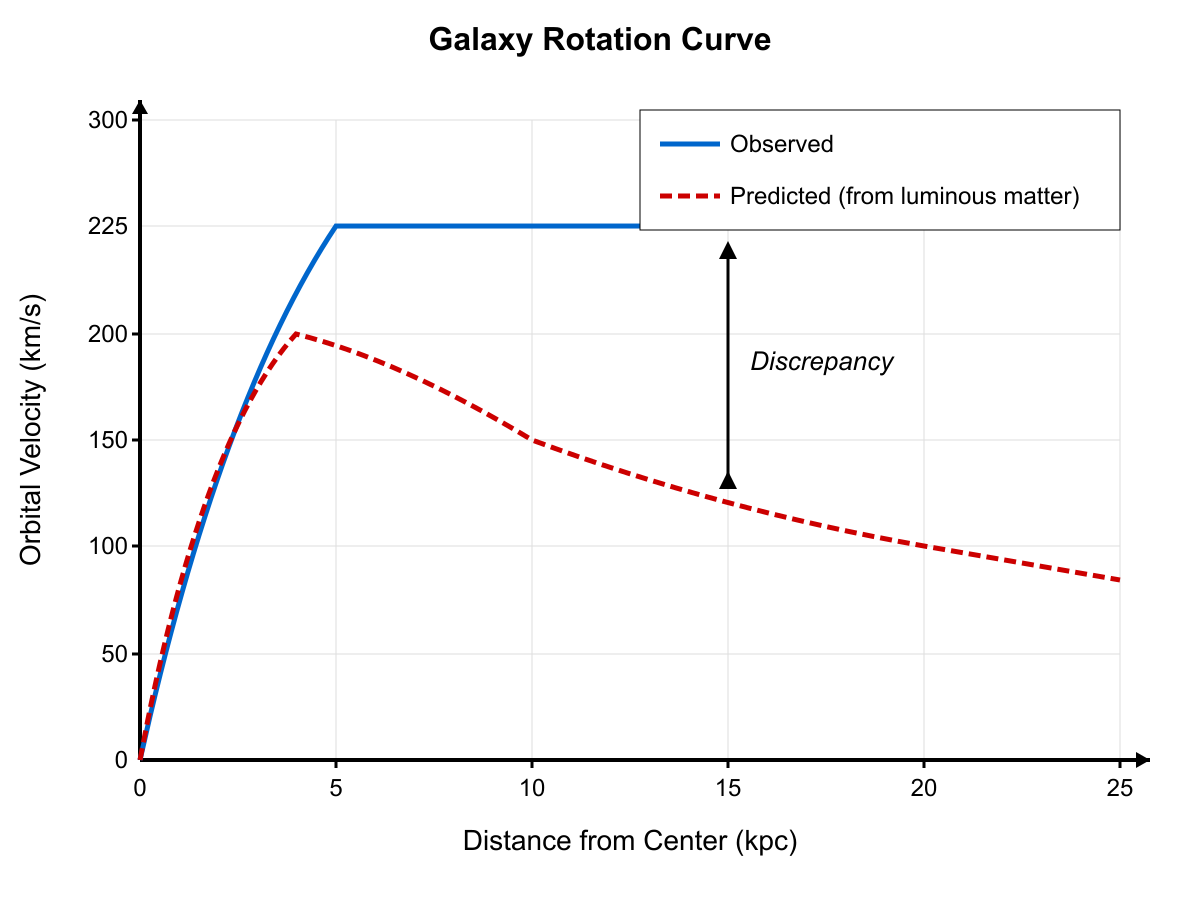
The graph shows the predicted and observed rotation curves for a typical spiral galaxy. Which statement best explains the discrepancy between the two curves at large radii?
AThe gravitational influence of a non-luminous component, distributed in a large halo, is required to keep outer stars in their high-velocity orbits.
BThe laws of gravity described by Newton and Einstein are incomplete and do not apply accurately over galactic distances, requiring modification.
CThe central supermassive black hole's gravity dominates the entire galaxy, causing all stars to orbit at a nearly constant speed.
DThe luminous matter in the galaxy is much more massive than models suggest, likely due to an underestimation of faint, low-mass stars.
Practice Evidence For Dark Matter in Astronomy with focused quiz questions that help you check what you know, review explanations, and build confidence with test-style prompts.
What this quiz covers
This quiz focuses on Evidence For Dark Matter, giving you a quick way to practice the rules, question types, and explanations that matter most for Astronomy.
How to use this quiz
Try each quiz question before looking at the correct answer. Use the explanations to review missed ideas, then come back to similar questions until the pattern feels familiar.
All questions
Question 1
The graph shows the predicted and observed rotation curves for a typical spiral galaxy. Which statement best explains the discrepancy between the two curves at large radii?
The gravitational influence of a non-luminous component, distributed in a large halo, is required to keep outer stars in their high-velocity orbits. (correct answer)
The laws of gravity described by Newton and Einstein are incomplete and do not apply accurately over galactic distances, requiring modification.
The central supermassive black hole's gravity dominates the entire galaxy, causing all stars to orbit at a nearly constant speed.
The luminous matter in the galaxy is much more massive than models suggest, likely due to an underestimation of faint, low-mass stars.
Explanation: The graph shows that observed velocities remain high and flat at large radii, while the velocity predicted from luminous matter drops significantly. This discrepancy is explained by the existence of a massive dark matter halo that extends far beyond the visible disk. Its gravity provides the necessary force to maintain the high orbital speeds of the outer stars. Alternative theories of gravity (B) exist but are not the standard explanation. The black hole's influence is confined to the center (C), and searches for missing luminous matter (D) have failed to account for the large mass deficit.
Question 2
A flat rotation curve for a spiral galaxy implies that the gravitational force Fg experienced by a star in the outer regions at a distance r from the center is proportional to:
r
1/r2
a constant value
1/r (correct answer)
Explanation: When analyzing galactic rotation curves, you need to connect observed stellar velocities to the underlying gravitational forces. A flat rotation curve means stars maintain roughly constant orbital velocities regardless of their distance from the galactic center.For circular orbits, gravitational force provides the centripetal force needed to keep stars in their paths: Fg=rmv2, where m is the star's mass, v is its orbital velocity, and r is its distance from the center. Since the rotation curve is flat, v remains constant. This means Fg=rm⋅constant2, so the gravitational force is proportional to 1/r.Answer choice A suggests Fg∝r, which would require velocity to increase with distance (v∝r) – the opposite of what we observe. Answer choice B represents Newton's inverse square law for point masses, which would produce a declining rotation curve where velocity decreases as 1/r. This is what we'd expect from visible matter alone. Answer choice C suggests constant gravitational force, which would make velocity increase as r – again inconsistent with flat rotation curves.The correct answer is D: Fg∝1/r. This seemingly counterintuitive result is what led astronomers to propose dark matter – there must be additional mass distributed throughout galactic halos to produce this force profile.Remember: flat rotation curves were the key evidence for dark matter because they showed gravitational forces behaving differently than predicted by visible matter alone.
Question 3
The term 'dark matter' refers to the fact that this substance does not appear to interact significantly with the electromagnetic force. Which of the following is a direct observational consequence of this property?
Dark matter halos cannot be imaged directly by telescopes operating at any wavelength, from radio to gamma rays.
Dark matter does not collapse into dense structures like stars and planets because it cannot radiate away energy and cool down.
In galaxy cluster collisions, the dark matter components pass through each other while the gas components collide and shock.
All of the above are direct consequences of dark matter's lack of electromagnetic interaction. (correct answer)
Explanation: All three statements are direct consequences of dark matter not interacting with the electromagnetic force. (A) It doesn't emit, reflect, or absorb light, making it invisible to all telescopes. (B) Normal matter collapses by radiating away thermal energy (via light), allowing it to cool and sink into denser configurations; dark matter lacks this cooling mechanism. (C) In the Bullet Cluster, the gas (normal matter) interacts via electromagnetic forces creating a shock front, while the dark matter, lacking this interaction, passes through unimpeded. Therefore, all listed options are correct consequences.
Question 4
Consider a hypothetical spiral galaxy whose rotation curve is measured. If the contribution to the curve from the dark matter halo exactly canceled out the expected Keplerian decline from the visible disk and bulge, what would the resulting overall rotation curve look like in the outer regions?
It would be flat, with velocity remaining constant with increasing radius.
It would rise linearly, with velocity increasing proportional to radius.
It would fall off as 1/r2, much faster than the expected Keplerian decline.
The concept is flawed; gravitational effects are additive and cannot cancel in this way. (correct answer)
Explanation: This is a trick question that tests the fundamental understanding of gravity. Gravitational forces are attractive and therefore their effects on orbital velocity are additive. The total orbital velocity at any radius is due to the combined gravitational pull of all enclosed mass: vtotal2=vdisk2+vbulge2+vhalo2. A dark matter halo adds to the gravitational potential, it cannot 'cancel' the effect of the visible matter. The halo's contribution is precisely what raises the falling Keplerian curve of the visible matter up to the observed flat curve.
Question 5
Suppose a new, highly sensitive telescope manages to map the distribution of extremely faint stars far into the halo of a nearby spiral galaxy. It finds that these stars orbit with velocities that decrease in accordance with Kepler's laws (v∝1/r). How would this (hypothetical) finding impact the dark matter hypothesis?
It would prove that dark matter is concentrated in the galactic disk rather than in a spherical halo for all galaxies.
It would invalidate the dark matter hypothesis entirely, proving that galaxy rotation is explained by visible matter alone.
It would suggest this particular galaxy's dark matter halo is much smaller or less massive than is typical for spiral galaxies. (correct answer)
It would have no impact, as rotation curves are only considered valid evidence within the bright, visible disk of a galaxy.
Explanation: When you encounter questions about galaxy rotation curves and dark matter, focus on what different velocity patterns tell us about mass distribution. Normal spiral galaxies show flat rotation curves in their outer regions, where stars maintain roughly constant orbital velocities despite increasing distance from the center. This contradicts Kepler's laws and suggests the presence of dark matter halos.In this hypothetical scenario, the faint halo stars follow Kepler's laws with velocities decreasing as v∝1/r. This Keplerian behavior indicates that most of the galaxy's mass is concentrated near the center, with little additional mass (like a dark matter halo) at large radii. Therefore, this galaxy would have a much smaller or less massive dark matter halo than typical spiral galaxies, making answer C correct.Answer A is wrong because this finding doesn't prove dark matter is in the disk rather than halo for all galaxies—it only tells us about this specific galaxy's mass distribution. Answer B incorrectly assumes one galaxy's behavior invalidates the entire dark matter hypothesis, when dark matter evidence comes from multiple independent sources across many galaxies. Answer D is false because rotation curves at all radii provide valuable information about mass distribution—observations of halo stars are actually more telling about dark matter than disk observations.Remember that rotation curve shape directly reflects mass distribution. Flat curves suggest extended dark matter halos, while Keplerian curves suggest centrally concentrated mass with little dark matter at large radii.
Question 6
An astronomer observes a distant spiral galaxy. Based solely on the distribution of its luminous matter (stars, gas, and dust), they predict its rotation curve. How would the observed rotation curve most likely differ from this prediction, and what is the primary implication of this difference?
The observed velocities in the outer regions would be significantly higher than predicted, implying the presence of a massive, non-luminous matter halo. (correct answer)
The observed velocities in the outer regions would be significantly lower than predicted, implying that gravity weakens more rapidly than expected at large distances.
The observed velocities near the galactic center would be much higher than predicted, implying the central supermassive black hole is more massive than estimated.
The observed and predicted curves would match closely, but only if the mass of difficult-to-detect interstellar dust is properly included in the calculations.
Explanation: The primary evidence for dark matter in spiral galaxies is the discrepancy between the predicted and observed rotation curves. Based on visible matter, orbital velocities should decrease with distance in the outer galaxy (Keplerian decline). Observations show that velocities remain flat or even rise, indicating the presence of a large, unseen mass component—the dark matter halo—providing the extra gravitational pull.
Question 7
If a significant amount of the dark matter in a galaxy's halo were suddenly converted into luminous matter (e.g., stars) but kept the same spatial distribution, how would the galaxy's observed rotation curve and its predicted-from-luminous-matter rotation curve change?
The observed curve would drop to match the original predicted curve, and the predicted curve would remain unchanged.
The observed curve would remain unchanged, while the predicted curve would rise to match the observed curve. (correct answer)
Both the observed and predicted curves would increase significantly at all radii due to the new source of light.
Neither curve would change, as the total mass and its distribution have not been altered in any way.
Explanation: Galaxy rotation curves are a cornerstone of dark matter evidence. When you encounter questions about rotation curves, focus on distinguishing between what we observe (actual stellar velocities) versus what we predict from visible matter alone.Let's think through this scenario step by step. Initially, dark matter provides the "missing mass" that explains why observed rotation curves stay flat at large radii, while predictions from luminous matter alone show declining curves. Now, if dark matter converts to luminous matter in the same locations, the total mass distribution remains identical—the matter just becomes visible.The observed rotation curve depends only on the total gravitational mass at each radius. Since the total mass and its distribution haven't changed, stellar velocities remain the same, keeping the observed curve unchanged. However, the predicted curve is calculated from luminous matter only. When dark matter becomes luminous, there's suddenly much more visible mass to include in predictions, causing the predicted curve to rise dramatically and match the observed curve.Choice A incorrectly suggests the observed curve would change—but gravitational effects depend on total mass, not whether it's visible. Choice C wrongly claims both curves increase, but the observed curve reflects unchanged gravitational dynamics. Choice D misses that while total mass stays constant, the luminous mass increases significantly, changing predictions.Remember: observed rotation curves reflect actual gravity from all matter, while predicted curves only account for matter we can see. Questions often test whether you can distinguish between these two perspectives.
Question 8
Scientists once hypothesized that the 'missing mass' could be baryonic matter in the form of Massive Compact Halo Objects (MACHOs), such as brown dwarfs and rogue planets. Which observational program provided the strongest evidence against this hypothesis being the full solution?
The Hubble Space Telescope's deep field observations, which placed limits on the number of faint, red stars in galactic halos.
X-ray space telescopes that searched for faint emissions from hot gas associated with these compact objects.
Gravitational microlensing surveys that monitored millions of stars for brightening events caused by foreground MACHOs. (correct answer)
Cosmic Microwave Background experiments that constrained the total density of baryonic matter in the early universe.
Explanation: When you encounter questions about dark matter detection methods, focus on which observational techniques directly test specific hypotheses about dark matter's composition.The MACHO hypothesis proposed that dark matter consists of ordinary (baryonic) matter in compact, dim objects like brown dwarfs, black holes, or rogue planets in galactic halos. Gravitational microlensing surveys provided the most direct test of this idea. These surveys, including MACHO and EROS projects, monitored millions of stars in the Magellanic Clouds for temporary brightening events. When a MACHO passes between Earth and a background star, its gravity acts as a lens, magnifying the star's light in a characteristic pattern. After monitoring for years, these surveys detected far fewer microlensing events than expected if MACHOs comprised most dark matter, effectively ruling out this hypothesis as the complete solution.Choice A is incorrect because Hubble's deep field observations, while revealing faint galaxies, don't specifically constrain MACHO populations in halos. Choice B is wrong because most proposed MACHOs (like brown dwarfs or black holes) wouldn't necessarily emit detectable X-rays. Choice D, while cosmic microwave background data does constrain total baryonic matter density, doesn't specifically test whether that baryonic matter exists as compact objects versus diffuse gas.Remember that the most convincing astronomical evidence comes from observations that directly test the predictions of a specific hypothesis. Microlensing surveys were designed specifically to detect the gravitational effects that MACHOs would produce, making them the definitive test.
Question 9
An astronomer studies a distant galaxy cluster and measures the line-of-sight velocities of hundreds of individual galaxies within it. They find the average velocity is so high that the cluster's total kinetic energy far exceeds its gravitational potential energy as calculated from all visible matter. Without invoking dark matter, what would this observation imply?
The cluster is gravitationally unbound and currently in the process of dispersing, meaning the high velocities are transient. (correct answer)
The measurements of galaxy velocities are systematically flawed due to gravitational redshift effects from the cluster's core.
The high velocities are primarily caused by gravitational tugs from neighboring superclusters, not the cluster's own internal mass.
Most of the cluster's mass consists of intergalactic gas that is too cold to be detected by current telescopes.
Explanation: This question asks for the implication without invoking dark matter. According to the virial theorem, for a stable, gravitationally bound system, the kinetic energy should be about half the magnitude of the potential energy. If the kinetic energy is observed to be much greater than what the potential energy from visible mass can contain, the logical conclusion (without dark matter) is that the system is not bound and must be flying apart. This was Fritz Zwicky's initial line of reasoning, which led him to postulate the existence of 'dunkle Materie' (dark matter) as the more likely alternative to all clusters being transient.
Question 10
Weak gravitational lensing is a powerful tool for studying dark matter. It relies on measuring the subtle, coherent distortion in the shapes of background galaxies. What information does this technique provide that is difficult to obtain from galaxy rotation curves?
The precise orbital velocity of stars in the outermost regions of a single spiral galaxy's halo.
A map of the projected mass distribution, including dark matter, over large areas of the sky and between galaxy clusters. (correct answer)
A determination of whether dark matter is composed of baryonic (MACHOs) or non-baryonic (WIMPs) matter.
Evidence for the existence of a central supermassive black hole in the lensing galaxy or cluster.
Explanation: When you encounter questions about gravitational lensing versus other dark matter detection methods, focus on what makes each technique unique and what scale of information it provides.Weak gravitational lensing works by detecting tiny, systematic distortions in the shapes of distant background galaxies caused by the gravitational field of intervening dark matter. This technique is revolutionary because it can map dark matter distributions across vast regions of space, revealing the large-scale structure of the universe including the "cosmic web" of dark matter filaments connecting galaxy clusters.Option B correctly identifies this key advantage: weak lensing provides projected mass maps over large sky areas, showing where dark matter exists between and around galaxy clusters - information that's impossible to get from studying individual galaxy rotation curves.Option A is wrong because rotation curves excel at measuring precise orbital velocities in single galaxies - that's actually their strength, not a limitation that lensing solves. Option C is incorrect because weak lensing detects gravitational effects regardless of what type of matter causes them; it cannot distinguish between baryonic and non-baryonic dark matter since gravity affects light the same way regardless of the source. Option D misses the point entirely - weak lensing studies diffuse dark matter distributions, not compact objects like black holes.Remember that different astronomical techniques complement each other by probing different scales: rotation curves reveal dark matter in individual galaxies, while weak lensing maps dark matter across cosmic scales, filling in the "big picture" of how dark matter is distributed throughout the universe.
Question 11
A powerful telescope observes a massive galaxy cluster. Behind the cluster, the images of a single distant galaxy appear distorted into multiple arcs. Analysis shows the amount of gravitational lensing is ten times greater than what could be produced by the combined mass of all the stars and gas in the cluster. This observation directly demonstrates that:
the cluster's total mass is dominated by a component that does not emit or absorb light, and this mass is responsible for the strong lensing. (correct answer)
the hot intracluster medium is acting like a refractive lens, bending the light from the background galaxy as it passes through the gas.
the expansion of space is being locally accelerated by the cluster, which stretches the images of background objects into arcs.
the supermassive black holes at the centers of the cluster's galaxies are aligning to create a powerful, combined gravitational lens.
Explanation: Gravitational lensing is the bending of spacetime by mass, as described by general relativity. The amount of bending is directly proportional to the total mass of the lensing object. The observation that the lensing effect is far greater than the visible mass can account for indicates that the majority of the cluster's mass must be in a non-luminous form, i.e., dark matter. Lensing is a gravitational effect, not a refractive one (B). Cosmic expansion stretches light's wavelength but doesn't create these distortions (C). SMBHs are not massive enough nor distributed correctly to explain the cluster-wide lensing effect (D).
Question 12
The Bullet Cluster consists of two colliding galaxy clusters. Gravitational lensing reveals that the majority of the system's mass is located in two clumps coinciding with the galaxies. In contrast, X-ray observations show that the majority of the system's baryonic matter, in the form of hot gas, is located in a central region between the two mass clumps.
How do these observations of the Bullet Cluster provide powerful evidence for dark matter that is independent of rotation curves?
They prove that the hot gas must be a different form of dark matter from the type associated with the galaxies themselves.
They demonstrate that when galaxies collide, their dark matter halos merge to form a single, larger halo around the baryonic matter.
They show a physical separation between the location of the gravitational potential and the location of most of the visible matter. (correct answer)
They provide a scenario where the effects of dark energy are clearly visible, causing the separation of gas and mass.
Explanation: When you encounter questions about the Bullet Cluster, you're dealing with one of the most compelling pieces of evidence for dark matter's existence. The key insight is understanding what happens when galaxy clusters collide and how different types of matter behave during such collisions.The Bullet Cluster observations reveal a crucial separation: gravitational lensing shows where the mass is concentrated (with the galaxies), while X-ray observations show where most of the baryonic (ordinary) matter is located (the hot gas between the clusters). This physical separation is exactly what dark matter theory predicts—dark matter interacts only gravitationally, so it passes through relatively unimpeded during collisions, while ordinary matter (the hot gas) experiences electromagnetic forces and gets stripped away, creating drag.Choice C correctly identifies this separation between gravitational potential (where the mass is) and visible matter (where the hot gas ended up) as the key evidence. This is independent of rotation curve evidence because it's based on a collision event, not orbital dynamics.Choice A is wrong because the hot gas is ordinary baryonic matter, not dark matter. Choice B incorrectly describes what happens—the dark matter halos don't merge around the baryonic matter; they actually separate from it. Choice D confuses dark energy with dark matter; this observation has nothing to do with dark energy, which operates on much larger scales.Remember: Bullet Cluster questions test whether you understand how different types of matter behave during collisions—dark matter passes through, ordinary matter gets separated due to electromagnetic interactions.
Question 13
Suppose a new, highly sensitive telescope manages to map the distribution of extremely faint stars far into the halo of a nearby spiral galaxy. It finds that these stars orbit with velocities that decrease in accordance with Kepler's laws (v∝1/r). How would this (hypothetical) finding impact the dark matter hypothesis?
It would prove that dark matter is concentrated in the galactic disk rather than in a spherical halo for all galaxies.
It would invalidate the dark matter hypothesis entirely, proving that galaxy rotation is explained by visible matter alone.
It would suggest this particular galaxy's dark matter halo is much smaller or less massive than is typical for spiral galaxies. (correct answer)
It would have no impact, as rotation curves are only considered valid evidence within the bright, visible disk of a galaxy.
Explanation: When you encounter questions about galaxy rotation curves and dark matter, focus on what different velocity patterns tell us about mass distribution. Normal spiral galaxies show flat rotation curves in their outer regions, where stars maintain roughly constant orbital velocities despite increasing distance from the center. This contradicts Kepler's laws and suggests the presence of dark matter halos.In this hypothetical scenario, the faint halo stars follow Kepler's laws with velocities decreasing as v∝1/r. This Keplerian behavior indicates that most of the galaxy's mass is concentrated near the center, with little additional mass (like a dark matter halo) at large radii. Therefore, this galaxy would have a much smaller or less massive dark matter halo than typical spiral galaxies, making answer C correct.Answer A is wrong because this finding doesn't prove dark matter is in the disk rather than halo for all galaxies—it only tells us about this specific galaxy's mass distribution. Answer B incorrectly assumes one galaxy's behavior invalidates the entire dark matter hypothesis, when dark matter evidence comes from multiple independent sources across many galaxies. Answer D is false because rotation curves at all radii provide valuable information about mass distribution—observations of halo stars are actually more telling about dark matter than disk observations.Remember that rotation curve shape directly reflects mass distribution. Flat curves suggest extended dark matter halos, while Keplerian curves suggest centrally concentrated mass with little dark matter at large radii.
Question 14
Weak gravitational lensing is a powerful tool for studying dark matter. It relies on measuring the subtle, coherent distortion in the shapes of background galaxies. What information does this technique provide that is difficult to obtain from galaxy rotation curves?
The precise orbital velocity of stars in the outermost regions of a single spiral galaxy's halo.
A map of the projected mass distribution, including dark matter, over large areas of the sky and between galaxy clusters. (correct answer)
A determination of whether dark matter is composed of baryonic (MACHOs) or non-baryonic (WIMPs) matter.
Evidence for the existence of a central supermassive black hole in the lensing galaxy or cluster.
Explanation: When you encounter questions about gravitational lensing versus other dark matter detection methods, focus on what makes each technique unique and what scale of information it provides.Weak gravitational lensing works by detecting tiny, systematic distortions in the shapes of distant background galaxies caused by the gravitational field of intervening dark matter. This technique is revolutionary because it can map dark matter distributions across vast regions of space, revealing the large-scale structure of the universe including the "cosmic web" of dark matter filaments connecting galaxy clusters.Option B correctly identifies this key advantage: weak lensing provides projected mass maps over large sky areas, showing where dark matter exists between and around galaxy clusters - information that's impossible to get from studying individual galaxy rotation curves.Option A is wrong because rotation curves excel at measuring precise orbital velocities in single galaxies - that's actually their strength, not a limitation that lensing solves. Option C is incorrect because weak lensing detects gravitational effects regardless of what type of matter causes them; it cannot distinguish between baryonic and non-baryonic dark matter since gravity affects light the same way regardless of the source. Option D misses the point entirely - weak lensing studies diffuse dark matter distributions, not compact objects like black holes.Remember that different astronomical techniques complement each other by probing different scales: rotation curves reveal dark matter in individual galaxies, while weak lensing maps dark matter across cosmic scales, filling in the "big picture" of how dark matter is distributed throughout the universe.
Question 15
If a significant amount of the dark matter in a galaxy's halo were suddenly converted into luminous matter (e.g., stars) but kept the same spatial distribution, how would the galaxy's observed rotation curve and its predicted-from-luminous-matter rotation curve change?
The observed curve would drop to match the original predicted curve, and the predicted curve would remain unchanged.
The observed curve would remain unchanged, while the predicted curve would rise to match the observed curve. (correct answer)
Both the observed and predicted curves would increase significantly at all radii due to the new source of light.
Neither curve would change, as the total mass and its distribution have not been altered in any way.
Explanation: Galaxy rotation curves are a cornerstone of dark matter evidence. When you encounter questions about rotation curves, focus on distinguishing between what we observe (actual stellar velocities) versus what we predict from visible matter alone.Let's think through this scenario step by step. Initially, dark matter provides the "missing mass" that explains why observed rotation curves stay flat at large radii, while predictions from luminous matter alone show declining curves. Now, if dark matter converts to luminous matter in the same locations, the total mass distribution remains identical—the matter just becomes visible.The observed rotation curve depends only on the total gravitational mass at each radius. Since the total mass and its distribution haven't changed, stellar velocities remain the same, keeping the observed curve unchanged. However, the predicted curve is calculated from luminous matter only. When dark matter becomes luminous, there's suddenly much more visible mass to include in predictions, causing the predicted curve to rise dramatically and match the observed curve.Choice A incorrectly suggests the observed curve would change—but gravitational effects depend on total mass, not whether it's visible. Choice C wrongly claims both curves increase, but the observed curve reflects unchanged gravitational dynamics. Choice D misses that while total mass stays constant, the luminous mass increases significantly, changing predictions.Remember: observed rotation curves reflect actual gravity from all matter, while predicted curves only account for matter we can see. Questions often test whether you can distinguish between these two perspectives.
Question 16
Which statement best contrasts the evidence for dark matter from the dynamics of galaxy clusters with the evidence from individual galaxy rotation curves?
Cluster dynamics relies on the motions of entire galaxies as test particles, while rotation curves use the motions of stars or gas within a single galaxy. (correct answer)
Rotation curves provide a map of dark matter distribution, whereas cluster dynamics only provides a single value for the total mass of the cluster.
Cluster dynamics provides evidence for dark matter on the largest scales, while rotation curves are only applicable to the central regions of galaxies.
The evidence from rotation curves is considered more robust because it relies on fewer assumptions than the evidence from cluster dynamics.
Explanation: This question asks for the best contrast between the two methods. The fundamental difference is the 'test particles' used to probe the gravitational potential. For galaxy clusters, astronomers measure the velocities of individual galaxies orbiting the cluster's center of mass. For a single galaxy's rotation curve, they measure the velocities of individual stars or clouds of gas orbiting the galactic center. Both methods can be used to infer mass distribution (making B incorrect). Rotation curves are key to proving dark matter exists in the outer regions of galaxies (making C incorrect). Both methods are considered robust and rely on the same fundamental physics (making D incorrect).
Question 17
An analysis of the Milky Way's rotation curve reveals the Sun (~8 kpc from the center) orbits at ~220 km/s. Stars at 16 kpc also orbit at ~220 km/s. This implies that the total mass enclosed within 16 kpc is approximately how many times greater than the total mass enclosed within 8 kpc?
1 time (the same)
4 times
0.5 times
2 times (correct answer)
Explanation: When analyzing galactic rotation curves, you're dealing with orbital mechanics on a cosmic scale. The key insight is understanding how orbital velocity relates to the mass distribution within a galaxy.For circular orbits, gravitational force provides the centripetal force: r2GMenc=rv2, where Menc is the mass enclosed within radius r. Rearranging gives us Menc=Gv2r.Since both the Sun (at 8 kpc) and stars at 16 kpc have the same orbital velocity (220 km/s), we can compare their enclosed masses. For the Sun: M8=Gv2×8. For stars at 16 kpc: M16=Gv2×16. Taking the ratio: M8M16=816=2. The mass within 16 kpc is twice the mass within 8 kpc.Answer A (1 time) would only be correct if no additional mass existed between 8 and 16 kpc, which contradicts the flat rotation curve. Answer B (4 times) mistakenly squares the radius ratio, perhaps confusing this with area calculations. Answer C (0.5 times) inverts the relationship entirely, suggesting the galaxy loses mass with distance.Remember that flat rotation curves in galaxies reveal dark matter's presence. In a purely stellar disk, you'd expect velocities to decrease with radius (like planetary orbits), but the constant velocity indicates substantial hidden mass at larger radii.
Question 18
If a spiral galaxy's rotation curve was observed to be perfectly flat (i.e., orbital velocity v is constant) from the edge of its central bulge to its outermost observable stars, what must be true about the distribution of its total mass M(r) enclosed within a radius r in that region?
The enclosed mass must be directly proportional to the radius (M(r)∝r). (correct answer)
The enclosed mass must be constant, with all mass concentrated at the center.
The mass density must be constant throughout the galaxy's halo (ρ(r)=constant).
The enclosed mass must be proportional to the square of the radius (M(r)∝r2).
Explanation: For a circular orbit, the gravitational force provides the centripetal force: GM(r)m/r2=mv2/r. Solving for velocity gives v=GM(r)/r. If v is a constant, then for GM(r)/r to be constant, the term M(r)/r must be constant. This implies that the enclosed mass M(r) must be directly proportional to the radius r. This requires a significant amount of mass in the outer regions, which is provided by the dark matter halo.
Question 19
If a spiral galaxy's rotation curve was observed to be perfectly flat (i.e., orbital velocity v is constant) from the edge of its central bulge to its outermost observable stars, what must be true about the distribution of its total mass M(r) enclosed within a radius r in that region?
The enclosed mass must be directly proportional to the radius (M(r)∝r). (correct answer)
The enclosed mass must be constant, with all mass concentrated at the center.
The mass density must be constant throughout the galaxy's halo (ρ(r)=constant).
The enclosed mass must be proportional to the square of the radius (M(r)∝r2).
Explanation: For a circular orbit, the gravitational force provides the centripetal force: GM(r)m/r2=mv2/r. Solving for velocity gives v=GM(r)/r. If v is a constant, then for GM(r)/r to be constant, the term M(r)/r must be constant. This implies that the enclosed mass M(r) must be directly proportional to the radius r. This requires a significant amount of mass in the outer regions, which is provided by the dark matter halo.
Question 20
Consider a hypothetical spiral galaxy whose rotation curve is measured. If the contribution to the curve from the dark matter halo exactly canceled out the expected Keplerian decline from the visible disk and bulge, what would the resulting overall rotation curve look like in the outer regions?
It would be flat, with velocity remaining constant with increasing radius.
It would rise linearly, with velocity increasing proportional to radius.
It would fall off as 1/r2, much faster than the expected Keplerian decline.
The concept is flawed; gravitational effects are additive and cannot cancel in this way. (correct answer)
Explanation: This is a trick question that tests the fundamental understanding of gravity. Gravitational forces are attractive and therefore their effects on orbital velocity are additive. The total orbital velocity at any radius is due to the combined gravitational pull of all enclosed mass: vtotal2=vdisk2+vbulge2+vhalo2. A dark matter halo adds to the gravitational potential, it cannot 'cancel' the effect of the visible matter. The halo's contribution is precisely what raises the falling Keplerian curve of the visible matter up to the observed flat curve.