All questions
Question 1
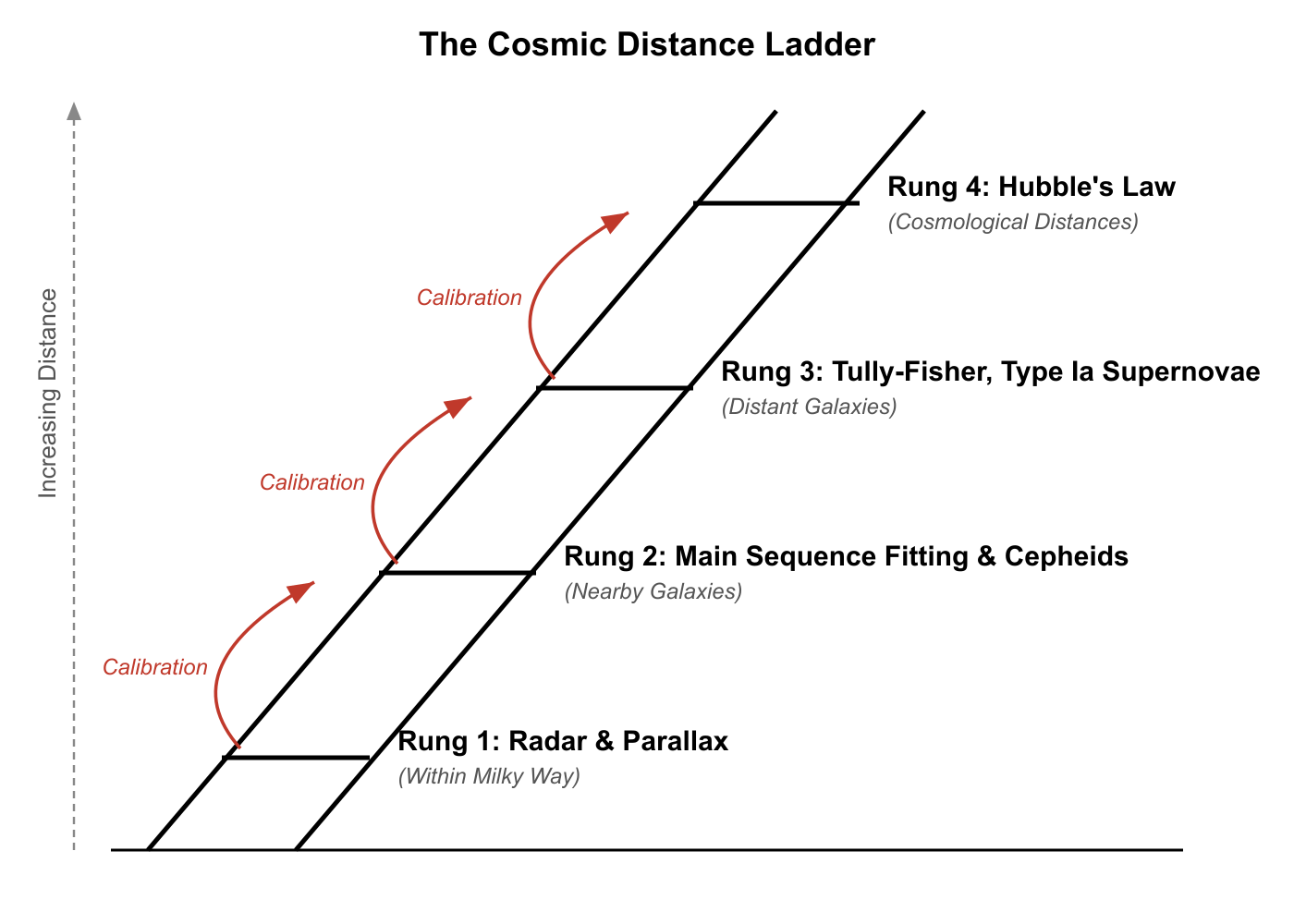
The diagram provided illustrates the structure of the cosmic distance ladder. The principle of calibration is key to its function. Which statement best describes the relationship between the methods on Rung 2 and Rung 3?
- The absolute luminosities for Rung 3 indicators, like Type Ia supernovae, are determined by observing them in galaxies whose distances are already known from Rung 2 indicators, like Cepheids. (correct answer)
- The distances determined using Cepheids (Rung 2) are checked for accuracy against the more reliable distances derived from Type Ia supernovae (Rung 3).
- Both Cepheid variables (Rung 2) and Type Ia supernovae (Rung 3) are independently calibrated using direct parallax measurements from Rung 1.
- Type Ia supernovae (Rung 3) are used to determine the intrinsic physical properties, such as mass and composition, of the Cepheid variables found on Rung 2.
Explanation: The diagram shows that the ladder is built upwards, with lower rungs calibrating higher rungs. Rung 2 (Cepheids) is used to measure distances to nearby galaxies. Rung 3 (Type Ia Supernovae) can be used for more distant galaxies because supernovae are much brighter. To use supernovae as standard candles, we must know their absolute luminosity. We determine this by finding a supernova in a relatively nearby galaxy where we can also measure the distance using Cepheids. By comparing the supernova's apparent brightness to the known Cepheid distance, we can calculate the supernova's intrinsic luminosity. This calibrated value can then be used for all other Type Ia supernovae at much greater distances.
- A (Correct): This accurately describes the calibration process where the established method (Cepheids) is used to set the scale for the next method (Supernovae).
- B (Incorrect): This reverses the flow of calibration. The higher rungs depend on the lower rungs, not the other way around. Supernovae distances are considered reliable because they are calibrated by Cepheids.
- C (Incorrect): Direct parallax can only be used for relatively nearby stars within our own galaxy. No supernova has ever occurred close enough for a direct parallax measurement, nor can we measure parallax to other galaxies. Therefore, supernovae cannot be directly calibrated by parallax.
- D (Incorrect): The relationship between these rungs is strictly for distance calibration. While we study the physics of both objects, we do not use supernovae to determine the physical properties of Cepheids.
Question 2
Imagine it is discovered that Type Ia supernovae are not true standard candles. Instead, their peak absolute magnitude is found to depend strongly on the age of the progenitor star system, a property that is difficult to determine for distant galaxies.
What would be the most profound consequence of this discovery for modern cosmology?
- The age of the universe, as estimated from the Hubble constant, would immediately be proven to be much younger.
- The calculated distances to all galaxies, including nearby ones like Andromeda, would have to be revised.
- The primary evidence for the accelerating expansion of the universe would be severely weakened. (correct answer)
- The period-luminosity relationship for Cepheid variables would need to be re-calibrated from scratch.
Explanation: When you encounter questions about standard candles in cosmology, focus on how they form the foundation of distance measurements and major cosmological discoveries. Type Ia supernovae are crucial because they appear to have consistent peak brightness, allowing astronomers to calculate distances to far-off galaxies.
The discovery of accelerating universal expansion—which led to the Nobel Prize and our understanding of dark energy—relies heavily on Type Ia supernovae as reliable distance indicators. If their brightness actually varies with stellar age (something we can't easily measure for distant galaxies), then all those distance calculations become unreliable. This would fundamentally undermine the primary evidence for cosmic acceleration, making option C correct.
Let's examine why the other answers miss the mark. Option A incorrectly assumes the Hubble constant age estimate would specifically become "much younger"—but if anything, unreliable distance measurements would create uncertainty in all directions, not a systematic bias toward younger ages. Option B overstates the impact; nearby galaxies like Andromeda are measured using other methods (like Cepheid variables), so their distances wouldn't necessarily need revision. Option D creates a false connection—Cepheid variable calibration is independent of Type Ia supernovae properties, so this discovery wouldn't directly affect the period-luminosity relationship.
Remember this pattern: when evaluating the consequences of flawed astronomical measurements, trace through which major discoveries depend most directly on that specific tool. Type Ia supernovae are the backbone of dark energy research, making this discovery's most profound impact on our understanding of cosmic acceleration.
Question 3
The cosmic distance ladder is primarily built upon "standard candles." However, some methods, such as those using eclipsing binaries or baryon acoustic oscillations, are considered "standard rulers." What is the fundamental difference between using a standard candle and a standard ruler to determine distance?
- Standard candles are physical objects like stars, while standard rulers refer to statistical properties of the universe like the distribution of galaxies.
- A standard candle has a known luminosity, and distance is found from its apparent brightness; a standard ruler has a known physical size, and distance is found from its apparent angular size. (correct answer)
- Standard rulers provide more precise distance measurements but are only effective for nearby objects, whereas standard candles are less precise but can be used for more distant objects.
- A standard candle's measurement relies on spectroscopy to determine its luminosity, while a standard ruler's measurement relies on photometry to determine its size.
Explanation: The cosmic distance ladder relies on two fundamental measurement principles that exploit different physical properties of astronomical objects. Understanding this distinction is crucial for grasping how astronomers map the universe's scale.
A standard candle is an object with a known intrinsic luminosity (actual brightness). By measuring how bright it appears from Earth and comparing this to its known true brightness, you can calculate distance using the inverse square law: dimmer appearance means greater distance. Cepheid variables and Type Ia supernovae are classic examples.
A standard ruler, conversely, is a feature with a known physical size. By measuring its apparent angular size in the sky and knowing its actual physical dimensions, you can determine distance through geometry: smaller angular appearance indicates greater distance. Eclipsing binary star separations and baryon acoustic oscillations (the characteristic scale of matter density fluctuations) serve as cosmic rulers.
Choice A incorrectly suggests the difference is about physical objects versus statistical properties, but both methods can involve either. Choice C reverses the typical precision and distance capabilities—standard rulers often work better at large scales. Choice D confuses the measurement techniques; both methods can use various observational approaches, and the distinction isn't about spectroscopy versus photometry.
The correct answer is B because it captures the fundamental physics: standard candles exploit known luminosity measured through apparent brightness, while standard rulers exploit known size measured through apparent angular extent.
Remember this key distinction: candles = brightness measurements, rulers = size measurements. Each exploits different inverse relationships with distance.
Question 4
Suppose the Gaia space observatory provides a new, highly precise parallax measurement for a sample of Cepheid variable stars, revealing they are, on average, 5% farther away than previously thought.
What is the most significant, direct implication of this finding for the cosmic distance ladder?
- The derived distances to galaxies measured using Type Ia supernovae would need to be revised upward by approximately 5%. (correct answer)
- The value of the Hubble constant (H₀) would decrease, suggesting a slower rate of cosmic expansion.
- The period-luminosity relationship for Cepheid variables would be invalidated as a reliable distance indicator.
- The distances measured using trigonometric parallax for other nearby stars would be considered less certain.
Explanation: The cosmic distance ladder is a chain of calibration. Parallax is used to find the distance to nearby Cepheids, which calibrates their true luminosity (absolute magnitude). This calibrated period-luminosity relationship is then used to find the distance to galaxies containing Cepheids. In turn, these galaxies (which have also hosted Type Ia supernovae) are used to calibrate the absolute magnitude of supernovae. If Cepheids are 5% farther away, their intrinsic luminosity must be greater than previously thought. This revised, brighter calibration for Cepheids would then be applied to Type Ia supernovae, making them also intrinsically brighter. For a supernova of a given apparent brightness, a higher intrinsic brightness implies it is farther away. Thus, all distances derived from supernovae would increase.
- A (Correct): Correctly identifies the propagation of the calibration change up the ladder. If Cepheids are farther, they are more luminous. This makes the supernovae they calibrate also more luminous, which in turn means galaxies measured via supernovae are farther away.
- B (Incorrect): This reverses the logic. Hubble's Law is v = H₀d. If the distance (d) to calibrating galaxies increases for the same recessional velocity (v), the Hubble constant (H₀) must increase, suggesting a faster expansion.
- C (Incorrect): The relationship itself (that period correlates with luminosity) is not invalidated. Rather, its calibration—the specific luminosity for a given period—is what gets revised. The method remains valid.
- D (Incorrect): A new, more precise measurement for one set of stars does not decrease the certainty of other, independent parallax measurements. It improves the overall foundation of the ladder.
Question 5
The entire cosmic distance ladder is a chain of calibrations, with each rung resting on the one below it. Which of the following measurements provides the most fundamental, geometric calibration for the entire extragalactic distance scale?
- The recessional velocity of the Coma Cluster of galaxies.
- The distance to the Large Magellanic Cloud determined via eclipsing binaries.
- The parallax of Cepheid variable stars within the Milky Way. (correct answer)
- The value of the Astronomical Unit (AU) determined via radar ranging.
Explanation: The cosmic distance ladder is astronomy's method for measuring distances to increasingly remote objects, with each "rung" calibrated using the previous one. To find the most fundamental calibration for the extragalactic distance scale, you need to identify which measurement forms the foundation that all galaxy distance measurements ultimately depend on.
The correct answer is C because Cepheid variable stars serve as the crucial bridge between our local measurements and extragalactic distances. These stars have a well-established period-luminosity relationship that makes them "standard candles" - once you know a Cepheid's period, you can determine its intrinsic brightness and thus its distance. However, this relationship must first be calibrated using nearby Cepheids in our own galaxy whose distances we can measure geometrically via parallax. Without accurate parallax distances to local Cepheids, we couldn't reliably use them to measure distances to other galaxies.
Option A is wrong because the Coma Cluster's recessional velocity tells us about cosmic expansion, not fundamental distance calibration. Option B is incorrect because while eclipsing binaries in the Large Magellanic Cloud do provide distance measurements, they're not the foundational calibration that enables all extragalactic measurements. Option D is wrong because the AU calibrates solar system distances but doesn't directly impact the extragalactic distance scale.
Remember: when tackling cosmic distance ladder questions, trace backwards from the most distant measurements to find what foundational calibration everything else depends on. Cepheid parallax measurements are that crucial foundation for extragalactic astronomy.
Question 6
The cosmic distance ladder is primarily built upon "standard candles." However, some methods, such as those using eclipsing binaries or baryon acoustic oscillations, are considered "standard rulers." What is the fundamental difference between using a standard candle and a standard ruler to determine distance?
- Standard candles are physical objects like stars, while standard rulers refer to statistical properties of the universe like the distribution of galaxies.
- A standard candle has a known luminosity, and distance is found from its apparent brightness; a standard ruler has a known physical size, and distance is found from its apparent angular size. (correct answer)
- Standard rulers provide more precise distance measurements but are only effective for nearby objects, whereas standard candles are less precise but can be used for more distant objects.
- A standard candle's measurement relies on spectroscopy to determine its luminosity, while a standard ruler's measurement relies on photometry to determine its size.
Explanation: The cosmic distance ladder relies on two fundamental measurement principles that exploit different physical properties of astronomical objects. Understanding this distinction is crucial for grasping how astronomers map the universe's scale.
A standard candle is an object with a known intrinsic luminosity (actual brightness). By measuring how bright it appears from Earth and comparing this to its known true brightness, you can calculate distance using the inverse square law: dimmer appearance means greater distance. Cepheid variables and Type Ia supernovae are classic examples.
A standard ruler, conversely, is a feature with a known physical size. By measuring its apparent angular size in the sky and knowing its actual physical dimensions, you can determine distance through geometry: smaller angular appearance indicates greater distance. Eclipsing binary star separations and baryon acoustic oscillations (the characteristic scale of matter density fluctuations) serve as cosmic rulers.
Choice A incorrectly suggests the difference is about physical objects versus statistical properties, but both methods can involve either. Choice C reverses the typical precision and distance capabilities—standard rulers often work better at large scales. Choice D confuses the measurement techniques; both methods can use various observational approaches, and the distinction isn't about spectroscopy versus photometry.
The correct answer is B because it captures the fundamental physics: standard candles exploit known luminosity measured through apparent brightness, while standard rulers exploit known size measured through apparent angular extent.
Remember this key distinction: candles = brightness measurements, rulers = size measurements. Each exploits different inverse relationships with distance.
Question 7
There is a well-known 'Hubble Tension' in modern cosmology. Distance measurements using the traditional distance ladder (based on Cepheids and Supernovae) consistently result in a higher value for the Hubble constant (H₀) than the value inferred from measurements of the Cosmic Microwave Background (CMB).
Assuming the CMB-derived value is correct, this discrepancy suggests a potential systematic error in the traditional distance ladder. What change to the ladder's calibration would resolve this tension?
- The standard candles (Cepheids and SNe Ia) used for calibration are intrinsically brighter than currently assumed, meaning the host galaxies are farther.
- The standard candles (Cepheids and SNe Ia) used for calibration are intrinsically fainter than currently assumed, meaning the host galaxies are closer. (correct answer)
- Random errors in measuring apparent magnitudes of supernovae are larger than estimated, adding more scatter to the data.
- The peculiar velocities of the calibrating galaxies are systematically directed away from us, artificially inflating their redshifts.
Explanation: When you encounter questions about the Hubble tension, focus on the relationship between distance measurements and the Hubble constant: H0=v/d. If the CMB gives a lower value for H0 than the distance ladder, then for the same recession velocity v, the distance ladder must be systematically underestimating distances.
The correct answer is B because if standard candles are intrinsically fainter than assumed, we've been overestimating their distances. Here's why: when you see a dim star, you assume it's far away. But if that star is actually intrinsically dimmer than you thought, it's actually closer than you calculated. This systematic underestimation of distances inflates H0 since H0=v/d - smaller denominators mean larger values.
Answer A is backwards - if standard candles were intrinsically brighter, we'd be overestimating distances, which would decrease H0, worsening the tension rather than resolving it.
Answer C describes random errors that add scatter but wouldn't create the systematic bias needed to explain why distance ladder measurements consistently give higher H0 values.
Answer D confuses the issue - peculiar velocities affecting redshift wouldn't systematically bias distance measurements, which depend on apparent brightness, not redshift.
Study tip: Remember that Hubble tension questions test your understanding of systematic vs. random errors and the inverse relationship in H0=v/d. If one method gives consistently higher H0, ask yourself: "Is this method systematically under- or overestimating distances?" Question 8
The concept of a "ladder" implies that each rung must overlap with the one below it for calibration. Which of the following scenarios represents a critical overlap point necessary for connecting the Cepheid scale to the supernova scale?
- The Sun, whose distance is known from radar ranging and whose properties are used to calibrate the main sequence of nearby stars.
- A globular cluster in the Milky Way whose distance is measured by both parallax and the brightness of its RR Lyrae variable stars.
- A distant quasar whose distance is estimated using Hubble's Law and which also has its light gravitationally lensed by a foreground galaxy.
- A nearby galaxy is close enough for its distance to be measured with Cepheid variables and has also hosted an observable Type Ia supernova. (correct answer)
Explanation: When you encounter questions about the cosmic distance ladder, think about how astronomers must carefully connect different measurement techniques across overlapping distance ranges to map the universe's scale.
The cosmic distance ladder works by using closer, well-calibrated objects to validate more distant measurement methods. For connecting Cepheid variables (which work within our local galaxy group) to Type Ia supernovae (which reach across the observable universe), you need an object that can be measured by both techniques simultaneously.
Option D provides exactly this critical overlap: a nearby galaxy close enough for individual Cepheid stars to be observed and measured, but which has also hosted a Type Ia supernova. This allows astronomers to calibrate the absolute brightness of Type Ia supernovae using the already-established Cepheid distance scale, creating the essential bridge between these two rungs of the distance ladder.
Option A describes calibrating stellar properties using solar measurements, which connects parallax distances to main sequence fitting - this is a much earlier rung in the ladder. Option B involves RR Lyrae variables and parallax within our own galaxy, connecting two short-range techniques rather than bridging to the supernova scale. Option C mentions quasars and gravitational lensing, which are tools for the most distant measurements but don't provide the specific Cepheid-supernova overlap needed.
Remember that distance ladder questions often test whether you understand these crucial overlap zones. Look for scenarios where two different measurement techniques can be applied to the same astronomical object or system.
Question 9
Hubble's Law (v = H₀d) is the final rung on the cosmic distance ladder, used to estimate distances to the most remote objects from their redshifts. The reliability of these distances depends on several underlying assumptions. A breakdown of which assumption would most directly challenge the use of Hubble's Law as a uniform distance indicator across the sky?
- All galaxies are gravitationally bound within clusters, and the expansion occurs only between these clusters.
- The peculiar velocities of individual galaxies are always negligible compared to their Hubble flow velocity.
- The rate of universal expansion has been constant throughout all of cosmic history.
- The value of the Hubble parameter, H₀, is the same in all directions on large scales (cosmological principle of isotropy). (correct answer)
Explanation: When dealing with Hubble's Law as a distance measurement tool, you need to understand that it assumes the universe expands uniformly in all directions. The key question here is which assumption, if violated, would make Hubble's Law unreliable as a "uniform distance indicator across the sky."
The correct answer is D because Hubble's Law fundamentally depends on isotropy—the idea that the Hubble parameter H0 is the same in all directions. If H0 varied significantly across different regions of the sky, then measuring a galaxy's redshift and applying v=H0d would give different distance estimates depending on which direction you're looking. This would make it impossible to use Hubble's Law as a uniform, reliable distance tool across the entire observable universe.
Let's examine why the other options are less critical: A is incorrect because while gravitational binding within clusters does affect local dynamics, astronomers already account for this when applying Hubble's Law to sufficiently large scales. B is wrong because peculiar velocities, while important, can be statistically averaged out over large samples—they don't fundamentally break the method's uniformity. C is incorrect because while a changing expansion rate affects the relationship between redshift and distance over cosmic time, it doesn't prevent uniform application of Hubble's Law at any given epoch.
Remember: isotropy is one of the fundamental pillars of modern cosmology. When you see questions about large-scale cosmic measurements, always consider whether the assumed uniformity of physical laws and parameters across space could be the critical factor. Question 10
An astronomer argues that to simplify the distance ladder, we should find the single most luminous type of object in the universe that has a consistent brightness and use it for all extragalactic distances, abandoning the complex 'ladder' of different methods.
- Without a method to determine the distance to at least one nearby example of this object independently, its absolute luminosity cannot be calibrated. (correct answer)
- The most luminous objects, such as quasars, are known to be too variable in their luminosity to serve as reliable standard candles.
- Such highly luminous objects are so rare that there would not be a large enough sample to map the universe effectively.
- Light from the most luminous objects would be distorted by gravitational lensing, making brightness an unreliable measure of distance.
Explanation: This question gets to the core reason for the ladder's existence. Even if we found a perfectly consistent, ultra-luminous object, it is useless as a standard candle until we know its absolute luminosity (L). To find L, we need to measure the distance (d) and apparent flux (F) of at least one example and use the formula L = F * 4πd². This requires an independent, and likely geometric, distance measurement. Since ultra-luminous objects are by nature very distant, no such direct distance measurement is possible. We would still need the lower rungs of the ladder (parallax, Cepheids) to work our way out to a distance where we could find one of these objects in a galaxy with a known distance, in order to perform the crucial calibration. The ladder is inescapable because calibration is essential.
- A (Correct): This identifies the fundamental flaw: a standard candle cannot be used until it is calibrated, and calibration requires an independent distance measurement provided by a lower rung of the ladder.
- B (Incorrect): While it is true that many luminous objects like quasars are variable, this is a property of a specific object class. The argument's flaw is more fundamental than the properties of any one candidate object.
- C (Incorrect): Rarity is a practical problem, but not the fundamental conceptual flaw in the reasoning, which is the problem of calibration.
- D (Incorrect): Gravitational lensing is a source of error and complexity, but it doesn't invalidate the entire standard candle concept. The core issue is calibration.
Question 11
Astronomers discover a new type of stellar explosion, "Type Z novae," which are significantly brighter than Cepheid variables but less luminous than Type Ia supernovae. They are observed to have a very consistent peak absolute magnitude across different environments.
For this discovery to be most useful as a new rung on the cosmic distance ladder, what crucial calibration step must be accomplished first?
- Identify several Type Z novae in galaxies whose distances have already been firmly established using Cepheid variables. (correct answer)
- Measure the redshift of the host galaxies of many Type Z novae to calibrate their luminosity using Hubble's Law.
- Develop a comprehensive theoretical model from first principles that explains the explosion mechanism of Type Z novae.
- Use trigonometric parallax to directly measure the distance to a nearby galaxy that has hosted a Type Z novae.
Explanation: To add a new rung to the distance ladder, it must be calibrated against a lower, more established rung. The new objects (Type Z novae) are brighter than Cepheids, so they can be seen farther away, making them a potential higher rung. To use them as a standard candle, we must first determine their absolute magnitude. The only way to do this is to find them in galaxies where we already know the distance from a reliable, lower-rung method. Since they are brighter than Cepheids, the logical step is to find them in galaxies where Cepheids have already provided a distance. By measuring the apparent magnitude of a Type Z novae in a galaxy with a known Cepheid distance, its absolute magnitude can be calculated, thus calibrating it for use at greater distances.
- A (Correct): This describes the essential process of calibration: using a known distance from a lower rung (Cepheids) to determine the absolute magnitude of the objects on the new, higher rung (Type Z novae).
- B (Incorrect): This inverts the logic of the distance ladder. Hubble's Law is the highest rung and is itself calibrated by standard candles. Using it to calibrate a new standard candle would be circular reasoning.
- C (Incorrect): While a theoretical model is scientifically valuable, it is not a prerequisite for using an object as a standard candle. Many standard candles, including Cepheids, were used effectively based on empirical calibration long before their physics was fully understood.
- D (Incorrect): Trigonometric parallax is not powerful enough to measure the distance to any galaxy, even nearby ones, that could host such an event. Parallax measures distances to individual stars within our own galaxy.
Question 12
Suppose the Gaia space observatory provides a new, highly precise parallax measurement for a sample of Cepheid variable stars, revealing they are, on average, 5% farther away than previously thought.
What is the most significant, direct implication of this finding for the cosmic distance ladder?
- The derived distances to galaxies measured using Type Ia supernovae would need to be revised upward by approximately 5%. (correct answer)
- The value of the Hubble constant (H₀) would decrease, suggesting a slower rate of cosmic expansion.
- The period-luminosity relationship for Cepheid variables would be invalidated as a reliable distance indicator.
- The distances measured using trigonometric parallax for other nearby stars would be considered less certain.
Explanation: The cosmic distance ladder is a chain of calibration. Parallax is used to find the distance to nearby Cepheids, which calibrates their true luminosity (absolute magnitude). This calibrated period-luminosity relationship is then used to find the distance to galaxies containing Cepheids. In turn, these galaxies (which have also hosted Type Ia supernovae) are used to calibrate the absolute magnitude of supernovae. If Cepheids are 5% farther away, their intrinsic luminosity must be greater than previously thought. This revised, brighter calibration for Cepheids would then be applied to Type Ia supernovae, making them also intrinsically brighter. For a supernova of a given apparent brightness, a higher intrinsic brightness implies it is farther away. Thus, all distances derived from supernovae would increase.
- A (Correct): Correctly identifies the propagation of the calibration change up the ladder. If Cepheids are farther, they are more luminous. This makes the supernovae they calibrate also more luminous, which in turn means galaxies measured via supernovae are farther away.
- B (Incorrect): This reverses the logic. Hubble's Law is v = H₀d. If the distance (d) to calibrating galaxies increases for the same recessional velocity (v), the Hubble constant (H₀) must increase, suggesting a faster expansion.
- C (Incorrect): The relationship itself (that period correlates with luminosity) is not invalidated. Rather, its calibration—the specific luminosity for a given period—is what gets revised. The method remains valid.
- D (Incorrect): A new, more precise measurement for one set of stars does not decrease the certainty of other, independent parallax measurements. It improves the overall foundation of the ladder.
Question 13
An astronomer is re-evaluating the total uncertainty in the measurement of the Hubble constant (H₀) derived from the distance ladder. Which of the following sources of uncertainty would have the most systematic and widespread impact on the final calculated value of H₀?
- The peculiar velocity of a single nearby galaxy used to help calibrate the Tully-Fisher relation.
- The random statistical error in measuring the apparent magnitude of a single Type Ia supernova in a very distant galaxy.
- Uncertainty in the model of stellar parallax arising from the Earth's non-circular orbit around the Sun.
- An undiscovered systematic error in the calibration of the Cepheid period-luminosity relationship's zero-point. (correct answer)
Explanation: When evaluating uncertainties in astronomical measurements, you need to distinguish between errors that affect individual data points versus those that propagate systematically through entire measurement chains. The distance ladder method for determining the Hubble constant relies on a carefully calibrated sequence of distance measurements, where each rung depends on the accuracy of previous steps.
Answer D is correct because the Cepheid period-luminosity relationship serves as a fundamental calibrator in the cosmic distance ladder. Cepheids are used to measure distances to nearby galaxies containing Type Ia supernovae, which then serve as standard candles for measuring distances to very remote galaxies. A systematic error in the Cepheid zero-point calibration would propagate through every subsequent distance measurement, creating a coherent bias in all calculated distances and therefore in H₀ itself.
Answer A is wrong because the peculiar velocity of a single galaxy represents a random error that affects only one data point and would average out across many measurements. Answer B is incorrect for similar reasons – statistical error in measuring one supernova's magnitude is random noise that doesn't systematically bias the entire dataset. Answer C is wrong because parallax measurements, while fundamental, primarily affect only the nearest stellar distance measurements and modern parallax techniques (like those from Gaia) account for orbital mechanics very precisely.
Remember: in astronomy, systematic errors that affect calibration standards have far more impact than random errors in individual measurements, because systematic errors propagate coherently through all subsequent calculations in the measurement chain.
Question 14
An astronomer measures the apparent magnitude (m) of a Cepheid variable in Galaxy M101 and determines its pulsation period. Using the established period-luminosity relationship, they calculate its absolute magnitude (M).
Which rung of the cosmic distance ladder was most essential for establishing the very relationship that allowed the astronomer to determine the absolute magnitude (M) in the first place?
- Radar ranging of planets within our Solar System to establish the Astronomical Unit (AU).
- Observations of Type Ia supernovae in galaxies beyond M101.
- Redshift measurements of M101 and other nearby galaxies using Hubble's Law.
- Trigonometric parallax of Cepheids or star clusters containing Cepheids within the Milky Way. (correct answer)
Explanation: This question tests your understanding of how the cosmic distance ladder builds upon itself, with each "rung" depending on more fundamental measurements below it. When you see questions about establishing astronomical relationships, think about which measurements had to come first historically and logically.
The period-luminosity relationship for Cepheid variables was established by studying Cepheids whose distances we could measure independently. This calibration required knowing both the apparent brightness and the actual distance to these stars, so we could calculate their true luminosity. Only then could astronomers relate pulsation period to absolute magnitude.
Answer D is correct because trigonometric parallax provided the only direct, geometric way to measure distances to nearby Cepheids in our galaxy. By measuring parallax for Cepheids (or for other stars in clusters containing Cepheids), astronomers could determine their distances independently of their brightness. This allowed them to convert apparent magnitudes to absolute magnitudes and establish the period-luminosity relationship.
Answer A is wrong because radar ranging establishes the AU scale but doesn't reach the distances needed for Cepheid calibration. Answer B represents a higher rung of the distance ladder—Type Ia supernovae are calibrated using Cepheids, not the other way around. Answer C is incorrect because Hubble's Law itself was established using Cepheid distances to nearby galaxies, making it dependent on the period-luminosity relationship rather than foundational to it.
Remember: the cosmic distance ladder builds from the bottom up. Each rung calibrates the next, so look for the most fundamental measurement that could establish the relationship in question.
Question 15
The concept of a "ladder" implies that each rung must overlap with the one below it for calibration. Which of the following scenarios represents a critical overlap point necessary for connecting the Cepheid scale to the supernova scale?
- The Sun, whose distance is known from radar ranging and whose properties are used to calibrate the main sequence of nearby stars.
- A globular cluster in the Milky Way whose distance is measured by both parallax and the brightness of its RR Lyrae variable stars.
- A distant quasar whose distance is estimated using Hubble's Law and which also has its light gravitationally lensed by a foreground galaxy.
- A nearby galaxy is close enough for its distance to be measured with Cepheid variables and has also hosted an observable Type Ia supernova. (correct answer)
Explanation: When you encounter questions about the cosmic distance ladder, think about how astronomers must carefully connect different measurement techniques across overlapping distance ranges to map the universe's scale.
The cosmic distance ladder works by using closer, well-calibrated objects to validate more distant measurement methods. For connecting Cepheid variables (which work within our local galaxy group) to Type Ia supernovae (which reach across the observable universe), you need an object that can be measured by both techniques simultaneously.
Option D provides exactly this critical overlap: a nearby galaxy close enough for individual Cepheid stars to be observed and measured, but which has also hosted a Type Ia supernova. This allows astronomers to calibrate the absolute brightness of Type Ia supernovae using the already-established Cepheid distance scale, creating the essential bridge between these two rungs of the distance ladder.
Option A describes calibrating stellar properties using solar measurements, which connects parallax distances to main sequence fitting - this is a much earlier rung in the ladder. Option B involves RR Lyrae variables and parallax within our own galaxy, connecting two short-range techniques rather than bridging to the supernova scale. Option C mentions quasars and gravitational lensing, which are tools for the most distant measurements but don't provide the specific Cepheid-supernova overlap needed.
Remember that distance ladder questions often test whether you understand these crucial overlap zones. Look for scenarios where two different measurement techniques can be applied to the same astronomical object or system.
Question 16
Imagine it is discovered that Type Ia supernovae are not true standard candles. Instead, their peak absolute magnitude is found to depend strongly on the age of the progenitor star system, a property that is difficult to determine for distant galaxies.
What would be the most profound consequence of this discovery for modern cosmology?
- The age of the universe, as estimated from the Hubble constant, would immediately be proven to be much younger.
- The calculated distances to all galaxies, including nearby ones like Andromeda, would have to be revised.
- The primary evidence for the accelerating expansion of the universe would be severely weakened. (correct answer)
- The period-luminosity relationship for Cepheid variables would need to be re-calibrated from scratch.
Explanation: When you encounter questions about standard candles in cosmology, focus on how they form the foundation of distance measurements and major cosmological discoveries. Type Ia supernovae are crucial because they appear to have consistent peak brightness, allowing astronomers to calculate distances to far-off galaxies.
The discovery of accelerating universal expansion—which led to the Nobel Prize and our understanding of dark energy—relies heavily on Type Ia supernovae as reliable distance indicators. If their brightness actually varies with stellar age (something we can't easily measure for distant galaxies), then all those distance calculations become unreliable. This would fundamentally undermine the primary evidence for cosmic acceleration, making option C correct.
Let's examine why the other answers miss the mark. Option A incorrectly assumes the Hubble constant age estimate would specifically become "much younger"—but if anything, unreliable distance measurements would create uncertainty in all directions, not a systematic bias toward younger ages. Option B overstates the impact; nearby galaxies like Andromeda are measured using other methods (like Cepheid variables), so their distances wouldn't necessarily need revision. Option D creates a false connection—Cepheid variable calibration is independent of Type Ia supernovae properties, so this discovery wouldn't directly affect the period-luminosity relationship.
Remember this pattern: when evaluating the consequences of flawed astronomical measurements, trace through which major discoveries depend most directly on that specific tool. Type Ia supernovae are the backbone of dark energy research, making this discovery's most profound impact on our understanding of cosmic acceleration.
Question 17
An astronomer wants to measure the distance to four objects: (1) the Hyades star cluster (at ~47 parsecs), (2) the Andromeda Galaxy (at ~0.77 megaparsecs), (3) the Virgo Cluster of galaxies (at ~16.5 megaparsecs), and (4) a quasar with a redshift of z = 2.
Which sequence of distance measurement techniques is most appropriate for this set of objects, ordered from nearest to farthest?
- Radar Ranging, Trigonometric Parallax, Type Ia Supernovae, Cepheid Variables.
- Trigonometric Parallax, Cepheid Variables, Tully-Fisher Relation, Hubble's Law. (correct answer)
- Main-Sequence Fitting, Hubble's Law, Cepheid Variables, Type Ia Supernovae.
- Trigonometric Parallax, Type Ia Supernovae, Cepheid Variables, Hubble's Law.
Explanation: When you encounter distance measurement questions in astronomy, think about the cosmic distance ladder - a hierarchy of techniques that work at different scales, from nearby objects to the edge of the observable universe.
The correct sequence follows this ladder logically. For the Hyades cluster at 47 parsecs, trigonometric parallax is ideal - this direct geometric method works reliably out to about 100 parsecs using the Earth's orbital motion. The Andromeda Galaxy at 0.77 megaparsecs requires Cepheid variables - these pulsating stars have a period-luminosity relationship that makes them excellent "standard candles" for distances up to about 25 megaparsecs. For the Virgo Cluster at 16.5 megaparsecs, the Tully-Fisher relation (correlating galaxy rotation speed with luminosity) works well for galaxy clusters. Finally, the quasar at z=2 is so distant that only Hubble's Law applies - using redshift to calculate distance based on universal expansion.
Option A incorrectly suggests radar ranging (only useful within our solar system) and places supernovae before Cepheids. Option C puts main-sequence fitting first (better for more distant clusters than nearby ones) and jumbles the remaining techniques illogically. Option D places Type Ia supernovae before Cepheids, but supernovae are needed for much greater distances than Andromeda.
Study tip: Memorize the distance ladder sequence - parallax (nearest), Cepheids (nearby galaxies), various galaxy relations (galaxy clusters), then Hubble's Law (most distant). Each technique has an effective range where it works best.
Question 18
To increase confidence in the cosmic distance ladder, astronomers seek independent methods to verify distances. Which of the following would constitute a genuinely independent, geometric cross-check on the distance to a galaxy like NGC 4258, a galaxy for which a Cepheid-based distance exists?
- Identifying and measuring the periods and magnitudes of RR Lyrae variable stars within the galaxy.
- Using the Tully-Fisher relation, which connects the galaxy's rotation speed to its luminosity, to estimate its distance.
- Measuring the proper motion and radial velocity of water masers in a disk orbiting the galaxy's central supermassive black hole. (correct answer)
- Observing a Type Ia supernova in that galaxy and comparing its derived distance to the Cepheid distance.
Explanation: The cosmic distance ladder relies on calibrating closer distance measurements to extend our reach to more distant objects. When astronomers want to verify these distances, they need truly independent methods—techniques that don't rely on the same physical principles or assumptions as the original measurement.
Option C provides a genuine geometric cross-check because water maser observations can directly measure the physical size and geometry of the accretion disk around a supermassive black hole. By tracking how these masers move over time and measuring their velocities, astronomers can determine the actual physical dimensions of the disk. Combined with the disk's angular size as seen from Earth, this gives a direct geometric distance through simple trigonometry—completely independent of any stellar physics assumptions used in Cepheid measurements.
Option A fails because RR Lyrae stars are also pulsating variable stars that rely on the same period-luminosity relationships as Cepheids. This isn't truly independent—it's just another rung on the same distance ladder. Option B uses the Tully-Fisher relation, which itself must be calibrated using other distance methods, making it dependent rather than independent. Option D involving Type Ia supernovae also relies on calibrations from the distance ladder, including Cepheid distances, so it's circular reasoning rather than an independent check.
Remember that "independent" in astronomy means using completely different physical principles. Look for geometric methods (like parallax, surface brightness fluctuations, or maser kinematics) when you need to verify photometric distance measurements like those from variable stars.
Question 19
An astronomer measures the apparent magnitude (m) of a Cepheid variable in Galaxy M101 and determines its pulsation period. Using the established period-luminosity relationship, they calculate its absolute magnitude (M).
Which rung of the cosmic distance ladder was most essential for establishing the very relationship that allowed the astronomer to determine the absolute magnitude (M) in the first place?
- Radar ranging of planets within our Solar System to establish the Astronomical Unit (AU).
- Observations of Type Ia supernovae in galaxies beyond M101.
- Redshift measurements of M101 and other nearby galaxies using Hubble's Law.
- Trigonometric parallax of Cepheids or star clusters containing Cepheids within the Milky Way. (correct answer)
Explanation: This question tests your understanding of how the cosmic distance ladder builds upon itself, with each "rung" depending on more fundamental measurements below it. When you see questions about establishing astronomical relationships, think about which measurements had to come first historically and logically.
The period-luminosity relationship for Cepheid variables was established by studying Cepheids whose distances we could measure independently. This calibration required knowing both the apparent brightness and the actual distance to these stars, so we could calculate their true luminosity. Only then could astronomers relate pulsation period to absolute magnitude.
Answer D is correct because trigonometric parallax provided the only direct, geometric way to measure distances to nearby Cepheids in our galaxy. By measuring parallax for Cepheids (or for other stars in clusters containing Cepheids), astronomers could determine their distances independently of their brightness. This allowed them to convert apparent magnitudes to absolute magnitudes and establish the period-luminosity relationship.
Answer A is wrong because radar ranging establishes the AU scale but doesn't reach the distances needed for Cepheid calibration. Answer B represents a higher rung of the distance ladder—Type Ia supernovae are calibrated using Cepheids, not the other way around. Answer C is incorrect because Hubble's Law itself was established using Cepheid distances to nearby galaxies, making it dependent on the period-luminosity relationship rather than foundational to it.
Remember: the cosmic distance ladder builds from the bottom up. Each rung calibrates the next, so look for the most fundamental measurement that could establish the relationship in question.
Question 20
The necessity of the cosmic distance ladder arises from a fundamental limitation in astronomical measurement. Which statement best encapsulates why a "ladder" of multiple, dependent techniques is required rather than a single, universal method?
- Each measurement technique is only sensitive to a specific type of celestial object (e.g., pulsating stars, spiral galaxies), necessitating a variety of tools to measure everything.
- The most precise, direct geometric methods of distance measurement are effective only for relatively nearby objects, requiring the calibration of less direct methods to extend our reach. (correct answer)
- The expansion of the universe distorts distance measurements, requiring different techniques that are valid in different cosmological epochs.
- Systematic errors accumulate with each new instrument, requiring older, more reliable methods to be used to continuously re-calibrate the newer ones.
Explanation: When you encounter questions about the cosmic distance ladder, remember that this is fundamentally about the practical limitations of measurement precision across vast scales. Astronomers can't use a single method to measure distances from nearby stars to distant galaxies because of how measurement accuracy degrades with distance.
The cosmic distance ladder exists because our most accurate distance measurements—direct geometric methods like parallax—only work for relatively nearby objects. Parallax, which measures the tiny apparent shift of a star's position as Earth orbits the Sun, becomes impossibly precise to detect beyond a few thousand light-years. This forces astronomers to calibrate indirect methods (like standard candles) using these precise nearby measurements, then use those calibrated methods to reach progressively farther distances. Each "rung" of the ladder extends our reach but depends on the accuracy of the previous rung.
Option A incorrectly suggests the limitation is about object types rather than distance precision. While different techniques do work on different objects, that's not the fundamental reason for the ladder structure. Option C misrepresents cosmological effects—universe expansion doesn't prevent single methods from working, and we don't need different techniques for different epochs. Option D gets the relationship backward; we use precise geometric methods to calibrate less precise but longer-range methods, not the other way around.
Remember: cosmic distance ladder questions test whether you understand that measurement precision decreases with distance, forcing astronomers to bootstrap from highly accurate nearby measurements to less direct but longer-range techniques.