All questions
Question 1
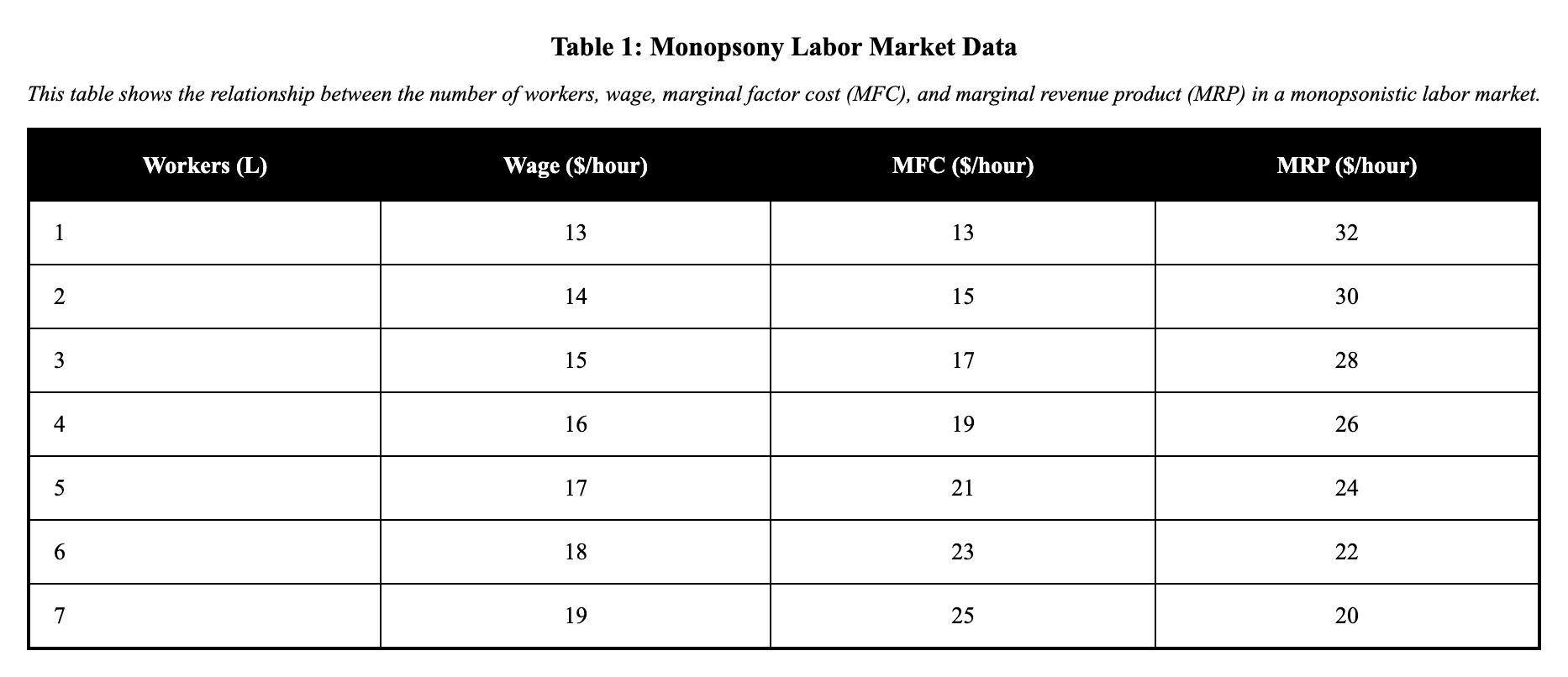
Based on the monopsonistic labor market shown in the table, a single agricultural processor is the only major employer of packers in a rural county. The labor supply to the firm is upward sloping, so MFC exceeds the wage. The processor's MRP schedule is shown. How many workers does the monopsonist hire and at what wage?
Monopsony labor market data
| Workers (L) | Wage ($/hour) | MFC ($/hour) | MRP ($/hour) |
|---|
| 1 | 13 | 13 | 32 |
| 2 | 14 | 15 | 30 |
| 3 | 15 | 17 | 28 |
| 4 | 16 | 19 | 26 |
| 5 | 17 | 21 | 24 |
| 6 | 18 | 23 | 22 |
| 7 | 19 | 25 | 20 |
- Hire 5 workers and pay $17 per hour (correct answer)
- Hire 6 workers and pay $18 per hour
- Hire 6 workers and pay $23 per hour
- Hire 7 workers and pay $19 per hour
- Hire 5 workers and pay $24 per hour
Explanation: This question illustrates monopsonistic behavior in an agricultural processing facility. A monopsony is a market with a single buyer of labor facing an upward-sloping labor supply curve, where each additional worker requires a higher wage for all workers. The fundamental concept is that MFC (marginal factor cost) exceeds the wage because hiring one more worker means paying the higher wage to all previously hired workers. The monopsonist maximizes profit where MRP = MFC, but examining the data reveals at 5 workers, MRP (24)>MFC(21), while at 6 workers, MRP (22)<MFC(23). Students often erroneously seek exact equality, but when there's no perfect match, the firm hires the last unit where MRP exceeds MFC. The transferable strategy is to locate where MRP last exceeds or equals MFC (5 workers), then find the corresponding wage from the labor supply curve ($17 per hour). Question 2
Based on the monopsonistic labor market shown in the table below (a single warehouse is the only large employer for forklift operators in the area), how many workers does the monopsonist hire and at what wage? Assume the warehouse hires where MRP=MFC and pays the wage on the labor supply curve at that level of employment.
Table: Labor Supply to the Firm and Marginal Factor Cost
| Operators hired (L) | Wage ($/hour) | MFC ($/hour) |
|---|
| 1 | 14 | 14 |
| 2 | 15 | 16 |
| 3 | 16 | 18 |
| 4 | 17 | 20 |
| 5 | 18 | 22 |
| 6 | 19 | 24 |
The warehouse's marginal revenue product (MRP) schedule is: MRP(1)=26, MRP(2)=24, MRP(3)=22, MRP(4)=20, MRP(5)=18, MRP(6)=16.
- Hire 3 operators and pay $16 per hour.
- Hire 4 operators and pay $17 per hour. (correct answer)
- Hire 4 operators and pay $20 per hour.
- Hire 5 operators and pay $18 per hour.
- Hire 5 operators and pay $22 per hour.
Explanation: This question tests your understanding of monopsonistic labor markets. A monopsony is a market structure where a single buyer, here the warehouse, dominates the demand for labor and faces an upward-sloping labor supply curve, requiring higher wages to attract additional operators. The marginal factor cost (MFC) is greater than the wage because hiring one more operator means raising the wage for all operators employed. The monopsonist hires where the marginal revenue product (MRP) equals MFC, resulting in 4 operators at a wage of $17 per hour read from the supply curve. A common misconception is treating the monopsonist as a wage taker in a competitive market, setting MRP equal to wage, which would incorrectly suggest hiring more. A transferable strategy is to find the quantity where MRP equals MFC, such as at 4 operators where both are $20. Then, read the wage directly from the supply curve at that employment level.
Question 3
Based on the monopsonistic labor market shown in the table below (a single logging company is the only employer of equipment operators in the region), how many workers does the monopsonist hire and at what wage? Assume the company hires where MRP=MFC and pays the wage on the labor supply curve at that employment level.
Table: Labor Supply to the Firm and Marginal Factor Cost
| Operators hired (L) | Wage ($/hour) | MFC ($/hour) |
|---|
| 1 | 18 | 18 |
| 2 | 19 | 20 |
| 3 | 20 | 22 |
| 4 | 21 | 24 |
| 5 | 22 | 26 |
| 6 | 23 | 28 |
The company's marginal revenue product (MRP) schedule is: MRP(1)=30, MRP(2)=28, MRP(3)=26, MRP(4)=24, MRP(5)=22, MRP(6)=20.
- Hire 3 operators and pay $20 per hour.
- Hire 4 operators and pay $21 per hour. (correct answer)
- Hire 4 operators and pay $24 per hour.
- Hire 5 operators and pay $22 per hour.
- Hire 5 operators and pay $26 per hour.
Explanation: This question tests your understanding of monopsonistic labor markets. A monopsony is a market structure where a single buyer, here the logging company, dominates the demand for labor and faces an upward-sloping labor supply curve, requiring higher wages to attract additional operators. The marginal factor cost (MFC) is greater than the wage because hiring one more operator means raising the wage for all operators employed. The monopsonist hires where the marginal revenue product (MRP) equals MFC, resulting in 4 operators at a wage of $21 per hour read from the supply curve. A common misconception is treating the monopsonist as a wage taker in a competitive market, setting MRP equal to wage, which would incorrectly suggest hiring more. A transferable strategy is to find the quantity where MRP equals MFC, such as at 4 operators where both are $24. Then, read the wage directly from the supply curve at that employment level.
Question 4
Based on the monopsonistic labor market shown in the table, a single hotel is the only large employer of housekeepers in a resort town during the off-season. The labor supply to the firm is upward sloping, so MFC exceeds the wage. The hotel's MRP schedule is shown. How many workers does the monopsonist hire and at what wage?
Monopsony labor market data
| Workers (L) | Wage ($/hour) | MFC ($/hour) | MRP ($/hour) |
|---|
| 1 | 11 | 11 | 28 |
| 2 | 12 | 13 | 26 |
| 3 | 13 | 15 | 24 |
| 4 | 14 | 17 | 22 |
| 5 | 15 | 19 | 20 |
| 6 | 16 | 21 | 18 |
- Hire 4 workers and pay $14 per hour
- Hire 5 workers and pay $15 per hour (correct answer)
- Hire 5 workers and pay $19 per hour
- Hire 6 workers and pay $16 per hour
- Hire 4 workers and pay $22 per hour
Explanation: This problem illustrates monopsonistic behavior in a hotel labor market during off-season. A monopsony occurs when a single employer faces an upward-sloping labor supply, meaning higher wages are needed to attract additional workers. The fundamental principle is that MFC (marginal factor cost) exceeds the wage because the employer must pay the new higher wage to all employees, not just the marginal worker. The profit-maximizing monopsonist hires where MRP=MFC, but the table shows at 5 workers, MRP (20)>MFC (19), while at 6 workers, MRP (18)<MFC (21). A common error is assuming exact equality is required, but when there's no perfect intersection, the firm hires up to where MRP still exceeds MFC. The key strategy is to find the last worker where MRP≥MFC (5 workers), then read the wage from the supply curve ($15 per hour). Question 5
Based on the monopsonistic labor market shown in the table, a single distribution warehouse is the only major employer of forklift operators in the area. The labor supply to the firm is upward sloping, so MFC exceeds the wage. The warehouse's MRP schedule is shown. How many workers does the monopsonist hire and at what wage?
Monopsony labor market data
| Workers (L) | Wage ($/hour) | MFC ($/hour) | MRP ($/hour) |
|---|
| 1 | 16 | 16 | 45 |
| 2 | 17 | 18 | 41 |
| 3 | 18 | 20 | 37 |
| 4 | 19 | 22 | 33 |
| 5 | 20 | 24 | 29 |
| 6 | 21 | 26 | 25 |
| 7 | 22 | 28 | 21 |
- Hire 5 workers and pay $20 per hour (correct answer)
- Hire 6 workers and pay $21 per hour
- Hire 6 workers and pay $26 per hour
- Hire 7 workers and pay $22 per hour
- Hire 5 workers and pay $29 per hour
Explanation: This question examines monopsonistic decision-making for a distribution warehouse. A monopsony is characterized by a single buyer of labor facing an upward-sloping labor supply curve, where attracting more workers requires raising wages for all employees. The crucial insight is that MFC (marginal factor cost) exceeds the wage because hiring an additional worker means paying the higher wage to all workers. The monopsonist maximizes profit where MRP = MFC, and examining the data shows at 5 workers, MRP (29)>MFC(24), but at 6 workers, MRP (25)<MFC(26). Students often mistakenly think the firm must find exact equality, but when there's no perfect match, the firm hires the last unit where MRP exceeds MFC. The transferable approach is to identify where MRP last exceeds or equals MFC (5 workers), then read the corresponding wage from the labor supply schedule ($20 per hour). Question 6
Based on the monopsonistic labor market shown in the table, a single logging company is the only buyer of seasonal labor in a remote area. The labor supply to the firm is upward sloping, so MFC exceeds the wage. The firm's MRP of labor is also given. How many workers does the monopsonist hire and at what wage?
Monopsony labor market data
| Workers (L) | Wage ($/day) | MFC ($/day) | MRP ($/day) |
|---|
| 1 | 80 | 80 | 170 |
| 2 | 90 | 100 | 150 |
| 3 | 100 | 120 | 130 |
| 4 | 110 | 140 | 110 |
| 5 | 120 | 160 | 90 |
- Hire 3 workers and pay $100 per day (correct answer)
- Hire 4 workers and pay $110 per day
- Hire 4 workers and pay $140 per day
- Hire 2 workers and pay $90 per day
- Hire 3 workers and pay $120 per day
Explanation: This question requires analyzing a monopsonistic labor market for seasonal logging workers. A monopsony exists when there's a single buyer of labor facing an upward-sloping labor supply, meaning the firm must raise wages to attract more workers. The crucial distinction is that MFC (marginal factor cost) exceeds the wage because hiring an additional worker requires paying the higher wage to all workers. The profit-maximizing monopsonist hires where MRP = MFC, but this exact equality doesn't occur in the table—at 3 workers, MRP ($130) $ > MFC(120), while at 4 workers, MRP (110) < MFC($140).Manystudentsmistakenlythinkthefirmhiresattheexactintersection,butwhenthere′snoexactmatch,thefirmhiresuptowhere$MRP≥MFC. The strategy is to find the last unit where MRP ≥ MFC, then read the wage from the supply curve—yielding 3 workers at $100 per day. Question 7
Based on the monopsonistic labor market shown in the table, a single commercial farm is the only employer of field workers in a remote valley. The farm faces an upward-sloping labor supply, so marginal factor cost (MFC) is greater than the wage. The table provides wage, MFC, and marginal revenue product (MRP). How many workers does the monopsonist hire and at what wage?
Table: Remote Valley Farm Labor Market
- Labor (workers): 1, 2, 3, 4, 5
- Wage ($ per worker): 9, 10, 11, 12, 13
- MFC ($): 9, 11, 13, 15, 17
- MRP ($): 16, 14, 12, 10, 8
- Hire 4 workers and pay a wage of $12 per worker.
- Hire 3 workers and pay a wage of $11 per worker. (correct answer)
- Hire 2 workers and pay a wage of $10 per worker.
- Hire 3 workers and pay a wage of $12 per worker.
- Hire 2 workers and pay a wage of $14 per worker.
Explanation: This question tests monopsony analysis in agricultural labor markets. A monopsony occurs when a single employer (the commercial farm) dominates the labor market, facing an upward-sloping supply curve where higher wages are needed to attract more workers. The marginal factor cost (MFC) exceeds the wage because hiring an additional worker requires raising wages for all employees, not just the marginal worker. The profit-maximizing monopsonist hires where MRP = MFC, which occurs at 3 workers where MRP (12)andMFC(13) are closest to equal. At this quantity, the monopsonist pays the supply curve wage of $11 per worker. Students often incorrectly assume monopsonists act as wage-takers like competitive firms, but monopsonists recognize their hiring decisions influence market wages. The solution strategy remains consistent: (1) find the employment level where MRP intersects MFC, then (2) determine the wage from the supply curve at that employment level. Question 8
Based on the monopsonistic labor market shown in the table, a single theme park is the only significant employer of ride operators in a small region. The labor supply to the firm is upward sloping, so MFC exceeds the wage. The theme park's MRP schedule is shown. How many workers does the monopsonist hire and at what wage?
Monopsony labor market data
| Workers (L) | Wage ($/hour) | MFC ($/hour) | MRP ($/hour) |
|---|
| 1 | 10 | 10 | 27 |
| 2 | 11 | 12 | 25 |
| 3 | 12 | 14 | 23 |
| 4 | 13 | 16 | 21 |
| 5 | 14 | 18 | 19 |
| 6 | 15 | 20 | 17 |
| 7 | 16 | 22 | 15 |
- Hire 5 workers and pay $14 per hour (correct answer)
- Hire 6 workers and pay $15 per hour
- Hire 6 workers and pay $20 per hour
- Hire 7 workers and pay $16 per hour
- Hire 5 workers and pay $19 per hour
Explanation: This problem tests understanding of monopsonistic labor markets at a theme park. A monopsony exists when there's a single employer facing an upward-sloping labor supply, requiring progressively higher wages to attract additional workers. The key principle is that MFC (marginal factor cost) exceeds the wage because the employer must pay the new higher wage to all workers, creating a wedge between wage and MFC. The profit-maximizing monopsonist hires where MRP=MFC, and the table shows at 5 workers, MRP (19)>MFC (18), while at 6 workers, MRP (17)<MFC (20). A common misconception is looking for exact MRP=MFC equality, but when there's no perfect intersection, the firm hires up to where MRP≥MFC (5 workers), then read the wage from the supply schedule ($14 per hour). Question 9
Based on the monopsonistic labor market shown in the table below (a single warehouse is the only large employer for forklift operators in the area), how many workers does the monopsonist hire and at what wage? Assume the warehouse hires where MRP=MFC and pays the wage on the labor supply curve at that level of employment.
Table: Labor Supply to the Firm and Marginal Factor Cost
| Operators hired (L) | Wage ($/hour) | MFC ($/hour) |
|---|
| 1 | 14 | 14 |
| 2 | 15 | 16 |
| 3 | 16 | 18 |
| 4 | 17 | 20 |
| 5 | 18 | 22 |
| 6 | 19 | 24 |
The warehouse's marginal revenue product (MRP) schedule is: MRP(1)=26, MRP(2)=24, MRP(3)=22, MRP(4)=20, MRP(5)=18, MRP(6)=16.
- Hire 3 operators and pay $16 per hour.
- Hire 4 operators and pay $17 per hour. (correct answer)
- Hire 4 operators and pay $20 per hour.
- Hire 5 operators and pay $18 per hour.
- Hire 5 operators and pay $22 per hour.
Explanation: This question tests your understanding of monopsonistic labor markets. A monopsony is a market structure where a single buyer, here the warehouse, dominates the demand for labor and faces an upward-sloping labor supply curve, requiring higher wages to attract additional operators. The marginal factor cost (MFC) is greater than the wage because hiring one more operator means raising the wage for all operators employed. The monopsonist hires where the marginal revenue product (MRP) equals MFC, resulting in 4 operators at a wage of $17 per hour read from the supply curve. A common misconception is treating the monopsonist as a wage taker in a competitive market, setting MRP equal to wage, which would incorrectly suggest hiring more. A transferable strategy is to find the quantity where MRP equals MFC, such as at 4 operators where both are $20. Then, read the wage directly from the supply curve at that employment level.
Question 10
Based on the monopsonistic labor market shown in the table, a single nursing home is the only major employer of certified nursing assistants in a rural town. The nursing home faces an upward-sloping labor supply, so its marginal factor cost (MFC) exceeds the wage. The nursing home's marginal revenue product (MRP) of labor schedule is also shown. How many workers does the monopsonist hire and at what wage?
Monopsony labor market data
| Workers (L) | Wage ($/hour) | MFC ($/hour) | MRP ($/hour) |
|---|
| 1 | 10 | 10 | 34 |
| 2 | 11 | 12 | 30 |
| 3 | 12 | 14 | 26 |
| 4 | 13 | 16 | 22 |
| 5 | 14 | 18 | 18 |
| 6 | 15 | 20 | 14 |
- Hire 4 workers and pay $13 per hour
- Hire 5 workers and pay $14 per hour (correct answer)
- Hire 5 workers and pay $18 per hour
- Hire 4 workers and pay $22 per hour
- Hire 6 workers and pay $15 per hour
Explanation: This question tests your understanding of monopsonistic labor markets. A monopsony is a market with a single buyer of labor, facing an upward-sloping labor supply curve where each additional worker requires a higher wage for all workers. The key insight is that marginal factor cost (MFC) exceeds the wage because hiring one more worker means paying the higher wage to all previously hired workers. The monopsonist maximizes profit by hiring where MRP=MFC, which occurs at 5 workers where both equal $18. A common misconception is thinking the monopsonist pays the MFC value as the wage, but they actually pay the wage from the supply curve. The transferable strategy is: find where $MRP = MFC$ for the employment level, then read the corresponding wage from the labor supply schedule—here, 5 workers at $14 per hour. Question 11
Based on the monopsonistic labor market shown in the table, a single call center is the only employer of bilingual customer-service representatives in a small city. The call center faces an upward-sloping labor supply, so MFC exceeds the wage. The table provides wage, MFC, and marginal revenue product (MRP). How many representatives does the monopsonist hire and at what wage?
Table: Bilingual Representative Labor Market
- Labor (representatives): 1, 2, 3, 4, 5
- Wage ($ per worker): 16, 18, 20, 22, 24
- MFC ($): 16, 20, 24, 28, 32
- MRP ($): 40, 36, 32, 28, 24
- Hire 4 representatives and pay a wage of $22 per worker. (correct answer)
- Hire 5 representatives and pay a wage of $24 per worker.
- Hire 3 representatives and pay a wage of $20 per worker.
- Hire 4 representatives and pay a wage of $28 per worker.
- Hire 3 representatives and pay a wage of $32 per worker.
Explanation: This problem demonstrates monopsony in the bilingual customer service market. In a monopsony, a single employer (the call center) has market power over labor, facing an upward-sloping supply curve that requires higher wages to attract additional workers. The marginal factor cost (MFC) exceeds the wage because hiring one more representative means raising wages for all existing employees, creating costs beyond the new hire's wage. The monopsonist maximizes profit by hiring where MRP = MFC, which occurs at 4 representatives where both equal $28. At this employment level, the monopsonist pays the supply wage of $22 per worker. A common misconception is thinking monopsonists pay workers their marginal revenue product; instead, they pay the lower supply curve wage while capturing the difference as profit. To solve monopsony problems: (1) locate where MRP and MFC intersect to find optimal employment, then (2) read the corresponding wage from the labor supply schedule.
Question 12
Based on the monopsonistic labor market shown in the table below (a single amusement park is the only employer of ride mechanics nearby), how many workers does the monopsonist hire and at what wage? Assume the park hires where MRP=MFC and pays the wage on the labor supply curve at that employment level.
Table: Labor Supply to the Firm and Marginal Factor Cost
| Mechanics hired (L) | Wage ($/day) | MFC ($/day) |
|---|
| 1 | 80 | 80 |
| 2 | 85 | 90 |
| 3 | 90 | 100 |
| 4 | 95 | 110 |
| 5 | 100 | 120 |
| 6 | 105 | 130 |
The park's marginal revenue product (MRP) schedule is: MRP(1)=140, MRP(2)=130, MRP(3)=120, MRP(4)=110, MRP(5)=100, MRP(6)=90.
- Hire 3 mechanics and pay $90 per day.
- Hire 4 mechanics and pay $95 per day. (correct answer)
- Hire 4 mechanics and pay $110 per day.
- Hire 5 mechanics and pay $100 per day.
- Hire 5 mechanics and pay $120 per day.
Explanation: This question tests your understanding of monopsonistic labor markets. A monopsony is a market structure where a single buyer, here the amusement park, dominates the demand for labor and faces an upward-sloping labor supply curve, requiring higher wages to attract additional mechanics. The marginal factor cost (MFC) is greater than the wage because hiring one more mechanic means raising the wage for all mechanics employed. The monopsonist hires where the marginal revenue product (MRP) equals MFC, resulting in 4 mechanics at a wage of $95 per day read from the supply curve. A common misconception is treating the monopsonist as a wage taker in a competitive market, setting MRP equal to wage, which would incorrectly suggest hiring more. A transferable strategy is to find the quantity where MRP equals MFC, such as at 4 mechanics where both are $110. Then, read the wage directly from the supply curve at that employment level.
Question 13
Based on the monopsonistic labor market shown in the table, a single call center is the only large employer for bilingual customer-service workers in the area. The labor supply to the firm is upward sloping, so MFC exceeds the wage. The firm's MRP schedule is shown. How many workers does the monopsonist hire and at what wage?
Monopsony labor market data
| Workers (L) | Wage ($/hour) | MFC ($/hour) | MRP ($/hour) |
|---|
| 1 | 9 | 9 | 25 |
| 2 | 10 | 11 | 23 |
| 3 | 11 | 13 | 21 |
| 4 | 12 | 15 | 19 |
| 5 | 13 | 17 | 17 |
| 6 | 14 | 19 | 15 |
- Hire 4 workers and pay $12 per hour
- Hire 5 workers and pay $13 per hour (correct answer)
- Hire 5 workers and pay $17 per hour
- Hire 6 workers and pay $14 per hour
- Hire 4 workers and pay $19 per hour
Explanation: This question examines monopsonistic behavior in a call center labor market. A monopsony occurs when a single employer faces an upward-sloping labor supply curve, meaning higher wages are needed to attract additional workers. The fundamental principle is that MFC (marginal factor cost) exceeds the wage because hiring one more worker requires paying the higher wage to all employees. The monopsonist maximizes profit by hiring where MRP = MFC, which occurs at exactly 5 workers where both equal 17.Studentsoftenconfusethewagedetermination,thinkingthefirmpaystheMFCamount,butthemonopsonistactuallypaysaccordingtothelaborsupplycurve.Thetransferableapproachisstraightforward:locatewhereMRP=MFCtodetermineemployment(5workers),thenfindthecorrespondingwagefromthesupplyschedule(13 per hour). Question 14
Based on the monopsonistic labor market shown in the table, a single food-processing plant is the only major employer in a small town. The plant faces an upward-sloping labor supply, so its MFC exceeds the wage. The plant's MRP schedule is shown. How many workers does the monopsonist hire and at what wage?
Monopsony labor market data
| Workers (L) | Wage ($/hour) | MFC ($/hour) | MRP ($/hour) |
|---|
| 1 | 12 | 12 | 40 |
| 2 | 13 | 14 | 36 |
| 3 | 14 | 16 | 32 |
| 4 | 15 | 18 | 28 |
| 5 | 16 | 20 | 24 |
| 6 | 17 | 22 | 20 |
| 7 | 18 | 24 | 16 |
- Hire 6 workers and pay $17 per hour
- Hire 5 workers and pay $16 per hour (correct answer)
- Hire 6 workers and pay $20 per hour
- Hire 4 workers and pay $15 per hour
- Hire 4 workers and pay $28 per hour
Explanation: This problem illustrates monopsonistic decision-making in a food-processing labor market. A monopsony is characterized by a single employer facing an upward-sloping labor supply curve, where attracting additional workers requires raising wages for all employees. The critical concept is that MFC (marginal factor cost) exceeds the wage because the employer must pay the new higher wage to all previously hired workers. The monopsonist maximizes profit where MRP equals MFC, which occurs between 5 and 6 workers—at 5 workers, MRP (24)>MFC(20), but at 6 workers, MRP (20)<MFC(22). A common error is assuming the firm hires exactly where MRP = MFC, but when there's no exact intersection, the firm hires the last unit where MRP exceeds MFC. The key strategy is to identify where MRP last exceeds or equals MFC (5 workers), then read the corresponding wage from the supply schedule ($16 per hour). Question 15
Based on the monopsonistic labor market shown in the table, a single airport contractor is the only buyer of baggage-handler labor at a small regional airport. The labor supply to the firm is upward sloping, so MFC exceeds the wage. The firm's MRP schedule is shown. How many workers does the monopsonist hire and at what wage?
Monopsony labor market data
| Workers (L) | Wage ($/hour) | MFC ($/hour) | MRP ($/hour) |
|---|
| 1 | 14 | 14 | 33 |
| 2 | 15 | 16 | 31 |
| 3 | 16 | 18 | 29 |
| 4 | 17 | 20 | 27 |
| 5 | 18 | 22 | 25 |
| 6 | 19 | 24 | 23 |
| 7 | 20 | 26 | 21 |
- Hire 6 workers and pay $19 per hour
- Hire 5 workers and pay $18 per hour (correct answer)
- Hire 6 workers and pay $24 per hour
- Hire 7 workers and pay $20 per hour
- Hire 5 workers and pay $25 per hour
Explanation: This question tests understanding of monopsonistic labor markets at an airport. A monopsony is a market structure with a single employer facing an upward-sloping labor supply curve, where each additional worker requires a higher wage for all workers. The critical concept is that MFC (marginal factor cost) exceeds the wage because hiring another worker means paying the higher wage to all previously hired workers. The monopsonist maximizes profit where MRP = MFC, but examining the table shows at 5 workers, MRP (25)>MFC(22), while at 6 workers, MRP (23)<MFC(24). Students often mistakenly look for exact equality, but when there's no perfect match, the firm hires the last unit where MRP exceeds MFC. The transferable strategy is to identify where MRP last exceeds or equals MFC (5 workers), then read the corresponding wage from the labor supply schedule ($18 per hour). Question 16
Based on the monopsonistic labor market shown in the table, a single large hotel is the only employer of housekeepers on a small island. The hotel faces an upward-sloping labor supply, implying MFC exceeds the wage. The table provides the wage to hire each quantity of labor, the MFC, and the marginal revenue product (MRP). How many housekeepers does the monopsonist hire and at what wage?
Table: Island Hotel Labor Market
- Labor (housekeepers): 1, 2, 3, 4, 5
- Wage ($ per worker): 18, 20, 22, 24, 26
- MFC ($): 18, 22, 26, 30, 34
- MRP ($): 37, 33, 29, 25, 21
- Hire 4 housekeepers and pay a wage of $24 per worker.
- Hire 3 housekeepers and pay a wage of $22 per worker. (correct answer)
- Hire 2 housekeepers and pay a wage of $20 per worker.
- Hire 4 housekeepers and pay a wage of $25 per worker.
- Hire 3 housekeepers and pay a wage of $29 per worker.
Explanation: This problem demonstrates monopsony principles in the hotel housekeeping market. In a monopsony, a single employer (the island hotel) has market power over labor, facing an upward-sloping supply curve where wages must rise to attract more workers. The marginal factor cost (MFC) exceeds the wage because hiring an additional housekeeper requires raising wages for all existing workers, creating costs beyond the new hire's wage. The monopsonist maximizes profit by hiring where MRP = MFC, which occurs at 3 housekeepers where MRP (29)isclosesttoMFC(26). At this quantity, the monopsonist pays the supply wage of $22 per worker. A common error is thinking monopsonists operate like competitive firms that take wages as given, when actually they recognize their hiring decisions affect market wages. To solve monopsony problems: (1) locate the intersection of MRP and MFC curves to find optimal employment, then (2) use the labor supply schedule to identify the wage at that employment level. Question 17
Based on the monopsonistic labor market shown in the table, a single food-processing plant is the only employer of line workers in an isolated region. The plant faces an upward-sloping labor supply, so marginal factor cost (MFC) exceeds the wage. The table provides wage, MFC, and the marginal revenue product (MRP). How many workers does the monopsonist hire and at what wage?
Table: Food-Processing Plant Labor Market
- Labor (workers): 1, 2, 3, 4, 5
- Wage ($ per worker): 12, 13, 14, 15, 16
- MFC ($): 12, 14, 16, 18, 20
- MRP ($): 19, 17, 15, 13, 11
- Hire 3 workers and pay a wage of $14 per worker. (correct answer)
- Hire 4 workers and pay a wage of $15 per worker.
- Hire 2 workers and pay a wage of $13 per worker.
- Hire 2 workers and pay a wage of $17 per worker.
- Hire 3 workers and pay a wage of $15 per worker.
Explanation: This question tests monopsony analysis in a food-processing labor market. A monopsony occurs when a single buyer of labor (the food-processing plant) faces an upward-sloping labor supply, meaning higher wages are needed to attract additional workers. The marginal factor cost (MFC) exceeds the wage because hiring one more worker requires raising wages for all employees, not just the marginal worker. The profit-maximizing monopsonist hires where MRP = MFC, which occurs at 3 workers where MRP (15)andMFC(16) are closest to equal. At this employment level, the monopsonist pays the supply curve wage of $14 per worker. Students often incorrectly assume monopsonists pay workers their MRP or MFC, but the wage comes from the supply curve at the chosen quantity. The solution strategy involves two steps: (1) find where MRP intersects MFC to determine employment, then (2) read the wage from the supply curve at that employment level.