All questions
Question 1
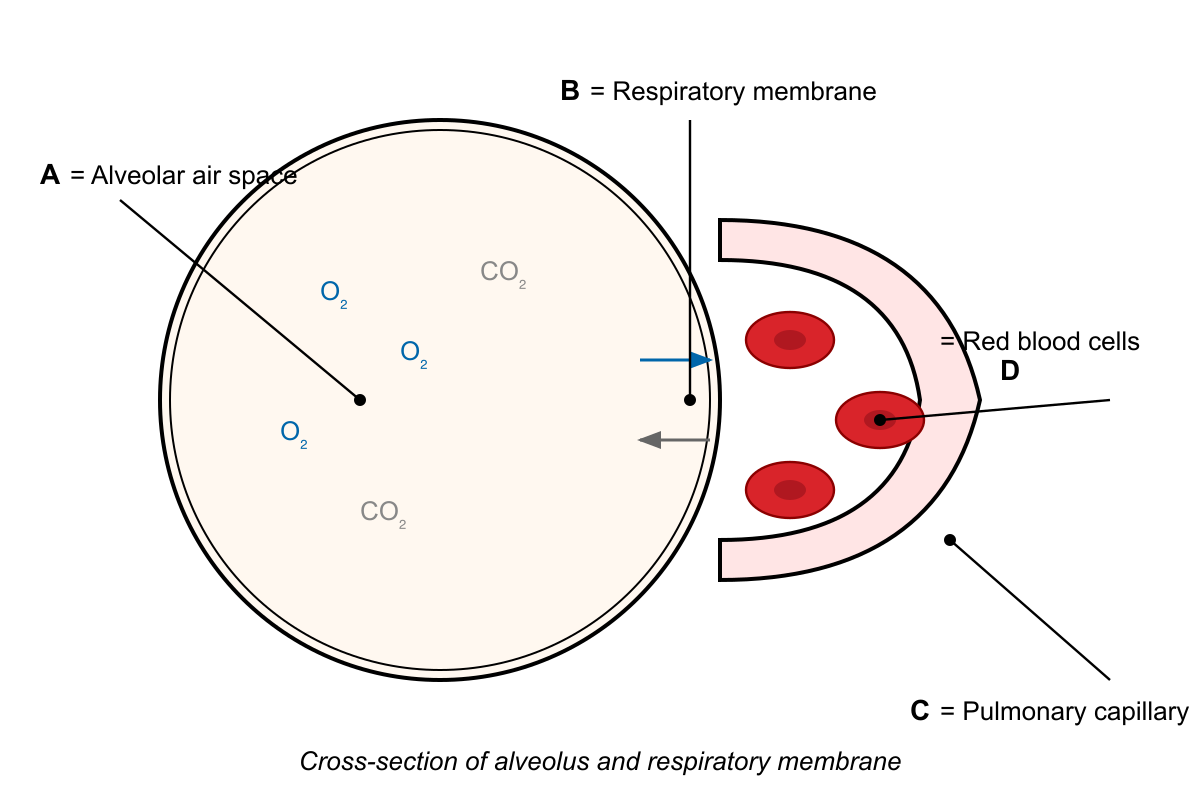
The cross-sectional diagram of an alveolus shown below illustrates the respiratory membrane with structures labeled A-D. If structure B becomes significantly thickened due to fluid accumulation, which aspect of gas exchange would be most directly affected?
- The partial pressure gradient between alveolar air and blood would be eliminated
- Oxygen diffusion rate would decrease due to increased diffusion distance (correct answer)
- Carbon dioxide would begin diffusing in the reverse direction from blood to alveoli
- The surface area available for gas exchange would increase compensatorily
- Hemoglobin oxygen saturation would immediately reach 100% in pulmonary capillaries
Explanation: Structure B represents the respiratory membrane (alveolar-capillary barrier), which consists of the alveolar epithelium, basement membrane, and capillary endothelium. According to Fick's law of diffusion, the rate of gas diffusion is inversely proportional to membrane thickness. Fluid accumulation would increase the diffusion distance, significantly slowing oxygen transfer from alveoli to blood. Choice A is incorrect because pressure gradients depend on ventilation and circulation, not membrane thickness. Choice C is wrong because CO₂ diffusion direction depends on partial pressure gradients, not membrane thickness. Choice D is incorrect because thickening reduces, not increases, effective surface area. Choice E is opposite to what would occur - thicker membranes would decrease, not increase, oxygen saturation.
Question 2
The cross-sectional view of a synaptic junction shown below displays structures labeled A through D. During synaptic transmission, if structure C malfunctions and cannot perform its normal role, what would be the most likely consequence?
- Action potentials could not be generated in the presynaptic neuron
- Neurotransmitter would accumulate in the synaptic cleft and cause prolonged signaling
- The postsynaptic membrane would become permanently depolarized
- Calcium channels would remain closed and prevent neurotransmitter release
Explanation: B
Question 3
The autonomic nervous system pathway diagram shows sympathetic and parasympathetic innervation of the heart, with components labeled 1-5. During a stress response, if pathway 2 is activated while pathway 4 is inhibited, what would be the expected combined effect on cardiac function?
- Heart rate would remain unchanged, but contractility would increase significantly
- Both heart rate and contractility would increase, while coronary blood flow would decrease
- Heart rate and contractility would both increase, enhancing cardiac output for the stress response
- Heart rate would decrease due to competing autonomic signals canceling each other out
Explanation: C
Question 4
The nephron pathway diagram shown below illustrates the route of filtrate flow with regions labeled A-E. If the concentration of glucose in the filtrate is 100 mg/dL at point A and 0 mg/dL at point C, but a patient's filtrate shows 50 mg/dL glucose at point E, what does this indicate about kidney function?
- Normal kidney function with appropriate glucose conservation occurring in region B
- Impaired glomerular filtration resulting in reduced glucose entering the filtrate initially
- Exceeded renal threshold for glucose reabsorption with saturation of transport proteins
- Enhanced glucose secretion occurring in regions C and D to maintain blood glucose levels
Explanation: C
Question 5
The cross-sectional diagram shows a portion of the small intestine wall with structures labeled 1-5. During the absorption of dietary fats, which sequence of structures would a fatty acid molecule most likely traverse to reach the systemic circulation?
- Structure 2 → Structure 4 → Structure 5 → portal circulation → liver → systemic veins
- Structure 1 → Structure 3 → Structure 5 → lymphatic vessels → thoracic duct → systemic veins
- Structure 1 → Structure 2 → Structure 4 → hepatic portal vein → liver → systemic circulation
- Structure 2 → Structure 3 → lymphatic capillaries → mesenteric lymph nodes → systemic arteries
Explanation: B
Question 6
The pathway diagram shows the flow of blood through the heart and major vessels, with structures labeled A through E. If structure C experiences a significant decrease in diameter due to smooth muscle contraction, which physiological change would most likely occur?
- Increased venous return to the right ventricle and elevated central venous pressure
- Decreased cardiac output and compensatory increase in heart rate and contractility
- Increased pulmonary capillary pressure and potential development of pulmonary edema
- Decreased oxygen saturation in systemic arterial blood and tissue hypoxia
Explanation: E
Question 7
The endocrine feedback pathway diagram shows the hypothalamic-pituitary-thyroid axis with components labeled 1-5. If structure 3 is surgically removed, which compensatory change would most likely occur in the remaining components?
- Structure 1 would decrease hormone production and structure 2 would become inactive
- Structure 1 and structure 2 would both increase hormone production due to loss of negative feedback (correct answer)
- Structure 4 would hypertrophy and take over the function of structure 3 completely
- Structure 5 would increase its sensitivity to compensate for reduced hormone levels
- The entire axis would shut down due to disruption of the feedback loop
Explanation: Structure 3 represents the thyroid gland, which produces thyroid hormones (T3/T4) that provide negative feedback to both the hypothalamus (structure 1) and anterior pituitary (structure 2). Without the thyroid gland, this negative feedback is lost, causing the hypothalamus to increase TRH production and the anterior pituitary to increase TSH production in an attempt to stimulate thyroid hormone production. Choice A is incorrect because loss of negative feedback increases, not decreases, upstream hormone production. Choice C is wrong because other glands cannot take over thyroid function. Choice D incorrectly suggests target tissue compensation rather than upstream gland responses. Choice E is wrong because the axis continues functioning, just without negative feedback regulation.
Question 8
The cross-sectional diagram of cardiac muscle tissue shows the cellular organization with structures labeled 1-4. Based on the structural arrangement shown, what functional characteristic would be most directly facilitated by structure 3?
- Individual cardiac myocytes can contract independently without affecting neighboring cells
- Rapid spread of electrical excitation throughout the cardiac muscle mass (correct answer)
- Enhanced calcium storage capacity compared to skeletal muscle tissue
- Increased resistance to mechanical stress during repeated contractions
- Selective permeability that prevents ion movement between adjacent cardiac cells
Explanation: Structure 3 represents intercalated discs, which contain gap junctions that allow direct electrical communication between cardiac muscle cells. This enables rapid propagation of action potentials throughout the cardiac muscle, allowing coordinated contraction of the heart chambers. Choice A is incorrect because intercalated discs actually promote coordinated, not independent, contraction. Choice C describes the sarcoplasmic reticulum, not intercalated discs. Choice D describes a general structural benefit but not the specific electrical function of gap junctions. Choice E is opposite to the actual function, as gap junctions facilitate, not prevent, ion movement between cells.
Question 9
The digestive system pathway diagram shows the route of food processing with organs labeled 1-6. If organ 4 is surgically bypassed so that material flows directly from organ 3 to organ 5, which digestive function would be most significantly impaired?
- Initial mechanical breakdown of food particles into smaller pieces
- Emulsification and digestion of dietary fats and fat-soluble vitamins (correct answer)
- Absorption of water and formation of solid fecal material
- Production and release of gastric acid for protein denaturation
- Secretion of insulin and glucagon for blood glucose regulation
Explanation: Organ 4 represents the small intestine, which is the primary site for fat digestion and absorption. The small intestine receives bile from the liver/gallbladder (essential for fat emulsification) and pancreatic lipases (for fat digestion), and its villi provide the surface area needed for fat absorption. Bypassing the small intestine would severely impair fat digestion and absorption of fat-soluble vitamins (A, D, E, K). Choice A describes mechanical digestion that occurs earlier in the pathway. Choice C describes large intestine function (organ 5/6). Choice D describes gastric function (organ 2). Choice E describes pancreatic endocrine function, which wouldn't be directly affected by intestinal bypass.
Question 10
The cross-sectional diagram of skeletal muscle tissue below shows the organization of myofibrils with regions labeled A-E. During muscle contraction, if the molecular interactions in region C are chemically blocked while regions B and D remain functional, what would be the most likely result?
- Normal muscle contraction would occur because regions B and D can compensate for region C
- Muscle contraction would be completely prevented despite normal calcium release and ATP availability (correct answer)
- The muscle would contract with twice the normal force due to reduced internal resistance
- Muscle relaxation would be impaired, but initial contraction would proceed normally
- Only eccentric contractions would be possible, while concentric contractions would be blocked
Explanation: Region C represents the overlap zone where thick (myosin) and thin (actin) filaments interact during muscle contraction. This is where cross-bridge formation occurs between myosin heads and actin binding sites, which is essential for the sliding filament mechanism. If these molecular interactions are blocked, the fundamental mechanism of muscle contraction cannot occur, regardless of calcium availability or ATP presence. Regions B and D represent areas of the sarcomere that don't contain the contractile overlap zone. Choice A is incorrect because other regions cannot perform cross-bridge cycling. Choice C is wrong because blocking contraction doesn't increase force. Choice D is incorrect because without contraction, relaxation is irrelevant. Choice E is wrong because all types of active contraction require cross-bridge cycling.
Question 11
The respiratory system pathway diagram shown below traces the movement of air from the external environment to the alveoli, with structures labeled A through F. If structure D becomes significantly narrowed due to smooth muscle contraction, what would be the most immediate effect on ventilation?
- Complete blockage of airflow to both lungs, resulting in immediate respiratory failure
- Increased work of breathing and decreased air flow specifically to the affected lung segment
- Improved gas exchange efficiency due to increased turbulence and mixing of gases
- Compensatory dilation of structure C to maintain normal total airflow to the lungs
Explanation: B