All questions
Question 1
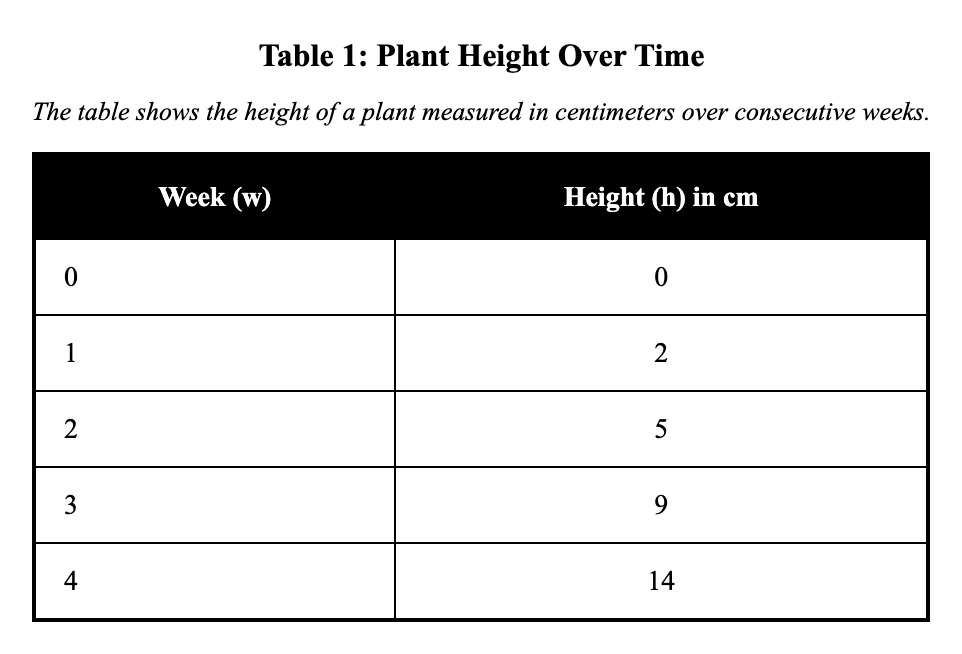
A plant's height h (in cm) is measured each week w. The data are shown below.
Does the table show a constant rate of change of height with respect to time? If not, choose the statement that best describes why.
- No; because w increases by 1 each time, the rate must be zero.
- Yes; the differences in h are 2,3,4,5, which shows a constant rate.
- No; the differences in h for each 1-week increase in w are not all the same, so the rate is non-constant. (correct answer)
- Yes; the ratio h/w is constant, so the rate of change is constant.
Explanation: This question tests your ability to recognize when a relationship has a constant rate of change—which is the defining characteristic of linear functions. To check if a rate is constant from a table: calculate Δy/Δx (change in y over change in x) for each consecutive pair of points. If you get the same number every time, the rate is constant. If the values differ, the rate is non-constant. Example: if differences are 3, 3, 3, 3—constant! If differences are 2, 4, 6, 8—non-constant (actually quadratic pattern). Let's check if the rate is constant by calculating Δh/Δw for each interval in the table: From w = 0 to w = 1: Δh/Δw = (2 - 0)/(1 - 0) = 2/1 = 2. From w = 1 to w = 2: Δh/Δw = (5 - 2)/(2 - 1) = 3/1 = 3. From w = 2 to w = 3: Δh/Δw = (9 - 5)/(3 - 2) = 4/1 = 4. From w = 3 to w = 4: Δh/Δw = (14 - 9)/(4 - 3) = 5/1 = 5. The rates are different (2, 3, 4, 5), so no, the rate is not constant—it's changing. Choice B correctly identifies the rate as non-constant because the differences in h for each 1-week increase are not all the same (they're 2, 3, 4, 5—an increasing pattern). Choice C sees the pattern 2, 3, 4, 5 and thinks this shows constant rate, but a constant rate means the SAME number repeated, not a pattern of different numbers. To confirm constant rate, all differences must be identical! The foolproof test for constant rate from a table: (1) Make sure your x-values increase by the same amount each time (like going 1, 2, 3, 4 or 0, 5, 10, 15), (2) Calculate the differences in y-values: y₂ - y₁, y₃ - y₂, y₄ - y₃, etc., (3) If all differences are equal, rate is constant! If they differ, rate is not constant. This works every time with equally-spaced x-values.
Question 2
Does the table show a constant rate of change between t (time in hours) and d (distance in miles)? If so, what is the constant rate Δd/Δt?
Table (equal t-intervals of 2 hours):
- t: 0, 2, 4, 6
- d: 0, 120, 240, 360
- Yes; constant rate Δd/Δt=360 miles per hour.
- Yes; constant rate Δd/Δt=60 miles per hour. (correct answer)
- No; the rate is not constant because the distances are different each time.
- Yes; constant rate Δd/Δt=120 miles per hour.
Explanation: This question tests your ability to recognize when a relationship has a constant rate of change—which is the defining characteristic of linear functions. To check if a rate is constant from a table: calculate Δy/Δx (change in y over change in x) for each consecutive pair of points. If you get the same number every time, the rate is constant. If the values differ, the rate is non-constant. Example: if differences are 3, 3, 3, 3—constant! If differences are 2, 4, 6, 8—non-constant (actually quadratic pattern). Let's check if the rate is constant by calculating Δy/Δx for each interval in the table: From t=0 to t=2: Δd/Δt=(120−0)/(2−0)=120/2=60. From t=2 to t=4: Δd/Δt=(240−120)/(4−2)=120/2=60. From t=4 to t=6: Δd/Δt=(360−240)/(6−4)=120/2=60. All rates equal 60, so yes, constant rate of 60! Choice C correctly identifies the rate as constant with Δd/Δt=60 because after dividing the equal Δd (120) by Δt (2), we get consistent 60 mph across intervals. Choice B says yes with 120, but that's forgetting to divide by Δt=2—it's easy to just look at Δd without the 'per hour' part; always compute the full ratio Δy/Δx! The foolproof test for constant rate from a table: (1) Make sure your x-values increase by the same amount each time (like going 1, 2, 3, 4 or 0, 5, 10, 15), (2) Calculate the differences in y-values: y₂ - y₁, y₃ - y₂, y₄ - y₃, etc., (3) If all differences are equal, rate is constant! If they differ, rate is not constant. This works every time with equally-spaced x-values. If x-intervals aren't equal, you must divide each Δy by its Δx to check if the ratios are equal—that's key for non-uniform spacing! Question 3
A gym charges a membership fee plus a fixed cost per visit. The total cost C (in dollars) after v visits is C=25+4v. Is the rate of change of cost with respect to visits constant? If so, what is the rate?
- Yes; constant rate ΔC/Δv=4 dollars per visit. (correct answer)
- No; it is not constant because there is a 25 dollar membership fee.
- Yes; constant rate ΔC/Δv=25 dollars per visit.
- No; the rate changes as v increases because the total cost increases.
Explanation: This question tests your ability to recognize when a relationship has a constant rate of change—which is the defining characteristic of linear functions. In real-world contexts, constant rate sounds like: 'travels at steady 60 mph,' 'costs $5 per item,' 'fills at 10 gallons per minute'—the 'per' language and steady/constant/fixed words signal constant rate. Non-constant rate sounds like: 'accelerating,' 'slowing down,' 'doubling each hour,' 'speed increasing'—these signal that the rate itself is changing! In this context, 'a gym charges a membership fee plus a fixed cost per visit with C = 25 + 4v,' we analyze: the language 'fixed cost per visit' indicates constant rate. Each unit of input (visit) produces the same change in output (cost), specifically 4 dollars per visit. Choice A correctly identifies the rate as constant with ΔC/Δv = 4 because the 'per visit' term is fixed, and the membership fee is just a starting point that doesn't affect the rate of change. Choice B says no because of the 25 membership fee, but that's a supportive reminder—the fee is like the y-intercept in y=mx+b, which doesn't change the constant slope m; it's easy to think constants make it nonlinear, but they don't! Context language decoder: words like 'constant speed,' 'steady rate,' 'X per unit,' 'every hour the same amount' → constant rate (linear). Words like 'accelerating,' 'percent per year,' 'doubling,' 'slowing down,' 'squared' → non-constant rate (nonlinear). The language almost always reveals which type! Formula clue: if the function is y = mx + b (first degree, just x, not x² or 2x or anything else), the rate is constant and equals m. Any other form (quadratic, exponential, rational, radical) has non-constant rate. The power of x tells you: power of 1 (or just x) = constant rate, any other power = non-constant rate. Question 4
Determine whether the function f(x)=4x−7 has a constant rate of change. If it does, what is the rate (the value of Δf/Δx for any equal Δx)?
- No; it is nonlinear because it has a subtraction.
- Yes; constant rate of change =4 because it is in the form y=mx+b. (correct answer)
- Yes; constant rate of change =−7 because b=−7.
- No; the rate changes as x increases because x is multiplied.
Explanation: This question tests your ability to recognize when a relationship has a constant rate of change—which is the defining characteristic of linear functions. Linear functions are the ONLY functions with constant rates of change: if a graph is a straight line, the rate is constant. A linear function in the form y = mx + b has a constant rate of change equal to m, the coefficient of x. Looking at the function f(x) = 4x - 7: This is a linear function in the form y = mx + b with slope m = 4, which means the rate of change is constant at 4 everywhere. For every 1-unit increase in x, f(x) increases by 4 units, regardless of where you are on the line. Choice B correctly identifies that this is a linear function with constant rate of change = 4 because it recognizes the y = mx + b form where m = 4. Choice C confuses the y-intercept (b = -7) with the rate of change—the constant term tells you where the line crosses the y-axis, not how steep it is! Formula clue: if the function is y = mx + b (first degree, just x, not x² or 2x or anything else), the rate is constant and equals m. The power of x tells you: power of 1 (or just x) = constant rate, any other power = non-constant rate. Question 5
A water tank is being filled at a rate of 15 gallons per minute for the first 20 minutes, then at 8 gallons per minute for the next 30 minutes. Which statement best describes the rate of change of water volume with respect to time?
- The water volume changes at a constant rate of 11.5 gallons per minute throughout the entire process
- The water volume changes at a constant rate during each interval, but the overall process does not have a constant rate (correct answer)
- The water volume changes at a constant rate of 23 gallons per minute when considering the combined flow rates
- The water volume does not change at a constant rate during any part of the filling process due to varying conditions
Explanation: The rate of change is constant within each time interval (15 gal/min for 0-20 min, 8 gal/min for 20-50 min), but the overall process has two different constant rates, making the entire process non-linear. A is incorrect because it averages the rates incorrectly. C is wrong because you don't add the rates. D is incorrect because each individual interval does have a constant rate.
Question 6
A research study tracks the population growth of two different bacteria colonies over time. Colony A starts with 200 bacteria and increases by 50 bacteria every hour. Colony B starts with 150 bacteria and doubles every 2 hours.
Over a 6-hour observation period, which statement best describes the rate of change in population for each colony?
- Colony A maintains a constant growth rate, while Colony B's growth rate increases exponentially over the time period (correct answer)
- Both colonies exhibit constant rates of change, but Colony A grows faster than Colony B throughout the observation
- Colony A has a variable growth rate that averages 50 per hour, while Colony B has a constant doubling rate
- Neither colony demonstrates a constant rate of change due to the biological nature of population growth patterns
Explanation: Colony A increases by exactly 50 bacteria each hour (linear: 200, 250, 300, 350, 400, 450, 500), showing constant rate of change. Colony B doubles every 2 hours (exponential: 150, 150, 300, 300, 600, 600, 1200), which means its rate of change increases over time. B incorrectly claims both are constant. C incorrectly describes A as variable. D incorrectly rejects A's constant rate.
Question 7
A swimming pool is being drained through two pipes. The water level decreases according to h(t)=48−6t for the first 4 hours, then according to h(t)=24−2t for the remaining time, where h is height in inches and t is time in hours from the start of each phase. What can be concluded about the rate of water level change?
- The water level decreases at a constant rate of 4 inches per hour when considering the average across both phases
- The water level decreases at variable rates throughout the draining process due to changing pipe pressure conditions
- The water level decreases at constant rates during each phase: 6 inches/hour initially, then 2 inches/hour subsequently (correct answer)
- The water level decreases at an increasing rate as the pool empties and gravitational effects become stronger
Explanation: Both functions are linear within their respective time periods. h(t) = 48 - 6t has a constant rate of -6 inches/hour for the first phase, and h(t) = 24 - 2t has a constant rate of -2 inches/hour for the second phase. A incorrectly averages the rates. B incorrectly claims variable rates within phases. D incorrectly describes an accelerating rate.
Question 8
A balloon is being inflated such that its radius increases according to the function r(t)=2t+3, where t is time in seconds and r is radius in centimeters. The volume of the balloon is given by V=34πr3. Which statement correctly describes the rates of change in this situation?
- Both the radius and volume of the balloon increase at constant rates throughout the inflation process
- Both the radius and volume increase at variable rates that depend on the initial balloon size
- The radius increases at a variable rate, while the volume increases at a constant rate of 34π per second
- The radius increases at a constant rate of 2 cm/sec, while the volume increases at a variable rate (correct answer)
Explanation: When analyzing rates of change in function problems, you need to distinguish between constant and variable rates by examining how quickly each quantity changes over time.
Let's examine each function separately. The radius function is r(t)=2t+3. Since this is a linear function, the rate of change is the coefficient of t, which is 2. This means the radius increases at a constant rate of 2 cm per second throughout the entire inflation process.
For volume, we have V=34πr3. Substituting the radius function: V=34π(2t+3)3. Since volume depends on the cube of the radius, and the radius is changing, the volume's rate of change varies over time. As the balloon gets larger, the same increase in radius produces a much larger increase in volume.
Looking at the answer choices: Choice A is incorrect because while radius increases at a constant rate, volume does not. Choice B is wrong because the radius rate doesn't depend on initial size—it's always 2 cm/sec regardless of when you measure it. Choice C reverses the situation, incorrectly stating that radius has a variable rate and volume has a constant rate of 34π (which isn't even dimensionally correct for a rate). Choice D correctly identifies that radius increases at a constant 2 cm/sec while volume increases at a variable rate.
Remember: linear functions always have constant rates of change, while functions involving powers (like cubes) typically have variable rates of change. Question 9
A manufacturing machine produces widgets according to the function W(t)=45t+120, where t is time in hours and W(t) is the total number of widgets produced. A second machine follows W(t)=60t2−15t+50. Which statement correctly describes the rate of change for these machines?
- Both machines produce widgets at constant rates, with the second machine having a higher constant rate of production
- The first machine produces at a constant rate of 45 widgets per hour, while the second machine's rate varies with time (correct answer)
- The first machine's rate decreases over time, while the second machine maintains a constant rate of 60 widgets per hour
- Both machines have variable rates of production, but the first machine's rate changes more gradually than the second's
Explanation: The first function W(t) = 45t + 120 is linear with a constant rate of change of 45 widgets/hour. The second function W(t) = 60t² - 15t + 50 is quadratic, so its rate of change (derivative = 120t - 15) varies with time. A incorrectly claims both are constant. C incorrectly describes the rates. D incorrectly claims the first machine has a variable rate.
Question 10
A gym charges a one-time sign-up fee plus a constant cost per month. The total cost C (in dollars) after m months is shown below.
Does this table show a constant rate of change of C with respect to m? If yes, what is the rate (in \/month$)?
- Yes; constant rate of 25 \/month because ΔC/Δm=25 for each 1-month interval. (correct answer)
- Yes; constant rate of 5 \/month because ΔC is 5 from m=0 to m=1.
- No; the change in C is not the same for each 1-month increase in m, so the rate is non-constant.
- Yes; constant rate of 20 \/month because C/m stays the same.
Explanation: This question tests your ability to recognize when a relationship has a constant rate of change—which is the defining characteristic of linear functions. To check if a rate is constant from a table: calculate Δy/Δx (change in y over change in x) for each consecutive pair of points. If you get the same number every time, the rate is constant. If the values differ, the rate is non-constant. Example: if differences are 3, 3, 3, 3—constant! If differences are 2, 4, 6, 8—non-constant (actually quadratic pattern). Let's check if the rate is constant by calculating ΔC/Δm for each interval in the table: From m = 0 to m = 1: ΔC/Δm = (30 - 5)/(1 - 0) = 25/1 = 25. From m = 1 to m = 2: ΔC/Δm = (55 - 30)/(2 - 1) = 25/1 = 25. From m = 2 to m = 3: ΔC/Δm = (80 - 55)/(3 - 2) = 25/1 = 25. All rates equal 25, so yes, constant rate of 25 $/month! Choice B correctly identifies the rate as constant because showing equal differences of 25 for each 1-month interval. Choice C calculates C/m (total/months) instead of ΔC/Δm (change/change)—this gives average cost per month from start, not the rate of change. To confirm constant rate, you need to check multiple intervals—if even one differs, it's non-constant! Always verify across at least 3-4 intervals before concluding constancy. The foolproof test for constant rate from a table: (1) Make sure your x-values increase by the same amount each time (like going 1, 2, 3, 4 or 0, 5, 10, 15), (2) Calculate the differences in y-values: y₂ - y₁, y₃ - y₂, y₄ - y₃, etc., (3) If all differences are equal, rate is constant! If they differ, rate is not constant. This works every time with equally-spaced x-values.
Question 11
A savings account balance is modeled by B(t)=100⋅(1.5)t, where t is the number of years. Is the rate of change of B with respect to t constant?
- Yes; constant rate because the ratio B(t+1)/B(t)=1.5 is constant.
- No; the rate is not constant because exponential growth does not add the same amount each year (nonlinear). (correct answer)
- Yes; constant rate =1.5 dollars per year.
- No; the rate is not constant because B(0)=100.
Explanation: This question tests your ability to recognize when a relationship has a constant rate of change—which is the defining characteristic of linear functions. Linear functions are the ONLY functions with constant rates of change: if a graph is a straight line, the rate is constant. If the graph curves (like a parabola or exponential curve), the rate is changing. You can visually spot constant rate—it's straightness! A steeper line has larger constant rate, flatter line has smaller constant rate, but both are constant as long as the line is straight. Looking at the function B(t)=100·(1.5)^t: This is an exponential function, and these function types have variable rates of change—the rate is different at different t-values, so it's not constant. Choice B correctly identifies the rate as non-constant because exponential growth does not add the same amount each year (nonlinear). Choice A says yes because the ratio B(t+1)/B(t)=1.5 is constant, but this confuses constant ratio with constant rate: in exponential contexts, the ratio between consecutive terms is constant (multiply by same factor), but the rate of change (Δy/Δx) is increasing. Constant ratio = exponential, constant rate = linear—don't mix these up! Common confusion: constant ratio ≠ constant rate! Geometric sequences have constant ratio (multiply by same factor), but their rate of change is not constant—it's increasing. Example: 2, 6, 18, 54... has constant ratio (×3) but rate goes 4, 12, 36 (not constant). Constant rate means linear, constant ratio means exponential!
Question 12
Which situation represents a constant rate of change (and therefore a linear relationship)?
(a) The area of a square as a function of its side length
(b) A car traveling at a steady 55 miles per hour
(c) A population that doubles every year
- Only (b) (correct answer)
- Only (a)
- (b) and (c)
- Only (c)
Explanation: This question tests your ability to recognize when a relationship has a constant rate of change—which is the defining characteristic of linear functions. In real-world contexts, constant rate sounds like: 'travels at steady 60 mph,' 'costs 5 per item,' 'fills at 10 gallons per minute'—the 'per' language and steady/constant/fixed words signal constant rate. Non-constant rate sounds like: 'accelerating,' 'slowing down,' 'doubling each hour,' 'speed increasing'—these signal that the rate itself is changing! Let's analyze each situation: (a) Area of a square = (side length)², which is quadratic—not constant rate. (b) 'A car traveling at a steady 55 miles per hour'—the word 'steady' and '55 miles per hour' indicate constant rate of 55 mph. (c) 'A population that doubles every year'—'doubles' indicates exponential growth with constant ratio but not constant rate. Choice B correctly identifies that only (b) represents a constant rate because 'steady 55 miles per hour' means the distance increases by exactly 55 miles each hour—a constant rate. Choice D includes (c), but 'doubles every year' means multiply by 2 each year (constant ratio), not add the same amount each year (constant rate). Context language decoder: words like 'constant speed,' 'steady rate,' 'X per unit,' 'every hour the same amount' → constant rate (linear). Words like 'accelerating,' 'percent per year,' 'doubling,' 'slowing down,' 'squared' → non-constant rate (nonlinear). The language almost always reveals which type!
Question 13
A coordinate plane shows a line passing through the points (0,2) and (4,10). Does this graph represent a constant rate of change? If yes, what is the rate (slope) Δy/Δx?
- No; the rate is not constant because the y-intercept is 2.
- Yes; constant rate 8 because 10−2=8.
- Yes; constant rate 2 because 10−2=8 and 8/4=2. (correct answer)
- No; a line does not have a constant rate of change.
Explanation: This question tests your ability to recognize when a relationship has a constant rate of change—which is the defining characteristic of linear functions. Linear functions are the ONLY functions with constant rates of change: if a graph is a straight line, the rate is constant. Looking at the graph: it's a straight line passing through (0,2) and (4,10), which means the steepness (slope) is the same everywhere, so the rate of change is constant. Let's calculate the rate: From x = 0 to x = 4: Δy/Δx = (10 - 2)/(4 - 0) = 8/4 = 2. Since this is a straight line, this rate of 2 is constant everywhere on the line. Choice A correctly identifies the rate as constant at 2 because the calculation (10-2)/(4-0) = 8/4 = 2 gives the slope of the line. Choice D says a line does not have a constant rate of change, but this is completely backwards—lines are the ONLY graphs that have constant rates of change! That's what makes them linear! Visual shortcut: if the graph is a straight line, the rate is constant. Period. Any curvature—even slight—means non-constant rate. Straightness = constant rate, curvature = variable rate. This is the quickest check!
Question 14
Which situations represent a constant rate of change?
(1) A worker earns $18 per hour.
(2) The area of a square is A=s2 where s is the side length.
(3) A car's distance traveled increases by 60 miles each hour at a steady speed.
- (1), (2), and (3)
- Only (1) and (3) (correct answer)
- Only (1) and (2)
- Only (2)
Explanation: This question tests your ability to recognize when a relationship has a constant rate of change—which is the defining characteristic of linear functions. In real-world contexts, constant rate sounds like: 'travels at steady 60 mph,' 'costs $5 per item,' 'fills at 10 gallons per minute'—the 'per' language and steady/constant/fixed words signal constant rate. Non-constant rate sounds like: 'accelerating,' 'slowing down,' 'doubling each hour,' 'speed increasing'—these signal that the rate itself is changing! Let's analyze each situation: (1) 'A worker earns $18 per hour' indicates constant rate—each hour produces the same change in earnings, specifically 18/hour. (2) 'The area of a square is A = s²' is a quadratic relationship, and quadratics have non-constant rates—as side length increases, the area increases faster and faster. (3) 'A car's distance traveled increases by 60 miles each hour at steady speed' indicates constant rate—the language 'steady speed' and 'each hour the same amount' confirms constant rate of 60 mph. Choice B correctly identifies only (1) and (3) as having constant rates because both describe situations where the change per unit time/input is fixed, while (2) involves a quadratic relationship with varying rate. Choice D incorrectly includes (2), not recognizing that A = s² represents a quadratic function where the rate of change of area with respect to side length is not constant (it equals 2s, which varies with s). Context language decoder: words like 'constant speed,' 'steady rate,' 'X per unit,' 'every hour the same amount' → constant rate (linear). Words like 'accelerating,' 'percent per year,' 'doubling,' 'slowing down,' 'squared' → non-constant rate (nonlinear). The language almost always reveals which type!
Question 15
A tank is being filled at a steady rate. After 2 minutes it contains 9 liters, and after 6 minutes it contains 21 liters.
What is the rate of change in liters per minute, and is it constant?
- Rate =6 L/min, and it is constant because 21−9=12 and 6−2=2.
- Rate =3 L/min, and it is constant because ΔV/Δt=(21−9)/(6−2)=3. (correct answer)
- Rate =12 L/min, and it is constant because the volume increased by 12 liters.
- Rate =3 L/min, but it is not constant because the tank is filling.
Explanation: This question tests your ability to recognize when a relationship has a constant rate of change—which is the defining characteristic of linear functions. In real-world contexts, constant rate sounds like: 'travels at steady 60 mph,' 'costs 5 per item,' 'fills at 10 gallons per minute'—the 'per' language and steady/constant/fixed words signal constant rate. In this context, 'a tank is being filled at a steady rate,' we analyze: the language 'steady rate' indicates constant rate. Let's calculate: From 2 to 6 minutes (Δt = 4), the volume goes from 9 to 21 liters (ΔV = 12). Rate = ΔV/Δt = 12/4 = 3 liters per minute. Since it's filling at a 'steady rate,' this 3 L/min is constant throughout. Choice B correctly calculates the rate as 3 L/min using ΔV/Δt = (21-9)/(6-2) = 12/4 = 3, and recognizes that 'steady' means constant. Choice A makes a calculation error by not dividing the change in volume by the change in time—rate requires division to get the 'per minute' unit! Context language decoder: words like 'constant speed,' 'steady rate,' 'X per unit,' 'every hour the same amount' → constant rate (linear). The calculation ΔV/Δt gives you the exact constant rate value.
Question 16
Does the table show a constant rate of change between x and y? Explain your choice by comparing Δy for each 1-unit increase in x.
Table (equal x-intervals of 1):
- x: 1, 2, 3, 4, 5
- y: 2, 4, 8, 16, 32
- Yes; constant rate Δy/Δx=2 because y doubles each time.
- No; Δy values are 2, 4, 8, 16, so the rate of change is not constant (nonlinear). (correct answer)
- Yes; constant rate Δy/Δx=0 because x increases by 1 each time.
- No; the rate is constant because Δx is 1 for every interval.
Explanation: This question tests your ability to recognize when a relationship has a constant rate of change—which is the defining characteristic of linear functions. To check if a rate is constant from a table: calculate Δy/Δx (change in y over change in x) for each consecutive pair of points. If you get the same number every time, the rate is constant. If the values differ, the rate is non-constant. Example: if differences are 3, 3, 3, 3—constant! If differences are 2, 4, 6, 8—non-constant (actually quadratic pattern). Let's check if the rate is constant by calculating Δy/Δx for each interval in the table: From x = 1 to x = 2: Δy/Δx = (4 - 2)/(2 - 1) = 2/1 = 2. From x = 2 to x = 3: Δy/Δx = (8 - 4)/(3 - 2) = 4/1 = 4. From x = 3 to x = 4: Δy/Δx = (16 - 8)/(4 - 3) = 8/1 = 8. From x = 4 to x = 5: Δy/Δx = (32 - 16)/(5 - 4) = 16/1 = 16. The rates are different (2,4,8,16), so no, the rate is not constant—it's changing. Choice B correctly identifies the rate as non-constant because the Δy values are 2,4,8,16, showing unequal differences that indicate a nonlinear (exponential) pattern. Choice A says yes with constant rate 2 because y doubles each time, but that's confusing constant ratio (multiplying by 2) with constant rate—constant ratio means exponential, not linear, so always check the differences, not just the ratios! Common confusion: constant ratio ≠ constant rate! Geometric sequences have constant ratio (multiply by same factor), but their rate of change is not constant—it's increasing. Example: 2, 6, 18, 54... has constant ratio (×3) but rate goes 4, 12, 36 (not constant). Constant rate means linear, constant ratio means exponential! The foolproof test for constant rate from a table: (1) Make sure your x-values increase by the same amount each time (like going 1, 2, 3, 4 or 0, 5, 10, 15), (2) Calculate the differences in y-values: y₂ - y₁, y₃ - y₂, y₄ - y₃, etc., (3) If all differences are equal, rate is constant! If they differ, rate is not constant. This works every time with equally-spaced x-values.
Question 17
Three investment accounts are tracked over time. Account X gains $150 each month. Account Y gains $100 the first month, then the monthly gain increases by $25 each subsequent month. Account Z gains $200 every other month and $0 on alternate months. Which account(s) show a constant rate of change?
- Only Account X demonstrates a constant rate of change at $150 per month throughout the investment period (correct answer)
- Both Account X and Account Z show constant rates of change, but at different monthly intervals
- Account Y shows the most consistent growth pattern with a constant rate of increase in the monthly gains
- All three accounts show constant rates of change when measured over appropriate time intervals for each account
Explanation: Account X gains 150eachmonth,whichisaconstantrate.AccountYhasincreasingmonthlygains(100, $125, $150, ...), so its rate increases over time. Account Z alternates between $200 and $0, which creates a variable rate (not constant even when averaged). B incorrectly includes Z. C incorrectly describes Y as constant. D incorrectly claims all are constant. Question 18
A cell phone plan charges a $25 monthly fee plus $0.10 per text message. After analyzing usage patterns, the company offers a new plan with a $35 monthly fee and $0.05 per text message. For what range of monthly text messages would the new plan result in a constant rate of savings compared to the original plan?
- The savings rate is constant at $0.05 per text message for any number of messages above 200 texts per month
- The savings rate varies depending on usage, so there is no constant rate of savings between the two plans
- The savings rate is constant at $0.05 per text message for all possible numbers of text messages sent monthly (correct answer)
- The savings rate is constant at $10 per month regardless of the number of text messages sent monthly
Explanation: The difference between plans is: (25 + 0.10x) - (35 + 0.05x) = -10 + 0.05x. This shows the new plan saves $0.05 per text message consistently, regardless of volume. The rate of savings is constant for all values of x. A is wrong about the threshold. B incorrectly suggests the rate varies. D confuses the fixed difference with the rate of change.
Question 19
A car rental company charges based on the function C(m)=0.25m+40 for the first 200 miles, then C(m)=0.15m+60 for additional miles beyond 200, where m is total miles driven and C is total cost in dollars. How does the cost change with respect to miles driven?
- The cost changes at a constant rate of $0.20 per mile averaged across both pricing tiers
- The cost changes at a constant rate of $0.15 per mile after accounting for the different fee structures
- The cost changes at a variable rate that decreases continuously as more miles are driven during the rental
- The cost changes at different constant rates: $0.25 per mile initially, then $0.15 per mile beyond 200 miles (correct answer)
Explanation: When you encounter piecewise functions like this car rental problem, you need to analyze each piece separately to understand how the rate of change varies across different intervals.
This function has two distinct pieces: C(m)=0.25m+40 for the first 200 miles, and C(m)=0.15m+60 for miles beyond 200. In linear functions like these, the coefficient of m represents the rate of change - how much the cost increases per additional mile. In the first piece, this rate is $0.25 per mile. In the second piece, it's $0.15 per mile. These are two different constant rates that apply to different intervals, making answer D correct.
Answer A incorrectly tries to average the two rates, but averaging doesn't reflect how the actual function behaves - you pay the higher rate first, then the lower rate. Answer B suggests there's a single constant rate of $0.15 throughout, which ignores the fact that the first 200 miles cost $0.25 per mile. Answer C claims the rate decreases "continuously," but that's misleading - the rate only changes once, at the 200-mile mark, then remains constant at $0.15.
Remember that in piecewise functions, you must examine each piece individually. Don't try to find a single rate or average - instead, identify what rate applies in each interval. The coefficients of the variable terms will always tell you the rate of change for linear pieces. Question 20
Does the table show a constant rate of change between x and y? If so, what is the constant rate Δy/Δx?
Table (equal x-intervals of 1):
- x: 0, 1, 2, 3, 4
- y: 5, 8, 11, 14, 17
- Yes; constant rate Δy/Δx=3 (the y-values increase by 3 each time x increases by 1). (correct answer)
- Yes; constant rate Δy/Δx=12 (because 17−5=12).
- No; the rate is not constant because y is increasing.
- Yes; constant rate Δy/Δx=2 (the y-values increase by 2 each time).
Explanation: This question tests your ability to recognize when a relationship has a constant rate of change—which is the defining characteristic of linear functions. To check if a rate is constant from a table: calculate Δy/Δx (change in y over change in x) for each consecutive pair of points. If you get the same number every time, the rate is constant. If the values differ, the rate is non-constant. Example: if differences are 3, 3, 3, 3—constant! If differences are 2, 4, 6, 8—non-constant (actually quadratic pattern). Let's check if the rate is constant by calculating Δy/Δx for each interval in the table: From x = 0 to x = 1: Δy/Δx = (8 - 5)/(1 - 0) = 3/1 = 3. From x = 1 to x = 2: Δy/Δx = (11 - 8)/(2 - 1) = 3/1 = 3. From x = 2 to x = 3: Δy/Δx = (14 - 11)/(3 - 2) = 3/1 = 3. From x = 3 to x = 4: Δy/Δx = (17 - 14)/(4 - 3) = 3/1 = 3. All rates equal 3, so yes, constant rate of 3! Choice A correctly identifies the rate as constant with Δy/Δx = 3 because the y-values increase by 3 for each 1-unit increase in x, showing equal differences. Choice D says constant rate of 12, but that's just the total change from first to last without dividing by the intervals—it's easy to forget to calculate per interval, but always divide Δy by Δx for each pair! The foolproof test for constant rate from a table: (1) Make sure your x-values increase by the same amount each time (like going 1, 2, 3, 4 or 0, 5, 10, 15), (2) Calculate the differences in y-values: y₂ - y₁, y₃ - y₂, y₄ - y₃, etc., (3) If all differences are equal, rate is constant! If they differ, rate is not constant. This works every time with equally-spaced x-values. Common confusion: constant ratio ≠ constant rate! Geometric sequences have constant ratio (multiply by same factor), but their rate of change is not constant—it's increasing. Example: 2, 6, 18, 54... has constant ratio (×3) but rate goes 4, 12, 36 (not constant). Constant rate means linear, constant ratio means exponential!