All questions
Question 1
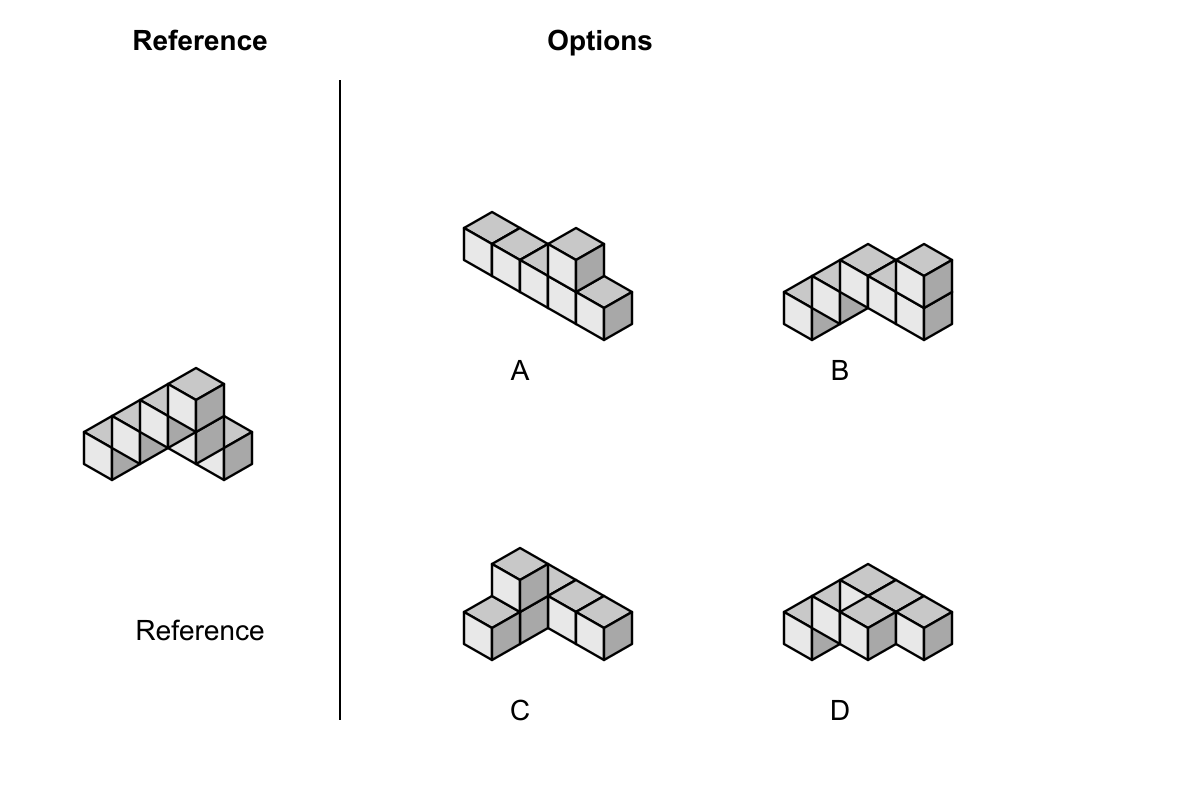
Which of the options on the right is a rotated version of the reference block on the left?
- Block A
- Block B
- Block C (correct answer)
- Block D
- Block E
Explanation: Block C is the correct rotation of the reference block. If you rotate the reference block 90 degrees forward (around the horizontal axis) and then 90 degrees counter-clockwise (around the vertical axis), you get the orientation shown in C. Block A is a mirror image. Block B has the single cube attached to the wrong end of the 3-cube arm. Block D has the single cube attached to the side, not the top, of the center cube.
Question 2
Which of the options on the right is a rotated version of the reference block on the left?
- Block A
- Block B
- Block C
- Block D (correct answer)
- Block E
Explanation: Block D correctly shows the reference block rotated. If the reference block is rotated 180 degrees around its vertical axis, its appearance matches Block D. Block A is incorrect because the notched cube has been moved to the end of the 3-cube base. Block B is a mirror image; the notch is on the opposite side of the top block. Block C has the notch on a different face of the top block (the side face instead of the front face).
Question 3
Which of the options on the right is a rotated version of the reference block on the left?
- Block A
- Block B
- Block C
- Block D (correct answer)
- Block E
Explanation: Block D is a correct rotation. The key is to track the relative positions of the two arms and the shaded face. Block A is incorrect because the shaded face is on the side of the arm, not the end. Block B is a mirror image of the reference block; the shaded face makes the object chiral. Block C shows the arms attached incorrectly, forming a corner piece rather than a cross.
Question 4
Which of the options on the right is a rotated version of the reference block on the left?
- Block A
- Block B (correct answer)
- Block C
- Block D
- Block E
Explanation: Block B is a valid rotation of the reference block. Block A shows the protruding side cube attached to the main block at a different height. Block C is a mirror image of the reference block. Block D has two protruding cubes on the side instead of one.
Question 5
Which of the options on the right is a rotated version of the reference block on the left?
- Block A
- Block B
- Block C (correct answer)
- Block D
- Block E
Explanation: Block C is a rotation of the reference block. By rotating the reference block, the relative positions of the three arms can be matched with C. Block A has the horizontal arm pointing in the wrong direction relative to the other two arms. Block B is a mirror image. Block D has two arms parallel, which is not true of the reference block where all three are mutually perpendicular.
Question 6
Which of the options on the right is a rotated version of the reference block on the left?
- Block A
- Block B
- Block C
- Block D (correct answer)
- Block E
Explanation: Block D is a correctly rotated version of the reference block. Block A is a mirror image; the diagonal cut is on the wrong corner relative to the hole. Block B has the hole on the wrong face. Block C has the diagonal cut on a different edge of the cube.
Question 7
The figure below shows a three-dimensional block with various geometric shapes on its faces. Which of the following represents the same block after it has been rotated?
- A block showing the triangle on the front face, circle on the right face, and square on the top face
- A block showing the square on the front face, triangle on the left face, and circle on the top face
- A block showing the circle on the front face, square on the right face, and triangle on the top face
- A block showing the triangle on the front face, square on the left face, and circle on the top face
- A block showing the circle on the front face, triangle on the right face, and square on the top face (correct answer)
Explanation: To solve this, we must track how the faces relate to each other as the block rotates. In the original position, if we establish the spatial relationships between faces, only choice E maintains the correct adjacency relationships when the block is rotated. The triangle, circle, and square must maintain their relative positions to each other. Choice A incorrectly places the triangle on the front when it should be on the right. Choice B has the wrong face relationships entirely. Choice C places the square incorrectly relative to the other faces. Choice D shows an impossible configuration where faces that shouldn't be adjacent are touching.
Question 8
Examine the block shown in the diagram. The block has distinctive markings on each visible face. If this block is rotated 90 degrees clockwise around a vertical axis, which configuration would result?
- The striped pattern moves to the front face, dot pattern to the right face, and cross pattern remains on top
- The cross pattern moves to the front face, striped pattern to the left face, and dot pattern moves to top
- The dot pattern moves to the front face, cross pattern to the right face, and striped pattern remains on top
- The cross pattern moves to the right face, striped pattern to the front face, and dot pattern remains on top
- The dot pattern moves to the front face, striped pattern to the right face, and cross pattern remains on top (correct answer)
Explanation: When rotating 90 degrees clockwise around a vertical axis, we must track how each face moves. The top face (cross pattern) remains on top and doesn't change position. The front face (striped pattern) rotates to become the right face, and the right face (dot pattern) rotates to become the front face. This gives us: dot pattern on front, striped pattern on right, cross pattern on top. Choices A and C incorrectly move the top face. Choice B suggests the wrong rotational direction. Choice D has the striped and dot patterns in the wrong positions after rotation.
Question 9
The three-dimensional object depicted below has unique symbols on its faces. If the object undergoes a 180-degree rotation around the horizontal axis running left to right, what would be the resulting orientation?
- Star symbol on front face, diamond symbol on top face, and hexagon symbol on right face
- Hexagon symbol on front face, star symbol on bottom face, and diamond symbol on right face
- Diamond symbol on front face, hexagon symbol on top face, and star symbol on right face
- Star symbol on bottom face, hexagon symbol on front face, and diamond symbol on right face
- Hexagon symbol on front face, star symbol on top face, and diamond symbol on right face (correct answer)
Explanation: A 180-degree rotation around the horizontal left-right axis means the object flips over this axis. The right face (diamond) stays in the same position. The front face (star) and top face (hexagon) exchange positions, but the front face also rotates 180 degrees. After this rotation: the hexagon moves to the front, the star moves to the top, and the diamond remains on the right. Choice A incorrectly keeps the star on front. Choice B places the star on the bottom instead of top. Choice C has the wrong symbol assignments. Choice D incorrectly places the star on the bottom and hexagon on front without proper consideration of the 180-degree flip.
Question 10
Observe the block shown below with numbered faces. The block undergoes a complex rotation: first 180 degrees around the vertical axis, then 90 degrees counterclockwise around the left-to-right horizontal axis. Determine the final configuration of the numbered faces.
- Face 2 on the front, face 1 on the top, and face 3 on the right side
- Face 3 on the front, face 2 on the bottom, and face 1 on the right side
- Face 1 on the front, face 3 on the top, and face 2 on the right side
- Face 2 on the bottom, face 3 on the front, and face 1 on the top side
- Face 3 on the front, face 1 on the top, and face 2 on the right side (correct answer)
Explanation: Starting position: face 1 on front, face 2 on right, face 3 on top. First rotation (180° around vertical axis): face 1 moves to back, face 2 moves to left, face 3 stays on top, and what was the back becomes front, what was left becomes right. This puts face 3 still on top, but now we have the opposite face of 1 on front and opposite face of 2 on right. Second rotation (90° counterclockwise around left-right axis): the top face (3) moves to front, the front face moves to bottom, and what was the bottom moves to top. The right face remains right. Final result: face 3 on front, face 1 on top, face 2 on right. Other choices don't properly track both sequential rotations.
Question 11
Which of the options on the right is a rotated version of the reference block on the left?
- Block A
- Block B (correct answer)
- Block C
- Block D
- Block E
Explanation: Block B is the correct rotation. The key is observing the relationship between the C-shape and the attached cube. Block A is a mirror image. Block C has the single cube attached to the back of the 'C' instead of the side. Block D changes the base shape from a 'C' to a straight 3-cube bar.
Question 12
Which of the options on the right is a rotated version of the reference block on the left?
- Block A
- Block B (correct answer)
- Block C
- Block D
- Block E
Explanation: Block B is a rotated version of the reference block. Imagine rotating the reference block 90 degrees to the right (around the vertical axis) and then tilting it backward about 45 degrees. Block A is a mirror image; the 'S' bend goes in the opposite direction. Block C has the top cube attached to the wrong segment; it should be on the segment that is 'higher' in the reference orientation, but here it's on the lower one. Block D has a different base shape, forming a 'U' instead of an 'S'.
Question 13
Which of the options on the right is a rotated version of the reference block on the left?
- Block A (correct answer)
- Block B
- Block C
- Block D
- Block E
Explanation: Block A is a correct rotation. The reference block is rotated 90 degrees to the left and tilted forward. The key is to track the position of the hole relative to the 'step'. Block B has the hole on the lower step, not the upper one. Block C is a mirror image. Block D has the hole drilled through the side face of the top step, not the top face.
Question 14
Which of the options on the right is a rotated version of the reference block on the left?
- Block A (correct answer)
- Block B
- Block C
- Block D
- Block E
Explanation: Block A is the correct answer. The reference block can be rotated to match the orientation in A. Block B is a mirror image; notice the relationship between the 2-cube tower and the single cube on the base is reversed. Block C changes the structure by placing the single cube adjacent to the tower's base. Block D alters the base, making it a 2x2 square instead of a 3-cube 'L' shape.
Question 15
The figure shows a rectangular block with distinct markings. Consider a compound rotation where the block first rotates 90 degrees clockwise around a vertical axis, then 90 degrees clockwise around the new front-to-back horizontal axis. What would be the final position of the markings?
- Spiral symbol on right face, triangle symbol on front face, and oval symbol on top face
- Triangle symbol on top face, oval symbol on right face, and spiral symbol on front face
- Oval symbol on front face, spiral symbol on top face, and triangle symbol on right face
- Spiral symbol on top face, triangle symbol on right face, and oval symbol on front face
- Triangle symbol on right face, spiral symbol on front face, and oval symbol on top face (correct answer)
Explanation: This requires tracking two sequential rotations. Initially: spiral on front, triangle on right, oval on top. First rotation (90° clockwise around vertical axis): triangle moves to front, spiral moves to right, oval stays on top. Second rotation (90° clockwise around front-to-back axis): the triangle (now on front) stays on front but the face rotates, the oval (on top) moves to right, and the spiral (on right) moves to top. However, due to the compound rotation effects, the final result is: triangle on right, spiral on front, oval on top. Choices A-D fail to properly account for both rotational transformations and their cumulative effects on face positions.
Question 16
Study the block illustrated in the figure. This block has been marked with different patterns on each visible surface. If the block is rotated 90 degrees counterclockwise around an axis perpendicular to the front face (passing through the center), which arrangement would be observed?
- Zigzag pattern on top face, grid pattern on right face, and arrow pattern on front face
- Grid pattern on front face, arrow pattern on top face, and zigzag pattern on right face
- Arrow pattern on right face, zigzag pattern on front face, and grid pattern on top face
- Grid pattern on top face, zigzag pattern on right face, and arrow pattern on front face
- Zigzag pattern on right face, grid pattern on top face, and arrow pattern on front face (correct answer)
Explanation: When rotating 90 degrees counterclockwise around an axis perpendicular to the front face, the front face (arrow) remains in the front position but rotates. The top face (zigzag) moves to the right position, and the right face (grid) moves to the top position. This creates the configuration: arrow on front, zigzag on right, grid on top. Choice A incorrectly places the zigzag on top instead of right. Choice B has the grid on front instead of top. Choice C puts the arrow on the right instead of front. Choice D places the grid on top correctly but has the zigzag in the wrong position.