What this quiz covers
This quiz focuses on Interpreting Data From Tables, giving you a quick way to practice the rules, question types, and explanations that matter most for ACT Science.
PASSAGE VI
BIOLOGY / GENETICS: Research Summary
Introduction
Restriction enzymes are proteins that cut DNA molecules at specific, predictable sequences of base pairs (bp). Gel electrophoresis is a technique used to separate these resulting DNA fragments by size. When an electrical current is applied to the gel, the negatively charged DNA fragments migrate toward the positive electrode. Smaller DNA fragments move through the gel much faster and travel further than larger fragments.
A researcher isolated a circular bacterial plasmid (a ring of DNA) consisting of exactly 5,000 bp. To map the plasmid, the researcher treated identical samples of the plasmid with different restriction enzymes—Enzyme 1 (E1), Enzyme 2 (E2), and Enzyme 3 (E3)—both individually and in combinations.
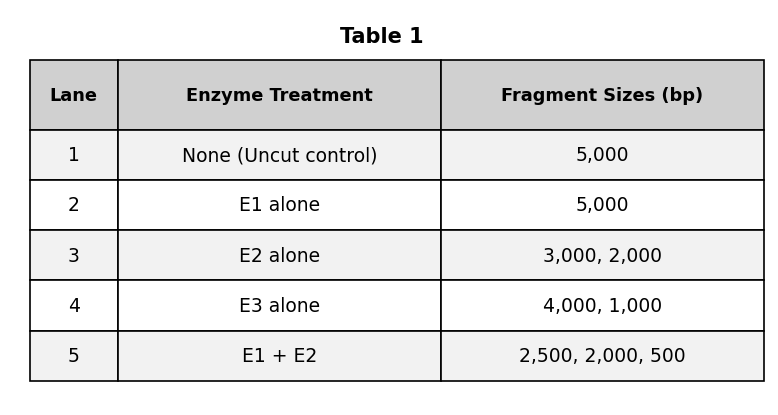
After allowing the enzymes to cut the DNA, the researcher ran the samples on an electrophoresis gel. A dye was added to make the DNA bands visible. The size of the fragments in each band was recorded in Table 1.
Based on the passage, which of the following fragments from Table 1 would migrate the furthest distance from the starting well during electrophoresis?
ACT Science Quiz
Practice Interpreting Data From Tables in ACT Science with focused quiz questions that help you check what you know, review explanations, and build confidence with test-style prompts.
This quiz focuses on Interpreting Data From Tables, giving you a quick way to practice the rules, question types, and explanations that matter most for ACT Science.
Try each quiz question before looking at the correct answer. Use the explanations to review missed ideas, then come back to similar questions until the pattern feels familiar.
PASSAGE VI
BIOLOGY / GENETICS: Research Summary
Introduction
Restriction enzymes are proteins that cut DNA molecules at specific, predictable sequences of base pairs (bp). Gel electrophoresis is a technique used to separate these resulting DNA fragments by size. When an electrical current is applied to the gel, the negatively charged DNA fragments migrate toward the positive electrode. Smaller DNA fragments move through the gel much faster and travel further than larger fragments.
A researcher isolated a circular bacterial plasmid (a ring of DNA) consisting of exactly 5,000 bp. To map the plasmid, the researcher treated identical samples of the plasmid with different restriction enzymes—Enzyme 1 (E1), Enzyme 2 (E2), and Enzyme 3 (E3)—both individually and in combinations.
After allowing the enzymes to cut the DNA, the researcher ran the samples on an electrophoresis gel. A dye was added to make the DNA bands visible. The size of the fragments in each band was recorded in Table 1.
Based on the passage, which of the following fragments from Table 1 would migrate the furthest distance from the starting well during electrophoresis?
Explanation: The correct answer is D (the 500 bp fragment in Lane 5). The passage states that smaller fragments travel further during electrophoresis. Among all the fragments listed in Table 1 — 5,000 bp, 3,000 bp, 2,000 bp, 4,000 bp, 1,000 bp, 2,500 bp, and 500 bp — the smallest is 500 bp in Lane 5. The smallest fragment experiences the least resistance passing through the gel matrix, moves fastest under the electrical current, and therefore travels the greatest distance from the starting well. A (5,000 bp) is the largest fragment and would travel the least distance. B (3,000 bp) and C (2,000 bp) are intermediate sizes. On migration distance questions, identify the smallest fragment across all lanes in the table.
Fruit Fly Genetics
In the fruit fly Drosophila melanogaster, eye color is a sex-linked trait determined by a gene on the X chromosome. The allele for the wild-type red eye color (XR) is dominant, while the allele for the mutant white eye color (Xr) is recessive.
Females (XX): Inherit one X chromosome from each parent. A female will have white eyes only if she is homozygous recessive (XrXr).
Males (XY): Inherit an X chromosome from the mother and a Y chromosome from the father. Because the Y chromosome does not carry the eye color gene, a male expresses whichever allele is present on his single X chromosome (X^R Y \= Red; X^r Y \= White).
Students conducted two studies to observe these inheritance patterns.
The students crossed a homozygous red-eyed female (XRXR) with a white-eyed male (XrY). To predict the genotypes of the offspring, they constructed a Punnett square (Figure 1).
They then collected 100 offspring (the F1 generation) and recorded the results in Table 1.
The students performed the reciprocal cross. They crossed a white-eyed female (XrXr) with a red-eyed male (XRY). A second Punnett square was constructed to predict the outcome (Figure 2).
They collected 100 offspring and recorded the results in Table 2.
Based on Table 1, what percent of the F1 offspring in Study 1 had white eyes?
Explanation: This is a straightforward data retrieval and percentage calculation question. You can identify this question type by the phrase "what percent" combined with "based on Table 1." To solve this, look at Table 1 and find all offspring with white eyes: Male White Eyes = 0, Female White Eyes = 0. Total white-eyed offspring = 0 out of 100 total. Therefore, 0/100 = 0%. Choice B (25%) represents a typical Mendelian ratio but doesn't match the actual data. Choice C (50%) is another common genetic ratio. Choice D (100%) is the opposite extreme. These wrong answers might tempt students who are trying to recall genetics ratios from memory instead of actually reading the table. Remember: Always use the actual data provided, not what you think "should" happen based on genetic theory—real experimental data may show all offspring with one trait, especially in sex-linked crosses!
A chemistry lab measured the pH of a buffer solution after adding different volumes of acid. Use Table 1 to answer the question.
When 6.0 mL of acid was added, the pH was:
Explanation: When 6.0 mL of acid was added, the pH was 6.55. In Table 1, locate the row for 6.0 mL acid volume and read across to the pH column to find the value of 6.55. This shows how the buffer solution's pH decreases as more acid is added, but the change is gradual due to the buffering capacity.
A lab tested how enzyme concentration affects reaction rate. Reaction rate was measured as product formed per minute under constant temperature and pH. Table 1 lists the results.
Based on Table 1, when enzyme concentration increased from 0.20 mg/mL to 0.40 mg/mL, the reaction rate changed by:
Explanation: Table 1 lists reaction rates at different enzyme concentrations. To find the change from 0.20 mg/mL to 0.40 mg/mL, subtract the rate at 0.20 mg/mL from that at 0.40 mg/mL, resulting in 1.2 µmol/min. This calculation uses values from the specific rows in the rate column. Miscalculation might involve adding instead of subtracting, or using wrong concentrations like 0.10 mg/mL.
Researchers tested how water temperature affects the time needed for a tablet to dissolve in 200 mL of water. Each trial used the same tablet mass and the same stirring rate. The results are shown in Table 1.
According to Table 1, what was the dissolve time when the water temperature was 40 °C?
Explanation: Table 1 shows dissolve times for tablets at different water temperatures. To find the dissolve time at 40 °C, locate the row for 40 °C in the temperature column and read across to the dissolve time column, where the value is 55 s. This is correct because the table organizes data by increasing temperature, ensuring accurate lookup for the specific condition. A key distractor might be misreading the row for a nearby temperature like 30 °C, which could show 70 s instead.
An environmental lab measured nitrate concentration in river water at different distances downstream from a wastewater outlet. Samples were collected the same day and analyzed with the same instrument. Table 1 reports the results.
At a distance of 5.0 km downstream, the nitrate concentration was:
Explanation: Table 1 reports nitrate concentrations at various distances downstream from a wastewater outlet. To find the concentration at 5.0 km, locate the row for 5.0 km in the distance column and read the corresponding value in the nitrate concentration column, which is 6.2 mg/L. This approach is correct as it directly intersects the specific distance with the measurement column for precise data retrieval. Misreading might occur by selecting the value from an adjacent row, such as 3.0 km showing 8.5 mg/L.
A nutrition study compared the caffeine content of several beverages. Each value in Table 1 represents the caffeine measured from a 355 mL (12 oz) serving. The same analytical method was used for all beverages.
Based on Table 1, which beverage had the lowest caffeine content per serving?
Explanation: Table 1 compares caffeine content per 355 mL serving for several beverages. To identify the beverage with the lowest caffeine, compare values in the caffeine column, finding cola as the lowest. This is achieved by scanning the column for the minimum value among the listed beverages. Confusion might arise from misordering the values, incorrectly selecting black tea as lowest.
A microbiology lab incubated bacterial cultures at different temperatures for 12 hours and then measured optical density (OD) at 600 nm as an estimate of cell density. All cultures started with the same initial OD. Table 1 reports the final measurements.
Based on Table 1, at which incubation temperature was the final OD highest?
Explanation: Table 1 reports final optical densities for bacterial cultures at various incubation temperatures. To find the temperature with the highest final OD, scan the OD column and identify the maximum value at 37 °C. This is correct by comparing all entries in the column to pinpoint the peak growth indicator. Misreading could lead to selecting 30 °C if overlooking the highest value in the list.
PASSAGE V
BIOLOGY: Data Representation
Introduction
Photosynthesis is the process by which plants use light energy to synthesize glucose. Plants capture light energy using pigment molecules located in their leaves. Different pigments absorb different wavelengths of visible light. The visible light spectrum ranges from 400 nanometers (nm), which is violet light, to 700 nm, which is red light. Light that is not absorbed is reflected (which determines the color the plant appears to the human eye).
A botanist investigated the light absorption and photosynthetic activity of a specific species of green plant.
Study 1
The botanist extracted the three primary photosynthetic pigments from the plant's leaves: Chlorophyll a, Chlorophyll b, and Carotenoids. Figure 1 shows the absorption spectrum for each pigment, which indicates the relative amount of light absorbed by each pigment at different wavelengths.
Study 2
The botanist then measured the overall action spectrum of the living, intact plant. The action spectrum shows the actual relative rate of photosynthesis (measured by oxygen production) for the whole plant when it is exposed to different wavelengths of light. Findings are shown in Figure 2
Based on Table 2, what is the relationship between blade pitch angle and power output? As the pitch angle increases from 0° to 40°, the power output:
Explanation: The correct answer is C. Table 2 shows power output rising from 20.0 mW (0°) through 75.0 (10°), 100.0 (15°), and peaking at 115.0 mW (20°) before declining to 80.0 (30°) and 35.0 mW (40°). The data traces a clear bell-curve pattern — increasing to a maximum, then decreasing. A is wrong — the data clearly shows a decrease after 20°. B is wrong — the data increases through the first four data points. D is wrong — the data starts by increasing, not decreasing. Pro tip: Bell-curve relationships (increase then decrease) are common in biology and physics. Scan the full column from top to bottom before deciding on the direction.
PASSAGE VII
PHYSICS: Data Representation
Introduction
A student investigated the relationship between voltage (V), current (I), and resistance (R) in a simple direct current (DC) electrical circuit.
•Voltage (V) is the electrical potential difference provided by a power source, measured in volts (V).
•Current (I) is the rate of flow of electrical charge, measured in amperes (A).
•Resistance (R) is the opposition to the flow of charge, measured in ohms (Ω).
The student set up a circuit containing a variable voltage power supply, a resistor, and an ammeter (a device used to measure current).
Experiment 1
In the first experiment, the student used a resistor with a constant resistance of 10.0 Ω. The student varied the voltage supplied to the circuit from 2.0 V to 10.0 V and recorded the resulting current measured by the ammeter. Results are shown in Table 1.
Experiment 2
In the second experiment, the student set the power supply to provide a constant voltage of 12.0 V. The student then swapped out the resistor, testing five different resistors with varying resistance values, and recorded the resulting current for each. Results are shown in Table 2.
Based on Table 2, as the resistance in the circuit increases from 2.0 Ω to 12.0 Ω, the current in the circuit:
Explanation: The correct answer is B (decreases only). Table 2 shows current values of 6.00, 3.00, 2.00, 1.50, and 1.00 A as resistance increases from 2.0 to 12.0 Ω. Every step shows a decrease — no increase, no plateau. This is consistent with the inverse relationship between current and resistance described by Ohm's Law: as resistance increases, it becomes harder for charge to flow, so the current drops. A (increases only) would require current to rise as resistance increases — the opposite of what the table shows. C (increases then decreases) would require at least one upward step in the current column before the decrease. D (remains constant) would require identical current values throughout. On trend questions, check each consecutive pair of values in the dependent variable column to confirm direction.
PASSAGE II
BIOLOGY: Research Summary
Soil salinity (salt concentration) and pH can significantly affect seed germination. A botanist conducted two studies to determine how these factors influence the germination rate of Medicago sativa (alfalfa) seeds. •Note: Germination rate is the percentage of planted seeds that successfully sprout.
Study 1
The botanist prepared 5 identical planting trays. Each tray was filled with 1 kilogram (kg) of the same potting soil. The botanist adjusted the soil in each tray to have a different concentration of sodium chloride (NaCl), measured in millimoles per kilogram (mM/kg). The soil pH for all trays was kept constant at 6.5.
Fifty M. sativa seeds were planted in each tray. The trays were placed in a greenhouse with a constant temperature of 25∘C and watered equally every day for 14 days. On day 14, the germination rate was recorded. Results are shown in Table 1.
Study 2
The botanist prepared 5 new trays with the same potting soil. This time, the NaCl concentration in all trays was kept constant at 40 mM/kg. The botanist adjusted the soil pH in each tray to a different value, ranging from highly acidic to highly basic.
Fifty M. sativa seeds were planted in each tray. The greenhouse conditions, watering schedule, and duration were identical to those in Study 1. Results are shown in Table 2.
According to the results of Study 1, as the NaCl concentration increased from 0 mM/kg to 160 mM/kg, the germination rate of M. sativa seeds:
Explanation: The correct answer is B (decreased only). Study 1's table shows a consistent decline in germination rate as NaCl concentration increases: 96% → 82% → 54% → 28% → 6%. Every step shows a decrease with no reversal. A (increased only) directly contradicts the data. C (increased then decreased) would require the germination rate to rise at some point before falling — this does not occur. D (remained constant) would require identical values across all trays. On trend questions using tables, trace the dependent variable column from top to bottom and identify the direction of change at each step.
PASSAGE VI
BIOLOGY / GENETICS: Research Summary
Introduction
Restriction enzymes are proteins that cut DNA molecules at specific, predictable sequences of base pairs (bp). Gel electrophoresis is a technique used to separate these resulting DNA fragments by size. When an electrical current is applied to the gel, the negatively charged DNA fragments migrate toward the positive electrode. Smaller DNA fragments move through the gel much faster and travel further than larger fragments.
A researcher isolated a circular bacterial plasmid (a ring of DNA) consisting of exactly 5,000 bp. To map the plasmid, the researcher treated identical samples of the plasmid with different restriction enzymes—Enzyme 1 (E1), Enzyme 2 (E2), and Enzyme 3 (E3)—both individually and in combinations.
After allowing the enzymes to cut the DNA, the researcher ran the samples on an electrophoresis gel. A dye was added to make the DNA bands visible. The size of the fragments in each band was recorded in Table 1.
According to Table 1, how many distinct DNA bands would be visible in Lane 3 of the electrophoresis gel?
Explanation: The correct answer is B (2 bands). Lane 3 was treated with E2 alone. Table 1 shows Lane 3 produced two fragment sizes: 3,000 bp and 2,000 bp. Each distinct size produces one visible band at a specific location in the gel — smaller fragments migrate further and appear lower, larger fragments appear higher. Two different sizes therefore produce exactly two distinct bands. A (1 band) would require only one fragment size, as in Lanes 1 or 2. C and D (3 or 4 bands) would require three or four different fragment sizes, which are not present in Lane 3. Note that the two fragments sum to 5,000 bp — consistent with the original plasmid size — confirming E2 cut the plasmid at exactly two locations.
PASSAGE II
BIOLOGY: Research Summary
Introduction
Transpiration is the process by which moisture is carried through plants from roots to small pores on the underside of leaves, where it changes to vapor and is released to the atmosphere. A botanist conducted two studies to investigate how environmental factors affect the transpiration rate of Spathiphyllum (peace lily) plants.
Study 1
The botanist placed 5 identical Spathiphyllum plants into 5 identical environmentally controlled chambers. The relative humidity inside all chambers was kept constant at 40%, and the temperature was kept constant at 22°C. The botanist varied the light intensity—measured in micromoles of photons per square meter per second (μmol/m2/s)—in each chamber. After 4 hours, the botanist measured the mass of water lost by each plant to calculate the transpiration rate in milligrams of water per square centimeter of leaf area per hour (mg/cm2/hr). Results are shown in Table 1.
Study 2
The botanist obtained 5 new, identical Spathiphyllum plants and placed them in the chambers. This time, the light intensity in all chambers was kept constant at 400 μmol/m2/s and the temperature at 22°C. The botanist varied the relative humidity in each chamber. The transpiration rates were calculated after 4 hours. Results are shown in Table 2.
Based on Study 2, what is the relationship between relative humidity and transpiration rate?
Explanation: The correct answer is A. Table 2 shows a consistent inverse relationship: as relative humidity increases from 20% to 100%, the transpiration rate drops from 6.5 mg/cm²/hr to 0.2 mg/cm²/hr without any reversals. This makes biological sense — higher humidity means the air is already saturated with water vapor, reducing the concentration gradient that drives water loss from the leaf. B is wrong — this describes the opposite relationship from what the data show. C is wrong — the rate clearly changes across humidity levels. D is wrong — the trend is very clear and consistent across all five data points. Pro tip: Relationship questions on the ACT always have a correct answer supported directly by the data. Scan the table for whether values increase, decrease, or hold steady before reading the choices.
Reaction Rates
The rate of a chemical reaction is defined as the speed at which reactants are consumed or products are formed. Students conducted three studies to investigate the factors affecting the rate of the reaction between magnesium ribbon (Mg) and hydrochloric acid (HCl). The reaction produces magnesium chloride (MgCl₂) and hydrogen gas (H₂):
Mg(s)+2HCl(aq)→MgCl2(aq)+H2(g)
In each trial, the students placed a specific mass of Mg into a flask containing excess HCl. They measured the time required to collect 50 mL of H₂ gas.
In Trials 1–3, the students varied the concentration of the HCl solution while keeping the temperature constant at 20°C. In each trial, a 0.5 g strip of Mg ribbon was used. The results are shown in Table 1.
In Trials 4–6, the students varied the temperature of the HCl solution while keeping the concentration constant at 1.0 M. In each trial, a 0.5 g strip of Mg ribbon was used. The results are shown in Table 2.
The students investigated the effect of surface area on reaction rate. They performed two trials using 1.0 M HCl at 20°C.
In both trials, the total mass of Mg was kept constant at 0.5 g to ensure the same theoretical yield of gas. They measured the volume of gas produced over time. The results are shown in Figure 1.
Based on Table 1, as the concentration of HCl increases from 1.0 M to 3.0 M, the time required to collect 50 mL of gas:
Explanation: This is a trend identification question that asks you to describe how one variable changes as another variable changes. You can recognize this question type by the phrase "as [variable X] increases" followed by asking what happens to another variable. To solve this, examine Table 1 systematically: as HCl concentration goes from 1.0 M → 2.0 M → 3.0 M, the time to collect gas goes from 85 s → 40 s → 25 s. The time is clearly decreasing throughout, making "decreases only" the correct answer. Choice A (increases only) describes the opposite trend. Choice B (increases, then decreases) would require the middle value to be higher than both endpoints, which doesn't happen here. Choice D (remains constant) would mean all three times were the same. Remember: For trend questions, write out the sequence of values in order—this makes the pattern obvious and prevents careless errors!
A chemistry class prepared salt solutions with different salt masses dissolved in the same final volume of water (1.00 L). The density of each solution was then measured at 25 °C. Table 1 shows the results.
According to Table 1, what was the density when 100 g of salt was used?
Explanation: Table 1 shows densities of salt solutions for different salt masses in 1.00 L of water. For 100 g of salt, find the row labeled 100 g in the salt mass column and read the density column, yielding 1.06 g/mL. This method ensures accuracy by matching the exact mass to its measured density. Confusion could come from selecting the wrong mass row, such as 150 g showing 1.10 g/mL.
A materials science team measured the electrical resistance of a wire at different lengths while keeping the wire type and temperature constant. Use Table 1 to answer the question.
According to Table 1, what was the resistance when the wire length was 1.5 m?
Explanation: When the wire length was 1.5 m, the resistance was 4.5 Ω. In Table 1, locate the row for 1.5 m wire length and read across to the resistance column to find 4.5 Ω. This demonstrates the linear relationship between wire length and resistance, where longer wires have higher resistance.
A public health team recorded the number of new cases of an illness in five neighborhoods during one week and also measured the percent of residents vaccinated. Table 1 shows the data.
Based on Table 1, which neighborhood had the lowest number of new cases?
Explanation: Table 1 reports new illness cases and vaccination percentages for neighborhoods. To find the neighborhood with the lowest new cases, scan the new cases column and identify East as the minimum. This involves comparing all entries in that column to find the smallest number. Confusion could stem from mixing with vaccination data, wrongly choosing South.
Reaction Rates
The rate of a chemical reaction is defined as the speed at which reactants are consumed or products are formed. Students conducted three studies to investigate the factors affecting the rate of the reaction between magnesium ribbon (Mg) and hydrochloric acid (HCl). The reaction produces magnesium chloride (MgCl₂) and hydrogen gas (H₂):
Mg(s)+2HCl(aq)→MgCl2(aq)+H2(g)
In each trial, the students placed a specific mass of Mg into a flask containing excess HCl. They measured the time required to collect 50 mL of H₂ gas.
In Trials 1–3, the students varied the concentration of the HCl solution while keeping the temperature constant at 20°C. In each trial, a 0.5 g strip of Mg ribbon was used. The results are shown in Table 1.
In Trials 4–6, the students varied the temperature of the HCl solution while keeping the concentration constant at 1.0 M. In each trial, a 0.5 g strip of Mg ribbon was used. The results are shown in Table 2.
The students investigated the effect of surface area on reaction rate. They performed two trials using 1.0 M HCl at 20°C.
In both trials, the total mass of Mg was kept constant at 0.5 g to ensure the same theoretical yield of gas. They measured the volume of gas produced over time. The results are shown in Figure 1.
Suppose the students had conducted a trial in Study 1 using 1.5 M HCl at 20°C. Based on the trend in Table 1, the time required to collect 50 mL of gas would most likely be:
Explanation: This is an interpolation question asking you to estimate a value that falls between two measured data points in a table. You can spot interpolation questions by phrases like "Suppose the students had conducted a trial using [value between measured points]." To solve this, identify which two measured concentrations bracket 1.5 M: it falls between 1.0 M (which took 85 s) and 2.0 M (which took 40 s). Following the inverse trend (higher concentration = shorter time), the time for 1.5 M must fall between 40 and 85 seconds. Choice D (less than 25 s) is wrong because that's beyond the fastest time in the table (which occurred at 3.0 M). Choice B (25-40 s) is tempting but wrong—these times correspond to concentrations higher than 2.0 M. Choice A (greater than 85 s) would only make sense for concentrations lower than 1.0 M. Pro tip: Always identify the two data points that bracket your target value, then select the answer range that falls between those two measurements—never pick a range that extends beyond the bracketing values!
Pendulum Motion
A simple pendulum consists of a mass (the bob) attached to the end of a thin cord of negligible mass. The period (T) of the pendulum is the time required for the bob to complete one full oscillation (swing back and forth).
Students performed three studies to determine how the length of the cord (L), the mass of the bob (m), and the release angle (θ) affect the period of a pendulum. In all trials, the pendulum was released from rest.
To test the effect of mass on the period, the students used a pendulum with a constant length L = 1.0 m and a constant release angle θ = 10°. They attached bobs of various masses to the cord. For each mass, they measured the time for 10 oscillations and calculated the average period. The results are shown in Table 1.
To test the effect of length on the period, the students used a constant mass m = 100 g and a constant release angle θ = 10°. They varied the length of the cord from 0.25 m to 2.25 m. The results are graphed in Figure 1.
To test the effect of the release angle, the students used a constant mass m = 100 g and a constant length L = 1.0 m. They released the pendulum from various angles. The results are shown in Table 2.
Based on the results of Study 1, which of the following best describes the relationship between the mass of the bob and the period of the pendulum?
Explanation: This is a trend identification question that tests whether you can recognize when two variables are independent (unrelated). The key phrase "best describes the relationship between" signals you need to identify a pattern. To answer this, examine the data in Table 1 systematically: as mass increases from 50 g → 100 g → 200 g → 500 g, the period stays essentially constant at 2.00-2.01 seconds (within experimental error). When one variable changes but the other doesn't, the variables are independent. Choice A is wrong because it claims the period increases with mass, but the data shows no such increase. Choice B claims the opposite (decreasing), which also isn't supported. Choice C suggests random variation, but the data shows a consistent pattern (staying the same), not randomness. The slight variations (2.00 vs 2.01 s) represent normal experimental error, not a meaningful trend. Pro tip: When data values remain essentially constant while another variable changes dramatically, the correct answer almost always involves the word "independent" or "no relationship"!
PASSAGE IV
CHEMISTRY: Research Summary
Introduction
Colligative properties are properties of a solution that depend on the ratio of the number of solute particles to the number of solvent molecules, and not on the identity of the solute. Two common colligative properties are freezing point depression (a lowering of the freezing point) and boiling point elevation (an increase in the boiling point).
At standard atmospheric pressure (1 atm), pure liquid water (H2O) has a freezing point of 0.00∘C and a boiling point of 100.00∘C. Students conducted two studies to investigate how adding different solutes to 1.00 kilogram (kg) of water affects these points.
Study 1
Sodium chloride (NaCl) is a salt that completely dissociates (breaks apart) into two separate ions (Na+ and Cl−) when dissolved in water. The students added varying amounts of NaCl, measured in moles (mol), to 1.00 kg of water. They measured the resulting freezing point and boiling point of the solutions. Measurements are shown in Table 1.
Study 2
The students wanted to see how the number of particles a molecule dissociates into (n) affects the freezing and boiling points. They gathered three different solutes:
•Sucrose (C12H22O11): Does not dissociate in water (n \= 1).
•Sodium chloride (NaCl): Dissociates into 2 ions (n \= 2).
•Magnesium chloride (MgCl2): Dissociates into 3 ions (Mg2+ and two Cl− ions) (n \= 3).
They added exactly 1.00 mole of each solute to separate beakers containing 1.00 kg of water and recorded the results. Findings are shown in Table 2.
According to Study 2, how does the dissociation of the solute affect the freezing point of the water?
Explanation: The correct answer is B. Table 2 shows a direct relationship between n (particles per molecule) and freezing point depression: sucrose (n=1) depresses the freezing point by 1.86°C, NaCl (n=2) depresses it by 3.72°C, and MgCl₂ (n=3) depresses it by 5.58°C. As n increases, the freezing point drops further. A reverses the direction of the relationship. C is wrong — more particles cause a greater decrease, not an increase. D is wrong — the data clearly show a strong relationship between n and freezing point. Pro tip: When a table shows three data points with a consistent directional trend, that trend is the answer. 'No relationship' is almost never correct when the data shows a clean progression.