What this quiz covers
This quiz focuses on Evaluating Models And Explanations, giving you a quick way to practice the rules, question types, and explanations that matter most for ACT Science.
PASSAGE VII
PHYSICS: Data Representation
Introduction
A student investigated the relationship between voltage (V), current (I), and resistance (R) in a simple direct current (DC) electrical circuit.
•Voltage (V) is the electrical potential difference provided by a power source, measured in volts (V).
•Current (I) is the rate of flow of electrical charge, measured in amperes (A).
•Resistance (R) is the opposition to the flow of charge, measured in ohms (Ω).
The student set up a circuit containing a variable voltage power supply, a resistor, and an ammeter (a device used to measure current).
Experiment 1
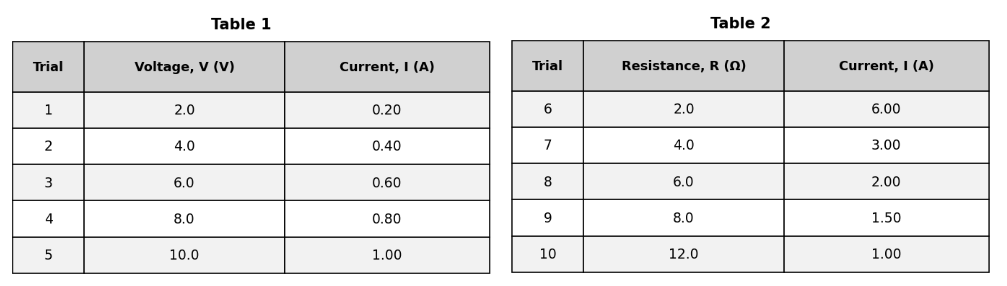
In the first experiment, the student used a resistor with a constant resistance of 10.0 Ω. The student varied the voltage supplied to the circuit from 2.0 V to 10.0 V and recorded the resulting current measured by the ammeter. Results are shown in Table 1.
Experiment 2
In the second experiment, the student set the power supply to provide a constant voltage of 12.0 V. The student then swapped out the resistor, testing five different resistors with varying resistance values, and recorded the resulting current for each. Results are shown in Table 2.
Based on the results of both experiments, which of the following best describes the mathematical relationships between voltage, resistance, and current?
ACT Science Quiz
Practice Evaluating Models And Explanations in ACT Science with focused quiz questions that help you check what you know, review explanations, and build confidence with test-style prompts.
This quiz focuses on Evaluating Models And Explanations, giving you a quick way to practice the rules, question types, and explanations that matter most for ACT Science.
Try each quiz question before looking at the correct answer. Use the explanations to review missed ideas, then come back to similar questions until the pattern feels familiar.
PASSAGE VII
PHYSICS: Data Representation
Introduction
A student investigated the relationship between voltage (V), current (I), and resistance (R) in a simple direct current (DC) electrical circuit.
•Voltage (V) is the electrical potential difference provided by a power source, measured in volts (V).
•Current (I) is the rate of flow of electrical charge, measured in amperes (A).
•Resistance (R) is the opposition to the flow of charge, measured in ohms (Ω).
The student set up a circuit containing a variable voltage power supply, a resistor, and an ammeter (a device used to measure current).
Experiment 1
In the first experiment, the student used a resistor with a constant resistance of 10.0 Ω. The student varied the voltage supplied to the circuit from 2.0 V to 10.0 V and recorded the resulting current measured by the ammeter. Results are shown in Table 1.
Experiment 2
In the second experiment, the student set the power supply to provide a constant voltage of 12.0 V. The student then swapped out the resistor, testing five different resistors with varying resistance values, and recorded the resulting current for each. Results are shown in Table 2.
Based on the results of both experiments, which of the following best describes the mathematical relationships between voltage, resistance, and current?
PASSAGE II
BIOLOGY: Research Summary
Soil salinity (salt concentration) and pH can significantly affect seed germination. A botanist conducted two studies to determine how these factors influence the germination rate of Medicago sativa (alfalfa) seeds. •Note: Germination rate is the percentage of planted seeds that successfully sprout.
Study 1
The botanist prepared 5 identical planting trays. Each tray was filled with 1 kilogram (kg) of the same potting soil. The botanist adjusted the soil in each tray to have a different concentration of sodium chloride (NaCl), measured in millimoles per kilogram (mM/kg). The soil pH for all trays was kept constant at 6.5.
Fifty M. sativa seeds were planted in each tray. The trays were placed in a greenhouse with a constant temperature of 25∘C and watered equally every day for 14 days. On day 14, the germination rate was recorded. Results are shown in Table 1.
Study 2
The botanist prepared 5 new trays with the same potting soil. This time, the NaCl concentration in all trays was kept constant at 40 mM/kg. The botanist adjusted the soil pH in each tray to a different value, ranging from highly acidic to highly basic.
Fifty M. sativa seeds were planted in each tray. The greenhouse conditions, watering schedule, and duration were identical to those in Study 1. Results are shown in Table 2.
Suppose the botanist performs a third study using soil with an NaCl concentration of 100 mM/kg and a pH of 6.5. Based on the results of Study 1, the germination rate would most likely be:
PASSAGE V
ASTRONOMY / EARTH SCIENCE: Data Representation
Introduction
Astronomers classify stars based on their surface temperature and their luminosity. Surface temperature is measured in Kelvin (K). Luminosity is a measure of a star's total energy output compared to the Sun (L⊙). For example, a star with a luminosity of 102L⊙ emits 100 times more energy than the Sun. The Hertzsprung-Russell (H-R) diagram shown in Figure 1 maps stars according to these two properties.
Study
Astronomers measured the properties of four specific stars, labeled A–D, located in different regions of the H-R diagram. Results are shown in Table 1.
Star X is a Main Sequence star that is exactly twice as hot at its surface as Star D. Based on the mathematical trend shown on the H-R diagram, the luminosity of Star X is approximately:
PASSAGE IV
PHYSICS: Research Summary
Introduction
A group of physics students investigated the motion of a projectile. They used a toy cannon that utilizes a compressed steel spring to launch a 50-gram (g) plastic ball. The students investigated how the horizontal distance traveled by the ball (D) was affected by two variables:
1. The launch angle (θ), measured in degrees from the horizontal.
2. The spring compression distance (x), which is the distance the spring is pushed inward before being released.
Study 1
The students set up the cannon on a flat, level field. They kept the spring compression distance (x) constant at 4.0 cm for all trials. They launched the ball at five different angles (θ) and measured the horizontal distance (D) the ball traveled before hitting the ground. The results are shown in Table 1.
Study 2
Next, the students kept the launch angle (θ) constant at 45∘ (the angle that yielded the greatest distance in Study 1). They varied the spring compression distance (x) and measured the resulting horizontal distance (D). The results are shown in Table 2.
Based on Table 2, what is the mathematical relationship between the spring compression distance (x) and the horizontal distance (D)? As x doubles, D:
PASSAGE V
ASTRONOMY / EARTH SCIENCE: Data Representation
Introduction
Astronomers classify stars based on their surface temperature and their luminosity. Surface temperature is measured in Kelvin (K). Luminosity is a measure of a star's total energy output compared to the Sun (L⊙). For example, a star with a luminosity of 102L⊙ emits 100 times more energy than the Sun. The Hertzsprung-Russell (H-R) diagram shown in Figure 1 maps stars according to these two properties.
Study
Astronomers measured the properties of four specific stars, labeled A–D, located in different regions of the H-R diagram. Results are shown in Table 1.
According to the passage and Table 1, which of the four listed stars is most likely the Sun?
PASSAGE III
EARTH SCIENCE / BIOLOGY: Conflicting Viewpoints
Introduction
Approximately 66 million years ago, a mass extinction event occurred at the boundary between the Cretaceous and Paleogene periods (the K-Pg boundary), wiping out roughly 75% of all plant and animal species on Earth, including all non-avian dinosaurs. Geologists have discovered a distinct layer of sedimentary rock worldwide at the K-Pg boundary that contains unusually high levels of iridium, a metal rare in Earth's crust. Two scientists present different hypotheses for the cause of the extinction and the source of the iridium.
Scientist 1
The mass extinction was caused by the impact of a massive asteroid, approximately 10 kilometers in diameter. Asteroids are naturally rich in iridium. When the asteroid struck the Earth, the immense force of the collision vaporized the asteroid and a large portion of Earth's crust, ejecting a massive cloud of iridium-rich dust and debris into the atmosphere. This dust cloud enveloped the planet for months or even years, blocking out incoming sunlight. The lack of sunlight halted photosynthesis globally, causing the collapse of marine and terrestrial food webs.
Furthermore, the impact would have triggered global wildfires, acid rain, and massive tsunamis. The presence of shocked quartz (quartz crystals deformed by intense, sudden pressure) and tektites (glassy spheres formed by rapidly cooling, ejected rock) in the K-Pg boundary layer alongside the iridium firmly points to a high-velocity extraterrestrial impact as the sole trigger of the extinction.
Scientist 2
The mass extinction was not caused by a sudden impact, but rather by intense, prolonged volcanic activity. Around 66 million years ago, a massive volcanic region in what is now India, known as the Deccan Traps, experienced a series of colossal eruptions that lasted for tens of thousands of years. These eruptions released millions of cubic kilometers of lava.
While iridium is rare in Earth's surface crust, it is present in high concentrations in the deep mantle. The massive magma plumes from the Deccan Traps brought this deep-Earth iridium to the surface, where volcanic ash plumes spread it globally. The prolonged eruptions released massive quantities of sulfur dioxide (SO2) and carbon dioxide (CO2) into the atmosphere. The SO2 caused severe short-term global cooling and acid rain, while the CO2 led to long-term extreme global warming. This resulting climate instability severely stressed ecosystems over thousands of years, leading to a gradual, rather than instantaneous, mass extinction. Shocked quartz can also be formed by the explosive pressures of massive volcanic eruptions.
Both scientists would most likely agree with which of the following statements about the K-Pg boundary?
PASSAGE I
CHEMISTRY/PHYSICS: Data Representation
Introduction
Viscosity is a measure of a fluid's resistance to flow. Fluids with high viscosity flow slowly, while fluids with low viscosity flow quickly. The viscosity of a liquid typically decreases as its temperature increases. Students investigated the viscosity of four different synthetic motor oils (Oils W, X, Y, and Z) by measuring the time it took for a solid steel ball to drop through a 50-centimeter (cm) vertical glass cylinder filled with the oil.
Study 1
The students recorded the drop time, in seconds (s), for the steel ball in each of the four oils at 20∘C, 40∘C, 60∘C, and 80∘C. The results are shown in Figure 1.
Study 2
The students also looked up the established viscosity values, measured in millipascal-seconds (mPa·s), for each oil at 40∘C and 100∘C. The results are shown in Table 1.
Based on the relationship between drop time and viscosity described in the passage, if the students tested a new oil, Oil V, that had a viscosity of 130.0 mPa·s at 40°C, the drop time of the steel ball in Oil V at 40°C would most likely be:
PASSAGE III
PHYSICS: This passage presents three hypotheses regarding the discrepancy between the observed mass of galaxies and their rotational speeds.
Introduction
In the 1970s, astronomer Vera Rubin observed that stars at the edges of spiral galaxies move just as fast as stars near the center. According to Newtonian physics, stars further from the center should move slower due to the decrease in gravitational pull. This observation implies that galaxies contain far more mass than what is visible in stars and gas. This missing mass is referred to as "Dark Matter." Three scientists propose different explanations for its nature.
Scientist 1
The missing mass consists of Weakly Interacting Massive Particles (WIMPs). These are subatomic particles that have mass but do not interact with electromagnetic radiation (light), making them invisible. WIMPs interact only through gravity and the weak nuclear force. They were produced in the early universe and now form a vast, spherical "halo" that surrounds every galaxy. Computer simulations of the universe's formation match observational data only when this "cold dark matter" is included. If WIMPs exist, they should eventually be detectable by sensitive underground experiments designed to catch rare collisions between WIMPs and atomic nuclei.
Scientist 2
The missing mass is not some exotic new particle; it is simply normal ("baryonic") matter that is too dim to see. These objects are called Massive Compact Halo Objects (MACHOs). They include black holes, neutron stars, brown dwarfs (failed stars), and rogue planets. Because they emit little to no light, they have escaped detection. The gravitational pull of these objects accounts for the high rotational speeds of galaxies. Evidence for MACHOs comes from "microlensing" events, where the gravity of a massive, invisible object bends the light of a distant star, causing it to brighten temporarily.
Scientist 3
There is no missing mass. The discrepancy is caused by a flaw in our understanding of gravity itself. This theory is known as Modified Newtonian Dynamics (MOND). Newtonian laws work well on the scale of our solar system, where accelerations are high. However, on the galactic scale, where accelerations are incredibly low (\<10−10m/s2), gravity behaves differently. Below this threshold, gravitational force decays more slowly with distance (1/r instead of 1/r2). This stronger effective gravity eliminates the need for invisible halos or new particles. The rotation curves are exactly what the laws of physics predict when corrected for this scale.
A critique of Scientist 3's hypothesis is that it requires changing a fundamental law of physics. Scientist 3 would most likely respond by pointing out that:
Two scientists debate the primary cause of climate change. Scientist A argues carbon emissions are the main factor, while Scientist B suggests solar activity plays a larger role. Data shows a strong correlation between carbon levels and temperature rise. Which explanation most logically accounts for the results?
Students test why an enzyme's reaction rate decreases at very high substrate concentrations. Two models are proposed.
Model 1 (Saturation Only): Rate approaches a maximum as substrate increases, then stays near that maximum. Prediction: At very high substrate, rate should plateau, not decrease.
Model 2 (Substrate Inhibition): Excess substrate binds to an inhibitory site, reducing activity. Prediction: Rate should increase at first, then decrease at very high substrate.
Figure 1 shows reaction rate versus substrate concentration.
Which model is best supported by the results in Figure 1?
Two hypotheses explain the increase in jellyfish populations. Hypothesis 1 states warmer ocean temperatures increase jellyfish numbers. Hypothesis 2 suggests overfishing of predators is the cause. Data correlates higher jellyfish numbers with warmer temperatures. Which hypothesis is more supported?
PASSAGE II
BIOLOGY: Research Summary
Soil salinity (salt concentration) and pH can significantly affect seed germination. A botanist conducted two studies to determine how these factors influence the germination rate of Medicago sativa (alfalfa) seeds. •Note: Germination rate is the percentage of planted seeds that successfully sprout.
Study 1
The botanist prepared 5 identical planting trays. Each tray was filled with 1 kilogram (kg) of the same potting soil. The botanist adjusted the soil in each tray to have a different concentration of sodium chloride (NaCl), measured in millimoles per kilogram (mM/kg). The soil pH for all trays was kept constant at 6.5.
Fifty M. sativa seeds were planted in each tray. The trays were placed in a greenhouse with a constant temperature of 25∘C and watered equally every day for 14 days. On day 14, the germination rate was recorded. Results are shown in Table 1.
Study 2
The botanist prepared 5 new trays with the same potting soil. This time, the NaCl concentration in all trays was kept constant at 40 mM/kg. The botanist adjusted the soil pH in each tray to a different value, ranging from highly acidic to highly basic.
Fifty M. sativa seeds were planted in each tray. The greenhouse conditions, watering schedule, and duration were identical to those in Study 1. Results are shown in Table 2.
A student hypothesizes that M. sativa seeds are completely incapable of germinating in highly acidic soils (pH less than 5.0). Do the results of Study 2 support this hypothesis?
PASSAGE IV
PHYSICS: Research Summary
Introduction
A group of physics students investigated the motion of a projectile. They used a toy cannon that utilizes a compressed steel spring to launch a 50-gram (g) plastic ball. The students investigated how the horizontal distance traveled by the ball (D) was affected by two variables:
1. The launch angle (θ), measured in degrees from the horizontal.
2. The spring compression distance (x), which is the distance the spring is pushed inward before being released.
Study 1
The students set up the cannon on a flat, level field. They kept the spring compression distance (x) constant at 4.0 cm for all trials. They launched the ball at five different angles (θ) and measured the horizontal distance (D) the ball traveled before hitting the ground. The results are shown in Table 1.
Study 2
Next, the students kept the launch angle (θ) constant at 45∘ (the angle that yielded the greatest distance in Study 1). They varied the spring compression distance (x) and measured the resulting horizontal distance (D). The results are shown in Table 2.
Based on the trend in Table 1, if the students had launched the ball at an angle of 90° (straight up), the horizontal distance traveled by the ball would most likely be:
PASSAGE VI
BIOLOGY / GENETICS: Research Summary
Introduction
Restriction enzymes are proteins that cut DNA molecules at specific, predictable sequences of base pairs (bp). Gel electrophoresis is a technique used to separate these resulting DNA fragments by size. When an electrical current is applied to the gel, the negatively charged DNA fragments migrate toward the positive electrode. Smaller DNA fragments move through the gel much faster and travel further than larger fragments.
A researcher isolated a circular bacterial plasmid (a ring of DNA) consisting of exactly 5,000 bp. To map the plasmid, the researcher treated identical samples of the plasmid with different restriction enzymes—Enzyme 1 (E1), Enzyme 2 (E2), and Enzyme 3 (E3)—both individually and in combinations.
After allowing the enzymes to cut the DNA, the researcher ran the samples on an electrophoresis gel. A dye was added to make the DNA bands visible. The size of the fragments in each band was recorded in Table 1.
Based on the results in Table 1, where is the cut site for Enzyme 1 (E1) located relative to the cut sites for Enzyme 2 (E2)?
PASSAGE VI
BIOLOGY / GENETICS: Research Summary
Introduction
Restriction enzymes are proteins that cut DNA molecules at specific, predictable sequences of base pairs (bp). Gel electrophoresis is a technique used to separate these resulting DNA fragments by size. When an electrical current is applied to the gel, the negatively charged DNA fragments migrate toward the positive electrode. Smaller DNA fragments move through the gel much faster and travel further than larger fragments.
A researcher isolated a circular bacterial plasmid (a ring of DNA) consisting of exactly 5,000 bp. To map the plasmid, the researcher treated identical samples of the plasmid with different restriction enzymes—Enzyme 1 (E1), Enzyme 2 (E2), and Enzyme 3 (E3)—both individually and in combinations.
After allowing the enzymes to cut the DNA, the researcher ran the samples on an electrophoresis gel. A dye was added to make the DNA bands visible. The size of the fragments in each band was recorded in Table 1.
A chemical agent is introduced that induces a mutation at the exact DNA sequence where Enzyme 1 (E1) normally binds, preventing E1 from cutting the DNA. If this mutated plasmid is treated with the E1 + E2 combination, what fragment sizes will be produced?
PASSAGE V
ASTRONOMY / EARTH SCIENCE: Data Representation
Introduction
Astronomers classify stars based on their surface temperature and their luminosity. Surface temperature is measured in Kelvin (K). Luminosity is a measure of a star's total energy output compared to the Sun (L⊙). For example, a star with a luminosity of 102L⊙ emits 100 times more energy than the Sun. The Hertzsprung-Russell (H-R) diagram shown in Figure 1 maps stars according to these two properties.
Study
Astronomers measured the properties of four specific stars, labeled A–D, located in different regions of the H-R diagram. Results are shown in Table 1.
Star B and Star D both emit radiation into space. However, Star B is significantly cooler than Star D at its surface, yet it emits 100,000 times more total energy. Based on the groups shown in Figure 1, which of the following best explains this phenomenon?
PASSAGE I
CHEMISTRY/PHYSICS: Data Representation
Introduction
Viscosity is a measure of a fluid's resistance to flow. Fluids with high viscosity flow slowly, while fluids with low viscosity flow quickly. The viscosity of a liquid typically decreases as its temperature increases. Students investigated the viscosity of four different synthetic motor oils (Oils W, X, Y, and Z) by measuring the time it took for a solid steel ball to drop through a 50-centimeter (cm) vertical glass cylinder filled with the oil.
Study 1
The students recorded the drop time, in seconds (s), for the steel ball in each of the four oils at 20∘C, 40∘C, 60∘C, and 80∘C. The results are shown in Figure 1.
Study 2
The students also looked up the established viscosity values, measured in millipascal-seconds (mPa·s), for each oil at 40∘C and 100∘C. The results are shown in Table 1.
Is the statement 'At any given temperature, the oil with the highest viscosity will have the shortest drop time' supported by the data in Figure 1 and Table 1?
PASSAGE VII
PHYSICS: Data Representation
Introduction
A student investigated the relationship between voltage (V), current (I), and resistance (R) in a simple direct current (DC) electrical circuit.
•Voltage (V) is the electrical potential difference provided by a power source, measured in volts (V).
•Current (I) is the rate of flow of electrical charge, measured in amperes (A).
•Resistance (R) is the opposition to the flow of charge, measured in ohms (Ω).
The student set up a circuit containing a variable voltage power supply, a resistor, and an ammeter (a device used to measure current).
Experiment 1
In the first experiment, the student used a resistor with a constant resistance of 10.0 Ω. The student varied the voltage supplied to the circuit from 2.0 V to 10.0 V and recorded the resulting current measured by the ammeter. Results are shown in Table 1.
Experiment 2
In the second experiment, the student set the power supply to provide a constant voltage of 12.0 V. The student then swapped out the resistor, testing five different resistors with varying resistance values, and recorded the resulting current for each. Results are shown in Table 2.
Based on the trend shown in Table 1, if the student had set the voltage to 14.0 V using the same 10.0 Ω resistor, the current measured by the ammeter would most likely have been:
PASSAGE III
BIOLOGY / PALEONTOLOGY: Conflicting Viewpoints
Introduction
For over 135 million years, dinosaurs dominated Earth's terrestrial ecosystems. A major debate in paleontology surrounds dinosaur metabolism. Were they ectotherms (cold-blooded animals, like modern reptiles, that rely on environmental heat), endotherms (warm-blooded animals, like modern mammals and birds, that generate their own internal heat), or mesotherms (animals with an intermediate strategy)? Three scientists present their viewpoints.
Scientist 1
Dinosaurs were endotherms. Like modern birds and mammals, they possessed high metabolic rates that allowed them to sustain rapid movement and thrive in a variety of climates. Fossilized bone cross-sections from many dinosaur species reveal dense networks of blood vessels called Haversian canals. In modern animals, this specific highly vascularized bone tissue is only found in endotherms, as it is required to support rapid, continuous, year-round growth. Furthermore, numerous dinosaur fossils have been discovered in paleolandscapes that were located near the Earth's poles during the Cretaceous period. These environments experienced months of freezing temperatures and complete darkness. An ectotherm would not survive these conditions, but an internally heated endotherm could.
Scientist 2
Dinosaurs were ectotherms. The "continuous growth" model proposed by Scientist 1 is flawed. A closer microscopic analysis of dinosaur bones reveals Lines of Arrested Growth (LAGs). These are rings within the bone, similar to tree rings, which form when an animal's growth temporarily stops due to a lack of resources or seasonal drops in temperature. LAGs are a hallmark of modern ectotherms like crocodiles and turtles.
The primary reason dinosaurs could remain active is a phenomenon called gigantothermy. Because many dinosaurs were massive, they had a very low surface-area-to-volume ratio. This allowed them to absorb heat from the sun and retain it for long periods, essentially keeping their massive bodies warm without the incredibly high energy cost of burning food to generate internal heat.
Scientist 3
Both Scientist 1 and Scientist 2 represent extreme ends of a spectrum. Dinosaurs were mesotherms. They could raise their body temperature through the heat generated by their massive muscles during activity, but they could not strictly regulate their temperature at a constant internal set point like modern endotherms.
By analyzing the spacing of LAGs alongside the estimated adult mass of various dinosaurs, we can calculate their specific growth rates. Dinosaur growth rates fall exactly in the middle—faster than modern reptiles (ectotherms) but significantly slower than modern mammals (endotherms). Additionally, modern endotherms possess complex nasal structures called respiratory turbinates, which prevent excessive water loss caused by the high breathing rates needed to sustain a warm-blooded metabolism. Dinosaur skulls completely lack respiratory turbinates, proving they could not have sustained the metabolic rates of true endotherms.
Suppose paleontologists discover the fossilized remains of a very small dinosaur species (roughly the size of a chicken) that lived exclusively in the freezing, dark climates of the Cretaceous polar regions. This discovery would most heavily weaken the hypothesis of:
PASSAGE VII
PHYSICS: Research Summary
Introduction
When an object falls through a fluid (like air), it experiences a downward gravitational force (Fg) and an upward air resistance, or drag force (Fd). As the object's falling speed increases, Fd also increases. Eventually, Fd becomes exactly equal to Fg. At this point, the net force on the object is zero, and it stops accelerating, falling at a constant maximum speed known as terminal velocity (vt). Students investigated terminal velocity by dropping standard paper coffee filters from a height of 5 meters.
Study 1
The students nested (stacked) different numbers of coffee filters (N) together. Nesting the filters increased the total mass (m) of the falling object without significantly changing its cross-sectional area. They dropped the nested filters and used a motion sensor to record the terminal velocity (vt) in meters per second (m/s). Findings are shown in Table 1.
Study 2
The students investigated how cross-sectional area (A) affects terminal velocity. They built 4 small parachutes of different cross-sectional areas. They attached a constant 10.0-gram mass to each parachute and dropped them from 5 meters, recording the vt. Findings are shown in Table 2.
A mathematical analysis of Study 1 reveals that the terminal velocity (vt) is directly proportional to the square root of the number of filters (√N). Note that for N=1, √1 = 1.0, and the measured vt = 1.0 m/s. Based on this relationship, if the students dropped a stack of N = 9 filters, the expected terminal velocity would be: