All questions
Question 1
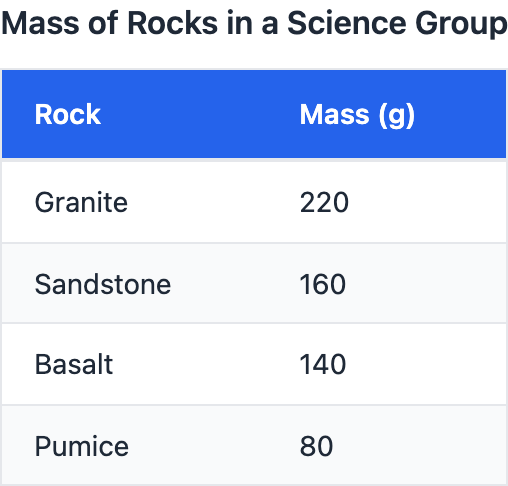
A science group compared four rocks by their mass. Granite had a mass of 220 grams and was much heavier than the other three rocks. Basalt had a mass of 150 grams, and shale had a mass of 140 grams. Pumice had a mass of only 80 grams, making it the lightest rock in the entire group.
Which detail from the passage best shows that granite was the heaviest rock and pumice was the lightest?
- The passage shows granite is 220 g and pumice is 80 g. (correct answer)
- The passage shows granite is 150 g and pumice is 140 g.
- The passage shows granite is 80 g and pumice is 220 g.
- The passage shows granite is 140 g and pumice is 150 g.
Explanation: The passage says granite has a mass of 220 grams, the largest number given, and pumice has a mass of only 80 grams, the smallest. Those two masses are exactly what show granite is the heaviest and pumice is the lightest. One choice gives granite 150 g and pumice 140 g, but those are really the masses of basalt and shale, not the two rocks the question asks about. Another choice flips the numbers, giving granite the lightest mass and pumice the heaviest, which is the opposite of what the passage says. A third choice uses 140 g and 150 g for granite and pumice, but again those belong to shale and basalt and would not make granite the heaviest. To answer correctly, find the biggest mass for granite and the smallest mass for pumice.
Question 2
Four students kept track of how many books they read in February. Mia read 9 books, Jay read 3 books, Sam read 6 books, and Priya read 7 books.
According to the data, which sentence correctly compares how many books two students read?
- Mia read more books than Jay. (correct answer)
- Jay read more books than Mia.
- Sam read more books than Priya.
- Priya read more books than Mia.
Explanation: The data shows Mia read 9 books and Jay read 3 books. Since 9 is greater than 3, Mia read more books than Jay is correct. Jay read more books than Mia flips the numbers around — Jay actually read fewer, so this one is wrong. Sam read more books than Priya is wrong because Sam read only 6 books while Priya read 7, so Priya read more. Priya read more books than Mia is wrong because Priya read 7 books but Mia read 9, so Mia read more. Only the first sentence matches what the numbers really show.
Question 3
A runner timed a 1-mile run for 5 days. Day 1: 10 minutes. Day 2: 8 minutes. Day 3: 7 minutes. Day 4: 6 minutes. Day 5: 5 minutes and 30 seconds.
Which statement matches the runner's times?
- The time increased each day, with the biggest jump from Day 1 to Day 2.
- The time stayed the same each day, with no change from Day 3 to Day 5.
- The time decreased each day, with the biggest drop from Day 4 to Day 5.
- The time decreased each day, with the biggest drop from Day 1 to Day 2. (correct answer)
Explanation: The times were 10, 8, 7, 6, and 5 minutes 30 seconds, so the time went down every single day. The biggest drop was 2 minutes, from Day 1 to Day 2, which makes the correct choice the one that says the time decreased each day with the biggest drop from Day 1 to Day 2. The choice saying the time increased each day is wrong because the numbers get smaller, not bigger. The choice saying the time stayed the same is wrong because it changed every day, including from Day 3 to Day 5. The choice about the biggest drop being from Day 4 to Day 5 gets the direction right but the size wrong: that drop was only 30 seconds, much smaller than the 2-minute drop from Day 1 to Day 2.
Question 4
Sam measured a plant every week for four weeks in a row, and he carefully wrote down each height. In Week 1, the plant was two inches tall, and in Week 2 it grew to three inches. In Week 3, the plant grew quickly and reached six inches tall. In Week 4, the plant grew a little more and reached seven inches tall.
Based on the measurements, during which weeks did the plant grow the most?
- The plant grew the same one inch every single week for all four weeks.
- The plant grew the most between Week 1 and Week 2, when it reached three inches.
- The plant grew the most between Week 2 and Week 3, when it reached six inches. (correct answer)
- The plant grew the most between Week 3 and Week 4, when it reached seven inches.
Explanation: To find the biggest jump, compare how many inches the plant added each week. From Week 2 to Week 3 it went from three inches to six inches, an increase of three inches, which is the largest jump of all. The choice saying it grew the same one inch every week is wrong because the weekly changes were different sizes, not equal. The choice about Week 1 to Week 2 is wrong because that jump was only one inch, from two to three. The choice about Week 3 to Week 4 is wrong because that jump was only one inch, from six to seven. Only the Week 2 to Week 3 change shows the greatest growth.