Question 1 of 25
Find the zeros.
Loading your content
Math
Practice Test 3 for Math: real questions and explanations from the Varsity Tutors practice-test pool.
0%
0 / 25 answered
Question 1 of 25
Find the zeros.
Question Navigator
Find the zeros.
 (correct answer)


Explanation: Factor the equation to 


Find the value of:
 (correct answer)


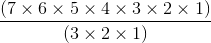
Explanation: The factorial sign (!) just tells us to multiply that number by every integer that leads up to it. So, 
Which of the following is a geometric sequence?

 (correct answer)






Explanation: A geometric sequence is one in which the next term is found by mutlplying the previous term by a particular constant. Thus, we look for an implicit definition which involves multiplication of the previous term. The only possibility is:

What is the area of a regular hexagon with an apothem of 

 (correct answer)


Explanation: How do you find the area of a hexagon?
There are several ways to find the area of a hexagon.
Alternatively, the area can be found by calculating one-half of the side length times the apothem.
Regular hexagons:
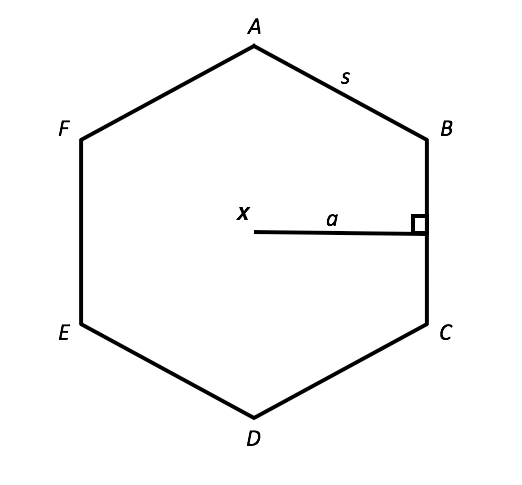
Regular hexagons are interesting polygons. Hexagons are six sided figures and possess the following shape:
In a regular hexagon, all sides equal the same length and all interior angles have the same measure; therefore, we can write the following expression.

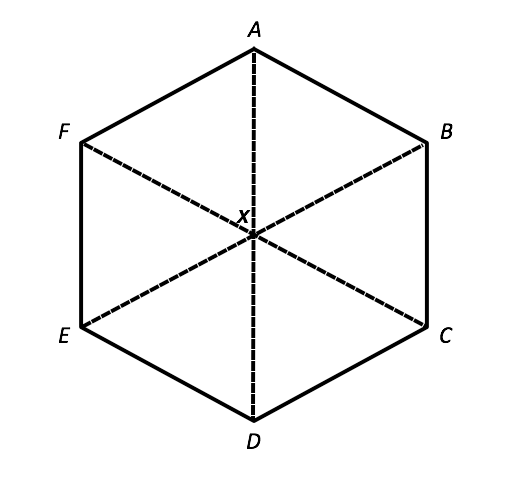 In this figure, the center point,

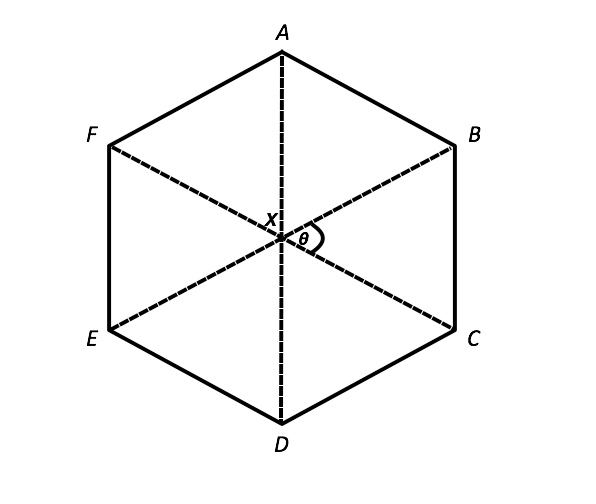








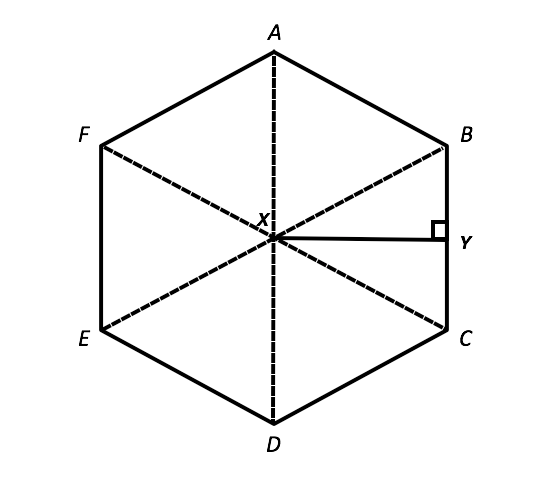 Let's solve for the length of this triangle. Remember that in


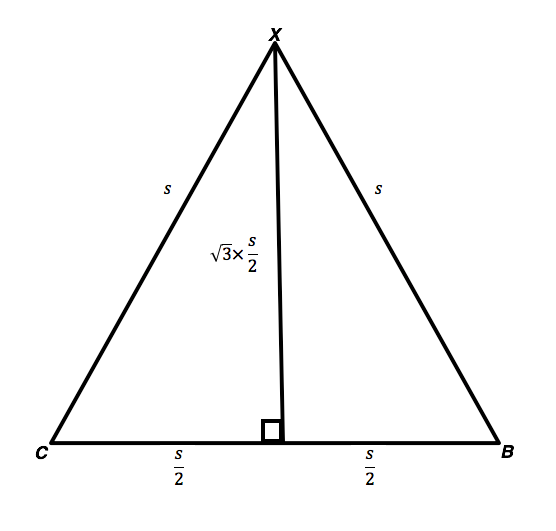 We know the measure of both the base and height of


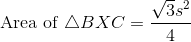





Alternative method:
If we are given the variables 

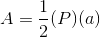




Solution:
In a hexagon the number of sides is 


What is the perimeter of a square with a side length of 
 (correct answer)


Explanation: To find the perimeter of a square you must multiply the side length by 




Let 
Find 
 (correct answer)


Explanation: 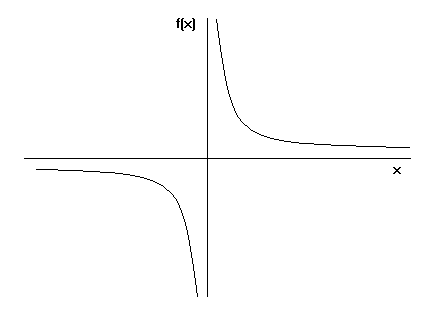 This is a graph of





The horizontal line in the box of the box and whisker plot represents .

Explanation: A box and whisker plot separates the data into quartiles so that each quartile has an equal number of data points. The box indicates the interquartile range, that is, the top line of the box is the third quartile and the bottom line of the box is the second quartile. The line separating the second and third quartiles indicates the median. The lines outside of the box indicate the outer-quartiles (first and fourth).
In 


 (correct answer)


Explanation: Since we are given 


What is the perimeter of the pentagon?
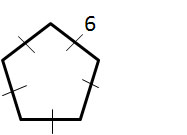
 (correct answer)


Explanation: The perimeter of a polygon is found by calculating the sum of all of the side lengths. In this instance, the polygon is regular, so the perimeter can be found by mulitplying the length of one side by the total number of sides:
Which analysis can be performed to determine if an equation is a function?
Explanation: The vertical line test can be used to determine if an equation is a function. In order to be a function, there must only be one 


Alice recorded the outside temperature at noon each day for one week. These were the results.
Monday: 78
Tuesday: 85
Wednesday: 82
Thursday: 84
Friday: 82
Saturday: 79
Sunday: 80
What is the range of temperatures?
 (correct answer)


Explanation: The range is the simplest measurement of the difference between values in a data set. To find the range, simply subtract the lowest value from the greatest value, ignoring the others.
Solve the equation.
 (correct answer)


Explanation: Change the left side to 


List the first 4 terms of an arithmetic sequence with a first term of 3, and a common difference of 5.
 (correct answer)

Explanation: An arithmetic sequence is one in which the common difference is added to one term to get the next term. Thus, if the first term is 3, we add 5 to get the second term, and continue in this manner.
Thus, the first four terms are:
What is the perimeter of a rectangle with a base of 

 (correct answer)


Explanation: To find the perimeter of a rectangle you must find the sum of all of the side lengths.
To do this, we plug the base and height into the equation 


An isosceles triangle has a base of 

 (correct answer)


Explanation: 

Which of the following does NOT belong to the domain of the function 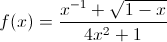
Explanation: The domain of a function includes all of the values of x for which f(x) is real and defined. In other words, if we put a value of x into the function, and we get a result that isn't real or is undefined, then that value won't be in the domain.
If we let x = 0, then we will be forced to evaluate 
Find the midpoint between (4, 3) and (6, 9).
 (correct answer)


Explanation: Add up the 


What is the value of 
Explanation: An exponent written as a fraction can be rewritten using roots. 


Simplify
 (correct answer)


Explanation: Multiplying top and bottom by the complex conjugate 
Simplify:
 (correct answer)


Explanation: 

The length and width of a rectangle are in the ratio of 3:4. If the rectangle has an area of 108 square centimeters, what is the length of the diagonal?
Explanation: The length and width of the rectangle are in a ratio of 3:4, so the sides can be written as 3_x_ and 4_x_. We also know the area, so we write an equation and solve for x: (3_x_)(4_x_) = 12_x_2 = 108. x2 = 9 x = 3 Now we can recalculate the length and the width: length = 3x = 3(3) = 9 centimeters width = 4x = 4(3) = 12 centimeters Using the Pythagorean Theorem we can find the diagonal, c: length2 + width2 = c2 92 + 122 = _c_2 81 + 144 = c2 225 = c2 c = 15 centimeters
 (correct answer)


Explanation: When multiplying polynomials you add the powers of each like-termed polynomial together to find the answer.
In this example the powers are 


What is the horizontal asymptote of this equation?
 (correct answer)


Explanation: Look at the exponents of the variables. Both our numerator and denominator are 
What is the area of a circle with a radius of 
 (correct answer)


Explanation: To find the area of a circle you must plug the radius into 


This figure is a right cylinder with radius of 2 m and a height of 10 m.
What is the surface area of the right cylinder (m2)?
 (correct answer)


Explanation: In order to find the surface area of a right cylinder you must find the area of both bases (the circles on either end) and add them to the lateral surface area. The area of the two circles is easy to find with 








