Question 1 of 25
The center of a circle is 

Loading your content
Math
Practice Test 2 for Math: real questions and explanations from the Varsity Tutors practice-test pool.
0%
0 / 25 answered
Question 1 of 25
The center of a circle is
Question Navigator
The center of a circle is
 (correct answer)



Explanation: The general equation of a circle is 



What is the perimeter of a rectangle with a base of 

 (correct answer)


Explanation: To find the perimeter of a rectangle, find the sum of all of the side lengths using the equation:


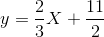
What is the y-intercept of the line 
 (correct answer)


Explanation: The y-intercept is the point at which the line intersects the y-axis.
It does this at 


Which analysis can be performed to determine if an equation is a function?
Explanation: The vertical line test can be used to determine if an equation is a function. In order to be a function, there must only be one 


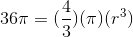
What is the diameter of a sphere with a volume of 
 (correct answer)


Explanation: To find the diameter of a sphere we must use the equation for the volume of a sphere to find the radius which is half of the diameter.
The equation is 


Stewie has 
 (correct answer)


Explanation: 

Which of the following does NOT belong to the domain of the function 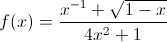
Explanation: The domain of a function includes all of the values of x for which f(x) is real and defined. In other words, if we put a value of x into the function, and we get a result that isn't real or is undefined, then that value won't be in the domain.
If we let x = 0, then we will be forced to evaluate 
What is the value of 
Explanation: An exponent written as a fraction can be rewritten using roots. 


Simplify:
 (correct answer)


Explanation: 

The length and width of a rectangle are in the ratio of 3:4. If the rectangle has an area of 108 square centimeters, what is the length of the diagonal?
Explanation: The length and width of the rectangle are in a ratio of 3:4, so the sides can be written as 3_x_ and 4_x_. We also know the area, so we write an equation and solve for x: (3_x_)(4_x_) = 12_x_2 = 108. x2 = 9 x = 3 Now we can recalculate the length and the width: length = 3x = 3(3) = 9 centimeters width = 4x = 4(3) = 12 centimeters Using the Pythagorean Theorem we can find the diagonal, c: length2 + width2 = c2 92 + 122 = _c_2 81 + 144 = c2 225 = c2 c = 15 centimeters
What is the horizontal asymptote of this equation?
 (correct answer)


Explanation: Look at the exponents of the variables. Both our numerator and denominator are 
Solve for 

 (correct answer)


Explanation: 1st equation: 


Find the height of a triangle if the area of the triangle = 18 and the base = 4.
Explanation: The area of a triangle = (1/2)bh where b is base and h is height. 18 = (1/2)4h which gives us 36 = 4h so h =9.
What is the area of a triangle with a base of 

 (correct answer)


Explanation: The formula for the area of a triangle is 


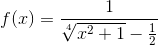
What is the domain of the function below:

 (correct answer)
Explanation: The domain is defined as the set of possible values for the x variable. In order to find the impossible values of x, we should:
a) Set the equation under the radical equal to zero and look for probable x values that make the expression inside the radical negative:


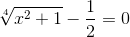
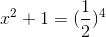


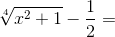
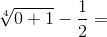

Find the equation (in slope-intercept form) of a line perpendicular to 
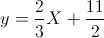 (correct answer)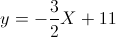
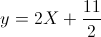
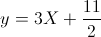
Explanation: First, find the slope of the original line, which is 


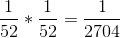
In a standard deck of cards, with replacement, what is the probability of drawing two Ace of Hearts?
 (correct answer)


Explanation: Probability of drawing first ace of hearts: 

The area of a particular rectangle is 
 (correct answer)


Explanation: The forumla for the area of a rectangle is Length X Width. Here, that would be Width X 2Width (length). Solving for width, you get


Solve the following equation for 
 (correct answer)


Explanation: The first step in solving this equation is to distribute the 2 through the parentheses. This gives us:


Two rectangles are similar. The perimeter of the first rectangle is 36. The perimeter of the second is 12. If the base length of the second rectangle is 4, what is the height of the first rectangle?
Explanation: Solve for the height of the second rectangle. Perimeter = 2B + 2H 12 = 2(4) + 2H 12 = 8 + 2H 4 = 2H H = 2 If they are similar, then the base and height are proportionally equal. B1/H1 = B2/H2 4/2 = B2/H2 2 = B2/H2 B2 = 2H2 Use perimeter equation then solve for H: Perimeter = 2B + 2H 36 = 2 B2 + 2 H2 36 = 2 (2H2) + 2 H2 36 = 4H2 + 2 H2 36 = 6H2 H2 = 6
Find the area of the following rhombus:
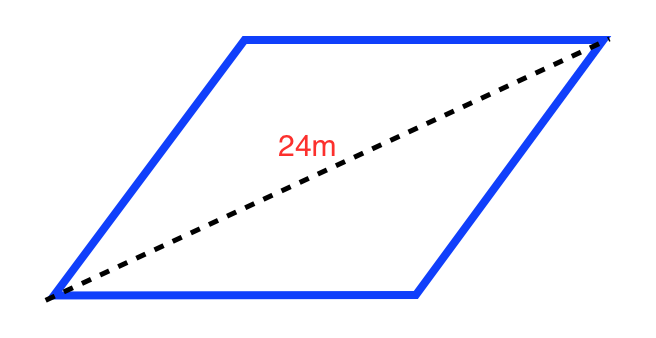
The perimeter of the rhombus is 
 (correct answer)


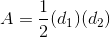
Explanation: The formula for the perimeter of a rhombus is:




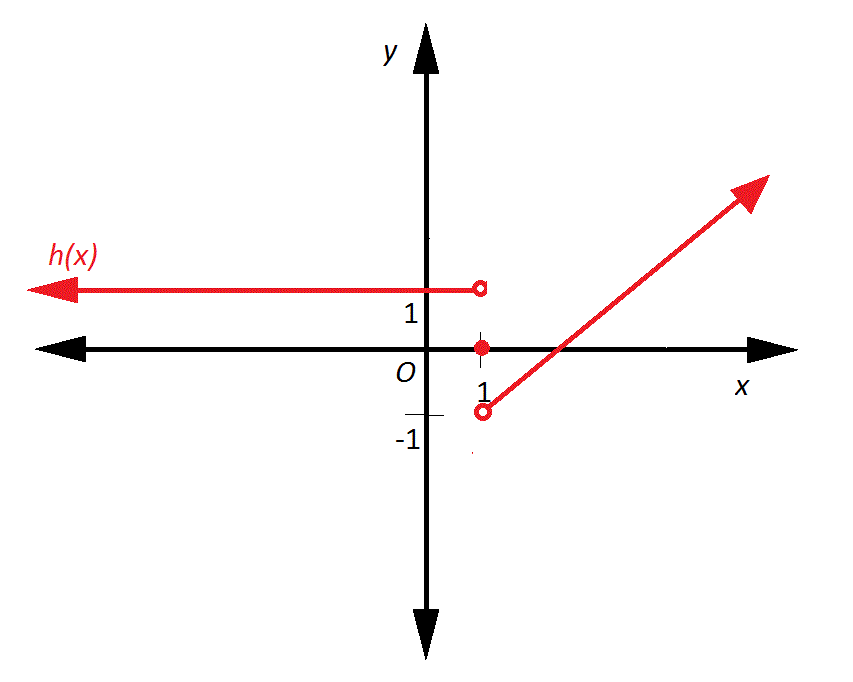
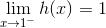
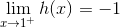
The above graph depicts a function 

 does not exist because
  . (correct answer)
 does not exist because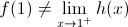
 does not exist because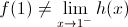
 exists because
 exists because
Explanation: 



What is the area of a rectangle with width 

 (correct answer)


Explanation: The area of a rectangle is found by multiplying the length times the width.
The fourth term in an arithmetic sequence is -20, and the eighth term is -10. What is the hundredth term in the sequence?
Explanation: An arithmetic sequence is one in which there is a common difference between consecutive terms. For example, the sequence {2, 5, 8, 11} is an arithmetic sequence, because each term can be found by adding three to the term before it.
Let 












What is the value of 
Explanation: ! is the symbol for factorial, which means the product of the whole numbers less than the given number.
Thus,