All questions
Question 1
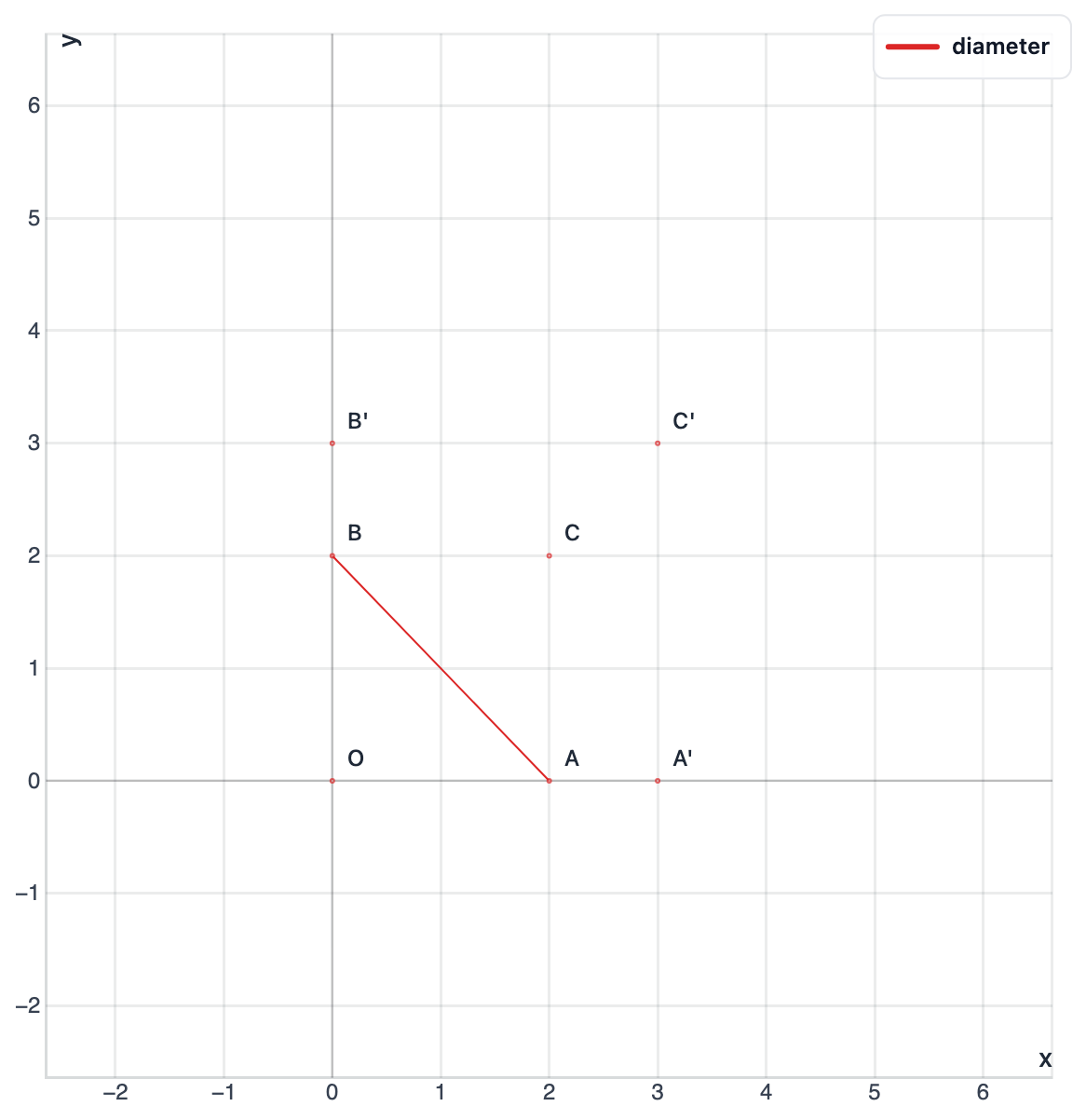
In the coordinate plane, triangle ABC is dilated about center O with scale factor k=23 to form triangle A′B′C′. How does the length of segment AB compare to the length of its image A′B′?
- A′B′ is 32 as long as AB.
- A′B′ is 23 as long as AB. (correct answer)
- A′B′ is the same length as AB.
- A′B′ is longer than AB by 21 unit.
Explanation: This question tests understanding of how dilations with scale factor k = 3/2 affect segment lengths. In a dilation, the scale factor multiplies all distances from the center, which means each segment length is multiplied by the scale factor. Since triangle ABC is dilated to form triangle A'B'C', the corresponding segments are AB and A'B'. Applying the scale factor k = 3/2, we get A'B' = (3/2) × AB, which means A'B' is 3/2 as long as AB. This matches answer choice B, confirming that the image segment is 1.5 times the original length. A common misconception (choice A) is to think the reciprocal 2/3 applies, but dilations multiply lengths by the scale factor, not its reciprocal. To solve dilation problems, always multiply the original length by the scale factor to find the image length.
Question 2
A line segment of length x undergoes a dilation with scale factor r to produce a segment of length y. If the same original segment undergoes a dilation with scale factor 3r, what will be the length of the resulting segment in terms of y?
- y+3
- y+3r
- 3y
- 3y (correct answer)
Explanation: When you encounter dilation problems, remember that dilation creates similar figures by multiplying all corresponding lengths by the same scale factor. The key insight is understanding how scale factors relate to each other.
Let's establish the relationship from the given information. The original segment of length x dilated by scale factor r produces length y, so: y=rx. This means r=xy.
Now, when the same original segment undergoes dilation with scale factor 3r, the new length becomes: x⋅(3r)=3rx. Since we know that rx=y, we can substitute: 3rx=3y.
Therefore, the resulting segment has length 3y.
Looking at the wrong answers: Choice A (y+3) incorrectly adds the scale factor instead of multiplying, which isn't how dilations work. Choice B (y+3r) makes the same addition error while also including the variable r, but dilation requires multiplication of the original length. Choice C (3y) represents the opposite relationship—this would be the result if you divided by 3 rather than multiplied, suggesting a misunderstanding of how scale factors greater than 1 affect size.
Study tip: In dilation problems, always remember that "scale factor k" means "multiply all lengths by k." When you see relationships between different scale factors applied to the same original figure, look for proportional reasoning opportunities—if one scale factor produces a certain result, a scale factor three times larger will produce a result three times larger. Question 3
Segment JK is dilated about center O to form J′K′. The diagram shows OJ=4 units and OJ′=10 units. Which claim about length is supported by the diagram?
- J′K′ is 52 as long as JK.
- J′K′ is 25 as long as JK. (correct answer)
- J′K′ is the same length as JK.
- J′K′ is longer than JK by 6 units.
Explanation: This question tests finding the scale factor from given distances and applying it to segment lengths. The diagram shows OJ = 4 units and OJ' = 10 units, so the scale factor k = OJ'/OJ = 10/4 = 5/2. In a dilation, this scale factor applies to all segments, not just distances from the center. Therefore, J'K' = (5/2) × JK, which means J'K' is 5/2 as long as JK, confirming answer B. This represents an enlargement where the image is 2.5 times the original length. A common error (choice A) is to use the reciprocal 2/5, but the scale factor is always the ratio of image distance to original distance from the center. Remember: once you find the scale factor from any corresponding distances, it applies to all segment lengths in the figure.
Question 4
A square with side length s is dilated by scale factor 32. The resulting square is then dilated by scale factor m. If the final square has side length equal to 34 times the original side length s, what is the value of m?
- 98
- 34
- 23
- 2 (correct answer)
Explanation: When you encounter problems involving multiple transformations, the key is to track how each transformation affects the dimensions step by step, then work backward from the final result.
Let's trace what happens to the square's side length through both dilations. The original square has side length s. After the first dilation by scale factor 32, the new side length becomes s⋅32=32s.
Next, this resulting square is dilated by scale factor m, giving a final side length of 32s⋅m=32sm.
We're told this final side length equals 34 times the original side length, so: 32sm=34s
Solving for m: multiply both sides by 2s3 to get m=34s⋅2s3=24=2.
Looking at the wrong answers: Choice A (98) likely comes from incorrectly multiplying the two scale factors together. Choice B (34) represents the ratio of final to original side length, not the second scale factor. Choice C (23) is the reciprocal of the first scale factor, suggesting confusion about which transformation to undo.
Remember: when multiple transformations are applied sequentially, set up equations that track the cumulative effect, then solve for the unknown parameter. Don't assume you need to multiply or divide the given scale factors directly. Question 5
Parallelogram JKLM undergoes a dilation with center at vertex J and scale factor 53. In the original parallelogram, JK = 25 units and JM = 15 units. What is the perimeter of the image parallelogram J'K'L'M'?
- 72 units
- 56 units
- 48 units (correct answer)
- 80 units
Explanation: When you encounter a dilation problem, remember that dilation scales all lengths by the same factor while preserving shape. The key insight is that if each side length changes by the scale factor, the perimeter changes by that same factor.
In the original parallelogram JKLM, you're given JK = 25 units and JM = 15 units. Since opposite sides of a parallelogram are equal, the four sides are: JK = 25, KL = 15, LM = 25, and MJ = 15. The original perimeter is 25+15+25+15=80 units.
Under a dilation with scale factor 53, each side length gets multiplied by 53. The new side lengths become: 25×53=15 and 15×53=9. So the image parallelogram has sides of 15, 9, 15, and 9 units, giving a perimeter of 15+9+15+9=48 units.
Choice A (72 units) represents the error of multiplying the original perimeter by 109 instead of 53. Choice B (56 units) might result from incorrectly calculating the new side lengths or adding them wrong. Choice D (80 units) is the original perimeter—this would be your answer if you forgot that dilation changes all measurements.
Study tip: For any dilation, the perimeter of the image equals the original perimeter times the scale factor. This saves time: 80×53=48 units directly. Question 6
A rectangle undergoes two successive dilations. First, it is dilated by a scale factor of 2, then the resulting rectangle is dilated by a scale factor of 31. If the original rectangle had a diagonal of length 5 units, what is the length of the diagonal after both transformations?
- 65 units
- 310 units (correct answer)
- 35 units
- 215 units
Explanation: Successive dilations multiply their scale factors: 2 × (1/3) = 2/3. The diagonal length becomes 5 × (2/3) = 10/3 units. Choice A incorrectly subtracts scale factors (2 - 1/3 = 5/3, then 5 × 1/3 = 5/3, then divides by 3). Choice C uses only the second scale factor (5 × 1/3). Choice D incorrectly adds scale factors (2 + 1/3 = 7/3, then 5 × 7/3 ÷ 2).
Question 7
Triangle ABC is dilated by a scale factor of 43 to create triangle A'B'C'. If the perimeter of triangle ABC is 24 units and side AB has length 8 units, what is the length of side A'B' in triangle A'B'C'?
- 6 units (correct answer)
- 8 units
- 18 units
- 32 units
Explanation: In a dilation, all lengths are multiplied by the scale factor. Side AB has length 8 units, so A'B' = 8 × (3/4) = 6 units. Choice B incorrectly assumes the length stays the same. Choice C incorrectly applies the scale factor to the perimeter instead (24 × 3/4 = 18). Choice D incorrectly uses the reciprocal scale factor (8 × 4 = 32).
Question 8
Quadrilateral PQRS is dilated about center O with scale factor k=21 to form P′Q′R′S′. Which statement correctly describes the effect of the dilation on segment length?
- Each image segment is 21 the length of the corresponding original segment. (correct answer)
- Each image segment is 2 times the length of the corresponding original segment.
- Each image segment is the same length as the corresponding original segment.
- Each image segment is shorter than the original by 21 unit.
Explanation: This problem examines dilations with scale factor k = 1/2, which creates a reduction. When a figure is dilated, every segment length is multiplied by the scale factor to produce the corresponding image segment length. For quadrilateral PQRS dilated to P'Q'R'S', each image segment equals the original segment times 1/2. This means P'Q' = (1/2) × PQ, Q'R' = (1/2) × QR, and so on for all sides. Therefore, each image segment is 1/2 the length of the corresponding original segment, confirming answer A. Students might confuse this with doubling (choice B), but a scale factor less than 1 always produces a smaller image. Remember: multiply original lengths by the scale factor to find image lengths in any dilation.
Question 9
Triangle GHI is dilated about center O with scale factor k=2 to form triangle G′H′I′. Which conclusion follows from the dilation shown?
- Each image side is 21 the length of the corresponding original side.
- Each image side is 2 times the length of the corresponding original side. (correct answer)
- Each image side is the same length as the corresponding original side.
- Each image side is longer than the original by 2 units.
Explanation: This problem involves a dilation with scale factor k = 2, which creates an enlargement. In dilations, the scale factor determines how segment lengths change: each image segment equals the original segment multiplied by the scale factor. For triangle GHI dilated to G'H'I', we have G'H' = 2 × GH, H'I' = 2 × HI, and G'I' = 2 × GI. This means each image side is 2 times the length of the corresponding original side, confirming answer B. Students might mistakenly think k = 2 means adding 2 units (choice D), but dilations multiply lengths, not add to them. The key strategy is to recognize that scale factor k means "multiply all lengths by k" to find the image measurements.
Question 10
Rectangle LMNO is dilated about center O with scale factor k=34 to form L′M′N′O′. Which description uses the scale factor correctly?
- Each image side is 34 times the length of the corresponding original side. (correct answer)
- Each image side is 43 times the length of the corresponding original side.
- Each image side is the same length as the corresponding original side.
- Each image side is longer than the original by 31 unit.
Explanation: This problem examines dilations with scale factor k = 4/3, which produces an enlargement. When a rectangle is dilated, every side length is multiplied by the scale factor to create the corresponding image side. For rectangle LMNO dilated to L'M'N'O', each image side equals the original side times 4/3. This means L'M' = (4/3) × LM, M'N' = (4/3) × MN, and so on, confirming that each image side is 4/3 times the length of the corresponding original side (answer A). Students might confuse this with the reciprocal 3/4 (choice B), but k = 4/3 means multiply by 4/3, not 3/4. The misconception in choice D treats dilation as addition rather than multiplication. To solve dilation problems correctly, always multiply lengths by the given scale factor.
Question 11
Triangle VWX is dilated about center O with scale factor k=32 to form V′W′X′. Which statement correctly describes the effect of the dilation on segment length?
- Each image segment is 32 the length of the corresponding original segment. (correct answer)
- Each image segment is 23 the length of the corresponding original segment.
- Each image segment is the same length as the corresponding original segment.
- Each image segment is shorter than the original by 31 unit.
Explanation: This problem involves a dilation with scale factor k = 2/3, which creates a reduction. In any dilation, segment lengths are multiplied by the scale factor to produce image segment lengths. For triangle VWX dilated to V'W'X', we have V'W' = (2/3) × VW, W'X' = (2/3) × WX, and V'X' = (2/3) × VX. This means each image segment is 2/3 the length of the corresponding original segment, confirming answer A. Since 2/3 < 1, the image triangle is smaller than the original. A common error (choice B) is to use the reciprocal 3/2, but the given scale factor k = 2/3 directly multiplies the lengths. The misconception in choice D treats dilation as subtraction, but dilations always multiply. Apply the rule: image length = scale factor × original length.
Question 12
Segment MN is dilated about center O with scale factor k=45 to form M′N′. Which conclusion follows from the dilation shown?
- M′N′ is 54 as long as MN.
- M′N′ is 45 as long as MN. (correct answer)
- M′N′ is the same length as MN.
- M′N′ is longer than MN by 41 unit.
Explanation: This problem examines a dilation with scale factor k = 5/4, which produces an enlargement. When segment MN is dilated about center O, the image segment M'N' has length equal to MN multiplied by the scale factor. Applying k = 5/4, we get M'N' = (5/4) × MN, which means M'N' is 5/4 as long as MN, confirming answer B. This represents an enlargement where the image is 1.25 times the original length. A common misconception (choice A) is to use the reciprocal 4/5, but dilations multiply by the given scale factor, not its reciprocal. Choice D incorrectly treats dilation as adding a fixed amount, but dilations are multiplicative transformations. Remember: to find image lengths in dilations, always multiply the original length by the scale factor.
Question 13
In the coordinate plane, polygon ABCD is dilated about center O to form A′B′C′D′. The diagram shows OA=5 and OA′=3. Which relationship between corresponding segments must be true?
- ABA′B′=35
- ABA′B′=53 (correct answer)
- ABA′B′=1
- ABA′B′=2
Explanation: This question tests finding the scale factor from given information and applying it to segment ratios. The diagram shows OA = 5 and OA' = 3, which means the scale factor k = OA'/OA = 3/5. In a dilation, this scale factor applies uniformly to all segments in the figure. Therefore, for any corresponding segments like AB and A'B', we have A'B'/AB = k = 3/5, confirming answer B. This represents a reduction where each image segment is 3/5 the length of the original. Students might incorrectly invert the ratio (choice A), but the scale factor is always image distance divided by original distance. Once you determine k from any pair of corresponding distances from the center, that same ratio applies to all segment lengths in the dilated figure.
Question 14
Refer to the figure. Triangle DEF is the image of triangle ABC under a dilation. If the scale factor of the dilation is 35, and DE = 20 units, what is the length of AB?
- 12 units (correct answer)
- 15 units
- 25 units
- 3100 units
Explanation: Since DE is the image of AB under dilation with scale factor 5/3, we have DE = AB √ó (5/3). Given DE = 20, we solve: 20 = AB √ó (5/3), so AB = 20 √ó (3/5) = 12 units. Choice B incorrectly uses AB = 20 √ó (3/4). Choice C adds the scale factor to the image length. Choice D incorrectly multiplies: AB = 20 √ó (5/3).
Question 15
In the coordinate plane, segment PQ has endpoints P(2, 4) and Q(8, 12). After a dilation centered at the origin, the image segment P'Q' has length 15 units. What was the scale factor of the dilation?
- 21
- 23 (correct answer)
- 2
- 3
Explanation: First find the length of PQ: PQ = √[(8-2)² + (12-4)²] = √[36 + 64] = √100 = 10 units. Since P'Q' has length 15 units, the scale factor is 15/10 = 3/2. Choice A gives a length of 5 units. Choice C gives a length of 20 units. Choice D gives a length of 30 units.
Question 16
A regular hexagon has side length 12 cm. It undergoes a dilation with scale factor k, and the resulting hexagon has a perimeter that is 54 cm less than the original perimeter. What is the value of k?
- 41 (correct answer)
- 21
- 43
- 32
Explanation: The original perimeter is 6 × 12 = 72 cm. The new perimeter is 72 - 54 = 18 cm. Since dilation multiplies all lengths by k, we have 72k = 18, so k = 18/72 = 1/4. Choice B gives a perimeter of 36 cm (difference of 36 cm). Choice C gives a perimeter of 54 cm (difference of 18 cm). Choice D gives a perimeter of 48 cm (difference of 24 cm).
Question 17
Circle O has radius 8 inches. After a dilation, the image circle O' has a circumference that is 43 the circumference of the original circle. What is the radius of circle O'?
- 1032 inches
- 332 inches
- 6 inches (correct answer)
- 631 inches
Explanation: When you encounter dilation problems involving circles, remember that dilation affects all linear measurements by the same scale factor, including radius and circumference.
Let's work through this step-by-step. The original circle O has radius 8 inches, so its circumference is C=2πr=2π(8)=16π inches. After dilation, circle O' has a circumference that is 43 of the original, which means C′=43×16π=12π inches.
Since C′=2πr′, we can solve for the new radius: 12π=2πr′, so r′=6 inches. This confirms answer C is correct.
Now let's examine why the other options are wrong. Choice A (1032 inches) and choice B (332 inches, which equals 1032) both give a radius larger than the original 8 inches. This is impossible since the circumference decreased, meaning the radius must also decrease. These likely come from incorrectly taking the reciprocal 34 instead of 43. Choice D (631 inches) is close to the correct answer but represents a computational error, possibly from incorrectly calculating 43×8 instead of properly using the circumference relationship.
Remember: in dilation problems, always check whether your answer makes logical sense. If the image is smaller than the original, all corresponding measurements should be smaller too.