AP Physics 2 - AP Physics 2
Card 0 of 3880


Consider the three circuits shown. In each circuit, the voltage source is the same, and all resistors have the same value. If each resistor represents a light bulb, which of the three circuits will produce the brightest light?
Consider the three circuits shown. In each circuit, the voltage source is the same, and all resistors have the same value. If each resistor represents a light bulb, which of the three circuits will produce the brightest light?
To answer this question, we first need to determine what we're looking for that will allow any given light bulb to produce bright light. The answer is power. The more energy that is delivered to the light bulb within a given amount of time, the brighter the light will be. Let's go ahead and look at the equation for power in a circuit.

And since we're told in the question stem that the voltage source is identical in each circuit, we're looking for the circuit that has the largest current.
In order to find which circuit has the largest current, we'll need to invoke Ohm's law.


What this shows is that a higher current will occur in the circuit that has the lowest total resistance. Thus, we'll need to determine what the total resistance is in each of the three circuits.
In circuit A, we can see that there is only a single resistor. Thus, we can give this circuit's total resistance a value of  .
.
In circuit B, we have two resistors that are connected in series. Remember that when resistors are connected in this way, the overall resistance of the circuit increases. We find the total resistance by summing all the resistors connected in series.

Therefore, we can give circuit B a total resistance of  .
.
Now, let's look at circuit C. We can see that there are two resistors connected in parallel, and each of these are connected in series with a third resistor. To solve for the total resistance of this circuit, we first need to determine the equivalent resistance of the two resistors connected in parallel. Once we find that value, then we can take into account the third resistor connected in series.
To solve for the resistance of the two resistors connected in parallel, we have to remember that they add inversely.


Now that we've found the equivalent resistance for the two resistors connected in parallel, we can consider the third resistor connected in series.

Thus, we can give circuit C a value of  .
.
Now that we've found the total resistance for each circuit, we can obtain our answer. Since circuit A has the lowest total resistance, it will also have the greatest current. Consequently, it will also have the greatest power delivered to its resistor (the light bulb), thus causing the light coming from that bulb to be the brightest.
To answer this question, we first need to determine what we're looking for that will allow any given light bulb to produce bright light. The answer is power. The more energy that is delivered to the light bulb within a given amount of time, the brighter the light will be. Let's go ahead and look at the equation for power in a circuit.
And since we're told in the question stem that the voltage source is identical in each circuit, we're looking for the circuit that has the largest current.
In order to find which circuit has the largest current, we'll need to invoke Ohm's law.
What this shows is that a higher current will occur in the circuit that has the lowest total resistance. Thus, we'll need to determine what the total resistance is in each of the three circuits.
In circuit A, we can see that there is only a single resistor. Thus, we can give this circuit's total resistance a value of
In circuit B, we have two resistors that are connected in series. Remember that when resistors are connected in this way, the overall resistance of the circuit increases. We find the total resistance by summing all the resistors connected in series.
Therefore, we can give circuit B a total resistance of
Now, let's look at circuit C. We can see that there are two resistors connected in parallel, and each of these are connected in series with a third resistor. To solve for the total resistance of this circuit, we first need to determine the equivalent resistance of the two resistors connected in parallel. Once we find that value, then we can take into account the third resistor connected in series.
To solve for the resistance of the two resistors connected in parallel, we have to remember that they add inversely.
Now that we've found the equivalent resistance for the two resistors connected in parallel, we can consider the third resistor connected in series.
Thus, we can give circuit C a value of
Now that we've found the total resistance for each circuit, we can obtain our answer. Since circuit A has the lowest total resistance, it will also have the greatest current. Consequently, it will also have the greatest power delivered to its resistor (the light bulb), thus causing the light coming from that bulb to be the brightest.
Compare your answer with the correct one above
Diffusion can be defined as the net transfer of molecules down a gradient of differing concentrations. This is a passive and spontaneous process and relies on the random movement of molecules and Brownian motion. Diffusion is an important biological process, especially in the respiratory system where oxygen diffuses from alveoli, the basic unit of lung mechanics, to red blood cells in the capillaries.
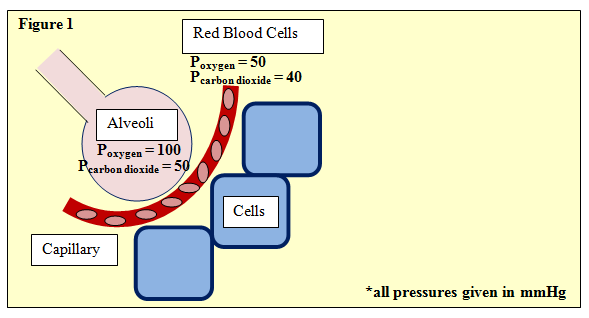
Figure 1 depicts this process, showing an alveoli separated from neighboring cells by a capillary with red blood cells. The partial pressures of oxygen and carbon dioxide are given. One such equation used in determining gas exchange is Fick's law, given by:
ΔV = (Area/Thickness) · Dgas · (P1 – P2)
Where ΔV is flow rate and area and thickness refer to the permeable membrane through which the gas passes, in this case, the wall of the avlveoli. P1 and P2 refer to the partial pressures upstream and downstream, respectively. Further, Dgas, the diffusion constant of the gas, is defined as:
Dgas = Solubility / (Molecular Weight)^(1/2)
Conceptually, if alveoli are considered to be perfectly spherical and assuming that its entire surface exchanges gas, which new relationship, introducing the variable, r, the radius of an alveoli, correctly describes Fick's Equation, assuming partial pressures remain constant?
Diffusion can be defined as the net transfer of molecules down a gradient of differing concentrations. This is a passive and spontaneous process and relies on the random movement of molecules and Brownian motion. Diffusion is an important biological process, especially in the respiratory system where oxygen diffuses from alveoli, the basic unit of lung mechanics, to red blood cells in the capillaries.
Figure 1 depicts this process, showing an alveoli separated from neighboring cells by a capillary with red blood cells. The partial pressures of oxygen and carbon dioxide are given. One such equation used in determining gas exchange is Fick's law, given by:
ΔV = (Area/Thickness) · Dgas · (P1 – P2)
Where ΔV is flow rate and area and thickness refer to the permeable membrane through which the gas passes, in this case, the wall of the avlveoli. P1 and P2 refer to the partial pressures upstream and downstream, respectively. Further, Dgas, the diffusion constant of the gas, is defined as:
Dgas = Solubility / (Molecular Weight)^(1/2)
Conceptually, if alveoli are considered to be perfectly spherical and assuming that its entire surface exchanges gas, which new relationship, introducing the variable, r, the radius of an alveoli, correctly describes Fick's Equation, assuming partial pressures remain constant?
The quickest approach to this equation is to see what variable in Fick's law might be affected by a change in the radius of an alveoli. Pressure is constant and can be ruled out. The diffusion constant would not be effected by radius (hence it being a constant).
The question stem mentions nothing about a change in thickness, therefore, we are left with area.
The surface area of a sphere is measured by 4πr2 and can be substituted. If you had difficulty remembering how to measure surface area, remember that the area of a circle is πr2 andlogically it follows that the surface area of an entire sphere must be greater due to it being three dimensional.
The quickest approach to this equation is to see what variable in Fick's law might be affected by a change in the radius of an alveoli. Pressure is constant and can be ruled out. The diffusion constant would not be effected by radius (hence it being a constant).
The question stem mentions nothing about a change in thickness, therefore, we are left with area.
The surface area of a sphere is measured by 4πr2 and can be substituted. If you had difficulty remembering how to measure surface area, remember that the area of a circle is πr2 andlogically it follows that the surface area of an entire sphere must be greater due to it being three dimensional.
Compare your answer with the correct one above
If the north end of a magnetic points towards the geographic north pole, that means that the geographic north pole is a magnetic pole.
If the north end of a magnetic points towards the geographic north pole, that means that the geographic north pole is a magnetic pole.
Magnets will align themselves with the surrounding magnetic field. Thus, if the north pole of a magnet is pointing north, the direction of the magnetic field must be pointing north. Magnetic fields point towards magnetic south poles, so the geographic north pole is actually a magnetic south pole.
Magnets will align themselves with the surrounding magnetic field. Thus, if the north pole of a magnet is pointing north, the direction of the magnetic field must be pointing north. Magnetic fields point towards magnetic south poles, so the geographic north pole is actually a magnetic south pole.
Compare your answer with the correct one above
You observe several stars in the distance with varying colors. Which of the following stars would have the highest surface temperature?
You observe several stars in the distance with varying colors. Which of the following stars would have the highest surface temperature?
The light portion of the electromagnetic spectrum, from lowest to highest frequency, is red, orange, yellow, green, blue, indigo, violet (ROYGBIV).
Frequency is proportional to temperature, and wavelength is inversely proportional to frequency. Since the energy level corresponds with the temperature, objects that emit a higher frequency and shorter wavelength photon will have higher energy. This corresponds with violet, as it is the highest frequency (shortest wavelength) of visible light
The light portion of the electromagnetic spectrum, from lowest to highest frequency, is red, orange, yellow, green, blue, indigo, violet (ROYGBIV).
Frequency is proportional to temperature, and wavelength is inversely proportional to frequency. Since the energy level corresponds with the temperature, objects that emit a higher frequency and shorter wavelength photon will have higher energy. This corresponds with violet, as it is the highest frequency (shortest wavelength) of visible light
Compare your answer with the correct one above
A person approaches a plane mirror at 5m/s. How fast do they approach the mirror image?
A person approaches a plane mirror at 5m/s. How fast do they approach the mirror image?
The image distance for a plane mirror is always equal to the object distance because the magnification is 1.

If the object and image are the same distance from the mirror and magnification is 1, then as the object approaches the mirror at a certain speed, the image is approaching the plane mirror at the same speed, therefore you approach the image more quickly than you approach the mirror, since you travel 5m/s toward the mirror and the image travels 5m/s toward the mirror.
The image distance for a plane mirror is always equal to the object distance because the magnification is 1.
If the object and image are the same distance from the mirror and magnification is 1, then as the object approaches the mirror at a certain speed, the image is approaching the plane mirror at the same speed, therefore you approach the image more quickly than you approach the mirror, since you travel 5m/s toward the mirror and the image travels 5m/s toward the mirror.
Compare your answer with the correct one above
A charged particle, Q, is traveling along a magnetic field, B, with speed v. What is the magnitude of the force the particle experiences?
A charged particle, Q, is traveling along a magnetic field, B, with speed v. What is the magnitude of the force the particle experiences?
Charged particles only experience a magnetic force when some component of their velocity is perpendicular to the magnetic field. Here, the velocity is parallel to the magnetic field so the particle does not experience a force.
Charged particles only experience a magnetic force when some component of their velocity is perpendicular to the magnetic field. Here, the velocity is parallel to the magnetic field so the particle does not experience a force.
Compare your answer with the correct one above
Jimmy is farsighted and uses a convex lens to correct his vision. Wendy is nearsighted and uses a concave lens to correct her vision. They both wear glasses. During a camping trip, they notice they do not have any matches, and decide to use their glasses to start the fire. Whose glasses could be used to start the fire?
Jimmy is farsighted and uses a convex lens to correct his vision. Wendy is nearsighted and uses a concave lens to correct her vision. They both wear glasses. During a camping trip, they notice they do not have any matches, and decide to use their glasses to start the fire. Whose glasses could be used to start the fire?
This question deals with an application of optics. In this case we have a farsighted person and a near sighted person. The farsighted person would use a convex lens, which is a converging lens. This would allow all of the rays of light to converge on a single point, allowing them to heat the object up and start a fire. Wendy’s glasses are diverging lenses, which would cause the rays to separate.
This question deals with an application of optics. In this case we have a farsighted person and a near sighted person. The farsighted person would use a convex lens, which is a converging lens. This would allow all of the rays of light to converge on a single point, allowing them to heat the object up and start a fire. Wendy’s glasses are diverging lenses, which would cause the rays to separate.
Compare your answer with the correct one above
Which of the following statements about dielectrics is false?
Which of the following statements about dielectrics is false?
Dielectrics are put between two parallel plates of a capacitor to increase capacitance. This is done by holding voltage constant and increasing charge, or decreasing voltage and holding charge constant.
This can be understood using the equation  . Either an increase in charge or a decrease in voltage will increase the capacitance.
Dielectrics are put between two parallel plates of a capacitor to increase capacitance. This is done by holding voltage constant and increasing charge, or decreasing voltage and holding charge constant.
This can be understood using the equation
Compare your answer with the correct one above
Which color of the visible spectrum of light has the highest energy of the answer choices?
Which color of the visible spectrum of light has the highest energy of the answer choices?
The highest energy of any visible light belongs to violet. The greater the wavelength, the lower the energy of the light. The greater the frequency, the higher the energy of the light. This is why ultraviolet light ("ultra" meaning "beyond" violet) is so damaging to DNA. Out of the answer choices, blue light has the lowest wavelength and greatest frequency, making it the highest energy.
The highest energy of any visible light belongs to violet. The greater the wavelength, the lower the energy of the light. The greater the frequency, the higher the energy of the light. This is why ultraviolet light ("ultra" meaning "beyond" violet) is so damaging to DNA. Out of the answer choices, blue light has the lowest wavelength and greatest frequency, making it the highest energy.
Compare your answer with the correct one above
Diffusion can be defined as the net transfer of molecules down a gradient created by differing concentrations of the molecule in different locations. This is a passive, spontaneous process and relies on the random movement of molecules and Brownian motion. Diffusion is an important biological process, especially in the respiratory system where oxygen diffuses from alveoli, the basic units of lung mechanics, to red blood cells in the capillaries.
Figure 1 depicts this process, showing an alveolus separated from neighboring cells by a capillary with red blood cells. The partial pressures of oxygen and carbon dioxide are given. One equation used in determining gas exchange is Fick's law, given by:

In this equation,  is the flow rate. Area and thickness refer to the permeable membrane through which the gas passes_—_in this case, the wall of the alveolus.
  and
and  refer to the partial pressures upstream and downstream, respectively.
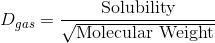
  , the diffusion constant of the gas, is defined as:
At high altitudes, the partial pressure of oxygen quickly drops while that of carbon dioxide decreases by much less. Given the following table, at what elevation is the pressure gradient of oxygen equal to half that of carbon dioxide, assuming constant capillary partial pressures of oxygen and carbon dioxide of 50mmHg and 40mmHg, respectively?
Elevation (m) PO2 (mmHg) PCO2 (mmHg) 0 100 50 1000 80 40 2000 60 30 3000 40 20 4000 20 10 5000 10 0
Diffusion can be defined as the net transfer of molecules down a gradient created by differing concentrations of the molecule in different locations. This is a passive, spontaneous process and relies on the random movement of molecules and Brownian motion. Diffusion is an important biological process, especially in the respiratory system where oxygen diffuses from alveoli, the basic units of lung mechanics, to red blood cells in the capillaries.
Figure 1 depicts this process, showing an alveolus separated from neighboring cells by a capillary with red blood cells. The partial pressures of oxygen and carbon dioxide are given. One equation used in determining gas exchange is Fick's law, given by:
In this equation,
At high altitudes, the partial pressure of oxygen quickly drops while that of carbon dioxide decreases by much less. Given the following table, at what elevation is the pressure gradient of oxygen equal to half that of carbon dioxide, assuming constant capillary partial pressures of oxygen and carbon dioxide of 50mmHg and 40mmHg, respectively?
| Elevation (m) | PO2 (mmHg) | PCO2 (mmHg) |
|---|---|---|
| 0 | 100 | 50 |
| 1000 | 80 | 40 |
| 2000 | 60 | 30 |
| 3000 | 40 | 20 |
| 4000 | 20 | 10 |
| 5000 | 10 | 0 |
This problem at first may seem straightforward, until you realize that the gradient (or difference in partial pressures of Fick's law) actually changes.
In normal circumstances, capillary pressure would be subtracted from arterial pressure; however, the body operates at a physiologic equilibrium, which essentially has a constant production of CO2 and demand for O2. At a certain point the capillary pressure will be greater than the arterial, and hence the gradient switches to Pcapillary – Parterial from the original Parterial – Pcapillary.
Simple arithmetic done alongside the table margins can quickly arrive to the correct answer. At an elevation of 3000 m, the gradients of oxygen (50 – 40 = 10 mmHg) and carbon dioxide (40 – 20 = 20 mmHg) differ by twofold. It is easy to be confused over a seemingly complicated table, when in reality, this question only asks for basic arithmetic.
This problem at first may seem straightforward, until you realize that the gradient (or difference in partial pressures of Fick's law) actually changes.
In normal circumstances, capillary pressure would be subtracted from arterial pressure; however, the body operates at a physiologic equilibrium, which essentially has a constant production of CO2 and demand for O2. At a certain point the capillary pressure will be greater than the arterial, and hence the gradient switches to Pcapillary – Parterial from the original Parterial – Pcapillary.
Simple arithmetic done alongside the table margins can quickly arrive to the correct answer. At an elevation of 3000 m, the gradients of oxygen (50 – 40 = 10 mmHg) and carbon dioxide (40 – 20 = 20 mmHg) differ by twofold. It is easy to be confused over a seemingly complicated table, when in reality, this question only asks for basic arithmetic.
Compare your answer with the correct one above
Which of the following is/are ionizing radiation?
- microwaves
- X-rays
- gamma rays
- all of the above
- 2 and 3, but not 1
Which of the following is/are ionizing radiation?
- microwaves
- X-rays
- gamma rays
- all of the above
- 2 and 3, but not 1
Choice 5 is correct. Highly energetic frequencies such as X-rays and gamma rays can displace electrons from materials upon which they impinge. Microwaves are a form of radio waves, which are long-wavelength, low frequency waves with little energy.
Mnemonic: Microwave ovens are fundamentally safe household items.
Choice 5 is correct. Highly energetic frequencies such as X-rays and gamma rays can displace electrons from materials upon which they impinge. Microwaves are a form of radio waves, which are long-wavelength, low frequency waves with little energy.
Mnemonic: Microwave ovens are fundamentally safe household items.
Compare your answer with the correct one above
A metal sample is suspended from a thread and submerged in a beaker of water. The metal sample does not touch the sides or bottom of the beaker. The beaker of water is on a laboratory scale as the metal sample is submerged. What happens to the scale reading as the sample is submerged?
A metal sample is suspended from a thread and submerged in a beaker of water. The metal sample does not touch the sides or bottom of the beaker. The beaker of water is on a laboratory scale as the metal sample is submerged. What happens to the scale reading as the sample is submerged?
Since the water is exerting an upward force  on the metal sample, it is receiving a force of equal magnitude pointing downward by Newton's third law. This downward force is transmitted by increased pressure in the water to the beaker and then to the scale.
Since the water is exerting an upward force
Compare your answer with the correct one above
Air is composed of about 78% nitrogen (molecular mass = 28 g/mole), 21% oxygen (molecular mass = 32 g/mole), and 1% argon (40 g/mole). The weighted average of these numbers leads to the approximation that if air was a pure gas, its “molar mass” would be about 29 g/mole. Helium has a molar mass of 4 g/mole. What is the volume of helium gas required to lift a balloon carrying a 100 gram sensor?
- about 20 liters
- about 50 liters
- about 90 liters
- about 120 liters
- about 166 liters
Air is composed of about 78% nitrogen (molecular mass = 28 g/mole), 21% oxygen (molecular mass = 32 g/mole), and 1% argon (40 g/mole). The weighted average of these numbers leads to the approximation that if air was a pure gas, its “molar mass” would be about 29 g/mole. Helium has a molar mass of 4 g/mole. What is the volume of helium gas required to lift a balloon carrying a 100 gram sensor?
- about 20 liters
- about 50 liters
- about 90 liters
- about 120 liters
- about 166 liters
Choice 3 is correct. The question forces the respondent to recall that one mole of an ideal gas occupies 22.4 liters at standard temperature (zero Celsius) and pressure (1 atmosphere). Helium balloons rise because they are less dense than air by a factor of 29 g/mole – 4 g/mole = 25 g/mole. Since the sensor has a mass of 100 g, it will require about 4 molar volumes of He to lift it.
Choice 3 is correct. The question forces the respondent to recall that one mole of an ideal gas occupies 22.4 liters at standard temperature (zero Celsius) and pressure (1 atmosphere). Helium balloons rise because they are less dense than air by a factor of 29 g/mole – 4 g/mole = 25 g/mole. Since the sensor has a mass of 100 g, it will require about 4 molar volumes of He to lift it.
Compare your answer with the correct one above
A 200-gram object is placed into a bucket of water and floats so that its top edge is just below the surface of the water. Which best describes the density of this object?
Density of water is 1000kg/m3.
A 200-gram object is placed into a bucket of water and floats so that its top edge is just below the surface of the water. Which best describes the density of this object?
Density of water is 1000kg/m3.
If the object is at rest, the net force on it must equal 0. At any point in the liquid, the total downwards force is described as the difference between the gravitational force and bouyant force:  . When the object is not accelerating, this reduces to
  .
.
Plugging in the equations for these forces respectively yields  .
.
Since mass is the product of density and volume,  .
.
Note that in this case the object's volume equals the volume of liquid displaced, since the object is completely submerged. So, the volumes on either side cancel, as does gravity, leaving just  .
.
If the object is at rest, the net force on it must equal 0. At any point in the liquid, the total downwards force is described as the difference between the gravitational force and bouyant force:
Plugging in the equations for these forces respectively yields
Since mass is the product of density and volume,
Note that in this case the object's volume equals the volume of liquid displaced, since the object is completely submerged. So, the volumes on either side cancel, as does gravity, leaving just
Compare your answer with the correct one above
What are the frequency and wavelength of a sound wave with a period of 0.04s and a velocity of 575m/s?
What are the frequency and wavelength of a sound wave with a period of 0.04s and a velocity of 575m/s?
Solve for frequency by taking the inverse of the period.
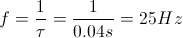
Next, solve for wavelength by dividing velocity by frequency.

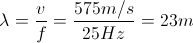
Solve for frequency by taking the inverse of the period.
Next, solve for wavelength by dividing velocity by frequency.
Compare your answer with the correct one above
Sound traveling at a velocity, V1, through a certain medium will travel at what velocity through a medium of twice the density?
Sound traveling at a velocity, V1, through a certain medium will travel at what velocity through a medium of twice the density?
The speed of sound depends on both the medium’s density and resistance to compression. We do not have enough information to solve for V2 in terms of V1.
The speed of sound depends on both the medium’s density and resistance to compression. We do not have enough information to solve for V2 in terms of V1.
Compare your answer with the correct one above
A sound source with a frequency of 790Hz moves away from a stationary observer at a rate of 15m/s. What frequency does the observer hear?
The speed of sound is 340m/s.
A sound source with a frequency of 790Hz moves away from a stationary observer at a rate of 15m/s. What frequency does the observer hear?
The speed of sound is 340m/s.
In this scenario the Doppler effect is described by the following equation.
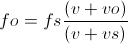
Using the values from the problem, we know that vo is zero and vf is 15m/s. v is 340m/s and fs is 790Hz.

In this scenario the Doppler effect is described by the following equation.
Using the values from the problem, we know that vo is zero and vf is 15m/s. v is 340m/s and fs is 790Hz.
Compare your answer with the correct one above
For a pendulum undergoing simple harmonic motion, the ratio of the weight of the pendulum and the displacement of the pendulum from the bottommost point in its path always equals .
For a pendulum undergoing simple harmonic motion, the ratio of the weight of the pendulum and the displacement of the pendulum from the bottommost point in its path always equals .
Hooke’s law, which is applicable to simple harmonic motion, states the relationship between force (F) and displacement (d).

k is equal to the spring constant. The ratio of F (force) to x (displacement) will be equal to the magnitude of k. In our set-up, the force is equal to the weight of the pendulum, so the ratio of weight to displacement is equal to the spring constant. This is true of all pendulums, and is given by the equation  .
.
Hooke’s law, which is applicable to simple harmonic motion, states the relationship between force (F) and displacement (d).
k is equal to the spring constant. The ratio of F (force) to x (displacement) will be equal to the magnitude of k. In our set-up, the force is equal to the weight of the pendulum, so the ratio of weight to displacement is equal to the spring constant. This is true of all pendulums, and is given by the equation
Compare your answer with the correct one above
What is the beat frequency if f1 = 200Hz and f2 = 150Hz?
What is the beat frequency if f1 = 200Hz and f2 = 150Hz?
Beat frequency is the difference between the two frequencies.

200Hz – 150Hz = 50Hz
Beat frequency is the difference between the two frequencies.
200Hz – 150Hz = 50Hz
Compare your answer with the correct one above
What is the frequency of a typical soundwave traveling at 340m/s with a wavelength of 40mm?
What is the frequency of a typical soundwave traveling at 340m/s with a wavelength of 40mm?
Using the equation  we can find the frequency of the soundwave.


Using the equation
Compare your answer with the correct one above