Elements, Ions, and Isotopes
Help Questions
AP Chemistry › Elements, Ions, and Isotopes
Am-242 undergoes beta-decay at a half-life of 16 hours. If a chemist starts with a sample of 


Explanation
With each half-life, the amount of Am-242 is halved. 4 days is 96 hours, which is 6 half-lives. For half-life questions use the formula:

Where 
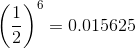

Thus 
Am-242 undergoes beta-decay at a half-life of 16 hours. If a chemist starts with a sample of
Explanation
With each half-life, the amount of Am-242 is halved. 4 days is 96 hours, which is 6 half-lives. For half-life questions use the formula:
Where
Thus
What kind of radiation has no charge or mass?
alpha
beta
gamma
delta
Explanation
This is the definition of gamma radiation.
What kind of radiation has no charge or mass?
alpha
beta
gamma
delta
Explanation
This is the definition of gamma radiation.
The isotope 

In order for the nuclear reaction to be balanced 
either an electro or β radiation
an electron
a proton
β radiation
Explanation
A beam of electrons is known also as β radiation. An electron has atomic number of 

Where 


The isotope
In order for the nuclear reaction to be balanced
either an electro or β radiation
an electron
a proton
β radiation
Explanation
A beam of electrons is known also as β radiation. An electron has atomic number of
Where
As atomic radius decreases, the force of attraction between the nucleus of the atom and its electrons .
increases
decreases
stays the same
cannot be determined
Explanation
As the atomic radius decreases, electrons are drawn closer to the nucleus. Since the electromagnetic force between the positively charged nucleus and negatively charged electrons is a function of distance, the force of attraction, or effective nuclear charge, exerted on each electron will be greater.
As atomic radius decreases, the force of attraction between the nucleus of the atom and its electrons .
increases
decreases
stays the same
cannot be determined
Explanation
As the atomic radius decreases, electrons are drawn closer to the nucleus. Since the electromagnetic force between the positively charged nucleus and negatively charged electrons is a function of distance, the force of attraction, or effective nuclear charge, exerted on each electron will be greater.
An electron falling to a lower energy level gives off a blue glow (λ=475nm). How much energy is emitted?
3.14x10-40J
4.184 x 10⁻¹⁹ J
4.184 x 10⁻¹⁷ J
3.14x10-37J
Energy is not emitted
Explanation
E=hf, or E=hc/λ
h is Planck's constant with a value of 6.62606957 × 10⁻³⁴ m2 kg / s. Converting 475nm to m gives 4.75x10⁻⁷m. c is the speed of light with 3x10⁸m/s. Putting these variables into the second equation you get 4.174x10⁻¹⁹J
An electron falling to a lower energy level gives off a blue glow (λ=475nm). How much energy is emitted?
3.14x10-40J
4.184 x 10⁻¹⁹ J
4.184 x 10⁻¹⁷ J
3.14x10-37J
Energy is not emitted
Explanation
E=hf, or E=hc/λ
h is Planck's constant with a value of 6.62606957 × 10⁻³⁴ m2 kg / s. Converting 475nm to m gives 4.75x10⁻⁷m. c is the speed of light with 3x10⁸m/s. Putting these variables into the second equation you get 4.174x10⁻¹⁹J